

The pulpy, B-grade cyberpunk film, Strange Days, is sleazy. Very, very sleazy. It's also completely hypocritical, or completely meta, we're not sure.
It's Los Angeles, and we're gonna party like it's 1999. Except, in this 1999, LA is a cesspit of near-constant rioting, corruption, sweaty grime and limp confetti. Clearly, it's only twenty years away from this LA.
Into this cyberpunk fest steps our usual anti-hero, the excellently named Lenny Nero (an excellently maned Ralph Fiennes), who indeed fiddles his way while the city burns. Which, in this story, means he peddles cortex-bending mindtrips (mindfraks, really) that latch onto your brain stem and make you really feel it, man. Our introduction to Lenny also outlines his strict ethical regulation: no snuff trips.
Which is all fine and well, as Lenny is just barely hanging on in his dingy apartment, pining away after his ex, Faith (Juliette Lewis, she of the 90s grunge), mostly by cradling bottles of vodka and re-living (literally) past happy times. This sad excuse of a life is casually destroyed by the arrival, into Lenny's hands, of a snuff trip produced by a deranged killer - perhaps the most horrible snuff trip ever produced. Lenny, a disgraced cop, is immediately sucked in - he must track the killer down, especially when the killer sends creepy mindtrip videos of himself creeping around Lenny's apartment and holding exacto knives at Lenny's throat.
Employing the help of his badass lady friend Mace (a wonderful Angela Bassett), Lenny soon realizes that there are nine rings in Dante's Inferno, and the evil killer is only a couple down. As the tension builds, the explosions become louder, and we descend further into the decay, a ticker periodically appears on our screen to remind us that the stroke of a new millennium is a mere X hours away. This creates a sense of BLUNT FOREBODING.
There are some things in Strange Days which are done very well: at its best, the film is a kinetic, lively, silly cross between Philip K. Dick's drugged-out vision of urban sprawl and alienation, and Frank Miller's pulpy pessimism. (Indeed, Angela Bassett would make a wonderful Martha Washington!) The feeling of fluorescent filth and universal corruption and decay was just lovely (and a little pleasantly nauseating). And Ralph Fiennes performance - a very against-type role - unexpectedly hit all the right notes. Lenny's nasally American accent; his vanity (he can afford awful paisley futuristic Armani, but not soap, it seems); and his clammy vulnerability - everything was as it should be. Another unexpected (well, not totally unexpected) hit was Angela Bassett's woman of steel - it's always relieving for the PPCC to (finally!) see strong women; and here, Mace was very, well, physically strong, often saving Lenny from the clutches of burly henchmen by beating the hell out of them. Huzzah! Mace's obvious tenderness towards Lenny was also strangely touching. They made quite a pair.
The movie tried to insert some obvious parallels to LA's realities of the 1990s, with a subplot of race rioting. This was not totally effective - each step and each character was too much a stereotype. But we appreciated the attempt.
And then the film had some awful bits: most particularly the gratuitous violence against women and the salacious way this violence was depicted. Others have already noted how lurid tales of rape and humiliation are often breathlessly portrayed in film, where our hero can be properly horrified and thus we can feel OK about watching it all. Ugh, spare us. This was one of those films: it rubbed our face in the awful, terrible, sick, twisted, etc., completely unnecessary scenes and - even more disturbingly - everything was eroticized. This was the male gaze on steroids: we only see men take the mindtrips (women are only ever performers), and these men unanimously experience orgasmic states of heavy breathing, moaning, twisted faces, etc. as they watch terrible things happen to women in their brains. "Oh, how horrible!" Lenny cries after one such ride. Right. Sure.
This aspect was all kinds of horrible, and confusing, to boot, since the director is a woman: Kathryn Bigelow! What the hell, Kathryn Bigelow? Not only is this completely ridiculous and harmful to women, but isn't this whole movie also supposed to be about how our pornographic pursuits lead to general societal decay?!
This is why we think this film's either totally hypocritical, or some sort of meta commentary that's beyond our comprehension. Either way, we could have done without all those shots of razors cutting into women's underwear; the movie would have been much improved.
In the meantime, the trailer is excellent - particularly 1:54 on. It's excellence exceeds the film's by a long shot (as sometimes unfortunately happens). The music of the film (particularly all that Skunk Anansie and Juliette Lewis and PJ Harvey and other angry young woman stuff) was also very 1990s and fun. Not really recommended, unless you have an obligation to watch all cyberpunk/New Wave science fiction ever committed to film (as we do).

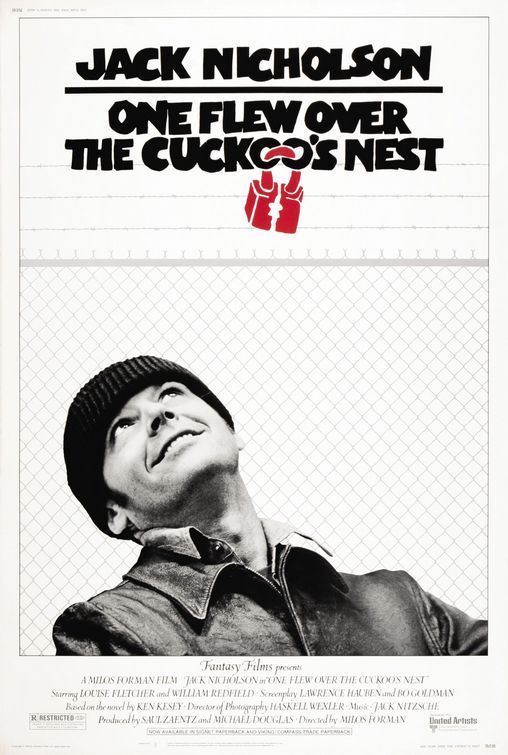
 on which the film is based, apparently sued the filmmakers and refused to see the film (so said our in-flight entertainment trivia box). We don't know how this compares with the book, but what could Mr. Kesey have to complain about? It's a near-perfect film! "Near" only because, as usual, it hates women: shrewish virgins (Nurse Ratched) combat whores (Jack's friends) for control and attention of men's manlinesses. BIG SIGH OF TIRESOME DISAPPOINTMENT.
