Wednesday, 30 December 2009

Same Time Next Year (1978)


The good ol' post-war American pop history movie is always a big gooey hit here at the PPCC. We love history, we love big picture "Oh, the humanity!" panoramas, and we are, fundamentally, made of mush. We are, also, big fans of Alan Alda (yay M*A*S*H!).

Same Time Next Year is like comfort food, all warm, homey 1970s vibes. It tells the story of George (Alan Alda) and Doris (Ellen Burstyn), two American Everypeople, who meet by chance in a California seaside resort one weekend in the 1950s. Over an innocent chat in the resort's restaurant, they hit it off big time and end up in bed. Both of them also happen to be married with kids.

However, thanks to their intense attraction and the fact that they both have viable excuses to be in California every year, they decide to repeat the one-night stand - same time, same place, the following year. And the one after that... and on, and on, for twenty-plus years.


We couldn't figure out how to take screencaps from this computer's DVD software, so here's a random picture of Ellen Burstyn, who is in this film.


As is Alan "OH GAWWD!" Alda.


This is a pretty fabulous idea, as it allows us, the audience, to meet George and Doris at five-year intervals, as they age through the tumultuous 50s, 60s and 70s. Both their love and the world they live in are painted in broad, heavy brush strokes. We laugh with George and Doris. We cry with George and Doris. Doris becomes a hippie. George gets into Freudian psychoanalysis. Doris emancipates herself and becomes a business owner.

The film's writing is snappy and irreverent, owing much to its theater pedigree (it's based on a Tony-nominated play by Bernard Slade). Alan Alda is his usual endearingly hammy, overly earnest self - he even does his signature acting move, the sobbing howl he uses to signify an emotional climax, which we will from here on dub The Alda. (As in, "OHHH GAWD! OH GAAAWD! I AM HAVING THE ALDA!"). Ellen Burstyn is a bright star - we rooted for Doris a bit more, who was complex, strong and changed the most over the course of the film. Their chemistry was also very sweet.

Unfortunately, the film's niceness takes some serious blows thanks to the cheesy photo montages (SIGNIFYING A PASSAGE OF TIME BETWEEN MEETINGS, the narrative screams) overlaid by a maudlin Celine Dion-type number (not by Celine Dion). Apparently the filmmakers passed up Paul McCartney's proposed song because it contained spoilers. That... was a mistake.

But everything else was great! Huzzah!


(Completely unrelated but Joshua Wolf Shenk's Lincoln's Melancholy is glorious.)

Tuesday, 29 December 2009

District 9 (2009)


Just the other day, we at the PPCC were selling ourselves as hardened sci-fi connoiseurs. And we are. So, with our shiny stamp of expert know-it-all-ness, we can heartily approve of the wacky District 9.

Now this, this, is what post-modern sci-fi should be all about. It should incorporate the globalized, post-colonial culture. Dammit! That's what Expanded Horizons strives so hard towards, and that's what our own efforts have been all about. The day and age of good ol' boy sci-fi - i.e. White Male Hero sci-fi from the 1950s and 1960s, especially that stuff by Alfred Bester and Robert A. Heinlein - should be over by now. (Yes, even when it was so gloriously clever.)

So we also admit, with a little shame, that District 9's hero is... well, White and Male. But he is also South African! That is a step in the right-ish direction.


Scenes of forced eviction.


Filmed as a part-mockumentary, District 9 tells the story of a not-so-aggressive alien invasion, which ends up with Johannesburg newly acquiring an enormous ghetto of poor, harassed aliens and their enormous, broken spaceship. The aliens, derogatively called "prawns" by the humans ("You can't say they don't look like that," one interviewee says. "They look like prawns!"), have now been living in disgrunt for twenty years. Now, a private corporation called Multinational United (ahem) is brought in by the South African government to semi-forcibly, semi-abiding by UN convention, move the prawns to their new home (later described as a "concentration camp"). Heading this initiative is the bumbling Afrikaner MNU employee, Wikus van der Merwe (Sharlto Copley). As the mockumentary cuts between present-day interviews of Wikus' associates, and past interviews of the bright-eyed Wikus himself, we begin to realize that something with Wikus went horribly, terribly wrong. Yay tension building! Tell us more, movie!

Most critics have already noted the film's obvious apartheid themes, and indeed District 9 - the slum in which the prawns are forced to live - is reminiscent of Soweto and directly inspired by District 6. The characterizations are also firmly along these lines: only poor, black South Africans are seen schmoozing with the prawns, and Wikus himself is a stereotype of clumsy colorblind racisms and a privileged, suburban upbringing. Nigerians make an appearance as scam artists and warlords... this has understandably led to much irritation on the Nigerian government's part.

The portrayals are blunt. And indeed, the great promise of District 9 - its brilliant conceit of using aliens as the stand-in for the ultimate Other, and rolling this up in a country with a charged post-colonial history - soon devolves into some mash-up Brundlefly/1980s carnage sci-fi stuff. And all the philosophical stuff kind of goes out the window.

But that's OK! We haven't been so captivated with a film in a long while, and there was a special pleasure in meeting a prawn named "Christopher Johnson", or hearing Wikus exclaim Afrikaaner expletives. All the performances - particularly Copley - were energetic and sharp, much like the entire film itself. Even if things sort of wound down to a less-than-inventive conclusion, and the grand moral was just a sort of vague, kumbaya feeling of intergalactic brotherhood, the strength of the set-up shot us off on a big "Wow!" We were very, very entertained. Definitely recommended.

Saturday, 26 December 2009

Avatar (2009)


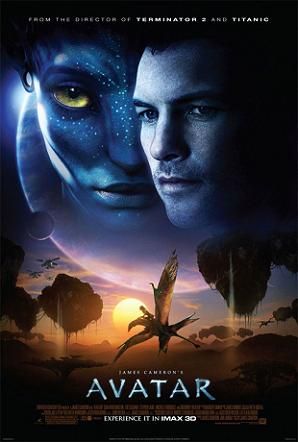
Opening with much pomp and circumstance (and East Coast blizzards!), James Cameron's long-awaited Avatar is NOT, as the PPCC had previously imagined, anything to do with the fun cartoon, Avatar: The Last Airbender.

Alas! We like that show!

Well, this clears up a long-held confusion on our part. It is also NOT, as we had previously imagined, really, really bad. It's only sort of bad. It's OK. It would not pass by the reviewers of our favorite sci-fi magazine, Strange Horizons, because it breaks one of their cardinal rules:
14. White protagonist is given wise and mystical advice by Holy Simple Native Folk.

Yes, Avatar does that thing where it simultaneously glorifies and undermines the Other (in this case, the blue-skinned, slightly feline alien race, the Na'vi). See how the Other is in touch with nature, while we white men worship only money and machines! See how the Other is generally primal, peaceful and unsophisticated! The Na'vi, apart from being dangerously close to furries (aaaaah! AAAAH!), are a cultural hodge podge of indigenous people from various parts of our planet (Native American, West African and Pacific Islander come to mind). This would all be fine and well - the movie, after all, spends a lot of time establishing a clear moral dichotomy between the Na'vi and the evil, Vietnam/Iraq-fightin' military-industrial complexed White Man. What's kind of lame and disappointing is that (1) the Na'vi are still patriarchal (so sue us for hoping!), and other boringly Earth-reminiscent things, and (2) it takes one of those evil White Men to save the Na'vi.

The plot, which is Joe Haldeman (like, really, REALLY Joe Haldeman!) as told through the lens of James Cameron in Aliens mode - complete with Sigourney Weaver! - centers around a wheelchair-bound Marine, Jake Sully (Sam Worthington). Jake has been sent in his deceased brother's place to the dreamy planet of Pandora, where the Americans have a strong, two-pronged presence. On the one prong is a not very subtle portrayal of the sort of steamrolling, "winning hearts and minds" stuff that happened/happens in Iraq. This is led, predictably, by Money, Power and Military Men (things which King Arthur warned us explicitly about!). The second prong is a slightly more eco-friendly research expedition led by a bunch of grungier scientists (with beards! and long hair!), who are in turn led by a grumpy Sigourney Weaver. Jake the hardened Marine is, on paper, with the scientists, but it's not long before he's in the military's pocket again.

Jake's task: to live in the body of an "avatar", a half-human, half-Na'vi hybrid that will travel among the Na'vi in order to, uh... win their hearts and minds. Jake takes to this job with gusto. It gives him the freedom of a whole, hale body again, but it also exposes him to the increasingly pretty, awesome and highly saturated adventure fun course that is the Na'vi society. (Dude, Na'vi warriors climb floating moutains and ride pterodactyls! It is cool.) Jake also gets some romance thrown in there, for good measure and for the ladies.

In the end, it all boils down to: what will Jake choose when faced with supporting the evil military people or defending the nature-loving, indigenous people? Let's just say that, about halfway through the film, the PPCC was suddenly seized with the intense desire to watch Last of the Mohicans. Hmmm.

The acting was predictable and OK, the filmmaking was enjoyable if uninspired and the story, well, see above. We at the PPCC are hardened sci-fi troopers, and so we found the plot and caboodle fairly dull. If you want an anti-war sci-fi epic about American soldiers in some far-out planet operating remote-control machines and occupying bodies, we would definitely recommend Joe Haldeman's Forever War and Forever Peace. It may not require 3D glasses - which, by the way, are a bitch if you suffer from poor depth perception! - but it will probably stimulate your gray matter a little more.