

Pedro Almodóvar's films are always a treat - colorful, outrageous, rich, bright and feminist - and Hable con ella (Talk to Her) is no different. One of his better known films, it features the strangest love scene ever recorded in film history (guaranteed!) as well as his usual provocative examinations of gender roles and relationships through an endearingly expressive telenovela-esque lens. Hable con ella also resembles other weird love stories such as The Crying Game or Léon (well, a little bit) in that the central romance is envelope-pushing to the extreme. Prepare to be provoked.
Love and longing are central to this film, and couples abound. The first couple are the sensitive, tearful Marco (Darío Gradinetti) and bullfighter Lydia (Rosario Flores) - they meet when he comes to interview her and, accompanying her home at night, is forced to kill a stray rattlesnake in her kitchen. She is phobic of snakes and decides to abandon the home altogether. Marco helps her - offering to raid her home of things she needs, driving her to the hotel, and so on - and eventually they get together.
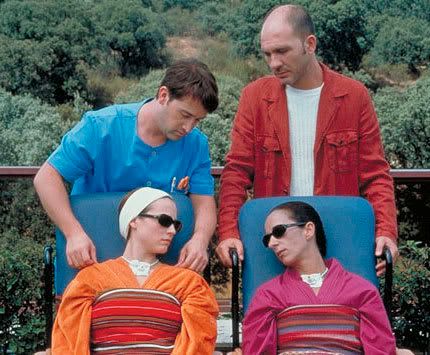
Clockwise from top left: Benigno (Javier Cámara), Marco (Darío Gradinetti), Lydia (Rosario Flores) and Alicia (Leonor Watling).
The second couple - if you can call them that - is male nurse Benigno (Javier Cámara) and his comatose patient, Alicia (Leonor Watling). If that sounds creepy, just wait - it gets creepier. Benigno, a friendless thirty-year-old virgin and social recluse, has obsessed over Alicia for years - even before the accident, he used to watch her in the dance studio across from his parent's apartment. When Alicia is in a car accident and rendered comatose, Benigno is only too thrilled to become her round-the-clock caretaker. After four years in a coma, Benigno is now unreservedly in love with her - he talks to her endlessly, does the things that she used to like to do (such as watch silent films and dance recitals) and plans their life together.
Meanwhile, tragedy strikes the first couple - Lydia is gored by one of the bulls, and her cerebral cortex is destroyed. Now also indefinitely comatose, she is taken to the hospital where Benigno cares for Alicia. There, Benigno - starved for more talkative company - immediately poaches Marco for friendship. Marco, simultaneously repulsed and curiously charmed by Benigno, spends many weeks waiting by Lydia and Alicia's sides, being lectured by Benigno on what makes women happy: you have to talk to them, be thoughtful sometimes, show you're listening and you care.
This all seems very cute, if weird, until things take a really weird turn. You'll have to watch it to find out (and don't let the kids around!).
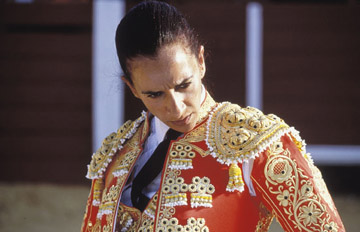
Lydia kicking some bull butt.
The most interesting stuff in Almodóvar films are his gender relations: often his protagonists are female, and his films are typically about the female experience. According to the Wikipedia article about him, he has said that women make better characters as they "are more spectacular as dramatic subjects, they have a greater range of registers, etc." In this film, the two male protagonists exhibit traditionally "feminine" characteristics, since Benigno is a nurse and Marco is moved to tears by just hearing delicate Caetano Veloso songs (admittedly, that is da bomb of a Caetano Veloso song). Meanwhile, Lydia works in a male-dominated sport - bullfighting - which also has heavy symbolism of virility and masculinity (fighting massive bulls, hello!). In the film itself, there are several dialogues which address the male-female dynamic. For example, Alicia's old dance instructor (a surprise cameo by Geraldine Chaplin, daughter of Charlie) excitedly describes a new interpretive dance she's choreographed, entitled "Trenches". The dance is about the First World War, and she has planned to show the soldier's souls floating up to heaven via ballerinas emerging from the male dancers: because, as she describes, the female emerges from the male, the male becomes female. The Wikipedia articles notes that this is then reflected directly in the story (though warning for spoilers!).

Benigno and Marco (in a moment of characteristic tearfulness).
The filmmaking in terms of editing, style and cinematography is lovely - and it is distinctly characteristic of Almodóvar's other work (e.g. Volver). The palette is suffused with bright, warm reds - the entire bullfighting spectacle, for example, or Benigno's dream bedroom - and there are some quirky details, such as the title cards announcing a relationship, or the notorious silent film-within-a-film sequence. Javier Cámara gives the most memorable performance as the increasingly creepy, increasingly vulnerable and increasingly unbalanced Benigno. He's saddled with the near-impossible task of maintaining Benigno as a sympathetic character for the audience and, generally, while he doesn't totally succeed (we were too freaked out!), it is a very compelling, even at times powerful performance.
This won't be a film for everyone's tastes - the story's outrageous twists make sure of that - and we have to caution that it fully deserves its R-rating for the troubling themes it discusses, but it is nonetheless a very good film: strangely whimsical, provocative and entirely unique.


