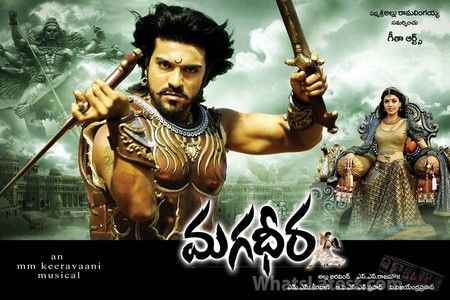
What the hell is going on in Magadheera? We don't know - we don't speak Telugu! But that didn't stop us from seeing it last night and loving it to bits. We were promised "three hero deaths" in Magadheera, but unfortunately that was false advertising - though reincarnation does feature prominently. We were also promised "masala on steroids", and, boy, did it deliver on that one! Even understanding nothing of the dialogue, we still laughed, cried and - man! - some of that epic dishoom dishoom really got our blood going. And the dancing? OMG.
Magadheera begins with some straining violins as we witness the studly warrior Kala Bhairava (Ram Charan Teja), as well as the beautiful Mitravinda (Kajal Agarwal), both badly wounded and drawing their final breaths on a rocky precipice overlooking that one scene from Crouching Tiger Hidden Dragon. After a brief exchange about... well, something (presumably their love for each other), Mitravinda passes away, tumbling over the precipice. With a look of anguished horror, Kala Bhairava throws himself off the cliff after her.
And so begins our story! Quickly zipping forward 1600 (?) - or possibly 400 (?) - years to present-day Hyderabad, we meet the studly cool dude Harsha (Ram Charan Teja... again), who has just finished winning a kabillion rupees on a motorcycle jumping contest. After a great song harkening back to a 1980s hit by the actor's real life father, 1980s Telugu star, Chiranjeevi, we follow Harsha as he goes off with his buddy in the auto-rickshaw. After sticking out his hand, he accidentally brushes the hand of the beautiful Indu (Kajal Agarwal... again) - this mere touch sends an electric jolt through Harsha, plummeting him in a super-hardcore out-of-body experience where we watch - again - the whole "throwing yourself over the precipice" thing, as well as other magnificent scenes from the year 400... or possibly 1600. Anyway, the glorious Andhra Pradesh past.
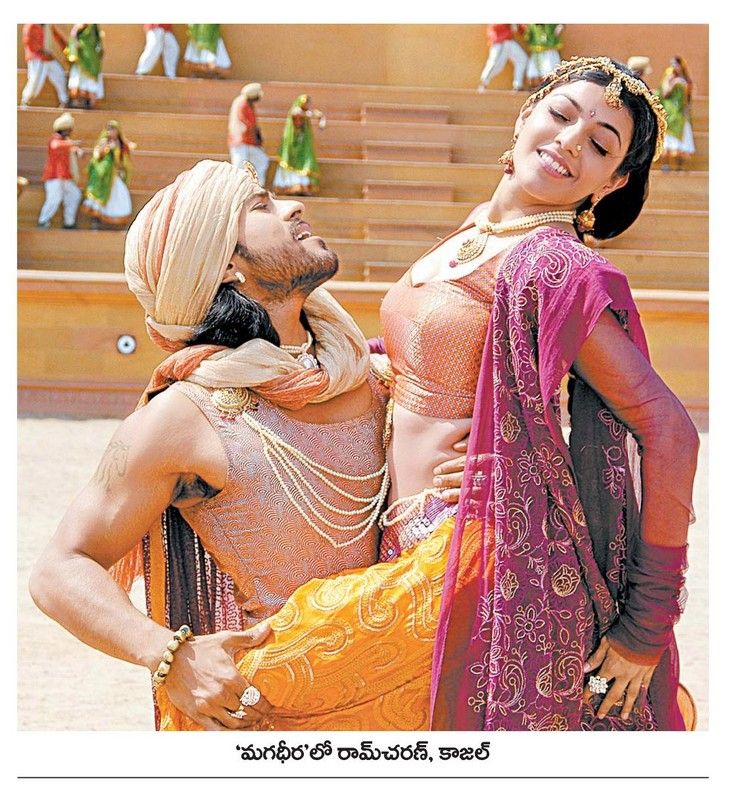
Past.
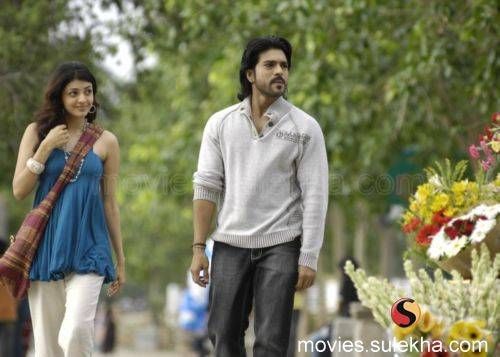
And present.
Harsha is now obsessed with finding the source of this electric jolt - and, particularly, the love from his past life. After some bumbling around (insert difficult-to-understand comic sequence), he eventually figures out that it is indeed Indu who is his reincarnated princess. And there is much rejoicing. However, at this point, we're introduced to the villain, Raghubeer (Dev Gill), who is some sort of modern-day prince... except completely evil. Witness his buffed up bod full of warrior scars - one can't help but wonder WHY he has those?! Anyway, after promptly introducing himself by killing off some guy with a spear in front of his enormous mansion, he too gets one look at Indu and goes immediately into Rapist Mode. After killing some other dude (his assistant!) for something his assistant apparently said, he decides to insinuate himself into Indu's home by ingratiating himself with her father. Alas, this works! When dastardly Raghubeer attempts to have his wicked way with Indu, however, the ghost of Kala Bhairava appears and beheads him in a most gory - though temporary - way. Suitably alarmed, Raghubeer hastily consults his nearest sage, who - using a potion? or a chant? or a book? well, something - explains the whole reincarnation deal. Now very alarmed - since in his previous life, he was killed by Harsha - Raghubeer decides to get rid of Harsha ASAP.
This leads to some fantastic sequences, including an extended flashback to the whole first life deal. Goodness, it was glorious! The introduction of the 400 AD/1600 AD setting, which had been constantly intimated to (and our appetite was suitably whetted for some rollicking good Ye Olde Times!), was so spectacular the PPCC was practically blown out of our seat. (Thank you also, multiplex, for maxing out the volume!) However, as exciting as it is to see both the original and reincarnated hero-damsel-villain love triangle play out, the second act unfortunately couldn't quite deliver on the first act's promise, and we really didn't need two identical resolutions. So the film finishes on a good note... not a great one.
So! Observations from a predominantly Hindi film viewer who speaks English, a little Hindi and NO Telugu (apart from "koncam" and "pakka"). Well, first of all: if there's one thing Magadheera did fluently and well, it was cinematic extravagance. For masala lovers such as the PPCC, this film packed a lot of meat: completely over-the-top and completely gratifying ideas, like Chicken Soup for the Sentimentalist Cinephile's Soul. Consider, for example, a great sequence in which modern-day Harsha - amidst a general chaos in the Hyderabadi streets which we won't explain right now - almost gets run over by a horse. Jumping onto a bus to avoid being trampled, his fingers brush those of Indu: electrical jolt again! Freaking out, because he needs to see who is this girl who keeps mildly electrocuting him, he grabs the horse, flings himself onto it, gallops after the bus, catches up with the bus and - gets a face-full of Indu's dupatta. As he fumbles to get the dupatta out of his face, he finally sees her. We will not lie: we were seriously verklempt at this point. It was incredibly indulgent, and incredibly great chocolate cake filmmaking.
Another great thing, and somewhat different from Hindi films, was the choreography. Gosh! Particularly the male choreography, which is usually under-emphasized in Hindi films (at least, pre-Hrithik Roshan): star Ram Charan Teja is a hell of a dancer, and his super-chill moves included popping and locking (!!). The dance sequences had a color and inventiveness which we see only sometimes in Hindi films (and mostly in films which have South Indian choreographers/directors... Pukar, Dil Se, Virasat... you get the idea). One of our favorite songs from the film was the flashback ballad, Dheera Dheera, which was just pounding with the powerful drums, haunting sopranos and stark, Zhang Yimou color palettes.
Oh, South Indian cinema. Where have you been all my life?


 Magic in the 19th century: not very safe.