Tuesday, 16 February 2010

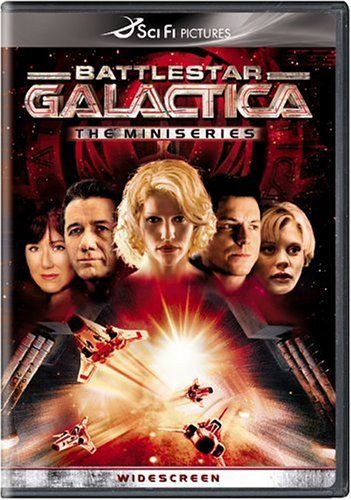
Battlestar Galactica (2003)


There's a series of books out there called Something... And Philosophy, where the Something will be something unexpected and pop culture-y, such as Star Trek, or Star Wars, or Lord of the Rings. We always thought it was just marketing tripe to get people into philosophy via their favorite low art setting. Surely Star Trek is the only TV pop which merits a book on philosophy?

Apparently not, for there is the movie-length pilot of Battlestar Galactica.

Everyone who knows us offline knows that we have a bit of a dystopia fetish. We have a worrying appetite for disaster stories, especially when they are set in the future and/or space, and we prefer all our characters in such stories to be dark, brooding and preferably doomed.

"Then you'll LOVE Battlestar Galactica!" our friends chorused.

And, yes, we have started the brainwashing, and, yes, we are loving it. But while it presses our usual buttons in a usual way (99% humans killed by angry robots! lone human ark sailing through space to an unknown destination! ensemble bonding! be still, my heart), it also amazes us by being so gosh darned philosophical. We could... well, gosh, we could write a book about it!

In the past or future or somewhere, but definitely in media res, it's been forty years since the human-Cylon war, and relations between the two groups are icy at best. One of the last warships of the human fleet, the Battlestar Galactica, is preparing for its decommissioning ceremony, and its crew is all abuzz with its quotidian soap opera motley human drama. There's Kara "Starbuck" Thrace (Katee Sackhoff), the stogie-chomping ace pilot with a big ego and big, cocky smile, there's the grim (and glorious!) Commander Adama (Edward James Olmos, of Blade Runner), his alcoholic XO, Tigh (Michael Hogan), and his son, Captain Lee "Apollo" Adama (Jamie Bamber). There are also a bunch of other people doing a bunch of other things. The point: no one has any idea of the dystopian doom which awaits them, nor will the dystopian doom necessarily drive much of the drama (though it drives a lot of it, admittedly).

Meanwhile, on the Earth-like human colony planet of Caprica, the terribly clever, terribly cheeky genius Dr. Gaius Baltar (James Callis) is discovered to be (1) cheating on his girlfriend, Six (Tricia Helfer), (2) who is also, incidentally, a Cylon in disguise (new model!) (3) who has used him for his defense systems knowledge, thus dooming the human race to near-extinction. Moments after Gaius learns this, a bunch of Cylon spaceships appear and the atomic bombs begin to drop. Gaius flees, but not before acquiring Six as a permanent companion via flickering hallucination; also, the decommissioning ceremony is interrupted, all twelve planets of the human colonies are destroyed, and the Secretary of Education, Laura Roslin (Mary McDonnell), becomes the new colonial President.

Not since Pasqualino Settebellezze has a film made us muse on the right to survive. But this movie-length pilot sets up a number of fruitful (and fairly typical) sci-fi themes: What makes us humans, when Cylons look, feel and act like us? What is free will and consciousness, in an age of artificial intelligence? As the first scene shows, a Cylon asks a human, "Are you alive? Prove it." Or, as a character from the new spin-off series says, "A difference that makes no difference is no difference." This is all par for the course - we've seen it before in movies like Blade Runner or books like Neuromancer - but BSG seems to be looking at it from an interesting angle: if the point of the human-Cylon conflict is that there is some fundamental difference between being human and being Cylon, and if humanity's uniqueness comes from its loftier ambitions (justice, mercy, compassion, blah), then what do we make of humans who must continuously do awful things in order to save themselves? That is, when the biological imperative of surviving drives out all the loftier concerns, the lines between human and Cylon are not just blurred - they're erased.

Pasqualino Settebellezze and BSG's pilot both demonstrate how surviving for surviving's sake can lead to some very nasty moments indeed. Or, let the PPCC rephrase: while Pasqualino unambiguously portrays the moments as nasty, BSG leaves the questions hanging. Two examples. First: there are a number of scenes in the pilot where the remaining humans (now numbering 50,000), have to choose to either let some X number of humans die (where X<<50,000) in order to save the majority. The characters agonize over this, but the conclusion is always the same: the majority wins. It has to. But the lingering doubts remain: Does it really? We can't be sure that the decision to survive, at the expense of an unlucky minority, was right or wrong. BSG impressed us by presenting these difficult questions for what they are: pretty unanswerable! Incidentally, there's a great game about this on the PhilosophersNet: Morality Play.

Second example: there are two notable scenes in which a major character admits that, even in the face of our species' worst crisis imaginable, they are still more concerned with their individual fate. These two characters are Gaius Baltar, who is concerned that the other 49,999 people will soon learn that the genocide was partly his fault, and Laura Roslin, who learns early in the pilot that she has cancer. Here, too, BSG emphasizes the ambiguity: Baltar is mocked by his hallucination-Cylon (who begins to sound increasingly like a sort of Jiminy Cricket-style disembodied conscience) for his selfishness, and Roslin is reassured that her feelings are normal, nay, characteristically human. So who's right? Does the victimless nature of Laura's doom erase her selfishness, redefining it as humanity?

With such a large cast of characters, it's easy to find your personal favorites. Our favorites are Commander Adama and Gaius Baltar, who are brilliant in radically different, clashing ways - like ice cream and cheese. But the performances by all the actors - particularly Mary McDonnell as Laura Roslin, Paul Campbell as her assistant Billy, and Katee Sackhoff as the swaggering Starbuck - are very good. We look forward to seeing how the characters and the themes (especially free will, given all those creepy sleeper Cylon agents!) develop over the next four seasons.

Sunday, 14 February 2010

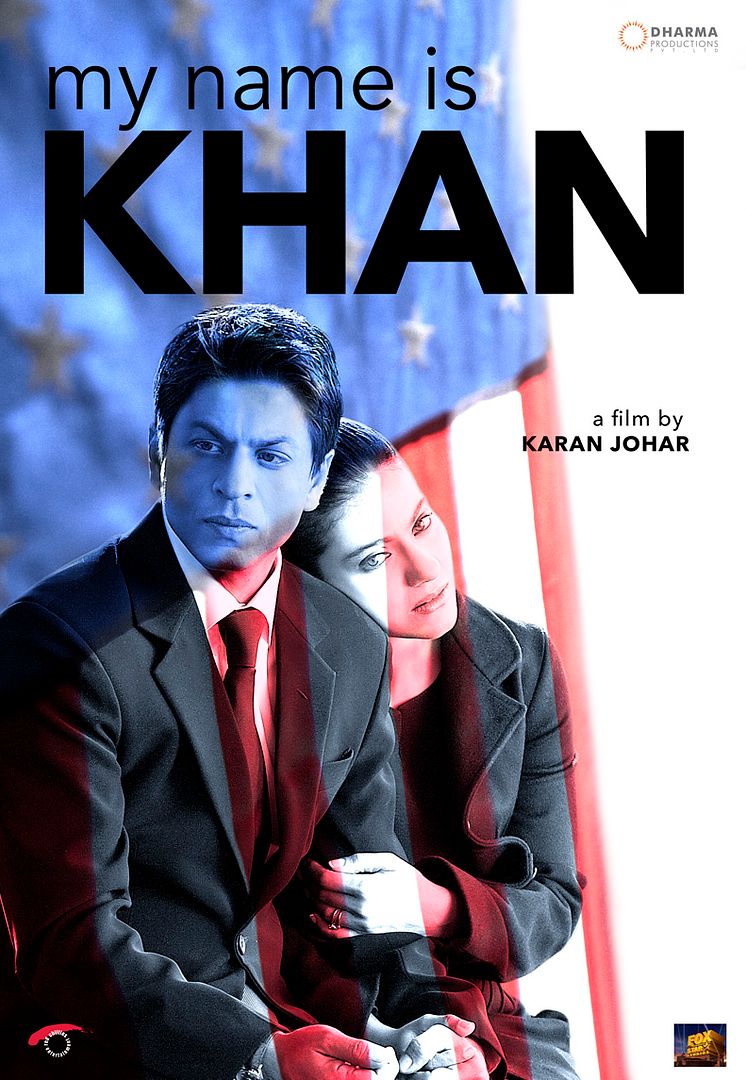
My Name Is Khan (2010)


My Name is Khan, the polished new venture of Karan Johar, is a sugarpuff film. It is very sweet, very earnest and, maybe in spite of or because of this, lovable. It also reunites the dynamite duo of Kajol and Shah Rukh Khan - those quirky, jittery fuzzies who made the 1990s such heady, halcyon days. Ahh, yes.

It is also charming enough that we can forgive SRK for the pain he brought us back in 2008, and we are now back on the SRK train. Ahh, to look forward to something... and be rewarded! What a nice feeling.

The film's first act follows the standard TV-movie "Disease of the Week" narrative arc: there is a brief prologue showing Rizwan Khan (Tanay Chheda, of Slumdog Millionaire), a young boy with Asperger's syndrome, facing ridicule, misunderstandings and other difficultes - and, thanks to his courage, as well as his wise, gentle mother's (Zarina Wahab) shelter, his eventual triumph. There is his maturation into a Rain Man-esque Shah Rukh Khan, and his move from India to San Francisco. There, he meets and courts the lovely Mandira (Kajol), a hairdresser and single mother. Mandira's charismatic tween son, Sameer (Yuvaan Makaar), eventually accepts Rizwan as friend and father figure, the adults marry, and the three form a happy, glowing family. This act is easy-going and lovable; it conquered us with little difficulty.

It is, however, the second act which is The Point of My Name is Khan, and here things falter and wander. 9/11 happens, anti-Islamic paranoia spreads, and an indirectly-related tragedy destroys the warm, fuzzy glow of the first act. The Point, which is helpfully explained by Rizwan's mother early in the film, is that the only true difference between people is whether they are good people or bad people - not whether they are Muslims or Hindus, Iraqis or Americans. Rizwan later repeats this phrase in the charming courtship of the first act when, introducing himself as a door-to-door soap salesman, he also appends, "I am a good person and I do good work." Rizwan's moral certitude is shaken by the second act, when he is suddenly profiled as a villain by strangers and loved ones alike, and his assurances of his own moral goodness begin to take on a more desperate air: "My name is Khan... and I am not a terrorist!" This becomes his mantra and, following the shake-up and break-up of his San Francisco shelter, he embarks on a cross-country trek to tell the President (and, in a way, the State), that he is, and has always been, a good person who does good things. Along the way, he has a variety of adventures which, as Don King would say, can happen only in America! Or post-9/11 America, that is. In particular, there are references to Hurricane Katrina (and the government's failure to manage the disaster) as well as Guantanamo. These are touchy subjects, but they are handled with a simple earnest "Humanity is good! Rizwan is good!" vibe, so we fly safe through.

Much of the movie's charm comes from the simplicity of its storytelling, its optimistic (secular-ish) humanism, and its depiction of sparkly joy. It is shamelessly manipulative, like a Disney film. But its moral message is also just as child-like and shiny as a Disney film's. People are good! Prejudice is bad! We laughed and cried throughout the film, and one of its most poignant moments was the montage of Happy Family Moments, where the Hindu Mandira does morning pooja while her husband does the salaat.

We've never considered SRK a particularly skilfull actor from a technical standpoint, but we've always admired his immense charisma as a performer. In My Name is Khan, SRK flexes a bit more acting muscle and generally does justice to his character's Asperger's syndrome. Or, at least, does justice to previous cinematic portrayals of autism. The best we can say is that he is no worse than Dustin Hoffman or our beloved Anil Kapoor (and, no, we will never stop finding ways to link to that song) - and that is, well, saying something. His chemistry with Kajol is just the same as it ever was - they seem like old friends reunited, entirely comfortable and at ease in their on-screen banter. Their courtship is the film's sugary icing. Unfortunately, Kajol's role is halved after intermission, and her character starts exhibiting schizophrenic changes in personality. Kajol is a strong enough actress to make this weak characterization not seem totally rubbish (even though it does push the envelope of the absurd). Other unexpected faces do well in their parts - Vinay Pathak as a silly motel owner was great.

Thematically, the movie is a child's plea for peace. It doesn't acknowledge the ambiguity of real life, the politicization of fear, instead leaving everything blunt and sharply defined. This is a world where grumpy tram-goers will heckle a man as a "freak!" until they are morally chided, when they will shuffle away shame-faced. Does this really happen? Anywhere?! But that's OK, The Lion King is also pretty straightforward - and it's magnificent! My Name is Khan is not magnificent, but it is awfully nice. Like candy!

Friday, 5 February 2010

Maya Bazaar (1957)


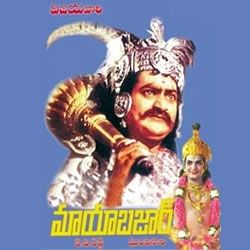
We at the PPCC are probably the last people who should be reviewing the recently-remastered Telugu classic, Maya Bazaar, as we don't know Telugu, are fuzzy on Mahabharata family trees, and we tend to fade out a little during our friends' stories of N.T. Rama Rao, legendary actor-turned-politician. But if our blog usually attempts to be well-versed in movies, let it also be a record of our ignorance. Maybe there'll be a day in the future when we'll be savvy connoiseurs of Telugu and Telugu movies, and we'll be able to laugh softly at our total and complete not-knowingness here. Right? RIGHT? Well, maybe. A blog can dream.

So, as you can tell, Maya Bazaar is a Telugu classic centered on a subplot of the Mahabharat and starring the legendary N.T. Rama Rao (who later created the popular Telugu Desam Party in Andhra Pradesh - interesting factoid!) as Lord Krishna. Thankfully, there is a Wikipedia entry for this film, so we can at least confirm some of the plot. But what we basically understood was this: there is the usual Mahabharat divide between the Kaurava and Pandava families, who are cousins. See the Mahabharat for more details. (Or, if you are a fan of Shashi Kapoor, see the excellent Kalyug.) Incidentally we have just recently learned about how, if you worship Vishnu, you have three white vertical marks on your forehead, and, if you worship Shiva, you have three horizontal marks. So each family has either the marks of Vishnu or of Shiva; interesting!


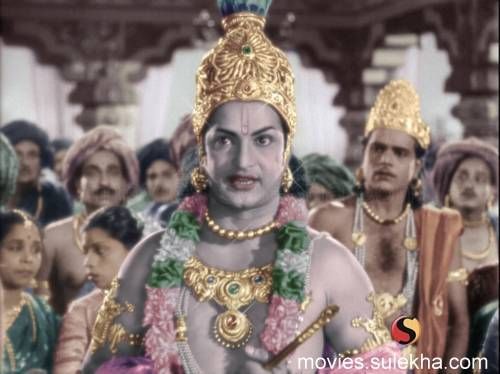
N.T. Rama Rao as Lord Krishna. He was really, really charismatic.


Anyway, there are two young people - a zesty girl who's name we didn't catch but who lives in the house with Lord Krishna and his brother, so she must be related (?), and a comically macho young man, Abhimanyu (Akkineni Nageshwara Rao) - who are in love, and have been since childhood. The older generation seem happy to arrange the match. Then one of the ladies in the older generation with the arched eyebrows says something in an arch way, and suddenly the lovers are crying and everyone is upset. Abhimanyu yells angrily (threatening something? promising something? who knows!). Then there is a fantastic bit where Abhimanyu and his mom are travelling through the forest with their driver, and a comical gang of rakshasas (?) - well, people with superpowers - try to stop them. Abhimanyu is an ace archer though, so he manages to defeat all these supernatural attacks with the cunning use of various custom-made arrows. Eventually, the leader of the rakshasa gang shows up as a very very large man with a mallet of some sort, and he and Abhimanyu engage in a most entertaining show-down. Abhimanyu loses, but leaves with only a bruised forehead and new friends among the rakshasas, who admire him for his courage.

We think.

Help!

And help on help! Should we read Devdutt Pattanaik, whose Maharabharat-suplot novel, The Pregnant King, was (if you'll pardon the pun) divine, and who has written extensively on Hinduism in general? Or should we read Roberto Calasso's Ka, that is in every bookstore of the city and is recommended by the expats? Or both?

Okay, getting back on track, here's some stuff that we noticed:

1. N.T. Rama Rao is cool.

First of all, we were the only people in the theatre that didn't fall into spasms of pure joy when N.T. Rama Rao appeared. The crowd went wild! At first, we were like, "Which guy? Which guy? That guy?!" But then, during the film, and especially afterwards, whenever we saw N.T. Rama Rao-as-Krishna's face looming over us in the enormous overpass advertisements, we felt a warm glow of affection. Yes - the charisma has worked on us. Suddenly, the story of his dramatic entrance into the Hotel Viceroy of Hyderabad, when he called out for his "brothers" to join him (in the Telegu Desam Party? who has details on this? we're too embarrassed to ask our friends to repeat it), becomes a lot more exciting - now that we can put a face to the name!

2. The tone of the movie.

We had a vague sense of Hindi mythological films as being over-the-top spectacles full of larger-than-life show-downs, booming monologues and flying chariots. Again, our only real exposure was Jai Bajrangbali. This is our second Hindu mythology film, and it confirmed our expectations of large-scale fantasy adventure (forests catching on fire! people disappearing!). The audience we watched it with was also very involved - cheering and laughing. What we didn't expect was the tone of the movie. First of all, our understanding of the Mahabharat - and especially the Kalyug ("Age of Vice") that follows - was that it's a somber affair. We expected a downer, with serious people being angry a lot and various smitings. Also, our cultural upbringing - where Jesus reportedly never cracked a joke, and Zeus or God threw thunderbolts at the cheeky - meant that we were completely baffled when... Krishna made jokes! Lots of them! And everyone laughed! He made snarky asides, he delivered punchlines!

It was never irreverent, to be sure. It was like Abraham Lincoln's legendary wit - i.e. funny, from someone you respect. But it was so different to how we were raised - where religious figures are uniformly pretty dour - that it was so interesting!

3. That great lovers-in-the-boat song

It was very cute, and one of the few visual gags thrown in there for the non-Telugu speakers.

4. Okay, so there was this one scene...


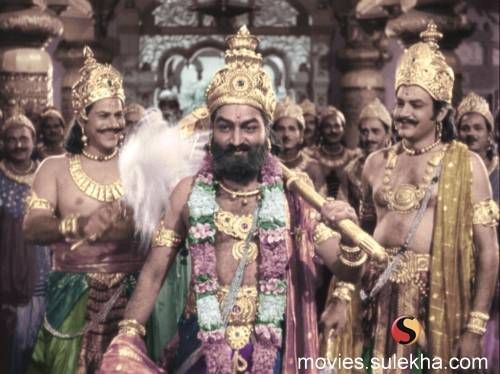
This bit!


...where some very important king guy walks in, with much pageantry and ado. And they show him variously glowing at the reception, and then looking almost a bit shy or weary of it. We found it so unexpected and humanizing, and we had NO IDEA what was going on, and now we're curious. Help!