Showing posts with label 1950s. Show all posts

Friday, 10 September 2010

Il generale della Rovere (1959)


When the Nazi prison commander is telling you you're the scum of the Earth, and everyone's agreeing with him, you've got to wonder just how scummy you really are.

And Emmanuele Bardone (Vittorio de Sica) is pretty scummy. I mean, even the Nazis think he's a spineless dick. Because what's worse - and possibly more dangerous - than explicit malice? Deception. Bardone is a con artist; he exploits the vulnerable. He tells the weeping mothers who come into the Nazi administrative office in Rome that, if they just shell out fifty or a hundred thousand lira (to him), they can get news of their imprisoned sons. While some of the money lines the pockets of corrupt German officials, most of it is just gambled away by Bardone himself.

What's even worse about this already unsavory mess is that Bardone really, sincerely, authentically believes he's a good guy. He doesn't see it as springboarding from one evil (Nazism) to another (his own selfishness) - he sees himself as a guy just trying to get by, as a man who is far too kind to tell the sobbing, weeping families the sordid, unhappy truths of their loved ones: that they're in prison, in a concentration camp, dead.

This painfully self-deluded confession Bardone sweats out in one of Il generale della Rovere's (General Della Rovere) early scenes, when he's outed as a con artist by the crafty Colonel Mueller (Hannes Messemer). Mueller, who is also pretty evil but at least abides by some internal code of honor, decides to use Bardone as a mole. Before being sent to a prison in northern Italy, a sort of way station for Italian political prisoners meant for the concentration camp, Bardone is equipped with a new name - General della Rovere - and a new identity: he is now a legendary resistance fighter. Mueller hopes that Bardone will be able to extract some juicy info from the other, nobly suffering political prisoners, who instinctively trust "General della Rovere" and seek to protect their hero. Bardone is happy to get the perks of being everyone's favorite partisan leader and eager to get out this jail ASAP.

But this is a mess. A frightening, hairy, ugly mess - and Bardone is right in the middle of it. This film - which is not as tight as Roberto Rossellini's masterpiece, Roma, città aperta, but is as gut-wrenching (if not more so!) - is a doozy. If this was 1970s Italian cinema, Bardone would have been played by Giancarlo Giannini and this would have been directed Lina Wertmuller - the whole thing would have been a pitch black comedy in the style of Pasqualino Settebellezze. Indeed, Bardone shares much of Pasqualino's (and other seedy Giancarlo Giannini characters') most notable characteristics: cowardice, vanity, a tendency to stand in bureaucratic lobbies and promise salvation.

But Rossellini - and de Sica - are much more earnest and much less cynical than Wertmuller - who, in cinematic terms, is their descendant. After all, Rossellini and de Sica come from the generation that lived the war. Roma, città aperta was made just months after Rome, actually, was opened up to the world - thanks to the Allied forces liberating it from Nazi occupation. We think that Rossellini and de Sica and the audience of that era just wouldn't have been ready for the shocking, provocative, mind-blowing razor wire satire that Wertmuller would provide their children and grandchildren. The wartime generation needed to believe that Bardone - even scummy, vulnerable, stupid Bardone - would have had an eleventh hour conversion and grow a spine. They needed to see the heroism and nobility of the other prisoners. (Compare these prisoners to Pasqualino's cohort - at least these guys have a code!)

This is not a perfect movie. Roma, città aperta and Pasqualino Settebellezze are, from a technical and artistic standpoint, better films - they're sharper, cleaner, smoother. In this film, we still see the rough edges: Vittoro de Sica's so-so moments of acting, the awkward side swipes, the clunky music. But the story is strong, and it propels the viewer forward, and it makes you care in a deep, intestinal way. Make no mistake: Bardone is an anti-hero, but you care about him - big time. He's conned himself into an impossible corner, and he's miserable, complex, ambiguous and deeply flawed, deeply human. You can't help but feel awful, riding the lows with him. Vittorio de Sica - who, tangentially, was a marvel to see, if only because of how much his son resembles him! - was, in many instances, really beautiful. Not just looks-wise (though he also was that; gosh, that shock of white hair… those eyes!), but also for sheer intensity: the sweat when he's under pressure, the despair when Mueller drags his face through the figurative shit and he has to come to terms with the reality and the horror of Nazi-occupied Italy. Overall, it was a real tour de force. Highly recommended.

Friday, 5 February 2010

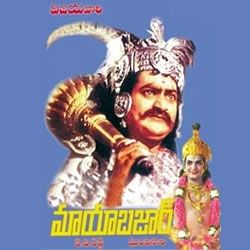
Maya Bazaar (1957)


We at the PPCC are probably the last people who should be reviewing the recently-remastered Telugu classic, Maya Bazaar, as we don't know Telugu, are fuzzy on Mahabharata family trees, and we tend to fade out a little during our friends' stories of N.T. Rama Rao, legendary actor-turned-politician. But if our blog usually attempts to be well-versed in movies, let it also be a record of our ignorance. Maybe there'll be a day in the future when we'll be savvy connoiseurs of Telugu and Telugu movies, and we'll be able to laugh softly at our total and complete not-knowingness here. Right? RIGHT? Well, maybe. A blog can dream.

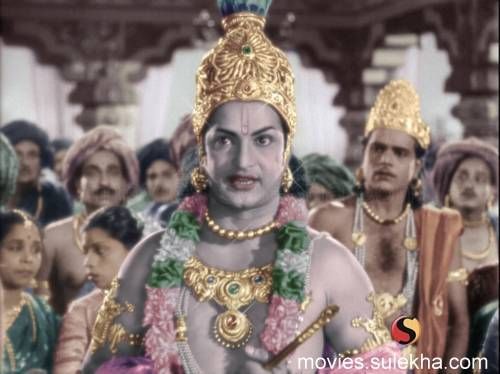
So, as you can tell, Maya Bazaar is a Telugu classic centered on a subplot of the Mahabharat and starring the legendary N.T. Rama Rao (who later created the popular Telugu Desam Party in Andhra Pradesh - interesting factoid!) as Lord Krishna. Thankfully, there is a Wikipedia entry for this film, so we can at least confirm some of the plot. But what we basically understood was this: there is the usual Mahabharat divide between the Kaurava and Pandava families, who are cousins. See the Mahabharat for more details. (Or, if you are a fan of Shashi Kapoor, see the excellent Kalyug.) Incidentally we have just recently learned about how, if you worship Vishnu, you have three white vertical marks on your forehead, and, if you worship Shiva, you have three horizontal marks. So each family has either the marks of Vishnu or of Shiva; interesting!


N.T. Rama Rao as Lord Krishna. He was really, really charismatic.


Anyway, there are two young people - a zesty girl who's name we didn't catch but who lives in the house with Lord Krishna and his brother, so she must be related (?), and a comically macho young man, Abhimanyu (Akkineni Nageshwara Rao) - who are in love, and have been since childhood. The older generation seem happy to arrange the match. Then one of the ladies in the older generation with the arched eyebrows says something in an arch way, and suddenly the lovers are crying and everyone is upset. Abhimanyu yells angrily (threatening something? promising something? who knows!). Then there is a fantastic bit where Abhimanyu and his mom are travelling through the forest with their driver, and a comical gang of rakshasas (?) - well, people with superpowers - try to stop them. Abhimanyu is an ace archer though, so he manages to defeat all these supernatural attacks with the cunning use of various custom-made arrows. Eventually, the leader of the rakshasa gang shows up as a very very large man with a mallet of some sort, and he and Abhimanyu engage in a most entertaining show-down. Abhimanyu loses, but leaves with only a bruised forehead and new friends among the rakshasas, who admire him for his courage.

We think.

Help!

And help on help! Should we read Devdutt Pattanaik, whose Maharabharat-suplot novel, The Pregnant King, was (if you'll pardon the pun) divine, and who has written extensively on Hinduism in general? Or should we read Roberto Calasso's Ka, that is in every bookstore of the city and is recommended by the expats? Or both?

Okay, getting back on track, here's some stuff that we noticed:

1. N.T. Rama Rao is cool.

First of all, we were the only people in the theatre that didn't fall into spasms of pure joy when N.T. Rama Rao appeared. The crowd went wild! At first, we were like, "Which guy? Which guy? That guy?!" But then, during the film, and especially afterwards, whenever we saw N.T. Rama Rao-as-Krishna's face looming over us in the enormous overpass advertisements, we felt a warm glow of affection. Yes - the charisma has worked on us. Suddenly, the story of his dramatic entrance into the Hotel Viceroy of Hyderabad, when he called out for his "brothers" to join him (in the Telegu Desam Party? who has details on this? we're too embarrassed to ask our friends to repeat it), becomes a lot more exciting - now that we can put a face to the name!

2. The tone of the movie.

We had a vague sense of Hindi mythological films as being over-the-top spectacles full of larger-than-life show-downs, booming monologues and flying chariots. Again, our only real exposure was Jai Bajrangbali. This is our second Hindu mythology film, and it confirmed our expectations of large-scale fantasy adventure (forests catching on fire! people disappearing!). The audience we watched it with was also very involved - cheering and laughing. What we didn't expect was the tone of the movie. First of all, our understanding of the Mahabharat - and especially the Kalyug ("Age of Vice") that follows - was that it's a somber affair. We expected a downer, with serious people being angry a lot and various smitings. Also, our cultural upbringing - where Jesus reportedly never cracked a joke, and Zeus or God threw thunderbolts at the cheeky - meant that we were completely baffled when... Krishna made jokes! Lots of them! And everyone laughed! He made snarky asides, he delivered punchlines!

It was never irreverent, to be sure. It was like Abraham Lincoln's legendary wit - i.e. funny, from someone you respect. But it was so different to how we were raised - where religious figures are uniformly pretty dour - that it was so interesting!

3. That great lovers-in-the-boat song

It was very cute, and one of the few visual gags thrown in there for the non-Telugu speakers.

4. Okay, so there was this one scene...


This bit!


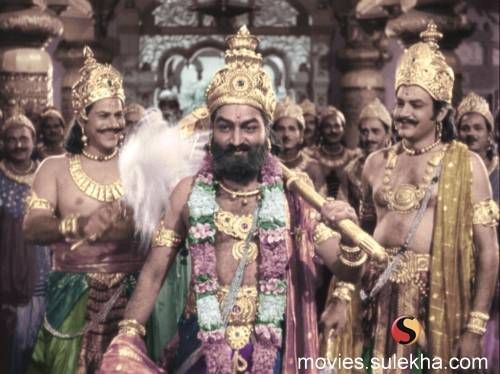
...where some very important king guy walks in, with much pageantry and ado. And they show him variously glowing at the reception, and then looking almost a bit shy or weary of it. We found it so unexpected and humanizing, and we had NO IDEA what was going on, and now we're curious. Help!

Monday, 2 February 2009

Main Nashe Mein Hoon (1959)

Main Nashe Mein Hoon (I Am Drunk, or MNMH) is a strange, funny, masala film, made about fifteen years too early, and featuring not one but three - three! - paeons to drinking. Now who doesn't love a good drunken song? Or three?! The PPCC is a big fan, and now we've got to add Raj Kapoor as an honorary participant in the Drunk Off!!. This film also featured the one thing they don't do enough of in Hindi films: the female villain, played here by the stunning Nishi. She is just a joy to watch: strong, gorgeous, business-like and EVIL. We have decided when we make it in Bollywood it's going to be as the modern-day her!


The foolish Ram (Raj Kapoor) getting his butt kicked by the villainous Miss Rita (Nishi). Also, incidentally, one of our favorite songs from the film, not available on YouTube but very similar to Raj Kapoor's brother, Shashi Kapoor's Jane Mujhe Tu Ne from the later Naina.


We at the PPCC tend to shoehorn Hindi films about drinking into either the Devdas box, the Sufi box or, more rarely, the Dionysus box. Yet we can't do that for MNMH, since it neither glamorizes drinking nor uses it as a vehicle for transcendental sadness. If anything, drinking is just portrayed as embarrassing, and our increasingly alcoholic anti-hero, Ram (Raj Kapoor), is a carefree, caddish idiot. He doesn't choose to drink because of some past lost love, but is instead just peer pressured again and again via the dealbreaking, "What are you? A baby?!" When drunk, he doesn't deliver poetic soliloquys full of existential angst a la Dilip Kumar; instead, he just becomes even more babbling, incomprehensible and childish (who would've thought that was even possible!). He also has a number of face-first falls which looked like they really hurt! The whole thing was a strange combination of humor and cringe-worthy pathos.


Whoa, easy on the Vat 69, RK...


The PPCC wants to be the Nishi of the new millennium!


The reason the drinking is important to the story - as this isn't supposed to be a film where we laugh at an idiot, though we often did - is two-fold. On the one hand, we have the scary, emancipated Miss Rita (Nishi) who has decided to seek vengeance on Ram's father, the severe Judge Kundanlal (Mubarak), by corrupting his prized eldest son. Cunning! Evil! Anyway, Miss Rita - a super-singleton and owner of the aptly-named Wonderful Club - speedily ruins Ram's rep by getting him hammered at a picnic, seducing him and getting him addicted to her and booze. From then on, an entranced Ram becomes a Wonderful Club regular.

Apart from just how embarrassing it is for Ram's father to see his son turn into Captain Stupid every night, there's also a poignant family history (and this is the second interesting plot device): Ram's grandfather, Dharam Das (Nasir Hussain), was an alcoholic who, during one of his drunken evenings, killed a dancer and her lover in a fit of jealous rage. Dharam Das went to jail and the entire family was shamed. Judge Kundanlal, whose entire life seems to be a reaction against the vices of his father, understandably fears that some of that behavior could be passed down to his son. Then - in an early surprise - Dharam Das is released from jail as a kindly, frail old man. Trying to reconcile the reeling, demonized Dharam Das of yore with the gentle, sad little man in the present is pretty difficult - for the PPCC and, it will turn out, for Judge Kundanlal. And it's interesting for a Hindi film to spend so much time humanizing a murderous alcoholic. But there you go: the present-day Dharam Das is positively saintly!


Nasir Hussain as the reformed grandfather, in one of his more typical poses.


Which brings us to the most interesting theme of MNMH: forgiveness. Usually drinking too much liquor and slapping your elders pretty much assures your death in a more mainstream Hindi film. Yet MNMH's treatment of alcoholism is not as a symbol of evil, but as a symbol of frailty; something that has embarrassing and occasionally destructive consequences. The two alcoholics in the film - Dharam Das and Ram - aren't demonized at all. Rather the only evil person is Miss Rita - who barely touches the stuff. Judge Kundanlal's rigid, zero-tolerance attitude - which is more in line with typical filmi morality - is upended as he eventually realizes that he loves and accepts his highly flawed father and son, despite all their imperfections. Tellingly, there's even a little subplot about the family's slightly evil servant, Munshi (Dhumal), who is also - after a particularly egregious fault - forgiven.

Basically, this film felt a lot more liberal than the more conservative Hindi films of that era - and its zany envelope-pushing filmmaking predated even crazy Manmohan Desai (you'll have to keep an eye open for some of those weird George Lucas-esque cuts!). And even better - the women rocked! For example, there was a bold, unexpected sequence when Ram's childhood love, the pure and kind-hearted Shanta (Mala Sinha), teams up with Grandpa Dharam Das to save Ram from the evil Miss Rita's clutches. Their plan includes transvestism and a jealousy-inducing courtship with strong homoerotic undertones: between several women!


Transvestism! Lesbian undertones! Shocking!


The film also has an interesting meta twist, in that Raj Kapoor (and his brothers and sons) was notorious for hard drinking (and hard eating). While most of his drunken scenes are over-the-top and quite funny ham-fests (pratfalls, high-pitched shrieks), the more understated moments were the hardest to watch: they just seemed a little too real. A thing we like about Raj Kapoor was his ability to project vulnerable intensity - both of his characters (the infamous moment when Raju slaps Rita in Awaara) and of himself as a performer (those self-obsessed performances that always tried so hard!). In this film, for once, the imperfections and vulnerability were difficult to watch: he ranged from ridiculous when over-the-top (the "look, I'm a baby! waah, waah!" moment was spork-inducing awful) to painful when understated (the poignant title song). That's not to say it's a bad performance (okay, sometimes it is, but sometimes it also isn't), it's just a thankless role with uncomfortable meta implications.


Raj in a rare moment of understated acting (his best!), kicking it a little too real.


Altogether this was a unique, enjoyable find: quirky story, novel themes of tolerance/rehabilitation rather than demonization, wonderful villain, incredibly fast pacing (bam-bam-BAM!) and fun songs. Like that Frank Sinatra movie where he's an alcoholic comedian who regularly bombs shows and humiliates himself, we found ourselves cringing through a lot of this film, but, well, like the Frank Sinatra movie, we also really liked it. The story was fun, interesting and well-told: pure, crazy masala. And there was a quality of sympathy and a rare tolerance for unromanticized weakness that was refreshing. But hey - whoa, new neural pathway: Frank Sinatra and Raj Kapoor!

Sunday, 21 September 2008

Devdas (1955)

"As such, the hero’s perhaps attractive rebellion is offset by his continually emphasized weaknesses: he is spineless, cruel, narcissistic, and a virtual Hindu Hamlet in his frustrating inability to act, especially when action seems most necessary."
- Corey Creekmur's review of Devdas


Oh, Devdas. How you torment us.
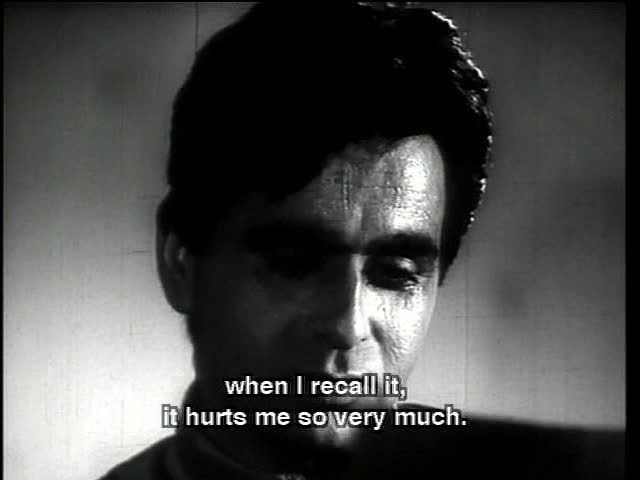

No kidding.


Nominally, we hate Devdas, and yet, like the man himself, we keep coming back for more. Watching his narcissistic, self-centred spiral into liver-failing oblivion is so, well, addictive. And it doesn't matter who's playing him: all our past Man of the Moments - Shah Rukh Khan, Amitabh Bachchan, Shashi Kapoor and now, Dilip Kumar - fail to make us sympathize with Devdas. Thankfully, quiet, sensitive Dilip comes closest in making us almost - almost - tolerate and pity him.

Soaked in the gentle realism of regional Bengali cinema (think Satyajit Ray's sun-dappled forests), Bimal Roy's Devdas is considered the best adaptation. Perhaps this is because it is most faithful to the book's vibe. Not that we've read the book, but this version - with its emotional complexity - certainly felt more faithful to something.

The film opens with an extended look at Devdas and Paro as children. Already as children, their personalities and their relationship are starkly evident: Devdas is older, macho, self-absorbed and entitled. He's a little peacock, and he thrives on Paro's adulations, even if he pretends not to. Meanwhile, Paro is his main devotee - in one scene, likening herself to Radha and he, Krishna - she laughs exaggeratedly at his shenanigans, and she relishes taking care of him when he hides from his abusive father. However, despite her simple devotion, she is also proud and prone to sulking. In one scene, Devdas slaps her. Upset, Paro immediately strikes back: she runs to Devdas' household and tells on him, which leads to Devdas getting a severe beating. Time passes, wounds heal, and Devdas and Paro reunite, all forgiven.
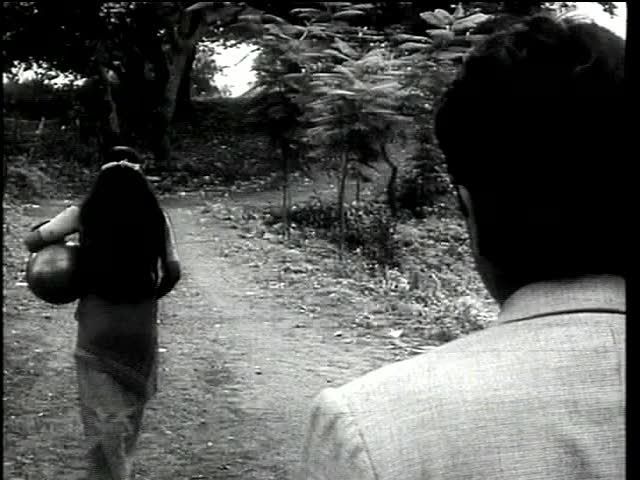

Oh, Bimal Roy, how we love thee.


The rest of the plot is well-known: Devdas is sent to Calcutta for his education and he returns to the little village a big city man. When Paro and Devdas are reunited as adults, the sparks fly. Yet Devdas' family refuses Paro's marriage proposal since Paro's family is much too low-caste. When Paro begs Devdas to do something, even risking her reputation by breaking into his bedroom one night (big taboo!), Devdas grows spineless and flees back to the city. Moping aimlessly, he writes Paro a letter claiming that he never loved her, but then regrets sending it. Meanwhile, boozy friend Chunni Babu (Motilal, reprising his role from Jagte Raho dhoti for flower garland) slowly introduces Devdas to the world of wine and women. Paro is married off to a much-older widower, becoming the stepmother to adult children. While Paro makes the most of her situation, Devdas skips the pleasantries and moves immediately to raging alcoholism. His new friend, Chandramukhi (Vyjayanthimala), develops a massive crush on his Byronic studliness and attempts (unsuccesfully) to rescue him from himself. Alas and woe ensue.

Although the character of Devdas retains his general unlikability, this film is leaps and bounds better than the 2002 Sanjay Leela Bhansali version. We at the PPCC don't mind unlikable anti-heroes - heck, we love those complex, tormented knuckleheads. Fab... and thorny, like a rose! What made the 2002 Devdas so problematic was that there was:
(1) No apparent link between Shah Rukh's jerk Devdas and Aishwarya's weepy, brainless Paro.
(2) No apparent personality on the part of either women, Paro or Chandramukhi.
(3) Only grovelling and bombastic sympathy for Devdas' self-induced plight.

The University of Iowa people - as always - said it right by noting that Bhansali's Devdas overemphasizes what should be subtle emotional nuances; the delicate and complex are enlarged to grotesque, silly size, and much is lost.

Thankfully, Bimal Roy's film has a much softer touch. It presents a believable and poignant relationship between Devdas and Paro - a relationship based on mutual dependency and life-long affection. Their doom is genuinely sad. Paro is also, thankfully, given a strong will and a complex personality. Unlike Aishwarya's devotional zombie, Suchitra Sen's Paro is fiery and proud. Indeed, the best scene turns out to be the famous moment when Devdas strikes Paro (as adults), leaving a scar on her forehead. Their argument - mutually abusive, scathing and needy - is painful and poignant to watch.
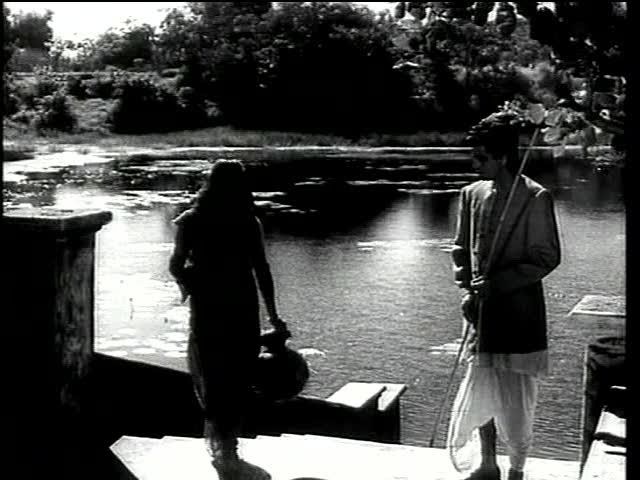

A gorgeous moment, aesthetically. Prelude to the argument.
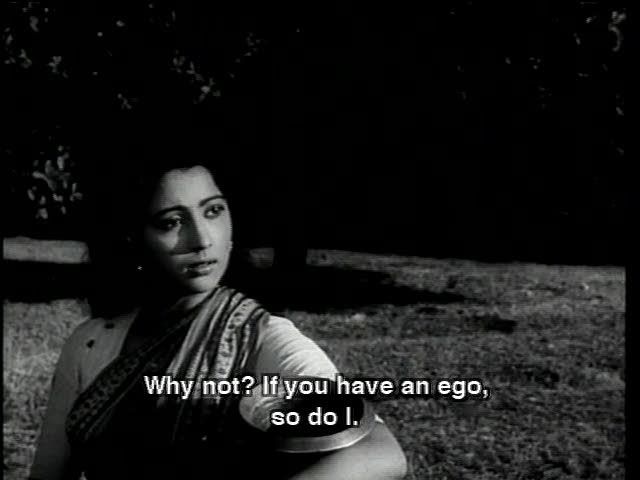

Amen, sister. You smack him down.


Regarding the problematic Sympathy for Devdas (the name of the PPCC's new band, by the way), we think the main structural problem is embodied in Chandramukhi, patron saint of self-neglecting servileness. Chandramukhi is the archetypal Whore (cf: Paro as archetypal Virgin): the fallen woman, dreaming to break free of the gutter and ascend back to purity. When Devdas initially meets Chandramukhi, he is disgusted - and tells her so. His abuse continues merrily along, with Chandramukhi lapping it up and loving it. Aargh! Indeed, Chandramukhi "reforms" herself in an effort to please Devdas - becoming a traditional Good Indian Wife, complete with pooja set.

Which brings us to...

A SIMPLE GUIDE ON HOW TO IMPROVE DEVDAS


Yes. Call us presumptious, but we think we've got it. So, all right: you've got a seriously flawed but still potentially sympathetic alcoholic ex-lover played, to the best of his ability, by the man of the moment. You've got a fiery, stubborn, self-defeatingly devotional heroine. What's the problem? The problem is Chandramukhi! Brainless, masochistic Chandramukhi! It's that damned Chandramukhi woman that turns the film into a Virgins and Whores fest, misogynistic, meekness pornography, complete with a man who can do no wrong, even when he clearly does wrong.

So how do we fix it? We look to Naina.

Yes, Naina! That film does a lot of things wrong, but it does some things really, really right. And one of the things it does right is present a Devdas-esque love triangle which is evocative and brutal, but blessedly gender friendly. That is, you've got your Devdasian Ravi (played by the scrumptious Shashi Kapoor, our number one), you've got your virginal and devotional Paro-esque Jyothi (played by the adorable and young Moushmi Chatterjee), and then you've got your complex, love-hating, drinking buddy "whore" ??? (played by some lady). That is, the courtesan doesn't feel ashamed and immoral around Devdas/Ravi that she has to sell her body. She doesn't judge all the drinking and hardcore partying. And she doesn't allow herself to be judged. Indeed, the poignant relationship between Naina's Ravi and his courtesan drinking buddy is the excessive, fun-loving hedonism that barely masks their mutual pain.

THAT is what Devdas needs. THAT is what Chandramukhi and Devdas should be like. Chandramukhi should be the devil on Devdas' shoulder. She should have dug herself into the same hole of despair and drinking that Devdas is in, and therefore she should be well-acquainted with the whole self-hating, self-pitying cycle. It would be so gloriously, pitch perfectly emo.

Anyway.

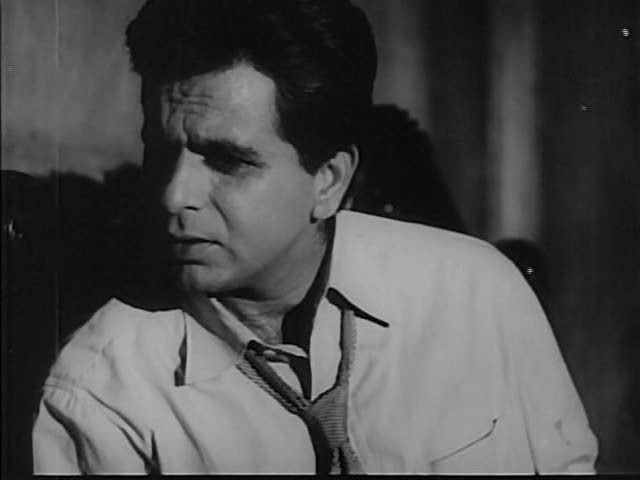
Our DVD had a lighting issue.

It was hard to see anybody!


So Dilip Kumar is very effective as Devdas - presenting him as a morally gray anti-hero with an emphasis on the anti. He drips with, as the Lutgendorf reviewer, Corey Creekmur, likens, Hamletian indecision and acidic self-pity.

The women, as we mentioned, seemed to have grown some self-respect in this one, thank goodness. Or at least Paro has - well-played by Suchitra Sen, who gravitates between misty-eyed infatuation and steely stubborness. Indeed, one of the sweetest moments of the film is when Paro's shields come down completely and she confesses to Devdas that all she ever wanted was to take care of him. Devdas is likewise exposed and, with him clearly in decline and her resigned, regretful defeat, the scene is a wonderfully tender, vulnerable moment - a moment when the PPCC suddenly wanted to take care of both of these two twisted, idiotic people. Oh, you two! Vijayanthimala, who we are slowly growing to love (she's like the old Moushmi Chatterjee, aww!), gets the worst role in the film. Le sigh.

Motilal has the easy job of playing Chunni Babu, always a lovable character despite being the pied piper to oblivion. Chunni Babu's the sole grace note of clueless good humor - as played by Jackie Shroff in the 2002 Devdas, as played by Ram P. Sethi in the loosely adapted Muqaddar ka Sikandar. Motilal doesn't have much to do in this, though his familiar drunken staggering and flower garland around his wrist reminded the PPCC immediately of his mirror performance in Jagte Raho.

Soundtrack-wise: surprisingly, many of the songs were average tending towards rubbishy. The only two that stood out for us were:
  • Jise Tu Kabul Kar Le, wherein Chandramukhi (wonderful Vyjayanthimala) attempts to dance away Devdas' (Dilip Kumar) demons, after having fished him out of some gutter covered in sewage. This song is so good that even Devdas, in his black-out haze, pauses in his misery to go, "Daa-amn."
  • Mitwa, wherein Devdas wails his laments to the pond lilies. That pond is a source of many poignant moments in the film - the place where we transition from child Paro to adult Paro, the place where Paro and Devdas have their ultimate fight, and the place now where Devdas goes to woe. This is such a gentle, sad song - and it's in this delicate moment, when the thunderclouds are reflected in the calm pond, and poor Devdas sits forlornly with his glorious Stubble of Woe, that we at the PPCC think, "God, maybe Devdas isn't so bad after all."

Monday, 1 September 2008

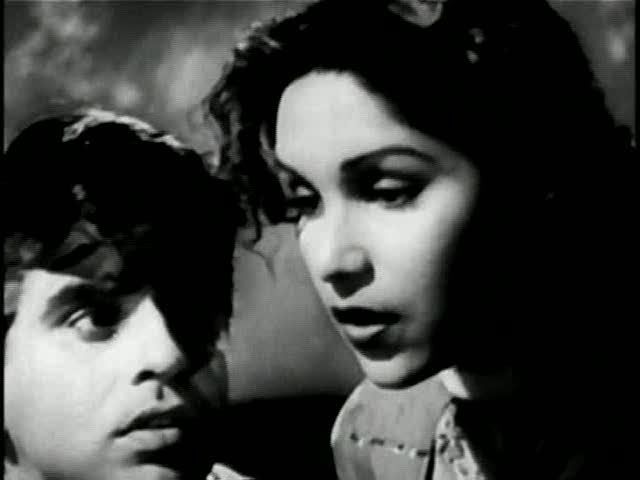
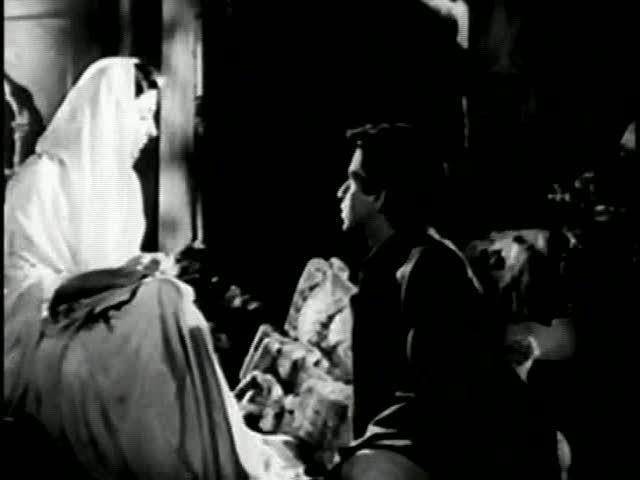
Jogan (1950)


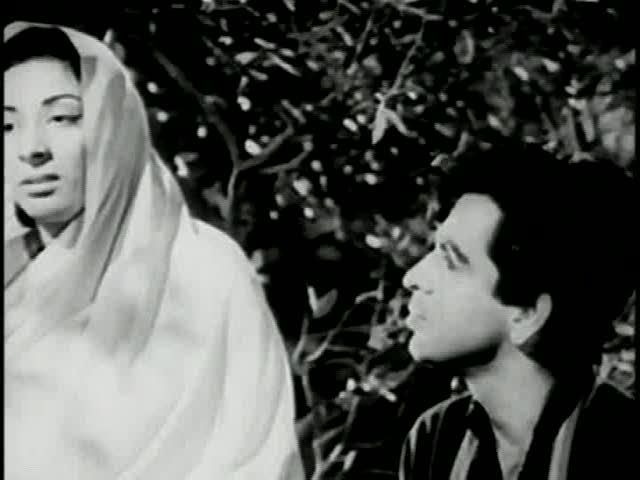
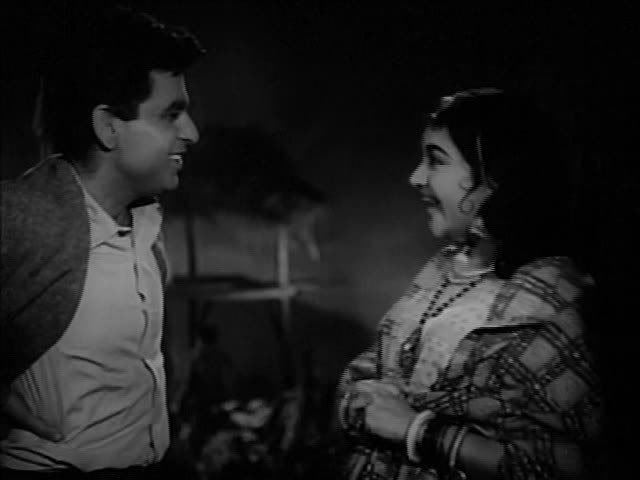
Hi, I'm Dilip. I'm an atheist. I'm also a stud.


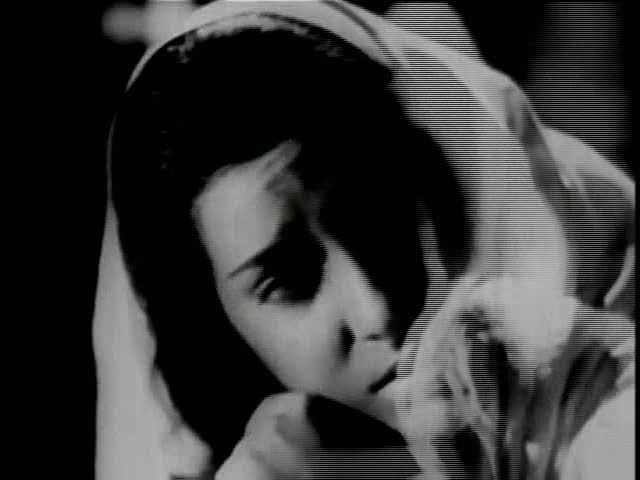
Hi, I'm Nargis. I'm a nun. See that bird fluttering over the superimposed image? That's my dil, trying to break free. Enjoy the angst!


Some films defy categorization. Films such as Dil Se and Awaara and now, Jogan (Yogi/Mendicant/Nun*). Neither mainstream nor arthouse, these films are difficult to describe, to pin down, because we can't compare them to anything else. They just are... how they are.

The story of Jogan is simple. According to the title credits, it was written by "?" - perhaps it's a traditional fable? Village atheist, Vijay (Dilip Kumar), is content with hanging around and avoiding the temple. One day, a traveling mendicant arrives - and this ascetic is none other than the gorgeous Nargis! Vijay is positively smitten, and suddenly going to temple doesn't seem like such a bad idea. However, the presence of a brooding hottie severely disturbs St. Nargis' peace of mind, and she repeatedly requests that he take his brooding butt and sit outside. He does, but then leaves flowers on her doorstep and engages in other manner of cuterie. St. Nargis' detached serenity just goes all higgledy piggledy.


As Joss Whedon would say, he is starting to damage her calm.


When Vijay confronts her about the turmoil in her eyes, and asks her why she gave up the material world, she narrates a sad and sweet story when she lived as the secular, frothy Nargis we all know and love. The present tension between religion and securalism, theism and atheism, and to hottie or not to hottie ends on a sad, symbolic note.

We definitely haven't captured the vibe of the film - which is deeply rooted, enigmatic, Zen-like (if we may mix religions). It's... just difficult to write about, as we've never seen anything even resembling it. We can only liken its profound emptiness to the feeling we got sometimes reading J.L. Carr's A Month in the Country, which was similarly thoughtful and vast.


Sometimes nuns can doubt...


...and atheists can worship.


Jogan treats its story with the softest of touches - neither the atheist nor the ascetic are demonized for their choice, though their choices are gently explored. In one touching sequence, a holy man arrives at a courtesan's parlor where Vijay is lounging. Everyone hurries to greet the ascetic - Pranaam, Gurudev! Namaste! - and, embarrassed, they urge Vijay to do the same. Vijay is reluctant, he keeps his eyes lowered and says, Log mujhe nastik kehte hain. (I am called an atheist.) The holy man and Vijay banter and tease each other, and the ascetic praises Vijay's atheism as a form of secular humanism and an ultimate search for love: "I am an atheist like you, I am constantly searching for God. God is truth, beauty, happiness. I search for these things in the huts of the poor, you search for them here [in the courtesan's parlor]. Lord, your soul is in search of someone. Someday you'll make room for God in your heart." Smiling wryly, Vijay finally greets the ascetic, Pranaam, Gurudev.

Similarly, Nargis' choice to become a wandering nun is gently questioned by the head nun. When Nargis arrives at the nunnery, having escaped from her home, hurt and upset, she asks to seek refuge in God. The head nun warns her that becoming a mendicant is not something to rush into, it's not something that happens just because you "give up" on the world. Still, Nargis insists and the head nun yields. Throughout the film, a perturbed Nargis chants the peace (shanti) mantra, seemingly to little effect - but we don't think the film is necessarily showing the meaninglessness of religious devotion. Rather, by our reckoning the main message is finding the happy medium, a flexible yielding between the purely areligious and purely devotional life. Vijay and Nargis' character are both very young and passionate about their beliefs, and yet these beliefs - while ostensibly deriving from choices made for their own happiness - seem to give them nothing but trouble. Why not just give a little and not be so inflexibly atheistic/ascetic? Gosh!


The relationship between this little firecracker and Dilip was adorable.


Dilip the atheist searching for God in the courtesan's parlor. Are you loving this movie? We are. Note the super-tight close-ups and the fact that they're both in each other's faces.


Both Nargis and Dilip Kumar do a very good job in their softspoken, sweet interactions. Dilip mostly maintains the same vibe throughout the film - dreamy-eyed and lovelorn - while Nargis demonstrates her formidable range as the ghost-like mendicant versus her former, high-spirited self. Watching her transform from one into the other is really quite sad.

The film's aesthetics, as we said, were hard to pin down. There were some cute, blunt symbols: such as when Nargis, after first meeting her admirer, escapes to her room and the picture of a fluttering, caged bird is superimposed over her. The director also favored incredibly tight close-ups coupled with minimalist composition, all contributing to the Zen look. Another really interesting thing: this might be the shortest Hindi film ever, clocking in at a mere 1hr 45min! Canst it be POSSible?! Just another thing to add to the list of Why Jogan Is So Unique.


Oh Lord, can't we be friends?


* So we're using "nun", "mendicant", "ascetic" and "holy type person" interchangeably in this review. If you are any of the previously mentioned and wish to complain, please take it up in the comments. We love those.

Sunday, 31 August 2008

The Robe (1953)

"Now you reason like a woman: foolishly." - Emperor Tiberius, The Robe

Back in the day, the PPCC studied Latin. As part of our curriculum, we watched every swords and sandals epic you can think of - notably Gladiator, Spartacus, Quo Vadis, and The Robe. For whatever reason, The Robe left us with a mixed, mostly bad impression - it was definitely the worst of the lot. But that was years ago, and, when we found it in our local DVD shop the other day, we gasped with delight, "Swords and sandals?! YES! And isn't this the one with Seneca?! OH, YES PLEASE."

But alas. Now we remember why we had bad memories of The Robe. (And no, it's not the one with Seneca.)


OMG Caligula was terrible.


The Robe shares many characteristics with its 60s pop Roman brethren - most notably Quo Vadis (the one with "Seneca", though we were actually thinking of Petronius). Like Quo Vadis, it is a fable of Ancient Rome based on a modern novel. It examines the earliest days of Christianity from a Roman normative framework, provoking much delight in the modern viewer since we are privy to Christianity's historical importance, but the silly Romans have no idea. Indeed, Christian or not, there is a feeling of conspiratorial delight in watching The Robe's ignorant and arrogant Romans refer to Jesus as a "fanatic" and "dead magician". Ha! Wait 2000 years and that "dead magician"'s gonna be everywhere.

Yet unlike Quo Vadis, a film which managed to keep its Christianity in check, The Robe positively overflows with zealous adulation. This renders it alienating to any viewer who doesn't consider themselves a Christian and, we would argue, even its treatment of Christianity borders creepily close to devotional superstition.


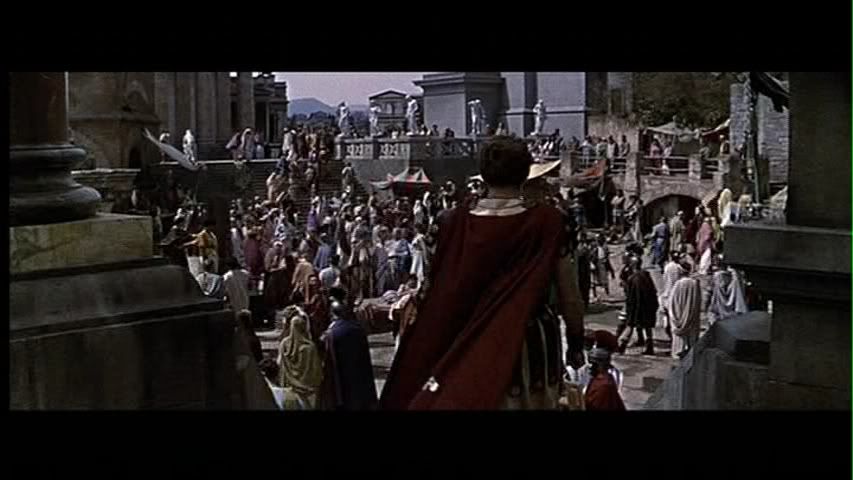
Wheee, Rome!


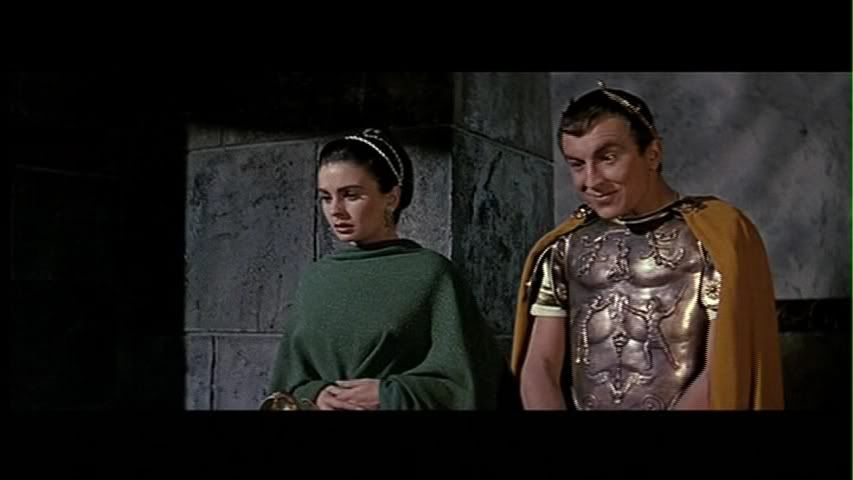
The Robe begins very strong. Welcome to ancient Rome, land of glittering debauchery, the slave trade and vomitariums! We are quickly introduced to hunky Roman tribune, Marcellus (Richard Burton), a self-described "drunk" who is busy buying some buxom babes on the slave market. There, he runs into the chaste Diana (Jean Simmons), childhood friend and eventual love interest. Diana, however, is betrothed to the demented Caligula (Jay Robinson), which, if you know your Roman history, does not bode well. After Marcellus publicly insults Caligula by outbidding him for the hunky Greek slave, Demetrius (Victor Mature), Caligula banishes Marcellus to the "backwater of the Empire" - that is, Judea. (Or, as the characters keep calling it, Palestine.) Oh boy! Are you pumped? We were pumped at this point! Oh boy! Oh boy!

If you recall your Roman history, Jesus lived under the reign of Tiberius, Caligula's predecessor. Hence when Marcellus and his loyal-yet-headstrong slave Demetrius arrive in ancient Judea, they waste no time in literally bumping into Jesus and his crew. One glimpse is enough to convert Demetrius, but Marcellus remains unaffected. Indeed, so unaffected is he that he barely bats an eyelid when Pontius Pilate orders him to execute Jesus.


All it takes is one look to convert Demetrius. He spends the rest of the film staring in helpless adulation.


And staring.


And staring. (Nice lighting, btw.)


Marcellus, though, can hardly be bothered to remove his hand from the trajectory of Jesus' bleeding.


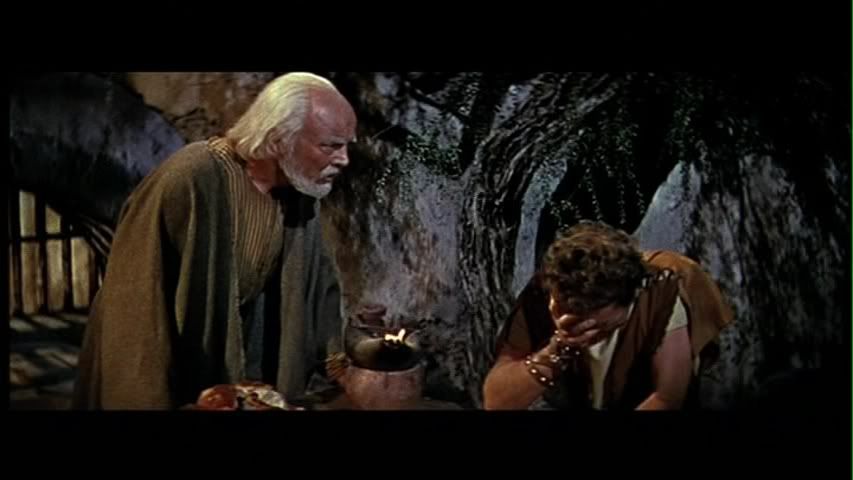
While Marcellus and his praetorian mates booze and gamble under the cross at Calvary/Golgotha, Demetrius picks up The Robe. As per Biblical record, the weather goes haywire and, when Marcellus orders Demetrius to cover him in said Robe, he is scalded by it. From that point on, he suffers from hallucinations and dramatic emo breakdowns. Demetrius, meanwhile, runs away to join the Christians.


The Robe has cursed Marcellus to horrible, soul-gnawing angst!


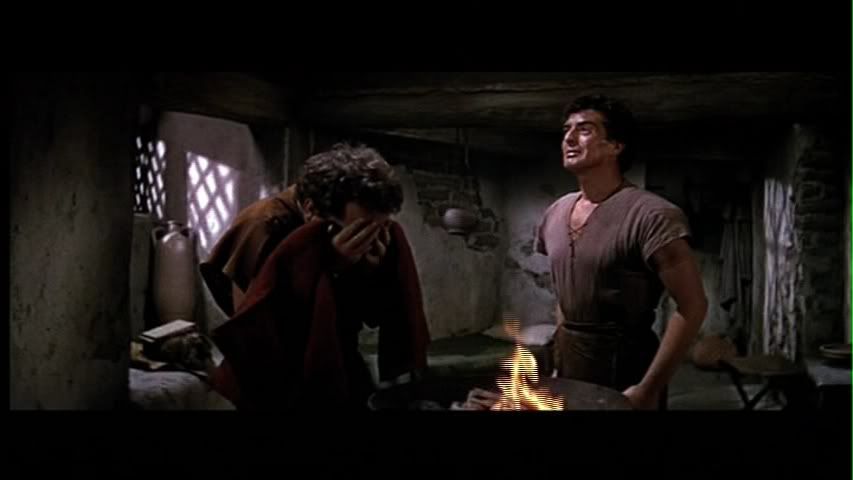
And yet more angst! (Note Demetrius' stubborn staring.)


When Marcellus returns to Rome a broken and tortured man, sympathetic Emperor Tiberius orders him to return to Judea in order to (1) find Demetrius and (2) destroy The Robe, as it's probably "bewitched" him with the curse of craziness. The rest of the film follows Marcellus' return to Judea, meeting with Christians (including Peter himself), and eventual conversion. The film ends on a particularly zealous note.

What's a shame is that this movie could have been so good. Some scenes, such as the bustling slave market or Marcellus' accidental witnessing of Jesus' procession into Nazareth (Edit: schooled in the comments, we meant Jerusalem... we are bad Biblical scholars), really do what they're supposed to do. In the former, we get a wonderful sense of the delirious busyness of cosmopolitan Rome. In the latter, we get a beautiful sense of awe as the heavenly choirs pipe up and we see the distant iconic image of Jesus on a donkey, waved forward by palm fronds. (Indeed, the film smartly maintains Jesus' mystique by never showing us his face.) Where the film goes very wrong is by preaching Christianity in blunt, glassy-eyed terms. In a way, it assumes the audience's worship of Jesus, so that Demetrius' insta-conversion - which, again, took all of a single glance, hello! - is supposed to seem natural instead of, well, bizarre.

The blunt black-and-white treatment is emphasized by Caligula's maudlin villainy. We've seen crazy emperors before - Peter Ustinov as Nero in Quo Vadis comes to mind - and it's true that Caligula was legendary for his craziness, but this guy was just ridiculous. He didn't seem like an insane potentate, he just seemed like... well, a bad actor. Similarly, everyone's reaction to the new Christian thing seems to be, rather than a thoughtful and complicated reaction to a new philosophy, more like catching some sort of craziness disease (a la the "Godhead" disease in this excellent science fiction story which we will here tangentially advertise). Just watch empty-headed Diana's final insta-conversion, just scenes after she (fragile woman that she is) declared herself "too weak to have faith". Oh, come on!

Oh well. You can't have everything. In a sea of pretty dreadful acting, Richard Burton did very well with his difficult role. Although his emo breakdowns were a little silly (and this is coming from us, the PPCC, lovers of limp-wristed "Nahiiins!"), he still presented a believable characterization of the slowly awakening Marcellus. Unfortunately, everyone else was pretty bad, with the possible exception of Michael Rennie as Peter, who looked like the poor man's Charlton Heston but was thankfully restrained, and Victor Mature, who was likewise restrained (despite all the staring).

Friday, 29 August 2008

Madhumati (1958)


My cup of angst overfloweth.


Meet Dilip Kumar. He's the new kid on the blog. Let's be nice to him.

Oh, Dilip Kumar. Dilip Dilip Dilip Kumar. Diliiiiip Kumaaaaaar. We looooooove you. We shall call him Dilip and he shall be ours and he shall be our Dilip. Wheee! OW, BAD DILIP!

In a single week, we've gone from zero to three on the Dilip Kumar film watching scale (Kranti, Mughal-e-Azam, this). And we are lovin' it!


Oh, you guys.


Madhumati is one of those juicy, angsty tales of emo drama, food for the PPCC soul. But don't be alarmed, emo-haters! Like a younger, immature brother of Teesri Kasam, the vibe of Madhumati is sweet and serene and pastoral. We promise that it is - excepting Johnny Walker's scenes - restrained and lovely. Also, hey, pedigree - it's directed by Bimal Roy!

Madhumati begins on a dark and stormy night in 1958. Bossy married man Deven (Dilip Kumar) is annoyed when his driver can't push huge boulders from the side of the road, and he and a pal retreat to an abandoned mansion to wait it out. There, while warming themselves over the fire and listening to creaky floorboards, Deven begins experiencing the typical Flashbacks of the Reincarnated. When a portrait of Pran (yes, our beloved Pran!) falls off the wall, it all comes flooding back:

Long ago (though still sometime in the 1950s, judging by the costumes), young Anand (Dilip Kumar) was sent to manage the accounts of a timber estate deep in Himachal Pradesh (perhaps? or perhaps it was Shashi Pradesh). There, he met the zany, alcoholic butler, Charandas (Johnny Walker), and the evil boss, Raja Ugra Narayan (PRAN!!!). Now, conflict just slid off Anand like water off a duck's back, so things were going well. Anand even met a beautiful forest nymph, Madhumati (Vyjayanthimala), and began a Bambi-esque courtship full of drawing sketches, skipping over stones, and gently cuffing each other on the nose. Tho cute! Of course, someone with a name like Ugra's not gonna let that fly, and one fateful evening, Ugra lures Madhumati to his mansion while sending Anand off on some invented excuse. Anand returns to find Madhumati gone, with tales of horror surrounding her disappearance. After confronting Ugra-Pran the Immoral, goons break all of Anand's bones and leave him to mope in a forest cottage.

And mope he does! Mopity mope. Lovely, glorious, sticky-sweet moping. MOPE MORE!


Oh, gosh.


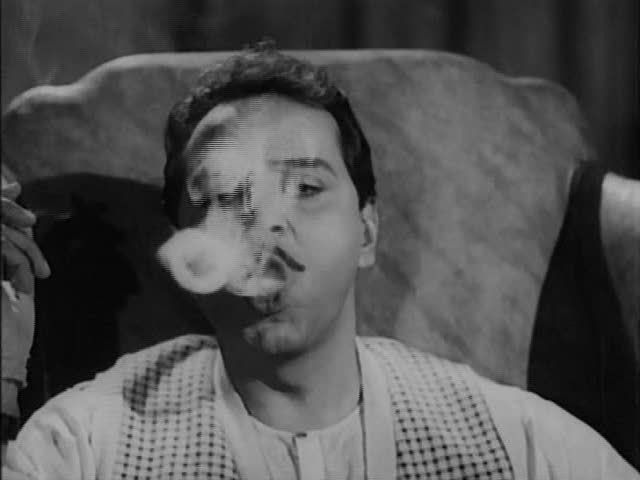
Pran's the stud himself, blowing smoke rings. Is it hot in here or is it just us?


A very young Johnny Walker!


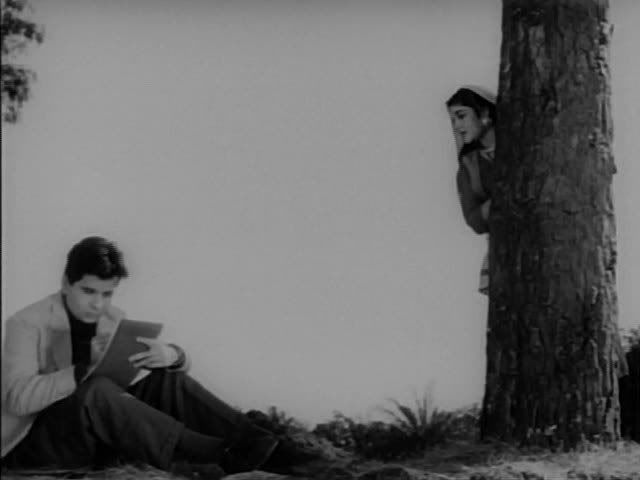
Things get even more gloriously tortured when an identical urban nymph, Madhavi (Vyjayanthimala, again), happens upon a brooding Anand as he sketches in the forest. Like the PPCC, Madhavi is instantly charmed by the hurt, puppy dog look in Anand's eyes, and much torturous heart-string-pulling of the Om Shanti Om variety ensues. Oh, glorious!

This is our second Bimal Roy film, after hearing much of Bimal Roy's genius. The first was Prem Patra, which provoked a combined yawn and shrug - a yug. Read Bollyviewer's and Beth's reviews - both kinder. In Madhumati, instead, we witnessed the flowering (forgive the forest puns) of Bimal's legendary talent. The film's pace is luxurious and slow - sometimes it drags - but each scene is infused with atmosphere. Bimal expertly uses the environment as a sort of Greek chorus: birds chirp, insects buzz, the river thunders. He creates a living, breathing world, and uses that naturalist setting to add punctuation and comment to the plot.


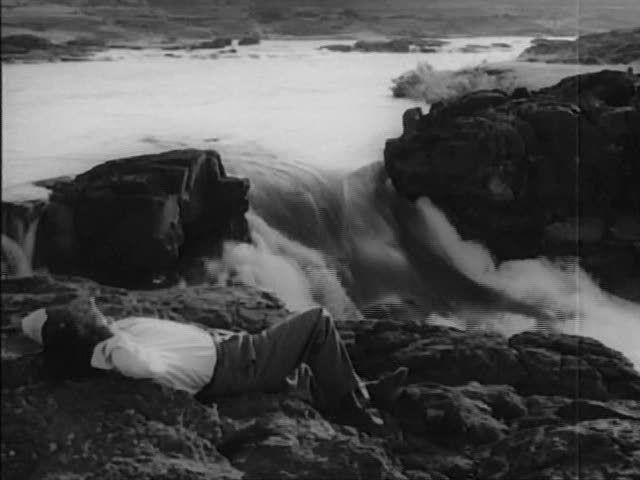
Dilip angsts by the thundering river. Sigh!


For example, when the villainous Ugra gallops through the forest, his arrivals are heralded by shrieking birds and flocks fleeing into the sky. In one scene, his surprise appearance is punctuated by a high-pitched squawk. In another scene, when Anand is thrown out of Madhu's cottage, we suddenly hear dogs barking in the distance. The delirious courtship, when the impish Madhu teases Anand and frollicks away, is sometimes literally suffused with rolling fog. As a result, and due also to the reincarnation theme, the film has a mysterious, fantasy-esque air. We wouldn't be surprised to find a troll in that forest.

Interestingly, this wonderfully moody setting is without the stark geometry and sharp diagonals of early Raj Kapoor. Instead, Bimal's aesthetics are rounded at the edges, misty and indistinct, much like a Turner painting.

Another nice touch which won us over immediately was Dilip's nervous hands. We don't know if this was specific to the role or if this was a Trademark Move, but Dilip Kumar matched the setting by infusing Anand with natural-seeming physical tics and mannerisms. He was constantly scratching his nose, picking at his scarf, touching his hair, shifting his weight. At times, these felt like affectations - a sort of forced realism which reminded us of modern dramatic American acting which, to us, always seems to say, "Behold, I am acting in a subtle manner!" Overall, though, it was good, and Dilip's style is so refreshingly subdued, it was a great change of scenery for a PPCC highly saturated on Kapoor histrionics and the Amitabh Bachchan sweaty face.

The main criticism we have of the film is that the pacing is trying at times, and there are certainly more efficient ways to tell simple stories about nostalgic forest love affairs (may we suggest one?). We wonder with delight what this plot would have been like in the hands of Nanni Moretti - who's La stanza del figlio matches this in moodiness, but exceeds in efficiency. Another problem was the number of songs. Song after song after song - it never let up! Even if they were sweet, it was still, like, whoa, mine ears.

And finally, sadly, we report an underwritten and superficial heroine. Some aspects of Madhu's characterization were awfully cute, and the film earned some points for having a courtship which is initiated by Madhu. However, sometimes the whole cutesie-coy act was tiresome, and Urga the Evil's rapist plot was a bit old school in its villainy. Kudos to Vyjayanthimala for showing us that she can act by presenting a sharply differentiated Madhavi. Indeed, her transformation from bubbly and brainless to world-weary and elegant reminded us of Kajol's fab ability to do that in films like Baazigar and Kuch Kuch Hota Hai.

But it was really Bimal Roy's sylvan chorus and Dilip's moody fidgeting which dazzled us. And now we want MORE, MORE.

Friday, 8 August 2008

Rashomon (1950)

It's not every day that a film is so philosophically and psychologically astute that it inspires a turn of phrase, but Akira Kurosawa's Rashomon is one of those films that's widely considered a Perfect Film and its influence, hence, is very wide. It is philosophically provocative, aesthetically intelligent, and just plain fun. The PPCC should also say that this was the first film we saw by Akira Kurosawa, and the first film we saw with Toshiro Mifune, and it made us zealous devotees of both.


Check out that composition!


Rashomon is the story of a rape and murder, as told in a series of conflicting flashbacks. Sound familiar? Yes, they still make Rashomony films today. The basic facts (though these are subject to change!) are that, one sunny day in 12th century Japan, a samurai (Masayuki Mori) and his wife (Machiko Kyō) were walking along in the forest. At one point, they ran into the notorious bandit Tajōmaru (Toshiro Mifune), and then a series of ambiguous events occurred which resulted in the samurai's death and the rape of his wife. But who killed the samurai, and whether the rape was really a rape, are all thrown into question. Three characters tell the story as a flashback-within-a-flashback: a woodcutter (Takashi Shimura), a Buddhist monk (Minoru Chiaki), and a peasant (Kichijiro Ueda). The three protagonists - the samurai, wife, and bandit - also have their say. And with each flashback, we become more convinced that the flashbacks preceding it were false and this one, no, this one, is the right one. Of course, in the end, even this conviction is questioned, and we are left confused and adrift in a sea of possibilities.


Machiko Kyō as the samurai's wife, kicking butt.


There are lots of visual triangles in this film.


While the trope of an unreliable narrator certainly didn't start with Kurosawa, using several unreliable narrators to present conflicting views of the same event - while never actually hinting at which narrative is the "true" one - is certainly unique. The few facts that remain constant in every version - the dead guy stays dead (though, in one of the best sequences, he too gets a chance to tell his story thanks to a "medium", and we learn that apparently dead men can lie too), the fancy dagger that gets lost, the hat in the trees - are even then thrown into question, as Kurosawa's main aim in the film seems to be, "With so many versions, what is reality?" The Criterion Collection copy of this film has an excellent commentary by Donald Richie, who says that Kurosawa's main aim was showing that every version is real, in that people's subjectivity influences their memories (e.g. in the bandit's memory, he's a fearsome warrior, in the woman's version, he's an infantile idiot), and there is no other reality apart from people's experience of it. Sound a bit like the proverbial lonely tree and other mind-bending kōans? Indeed!

If epistemology sounds a bit fancy for you, fear not! This film a rollicking good time, and no philosophical thinking is required (it's just a bonus!). Kurosawa is infinitely impressive for balancing lovely technical details (he was one of the first directors to shoot straight at the sun, and his overall use of lighting is amazing) with just meaty crowd-pleasing moments, such as the creepy medium or the crazy bandit.


Toshiro Mifune: our favorite actor, of all time, of anywhere, forever.


While everyone is very effective in the film, the standout performance is Toshiro Mifune. Compared to his other roles - such as in Yojimbo or Hell in the Pacific - this is a zany, over-the-top performance, and he chews up the scenery much like Gary in The Professional. Toshiro Mifune is our all-time favorite actor (hence the Dance Offs are actually deciding the second best actor), and his screen presence is so incredibly magnetic. In the very first moment we saw him, we immediately exclaimed, "Who's that guy?!" His awesomeness just cannot be contained. It's like Kung Fu Panda exclaims, "It is said that his enemies would go blind from over-exposure to pure awesomeness!"

Overall, we cannot recommend this film highly enough. It is one of the best films ever made, technically flawless, inventive, profound, and fun. Go, go! Watch it!

(Actually, you can. Because the internet is a many-splendored thing, and because it's old enough to be in the public domain (apparently), you can view the entire film online at Google Video.)

Tuesday, 5 August 2008

Jagte Raho (1956)


The alienating demon apartment block, standing in for Dante's rings of hell.


We were pumped to see Jagte Raho (Stay Awake). First, after hearing the song, Jago Mohan Pyare, our weak little dil filled up with great red excitement and our hair stood up on end. Check! Second, it was written and directed by Sombhu Mitra, a "legendary Bengali actor-director". Bengali cinema! Finally, we get to see what all the fuss is about. Indeed we were predisposed to approve of anything that came from the land of Devdas, Satyajit Ray, and Amartya Sen, a region in India renowned for its intelligentsia. Check! Third, it promised to be one of those wonderfully stark, arthouse Raj Kapoor films. Triple check!

Jagte Raho takes place over one long, surreal night in a city apartment block. A thirsty villager (Raj Kapoor) arrives in search of some water. When he worms his way through the apartment gate to drink from a pipe, he is quickly spotted and accused of being a thief. As the apartment comes alive, demon-like, the villager goes from flat to flat in search of a safe hiding spot. And in every home, he's confronted with corruption and moral bankruptcy. A group of angry young men, headed by a wannabe tough guy (a very young Iftikhar!), organize relentless search parties. An alcoholic (Motilal) insists that his wife sing and dance in the manner of loose Western types. A corrupt Hindu pandit (???) charges commission for false predictions on the upcoming horse races.


Director Mitra uses a lot of widely framed shots, where the characters are dwarfed by looming buildings and deserted city streets.


Raj Kapoor disguises himself as a Sikh, while the thuggish Iftikhar freaks him out.


Eventually, our poor, hapless hero gets trapped in this web of sin when he gets mixed up with an illegal money-printing business in the basement. Now, some scary money-printing thugs are going to kill him if Iftikhar's mob doesn't, and all he wanted was a glass of water!

Much in the manner of Martin Scorsese's After Hours, this film is a satirical look at the dark side of humanity, using one interminable, weird night as the allegorical setting. By day, the apartment block is full of respectable people going about their respectable, middle class lives. By night, the apartment becomes a living inferno, complete with Dante's rings of increasing evilness. Neighbors have petty feuds. Daughters disobey their fathers and have private affairs with cowardly men. Husbands attempt to pawn their wives' jewelry. It's a violent baptism by fire for our naive protagonist to see how flawed and hypocritical these rich city people are. In one sequence, when he's reached the end of his tether and has been literally cornered by the mob, he lashes out, screaming and voice breaking, "You're literate people, big people! You taught a peasant like me that you must rob to be rich!"


Our favorite scene, for Raj's acting. Here, he's confronted with loads and loads of money.


Motilal, hamming it up. He's a good sharaabi, but he's not the best; that title belongs to our beloved Shashi!


The pervasive cynicism is occasionally lightened by tragicomic details - no character is spotless, but they are human, and their human frailty is treated with a sort of weary sympathy cum despair. Raj Kapoor is surprisingly sweet as the child-like villager, scared witless and head spinning. And while he's technically the protagonist, he acquiesces the spotlight constantly, acting more like a peripheral Greek chorus to the drama of the petit bourgeoise around him. It's notable that he hardly says a word in the film - mostly emitting terrified squeaks and sqawks and reacting rather than acting. The only scene where he says anything of substance is his moment in the corner, when he declares he too will be a thief, if that's what the stupid world wants him to be. But, no! Don't give up, Raj!

A constant theme of the film is sleeping versus waking. In the final scene of the film, when the woman at the temple (Nargis, in a gorgeous cameo) beckons for the flowers and Krishna to wake up, we see that all the evils fade away in the dawn light. Just like to be a buddha means to be "awakened" (from the Sanskrit root, budh, to know, to understand), the film draws parallels between the evils committed when the mind/conscience is "asleep" and the importance instead of remaining "awake", that is, mindful. Just as, in the opening scene, night watchmen cry out to each other, "Jagte raho!" (Stay awake!) So the film cries out to the audience - wake up! Whether this be to your social reality, political injustices, or personal demons.

This rather broad moral theme is painted on the canvas of post-Partition India. Several times in the film we see characters committing evil deeds in front of portraits of national heroes. In the end, when dawn finally breaks and the light hits our hero's eyes, these portraits reappear in all their bombastic glory. It is, depending on how sentimental you are, either powerfully moving or somewhat undermining of the film's earlier nihilistic despair. Prof. Lutgendorf, as usual, sums it up perfectly:
"The coexistence of patriotic schmaltz with trenchant social critique is of course characteristic of Kapoor's films, as is the suggestion, in the apotheosis-like finale, that the vision of a buxom goddess in a blouseless sari (played by Nargis, naturally), accompanied by a soaring hymn to Krishna, (Jaago Mohan pyaare, "Wake, O beloved Enchanter") might suffice to lift this dark Dystopia into a bright New Day. The awakened viewer gets to choose between lingering skepticism, and surrender to enchantment—or go away savoring both."
- philip's fil-ums: Jagte Raho

This tension between "skepticism" and "enchantment" is perhaps the film's golden touch: the extreme highs and lows of humanity are on display, from mindless mob violence to gentle compassion.

Raj Kapoor is very effective in his Chaplinesque tramp persona. We've never liked this character, and yet here - partly because he seems to naturalistic and, well, terrified, and partly because he allows himself to remain largely peripheral - we thought he was very effective. Other reviews have noted Motilal's performance as the drunkard, and he is indeed very touching, infusing his character with that sort of tragic, debauched Sufi-esque epistemological doubt. Life is a dream, he sings continuously. People make decisions based on what their heart says, but when they "wake" up, they're not sure whether they did the right thing or not.

Monday, 30 June 2008

Anari (1959)

Disclaimer: This is not going to be a very good review. We'll just say that up front. We wrote this when sick, when it felt like our brain had a light fuzz on it, much like jam gone bad. Ughh. Woe. We also watched this film with the most excellent Memsaab, so we were more interested in happily chatting away than picking up any filmmaking nuances. Who knows how much we missed. In fact, a better bet would be not to read this review but to proceed apace to Prof. Lutgendorf's review. If instead you'd like a painfully simple and slightly incoherent (our brain = jam gone bad!) review written by a grumpy PPCC, yes, you've come to the right place.


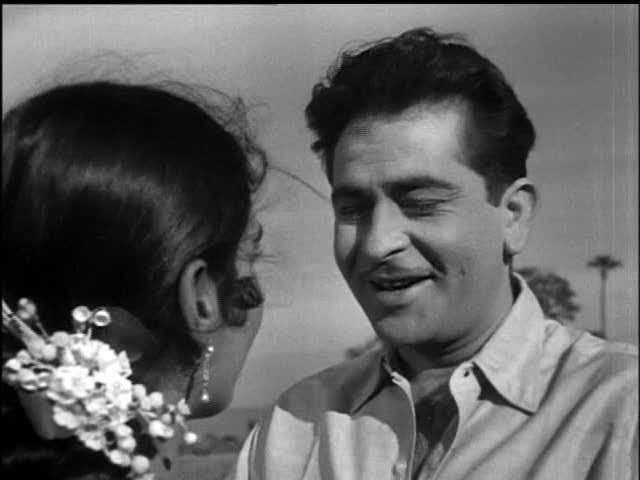
We also managed to cap everyone when they were blinking. Anyway. We thought Raj's tired, aging look worked very well, juxtaposing nicely against his inner child. Being naive takes its toll!


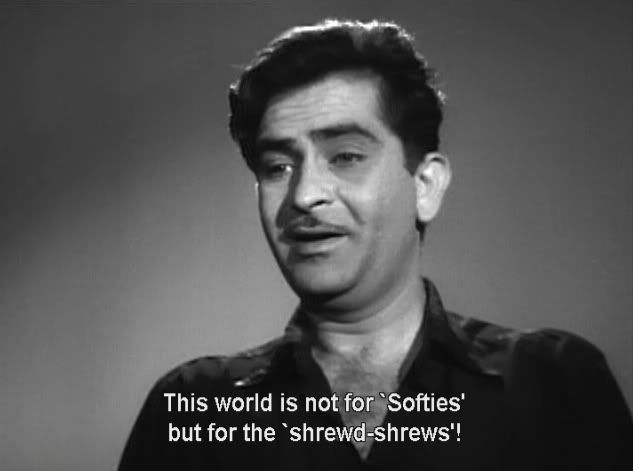
Anari (often subtitled as Idiot but "an inexperienced, unsophisticated, or naïve person" according to Prof. Lutgendorf) is but a simple story of a simple man. Or so we thought. It then adds some simple melodrama and becomes a bit less simple, but ultimately the message is clear:


Cap courtesy of Memsaab.


Yes. As Marx and Engels noted, history has been one long class struggle between the 'Softies' and the 'shrewd-shrews'. And Raj is here to tell you something: 'Softies' of the world unite, you have nothing to lose but your dils!


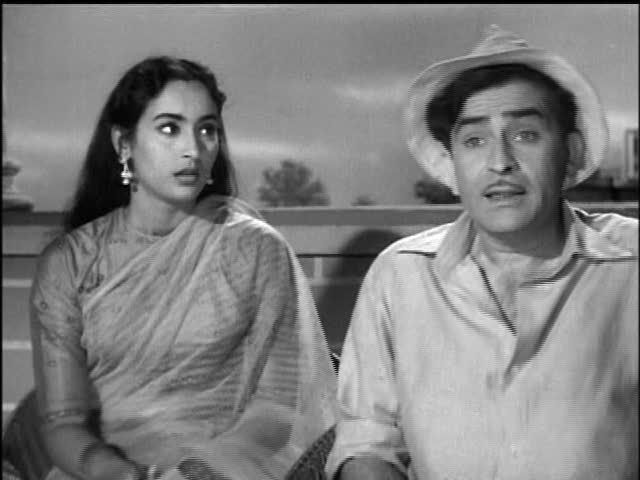
Nutan and the PPCC slowly fall for Raj's bumbling anari-ness.


Meet Raj (Raj Kapoor). Raj is just your regular old simpleton, all bright eyes and bushy tail and charming male ingénue-ness. He is a boarder with the irascible, adorable Mrs. D'Sa (Lalita Pawar). Mrs. D'Sa harasses Raj day and night for the rent, and yet in her heart beats a great, big pumping sweetness - she loves Raj as a son, since her own son passed away years ago. Raj, who seems too idiotic to get a job or keep it for very long, is characteristically slow on the uptake.

Here then are the two major themes of this film: big, big juicy dil (that is, heart) and stupidity. Well, maybe "stupidity" is a bit harsh. Let's replace that with "naïveté to a lethal degree". Yes, lethal. See melodrama.


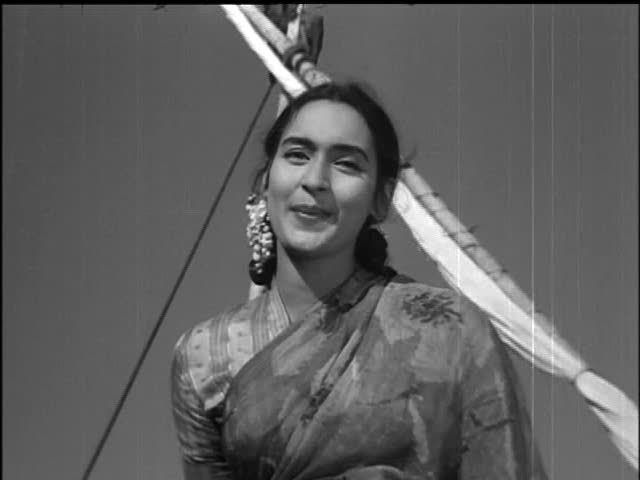
Nutan was FAB in this. But such a liar.


Anyway, one day Raj meets Aarti (an awesome Nutan), who is rich, smart and sassy. Aarti, much like the PPCC, is quickly charmed by Raj and, half in jest, she trades places with her lower-class friend and servant, Asha (Shubha Khote) in order to put herself on Raj's level. A courtship begins - and you just know it's not gonna fly because such love never flies for liars. Indeed, in the requisite Hindi Movie Irony, Raj ends up (finally) landing a job with none other than Aarti's uncle (Motilal), a man who likes a hard worker but is not such a fan of having poor folk in the family. And if you foresee disaster already - wait 'til Mrs. D'Sa catches the flu right when a box of poisoned medicine is accidentally at large! Oh no!

There's probably some big theme going on about the relationship between cynicism, morality and class matters, but the PPCC is too befuddled to figure it out or care. Onto what we do understand: Raj's histrionics!


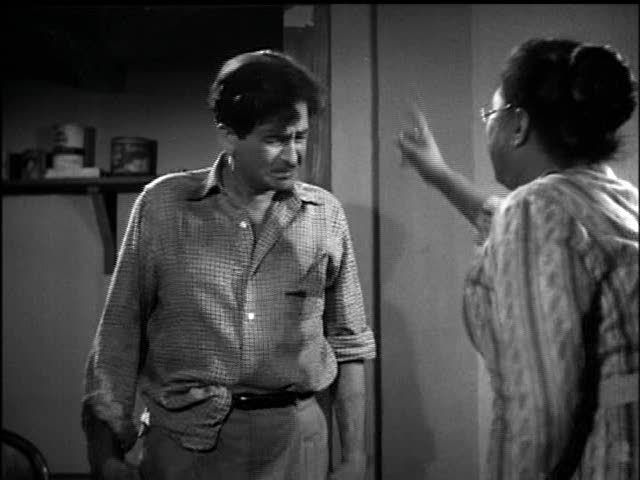
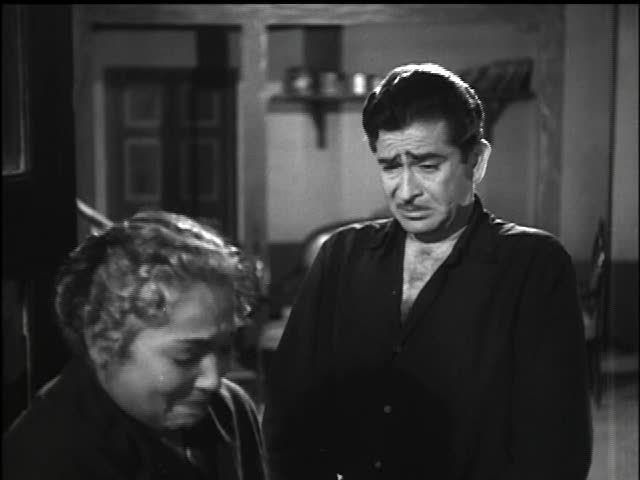
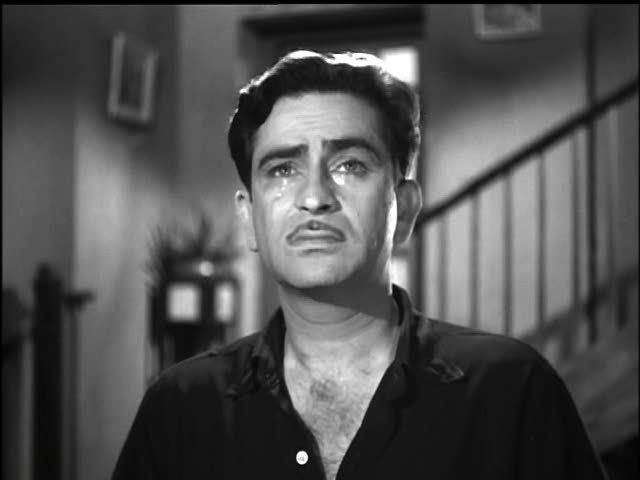
CRY!


CRY!


AND AGAIN!


Crying is important to the PPCC. We like a good cry. Some films - like 1989's Civil War flick Glory - get watched merely so we can have a good cry. We also are easily charmed by actors that can cry convincingly - like Naseeruddin Shah's hyperrealist tears in Monsoon Wedding or Kenneth Branagh's dramatically Welsh Welshness in Henry V. Oh, the humanity!

Raj does a lot of good, meaty crying in Anari. Memsaab wasn't as charmed as the PPCC was during Raj's various sniffles, but we found these scenes endearingly open-hearted and satisfying, "Aww, look! He's a 12-year-old boy trapped in a 40-year-old man's body! It's like Big, only with fab songs!" And maybe that's the best way to take Anari.