Showing posts with label dystopia. Show all posts

Sunday, 11 May 2014

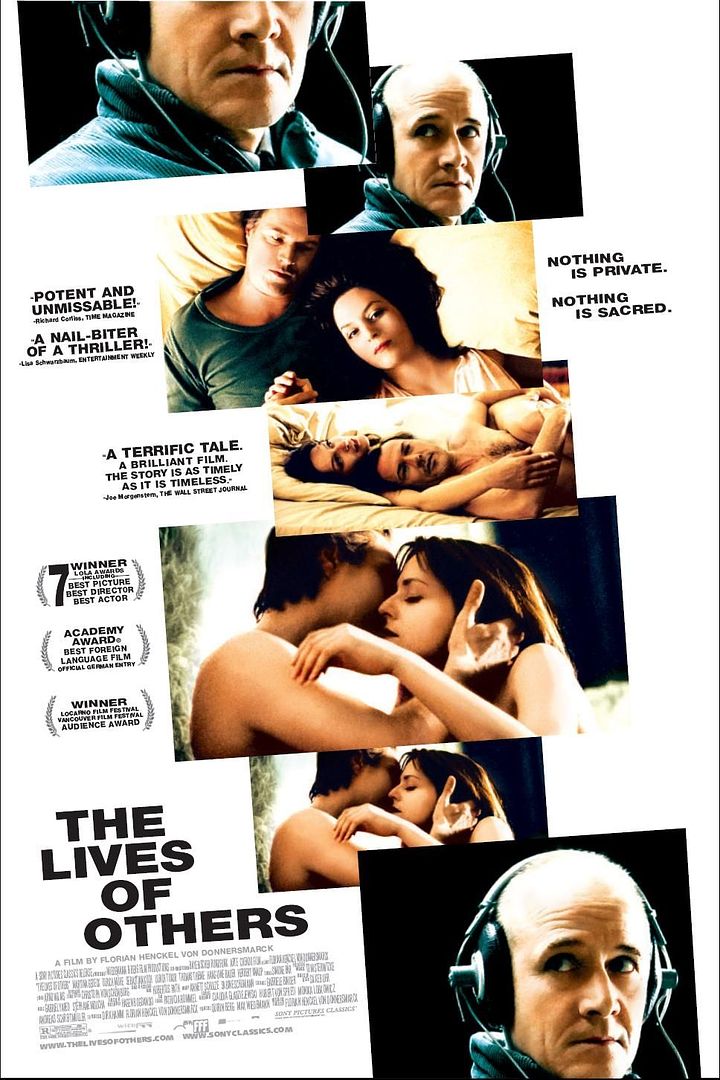
Das Leben der Anderen (2006)

Like many other dystopian films, the hero of Das Leben der Anderen (The Lives of Others) is a common drone worker who breaks out of his shell, opens his eyes and rebels against the gray dystopia around him. Usually, aided via a soulful woman.

The kicker, then, is that the setting of Das Leben der Anderen is a real dystopia, not an imagined one. Taking place in 1980s East Germany, we follow an agent of the Ministry of State Security, better known as the Stasi. This agent, Wiesler (an owlish Ulrich Mühe), has recently been assigned the surveillance of a prominent, seemingly loyal playwright, Georg Dreyman (Sebastian Koch). After outfitting Dreyman's East Berlin apartment with various wiretaps, Wiesler sets up shop in his lair - big headphones on, single lamp illuminating - and listens into... the lives of others (sorry).

And oh, the tangled lives they lead! Dreyman's girlfriend, the soulful Christa-Maria (Martina Gedeck), is getting trapped in the sights of a lecherous, high-ranking East German politician (Thomas Thieme). Said politician's minion, and Wiesler's boss, Grubitz (Ulrich Tukur), decides to use the state surveillance apparatus for less than gloriously Socialistic means. Wiesler, instead, is a tidy, almost fastidious non-man. His gray outfits, emotionless expression, and all-seeing eyes make him look like the Ultimate Stasi Man, the ultimate dystopian drone. He sees everything, passionless, he is completely forgettable. So, of course, his slow warming up to humanity via the vicarious living-through the lives of Dreyman and Christa-Maria is subversively joyful. His tiny acts of heroics are powerful, and very moving.

Indeed, this film is about the banality of good (a nice inversion for post-war Germany), as Dreyman and Wiesler are both essentially good men, doing what they can in a stifling environment.

This film won Best Foreign Film at the 2007 Oscars, and, indeed, it is very much an Oscar Film: polished, feel-good, not too controversial either in its craft or its content. It's smart, but not baffling, not mind-blowing. Overall, then, this makes it a very nice film, but not a great one. And that's fine! It was a fascinating story, told with a deft hand, with a deeply humanistic message. The performances were great; Mühe, who passed away from stomach cancer shortly after winning the Oscar in 2007, gives a performance that is understated and tender; it really carries the film.

Thursday, 24 April 2014

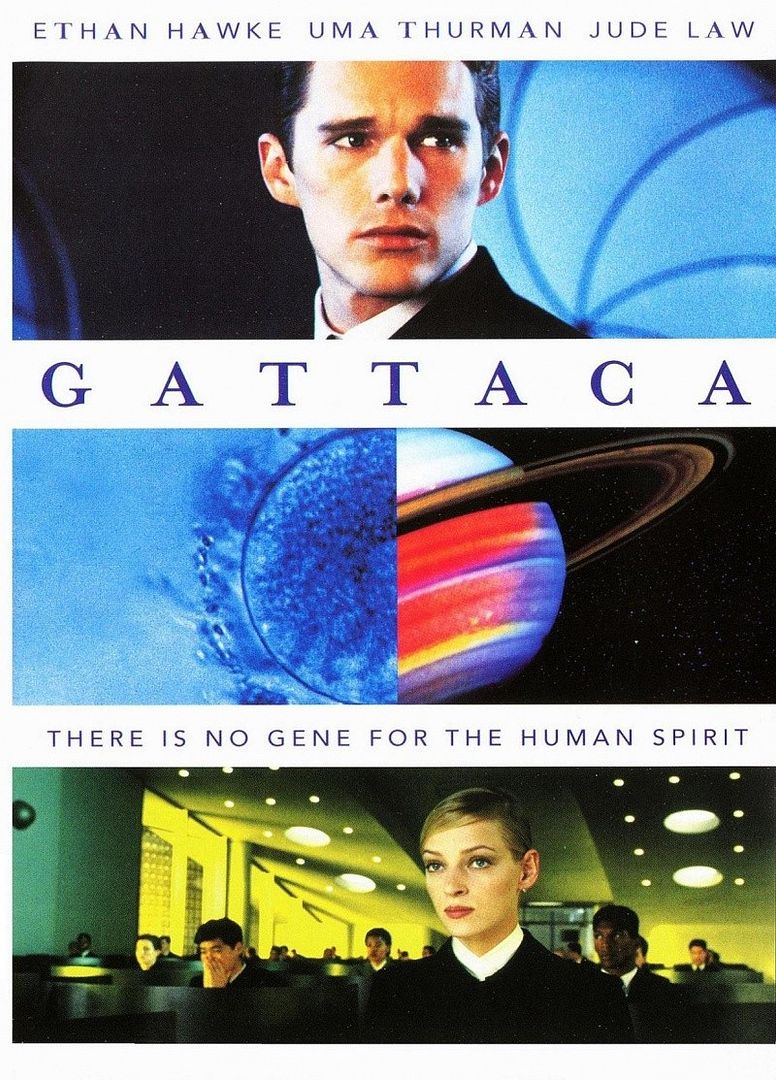
Gattaca (1997)

Just like Kramer vs. Kramer - a sexist movie about sexism - Gattaca is a prejudiced movie about prejudice.

Yes, it's also very slick and stylish and clever (check out everyone's names - e.g. Eugene, "you gene", GET IT?). Yes, the music by minimalist composer Michael Nyman is cosmically evocative (indeed, his this inspired us to make our this). And yes, the set/costume design, with its sleek, clean lines and 1950s jagged angulariness, is very beautiful too.

But!

Well, maybe the plot first.

The plot!

We begin our tale following Any Dystopia's Requisite Bureaucratic Drone, Jerome Morrow (Ethan Hawke), and his clinical, fussy morning preparations. This man's breakfast includes placing tiny tiny vials of blood into tiny little fingerprint pads and then methodically gluing them to his fingers. Among other things. We soon learn that Jerome is actually named Vincent Freeman, and he is an In-Valid. That is, he's not a genetically modified super-person. He's just a guy with bad eyesight and big ambition.

Vincent's world is a semi-Fascist gene-obsessed dystopia, where inequalities are perpetuated via parents investing in their kids' DNA. Being "Valid" - i.e. having been designed for success since fetus days - ensures you the best jobs, the best credit rating, the best life. Vincent, who dreams of joining the Gattaca Corporation and becoming an astronaut on one of their space missions, eventually finds - via a swarthy underground gene dealer (Tony Shalhoub!) - a way in: he steals the identity of a good-gene has-been, Jerome Eugene Morrow (Jude Law). Jerome - the real Jerome - was recently paralyzed in an accident, cutting his athletic career short and, it seems, his will to do anything. He's now all too happy to lend his now "useless" advantage to the under-privileged Vincent.

The rest of the film is basically about Vincent trying to hide his identity, especially as an unfortunately-timed murder and attendant investigation come down on Gattaca Corp.

Of course, this is all intended to be a clever commentary on our real biases and prejudices, and the actual moral issues around, for example, designer babies. Taller, beautifuller people have been shown to get higher salary offers, after all. (Too lazy to find the citation - but you can confirm-bias your way through the Google and find it.)

What then undermines this whole thing is how deeply, subconsciously prejudiced the film is. Some examples: well, the most glaring one is the fact that the hero(es) of the film, Vincent and Eugene, are polished, Anglo, white dudes. And that the only woman in the film, Irene (Uma Thurman), has no personality and is only present to be a love interest. So that's one prejudice in Gattaca: sexism. Let's see if we can keep count.

Next example: The sordid underworld gene dealer is coded as a swarthy foreigner, played by the Lebanese-American actor, Tony Shalhoub. This, coupled with only one black dude in the entire film, gives Gattaca its second strike: Racism.

And perhaps the most insidious example: Jude Law's performance was lauded and celebrated, and, indeed, it includes a number of "For Your Consideration - Academy Voters" scenes meant to elicit strong feelings. His character, Eugene, spends most of his days drinking away his obvious sorrows (cuz, you know, WHEELCHAIR). He is a self-destructive martyr whose only joy - he explicitly notes - is by living vicariously through the able-bodied Vincent.

And that's the third strike, and it's a big one: Ableism. Oh my Lord, we hated this aspect of the film. It played into the most insidious, seedy stereotypes about being able-bodied or not, and basically gave the message that, "If you're in a wheelchair, the best you can hope for is to transfer your earthly ambitions to someone who can walk. And then just die." His entire characterization was meant to evoke some sort of sickly pity, we were meant to see him as a tragic figure. Lest it not be clear, we don't think wheelchair = pitiable tragedy! And it's completely ridiculous to say so! And, ahem, completely undermining of the film's whole point, which is about overcoming perceived physical challenge to, nonetheless, come out on top. And the film's other big point, which is that prejudice based on those perceived challenges is stupid and semi-Fascist.

For these reasons - especially the last - we really kinda hated this film. Not recommended.


Friday, 11 June 2010

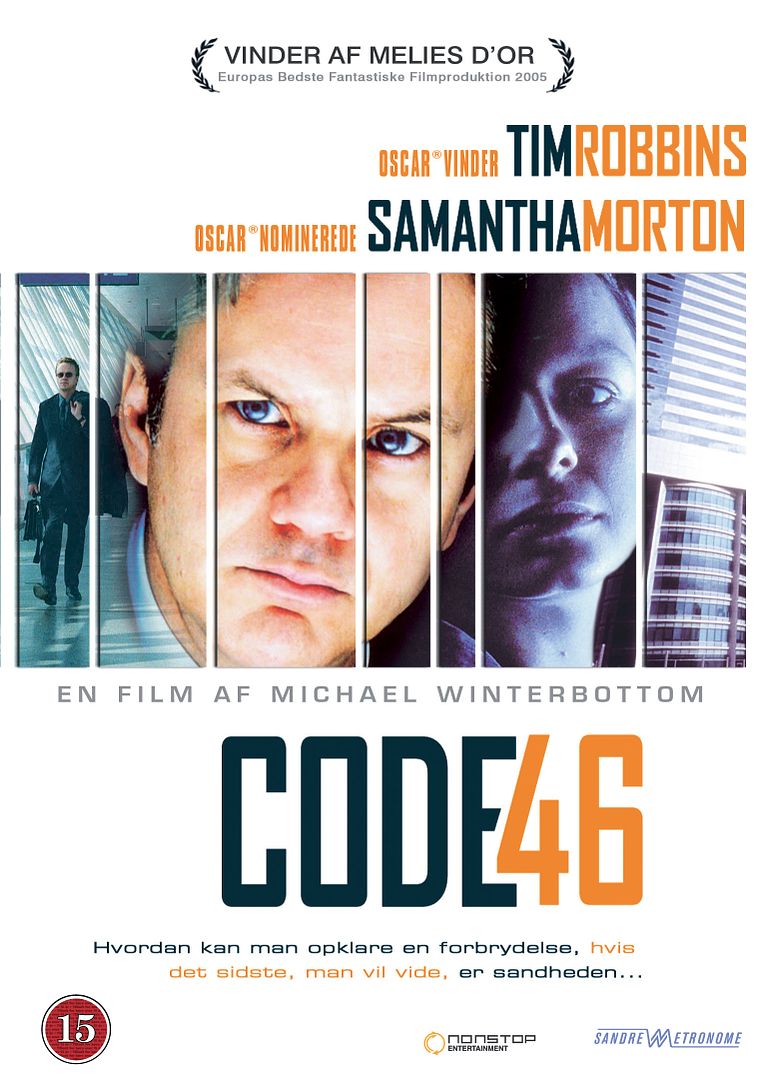
Code 46 (2003)


Code 46, the troubling, moody dystopian romance, initially charmed us, then baffled us, then kinda freaked us out, and then surprised us (Coldplay? Really?). But we are so terribly partial to dystopias filmed in atmospheric indie fuzz that we could overlook even the uncomfortable Oedipal kinks and the too-mainstream pop bookend: we liked it.

Kind of like the (incestuous!) love child between Blade Runner and Eternal Sunshine of the Spotless Mind, Code 46 is about love in the time of being almost-post-human. The film pushes special PPCC buttons by also being post-colonial: it acknowledges the Rest of the World, and what its position would be in a freaky future. But best of all: it's just a sweet, heady, doomed romance full of brooding darkness and two very weird people.


Some scene setting.


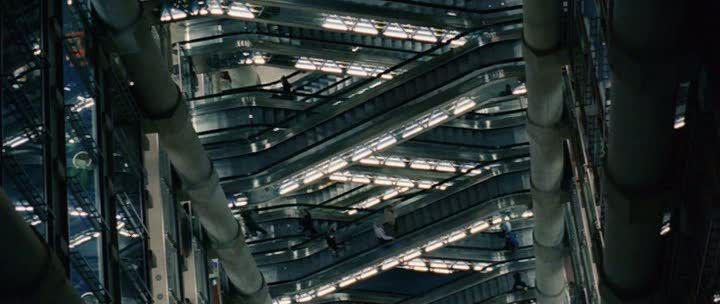
Living in an Escher world (where are Godel and Bach?!).


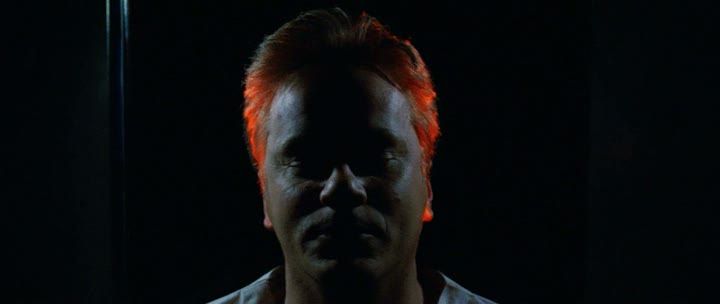
William (Tim Robbins, who is apparently a giant) is - like all good dystopian anti-heroes - a bureaucratic drone. This drone's particular job is investigating "papelles" fraud. The world has been divided into the Inside - buzzing metropolises full of light, drugs and technology - and the Outside - underdeveloped, poverty-stricken deserts. Movement across this so-familiar-it's-alien world is heavily controlled, and you need "papelles" to get anywhere. Interestingly, the axis of geopolitical influence has shifted from the Atlantic to the Indian Ocean - most characters circle around India, the Middle East and China.


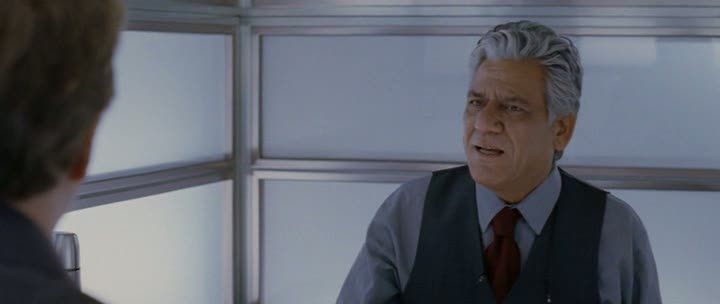
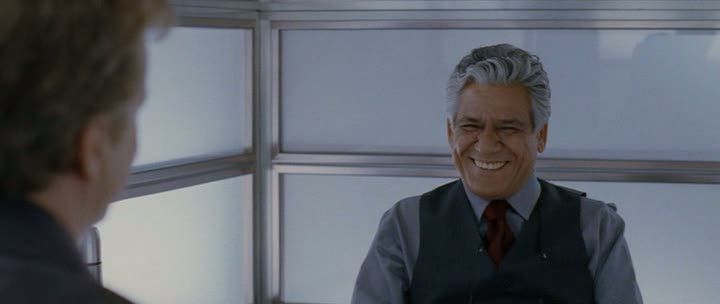
Let the Om Puri Lovefest begin! We love you, Om Puri!


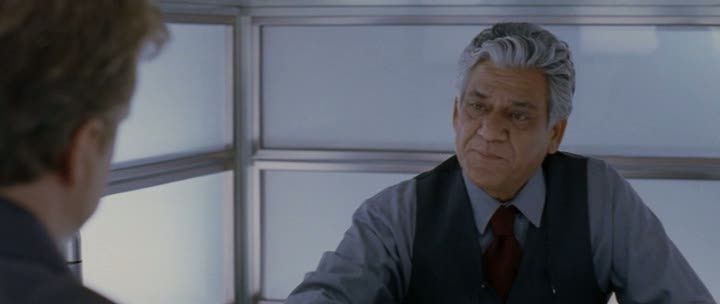
You're so cute and great, Om Puri!


Oh, Omnomnom Puri!


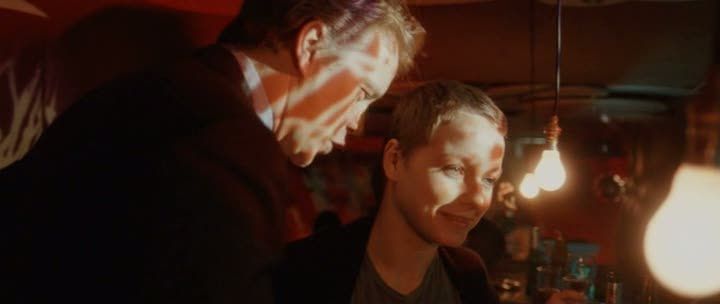
William has now been sent to Shanghai (looking remarkably like Hong Kong) to investigate a possible fraud at the large Sphinx company. While the anxious manager (Om Puri!!!) is eager to keep things quiet, William - tripping, William Gibson-style, on an "empathy virus" that spikes his intuition - easily identifies the culprit using only one, quick meeting with all the employees. That culprit, unfortunately, is the sexy, alluring Maria Gonzalez (Samantha Morton, still in Minority Report buzzcut mode). Maria is so totally awesome that William has some other, less attractive person arrested (whose only line announces that he was born in Hyderabad!), then follows her into a karaoke club where Mick Jones sings Clash songs. And so begins their very inappropriate, kinda gross but also fascinating romance.
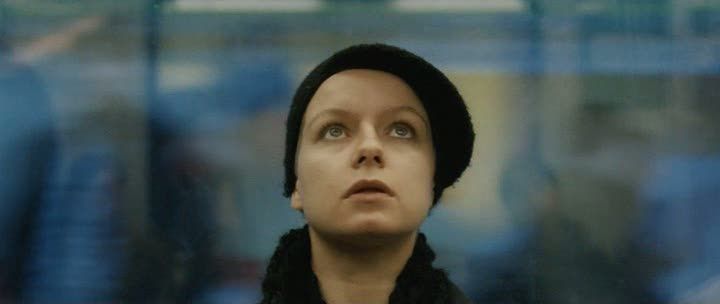

Her.


Him.


Them.


It's been a long time since we've seen a believable future presented, but Code 46 was the most evocative, grimy and convincing future since Gateway. Everyone speaks a babel of world languages - their chatter is peppered with Spanish, Italian, Urdu, Arabic and Mandarin. Familiar cities - Hong Kong, Shanghai, Seattle, Delhi (?) - are filmed in ways which render them otherworldly. The whole territory is strange, yet its links to our present are easily traceable. The whole film's look is very mysterious and beautiful.
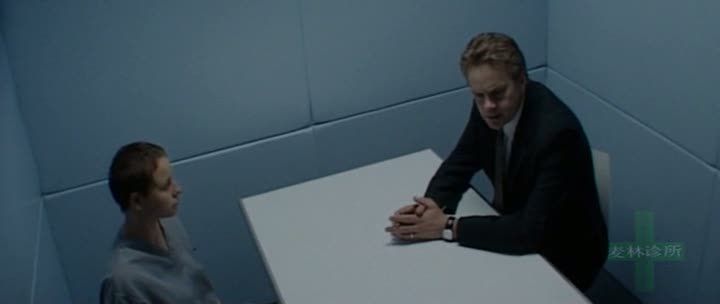
Big Brother is watching you. As usual.


This sort of story also encourages us to THINK in capital letters, and it does raise some interesting questions about gene pools, designer babies and the "Third World". But we were much more refreshed by the interpretation of this as an updated Greek tragedy, full of yearning and elliptical consciousness and DOOM in capital letters (also). It is forbidden love at its most primal, and the modern spin to the tragedy is that it was technological drive which set William and Maria up for their Sophocles-and-Aeschylus-style fall. Are all dystopias cautionary fables with a Luddite bent? Maybe. But only some of them are as classy (and classical) as this one, and even fewer let the softest of human emotions take center stage.

Thursday, 10 June 2010

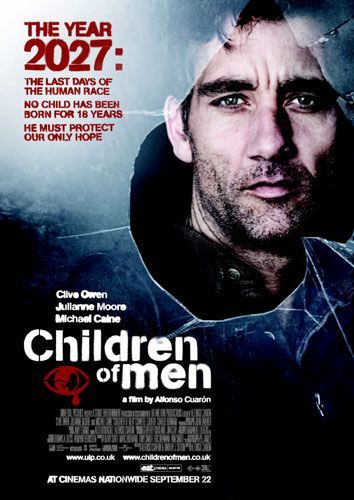
Children of Men (2006)


Back when Children of Men came out, a lot of people took it as an incoherent parable for the modern day problems of Guantanamo and Abu Ghraib; Western paranoia of encroaching terrorist agendas leading to a Big Brother lockdown, etc. We were surprised that what we considered to be the driving symbolism of the movie - that is, orthodox Christianity - was instead downplayed or ignored completely. Did no one get it!?

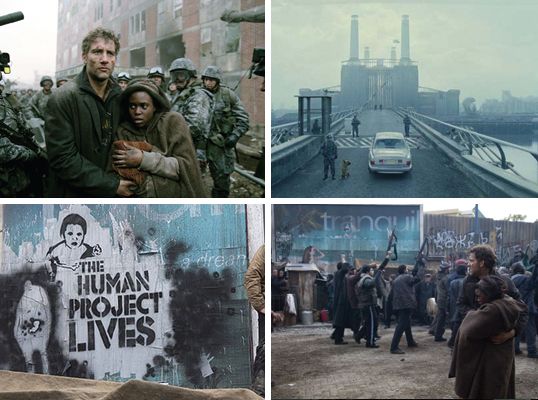
The year is 2027 and Britain is a dark, crummy dystopia that no one likes. It's still better than the Rest of the World, which lies in literal ruins - fire, rubble, AK-47s. "Fugees" - i.e. non-British - are detained in filthy prison colonies on the southern coast of England, and meanwhile a terrorist organization calling itself the "Fishes" is planting bombs in downtown London coffee shops. What a mess.


Various scenes of wreck and ruin and... Bansky?


But the main problem is humanity's sterility. For 18 years, not a single baby has been born. The film opens then on Theo (Clive Owen), a rumpled bureaucratic drone, never too far from some liquor, who lives a wretched half-life in this childless purgatory. One day, Theo is contacted by his former flame, Julian (Julianne Moore), who asks him for some rare "transit papers" to help a friend get off the isle (and the Casablanca bell goes CLANG! hooray!). Theo reluctantly agrees to help, even though Julian is mixed up with the Fishes and their charismatic (well, we think so) leader, Luke (Chiwetel Ejiofor, always great). Of all the gin joints! Theo is then shocked to learn that Julian and the Fishes are secretly protecting none other than the World's Only Pregnant Woman, Kee (Clare Hope-Ashitey), who is in her eighth month (she thinks - everyone's sort of forgotten how this pregnancy thing works). Theo, Julian and the Fishes are now all competing to help Key get to the "Human Project" - a rumored Eden where humans aren't stuffing each other's heads into black bags and pushing them into detention centers. Insert also one extremely off-the-grid, pot-growing, old hippie Jasper (Michael Caine, always lovable) and shake well.


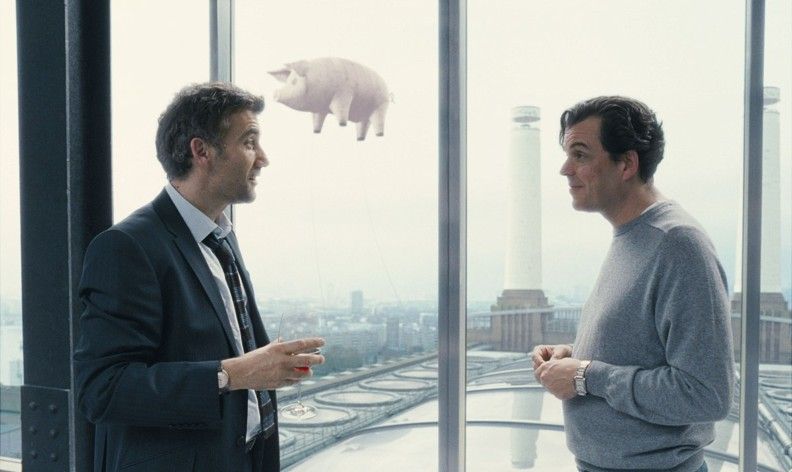
Clive Owen and Danny Huston, in a brilliant "brick in the wall" scene. We're starting to think no one on Earth appreciates Danny Huston the way we do. The man is AMAZING. Just watch The Proposition and you'll see.


Much of the film is, as you would expect, an exercise in dystopian misery. The tone is perpetually bleak, and the slightest levity is only the cynical, sarcastic kind. This film is also very self-aware; i.e. it knows its roots. For example, a brilliant scene featuring the brilliant and underrated Danny Huston as a "Noah of the arts", living alone with his deranged 20something son in a revamped Tate Modern, manages to throw in a Pink Floyd cover. And there are the obvious allusions to 1984 or Brave New World, what with the government-approved suicide rations and overbearing bureaucracy.
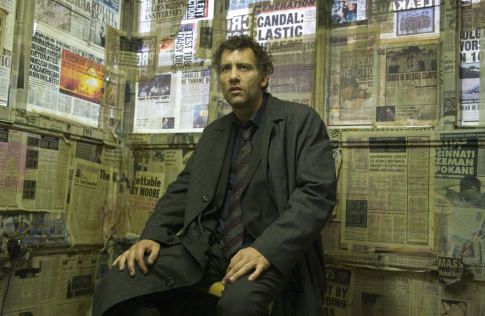
But the film is mostly about the Bible. We think. This is a very classical, orthodox Christian story, stuffed full of allusions: Theo, underground fish and miracle babies. Director Alfonso Cuarón is only using these Abu Ghraib-type aesthetics in the same way he uses the 1970s acid rock (King Crimson!): as a familiar, modern idiom to get across a very ancient story of miracle and saviors. When Kee reveals her pregnancy to Theo, she's in a manger. Theo's last words in the film are, "Oh, Jesus." Danny Huston's character could be Pilate. And one of Jesus' titles was the Son of Man - just pluralfy that and you get the title. Indeed, it's a very fun story to pick apart, as the Christian symbols are layered everywhere. Personally, we felt like Indy at the end of The Last Crusade (remember: there is no "J" in Greek).


Ahem, "Theo", meets the, ahem, "Fishes".


Another notable feature about this film is Cuarón's use of really, REALLY long takes. There are three in particular, each lasting as much as ten minutes (!). That's ten minutes of a single shot. The most impressive of these, by far, is the one in the car. This is an early climax in the film, and it begins when Theo wakes up from a nap, the camera slowly zooming out from him. Watch out for it. The entire thing is filmed on a single camera, spinning deliriously within a cramped, cluttered car. And from that single shot, we manage to witness the build-up, climax and after-effects of a chaotic action piece. It's a testament to everyone involved - Cuarón and the actors, especially - for making such an impressive, uninterrupted piece of movie magic.

Oh yeah, and it's based on a (waay more obviously Christiany) book by P.D. James.