Thursday, 30 September 2010

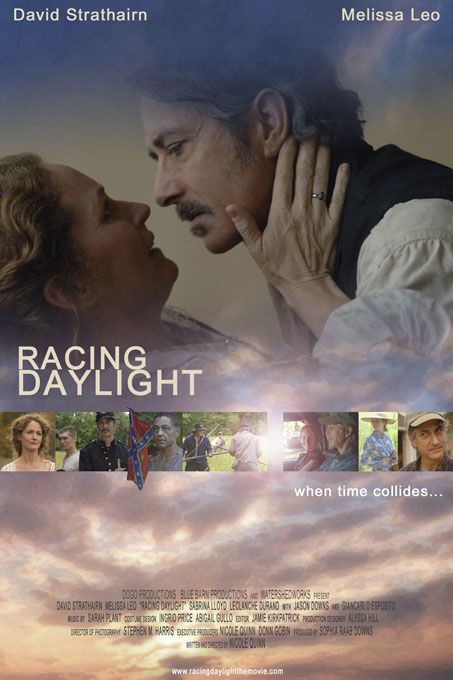
Racing Daylight (2007)


If NPR ever decided to start making movies, Racing Daylight would probably be their first box office smash. (Or flop, actually.) Because Racing Daylight - a tweedy, low-fi look at a small, East Coast town's past and present - is very, very NPR. And it stars David Strathairn! You can't get more charmingly "this American life" than that. Cape Cod ho!

Sadie (Melissa Leo) lives a dead-end life on Sesame Street whatever street she lives on in Cedarsville, New York. Death and life are a bit blurred here in Cedarsville, since Sadie's been receiving spectral visitations from Civil War vets. When not seeing ghosts, she tends to her catatonic grandmother (Le Clanche du Rand) and pines mutely after the dashing handyman (and adorably nerdy Civil War freak), Henry (David Strathairn, looking pretty dashing indeed!). The ghosts meanwhile creep in and take over Sadie's life, flinging her back to the high romance of Cedarsville during the Civil War, when she - now named Anna - was pining much more vocally for the dashing soldier, Harry (David Strathairn, now with facial hair and even more dashing!), and her young, slightly dodgy "killer inside me" husband, Edmund (Jason Downs).

Filmed on a shoestring budget, with costumes and props seemingly from the Dollar Store, Racing Daylight has some moments which are adorable and quirky and charming, and many other moments which are scrape-out-your-eyeballs awful. Relatedly, the tone swings wildly around - is it a Gothic horror-romance? Is it a whimsical What's Eating Gilbert Grape?-ish look at the weird and wonderful of American's forgotten poor? Is it a David Strathairn/Civil War broad comedy gush fest? Any of these options would have been great. Unfortunately, Racing Daylight has shrieking violins in one moment and dueling banjos the next. It has some very good acting - such as David Strathairn's pitch perfect weirdness as Henry the Nerd, with his "Do you like facts?" non sequiturs - and some very bad acting - such as Melissa Leo going a bit too broad on the coy girlishness of Sadie-infatuated. The writing is rough. And, overall, everyone is very, very earnest - which earns some points, at least. Hey, we wouldn't mind sitting in a classroom or a museum and watching this while someone explained the threading work in Union uniforms. Hey, so we're earnest Civil War buffs too - sue us!

But should YOU watch it? ("Wait, wait, don't tell me!" we hear you cry.) Well... if, like us, you get your kicks from American history and, especially, facts, then yes. There just aren't enough Civil War movies out there, and it's always nice to see a smart Union uniform. Be warned, though, this is not by any measure a "good" movie. It's clunky, clumsy, awkwardly filmed and very cheap. If you want fancy, polished filmwork on the era, go for Glory (to cry), Gettysburg (to learn, and then cry), Cold Mountain (OK, we haven't actually seen this one) or Shenandoah (to Jimmy Stewart). If you don't need to focus on the Civil War, but instead would just appreciate a handheld tour through history with David Strathairn, preferably in a state of romantic poverty, then you can watch any number of excellent John Sayles films - Limbo (Alaska!), Matewan (West Virginia!), Eight Men Out (daaaa Bears!). If you don't have any of those at hand, this will do.

Oh yeah, and if you like Tom Waits' experimental industrial music with saws and banjos and other hard-to-identify instruments, you can watch this. The intro music is crazy!
<=== and what is that cover about?!

Tuesday, 28 September 2010

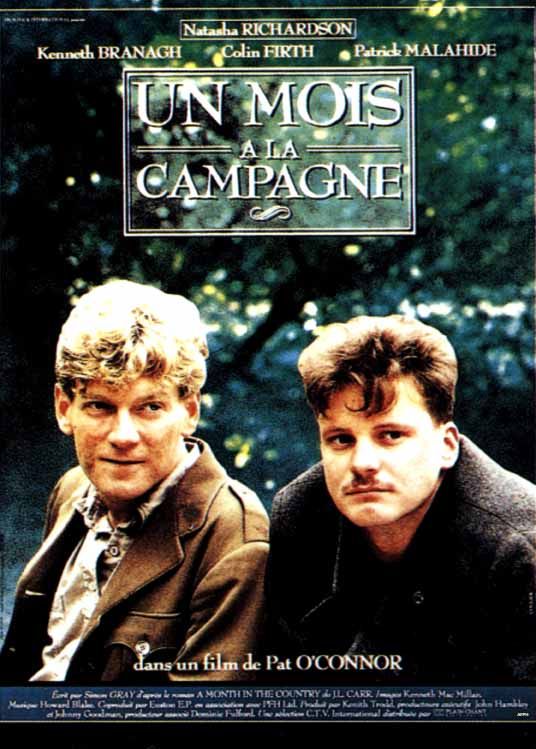
A Month in the Country (1987)


If there is one movie that is terribly, tragically underrated and unknown, it is A Month in the Country.

It's ironic because J.L. Carr's novel of the same name, on which the 1980s movie is based, is also terribly, tragically unknown. It just missed a Booker back in 1980, and instead won the Guardian Fiction Prize - a lesser trophy and, it seems, a punishment to anonymity. The movie, in the meantime, stars everyone's favorite English actors, Colin Firth and Kenneth Branagh, as young World War I veterans struggling to cope with their traumatic experiences in the first, Elysian summer after peace is declared. It's great. Really beautiful. And there's no DVD for it!?!!
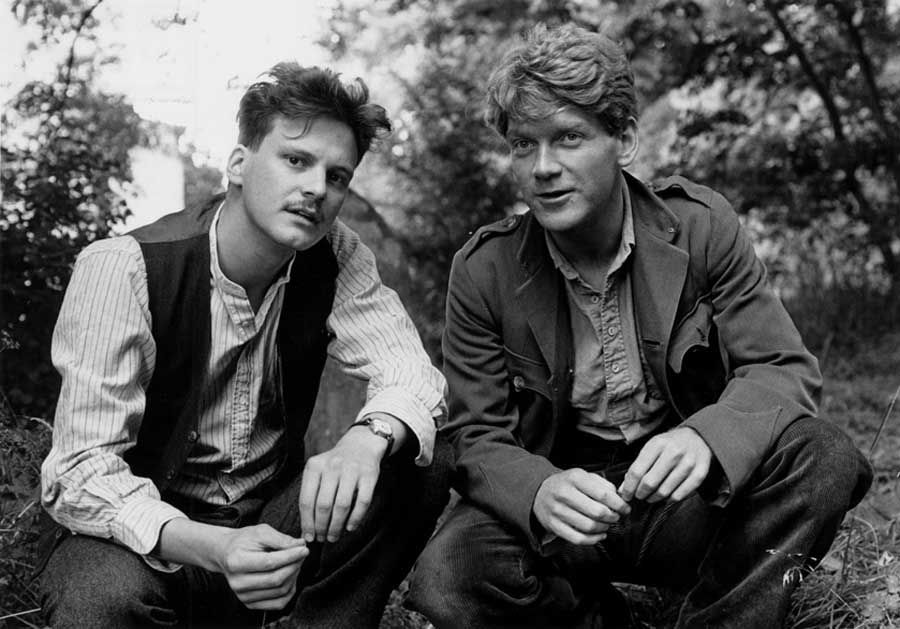
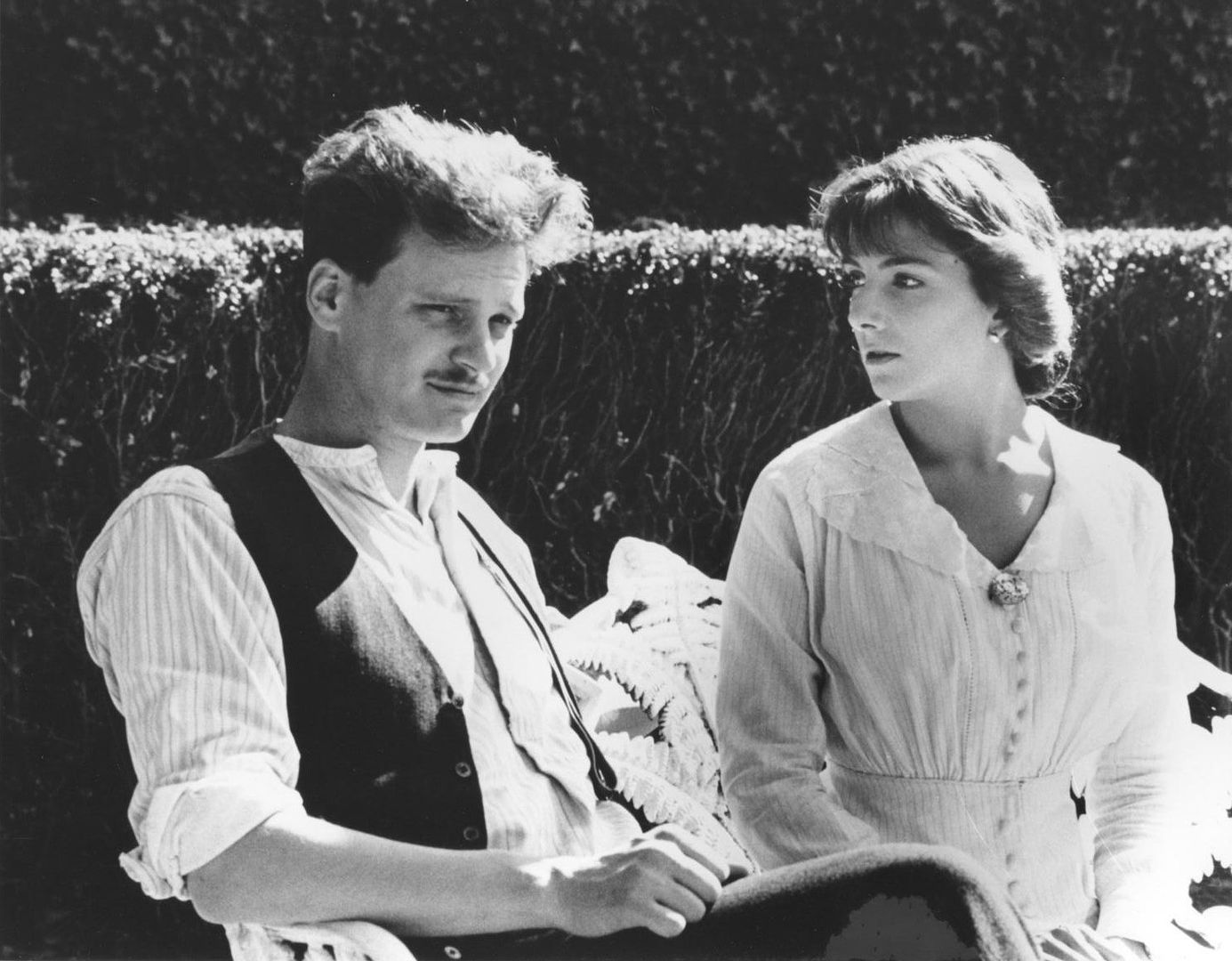
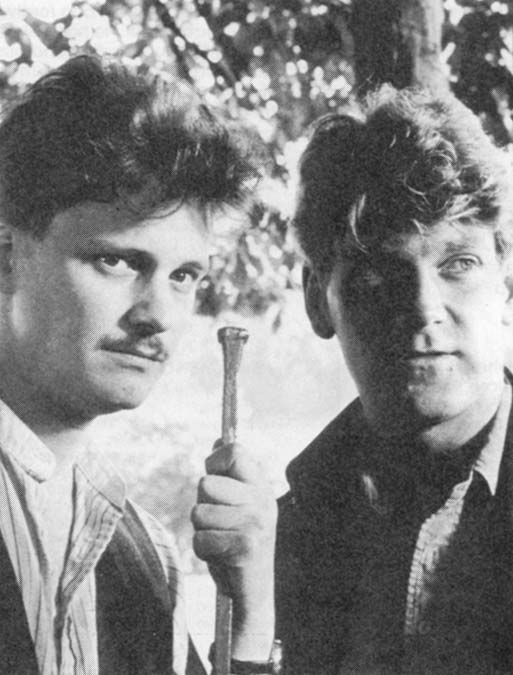
Colin Firth as Tom Birkin and Kenneth Branagh as Moon, both so young!


It's terrible, tragic and ironic, but it also makes sense - in a weird, double-agent-ironic way - that this small, understated story of remembering and loss should be on the verge of falling into the vacuum. The story is, after all, an extended meditation on nostalgia, grieving and renewal. It's about preserving yourself against the abyss; carving a space of light in a world where all seems dark. When Tom Birkin (Colin Firth) arrives in the tiny Yorkshire hamlet of Oxgodsby, he suffers from a stammer, a facial tic and terrible nightmares. He's also freshly divorced and still pining for his ex-wife, Vinnie (never shown on screen). He arrives in Oxgodsby in rainy twilight and makes his way to a gloomy church. His job for the coming summer months is to restore a decrepit, hidden 14th-century fresco from the church's ancient walls.

The pace is slow, matching the drift of motes in sunlight. Birkin meets another young vet, Moon (Kenneth Branagh), who has been paid to dig up the lost grave of a rich townie's ancestor. Moon is, like Birkin, still damaged from the war, though the quality of his suffering becomes an unexpected parallel with the mysterious artist's life. Birkin, when not drinking tea with Moon or brushing turpentine onto plaster, falls into quiet, intense love with the vicar's wife, Alice Keach (Natasha Richardson).


Love with the vicar's wife (Natasha Richardson)! The bit when she explains her apple savantness is so good.


Colin Firth recently waxed nostalgic about director Pat O'Connor's confidence in making this film: the story was allowed to breathe, actors were allowed to be silent. Indeed, the whole point of the film is the profound, emotional intensity that underscores this pleasant facade, and the uselessness of words. The trauma of World War I still lingers like a ghost in the landscape: and O'Connor does a brilliant job of never gazing directly at the war, but rather coming at it sideways. The most explicit war scene we see is the opening shot of Birkin struggling through the mud and barbed wire: the camera is zoomed tightly on him, we have little sense of context, and there's a sense of claustrophobia and horror. The haunting church hymns underscore the usual aphorism: war is hell (in the religious and literal senses). Similarly, Birkin and Moon's PTSD is a smothered suffering that we see only through the cracks of Birkin's twitch or Moon's nighttime howling.

But this story isn't about dwelling in the horribleness of World War I - rather, it's a realist, poignant look at slow healing. Oxgodsby's warm fuzziness is the perfect restorative for the broken vets, even if that healing is fragile and tentative. And the narrative is a looking back, so nostalgia is thick. The greatness of this story is the way it captures ephemeral beauty, a feeling that is vibrant and impermanent. Quite spiritual. And, like all art that does what it's supposed to, it captures and transmits an emotional quality.


We should probably mention that this film is, actually, in color.


The film is also a marvelous companion to the book - they both really enrich each other. And experiencing either is like breathing in purified rural gold. People, get thee to this film - or rather, get thee to preserving this rich work! We can't let gems like these disappear. Ahh, Angleterre. Where's good ol' William Blake when ya need him?
Bring me my Bow of burning gold;
Bring me my Arrows of desire:
Bring me my Spear: O clouds unfold!
Bring me my Chariot of fire!
(the book!)

Sunday, 26 September 2010

Caos Calmo (2008)


Caos Calmo (Quiet Chaos), the weirdly derivative film starring Nanni Moretti as yet another grieving parent, is bad, people. Just bad.

It's also weird. Weird because it is so derivative - essentially a lesser, paler, crappier copy of the far, far superior The Son's Room, a film directed and starring Nanni Moretti, and the film for which he won the Palme D'Or back in 2001. In Caos Calmo, Moretti returns, seven years later, with much the same parlor tricks: a sudden death of a loved one leading to warmly nihilistic despair, meandering through the comfortable Italian bourgeoise, Silvio Orlando wringing his hands in anxiety, some unexpected pop tunes, and some sex (not with Silvio Orlando).

All these things came together to form a cohesive, bright, beautiful thing in The Son's Room, a film which left us in a sheen of brilliance for years and years. Yes, it was that good. It makes you love humanity, for the love of… humanity. And it makes grief something dignified and heroic, something tragic and pure. It made us cry so, so much.

Caos Calmo, instead, nearly bored us to tears. After Pietro's (Nanni Moretti) wife dies unexpectedly, Pietro - a top man in some sort of fancy film distribution company - spends his days sitting on the bench outside of his young daughter's school. There, he makes flimsy connections with the local characters. Let the healing begin?

Nanni Moretti's father figure here seemed selfish, vapid and whiny - quite a feat considering how naturally charismatic Moretti normally is for us. But his ordeal is nebulous and ill-defined: a loved one has died, but he doesn't feel bad? He didn't love her and he feels guilty? She was crazy? No wait, his sister-in-law was crazy? …What?

It's all a big, unfocused mess, without a single redeeming feature. Like The Son's Room, it clocks in at under 90 minutes, but - unlike The Son's Room - these 90 minutes feel like a plod. If you're looking for charming, humanistic, recent-ish Italian films, steer clear of this one, skippers, and point your vessels to other, better fare such as The Son's Room (DID YOU GET THAT? THE SON'S ROOM, RIGHT HERE), Caro Diario or The Best of Youth.

Monday, 20 September 2010

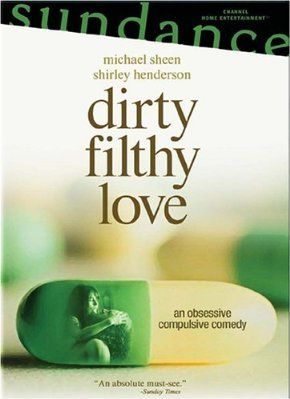
Dirty Filthy Love (2004)


It's unfortunately very rare to see a responsibly-made, informative and entertaining film about mental illness. Dirty Filthy Love, which covers obsessive-compulsive disorder (OCD) and Tourette's Syndrome, is just that: educational without sacrificing narrative, touching without sacrificing realism.

Mark's (Michael Sheen) life is falling apart. He just lost his job at a prominent London architecture firm and his wife (Anastasia Griffith) has filed for separation. Worse still, he seems to live in a prison of irrational tics and ostracizing habits: every day is an uphill battle with the stairs, chairs, shaving, the metro, and other people. When Mark asks his (NHS?!!) psychiatrist (John O'Mahony?) for help, the psychiatrist tells him again that it's just "clinical depression", and surely if he ups his anti-depressant dosage, he'll be fine. Mark knows that it isn't depression, he knows that the drugs aren't working, but he's not quite sure what it could be either: at the moment, he's narrowed it down to a brain tumor, meningitis or early-onset senility.

That is, of course, until Mark meets Charlotte (Shirley Henderson, "Moaning Myrtle" from the Harry Potter series) - a fellow OCD sufferer and the Beatrice to his Dante as she leads him out of the Inferno. And it is a pretty harrowing inferno indeed - be prepared for some shockingly awful stuff as Mark crashes down to the bottom.

OCD is one of those things that isn't normally presented realistically; the cinematic shorthand we have for OCD is Jack Nicholson dancing over pavement cracks in the dreamy fairy tale that is As Good As It Gets, or Tony Shalhoub's latex-glove wearing detective in Monk. That is, "pop OCD" is all about washing your hands repeatedly and being a sort of old-fashioned, Woody Alleny type of quirky urban neuroticism. It's about as helpful a representation as the "hysteria" label that women would get slapped with on their foreheads back in the day. In other words, not very helpful and basically made-up.

Dirty Filthy Love, thankfully, keeps it real. It represents. Mark's fears, compulsions and tics aren't cute and filmi - they're awkward, painful and, often, baffling. When Mark hits bottom, it's not rock star glamorous, it's ugly and uncomfortable to watch. Tragically, Mark is fully aware that he is suffering from some deep problem, but he has a terrible time pinpointing what, exactly, is wrong - a characteristic of OCD. In the sea of anxiety that Mark navigates every day, everything seems threatening. And Mark's "cure" isn't a miracle drug or a cuckoo's nest (sorry, Jack) or love (sorry, Jack) - it's not even a cure at all, but more of a management technique. Shout out for cognitive behavioral therapy!

Michael Sheen is great in these sort of modern edutainment roles, what with his Tony Blair looks and Every(British)man versatility - so we don't know why he spends his time taking loony bit parts in big-budget fantasies (Tron, Alice in Wonderland), or taking big parts in morally dodgy B-films (Beautiful Boy, Unthinkable). As a friend of ours said, Michael Sheen should be playing BP's Tony Hayward (seriously, they're identical) or Lancelot or some other modern British docudrama thing. Or a Zadie Smith film adaptation.

Saturday, 18 September 2010

Planet of the Apes (1968)


What a classic! And what an underrated work of genius.

Like all good sci-fi, Planet of the Apes is an imaginative and entertaining commentary on major parts of our current society. Or, in this case, 1960s American society. Segregation, anti-intellectualism and creationism are all dissected via the lens of one unlucky space explorer, Taylor (Charlton Heston), and his misadventures in a civilization where apes enslave humans.

Taylor, along with his two cosmonaut friends, Landon (Robert Gunner) and Dodge (Jeff Burton), are heading to Earth after a brief mission to space which has dilated time over seven centuries for the Earthlings. But after they bump something in the ship, they end up way off course: thousands of years wrong, and crash landing into a planet where the few humans are primitive mutes who are rounded up by troops of gorilla soldiers wielding muskets and flash photography.

Things quickly spiral into the surreal as Taylor and the others end up imprisoned by the apes. Already we see clear segregation: the orangutans are the scientists, the gorillas are the soldiers, and the chimpanzees are just trying to get by (especially after the "quota system" has ended - Affirmative Action?). After a wounded Taylor regains his voice, all hell breaks loose. He befriends two chimpanzee progressives - Dr. Zira (Kim Hunter) and Cornelius (Roddy McDowall) - who liberate him and send him off to discover the truth about this crazy planet's great mysteries.

The setting is rich and vivid. There's a great moment, for example, when Taylor is fleeing the guards and he ends up in a natural history museum - taxidermied humans are exhibited in various scenes "from the wild". The characterizations are also fascinating; Taylor and his astronauts chat at length about their old habits as misanthropes and lotharios. And we just loved the cheeky nudges to 1960s (counter)culture - at one point, Taylor shaves and tells a young sympathetic chimp that where he comes from, "only kids your age wear beards". The kid cocks his head, "Beards? I don't go in for fads." Cornelius chimes in: "Somehow, [clean-shavenness] makes you look less intelligent." Later on, Taylor jokes with the young chimp, "Remember: never trust anyone over thirty!"

A lot of a fun (and a lot better than the 2001 remake); it was clearly made with passion and intelligence. And some of the dialogue - especially Taylor's liberal use of "Damn you, damn you to hell!"s - is delightful. Now get your stinking paws off me, your damned dirty ape, and watch this damned film!

Friday, 10 September 2010

Il generale della Rovere (1959)


When the Nazi prison commander is telling you you're the scum of the Earth, and everyone's agreeing with him, you've got to wonder just how scummy you really are.

And Emmanuele Bardone (Vittorio de Sica) is pretty scummy. I mean, even the Nazis think he's a spineless dick. Because what's worse - and possibly more dangerous - than explicit malice? Deception. Bardone is a con artist; he exploits the vulnerable. He tells the weeping mothers who come into the Nazi administrative office in Rome that, if they just shell out fifty or a hundred thousand lira (to him), they can get news of their imprisoned sons. While some of the money lines the pockets of corrupt German officials, most of it is just gambled away by Bardone himself.

What's even worse about this already unsavory mess is that Bardone really, sincerely, authentically believes he's a good guy. He doesn't see it as springboarding from one evil (Nazism) to another (his own selfishness) - he sees himself as a guy just trying to get by, as a man who is far too kind to tell the sobbing, weeping families the sordid, unhappy truths of their loved ones: that they're in prison, in a concentration camp, dead.

This painfully self-deluded confession Bardone sweats out in one of Il generale della Rovere's (General Della Rovere) early scenes, when he's outed as a con artist by the crafty Colonel Mueller (Hannes Messemer). Mueller, who is also pretty evil but at least abides by some internal code of honor, decides to use Bardone as a mole. Before being sent to a prison in northern Italy, a sort of way station for Italian political prisoners meant for the concentration camp, Bardone is equipped with a new name - General della Rovere - and a new identity: he is now a legendary resistance fighter. Mueller hopes that Bardone will be able to extract some juicy info from the other, nobly suffering political prisoners, who instinctively trust "General della Rovere" and seek to protect their hero. Bardone is happy to get the perks of being everyone's favorite partisan leader and eager to get out this jail ASAP.

But this is a mess. A frightening, hairy, ugly mess - and Bardone is right in the middle of it. This film - which is not as tight as Roberto Rossellini's masterpiece, Roma, città aperta, but is as gut-wrenching (if not more so!) - is a doozy. If this was 1970s Italian cinema, Bardone would have been played by Giancarlo Giannini and this would have been directed Lina Wertmuller - the whole thing would have been a pitch black comedy in the style of Pasqualino Settebellezze. Indeed, Bardone shares much of Pasqualino's (and other seedy Giancarlo Giannini characters') most notable characteristics: cowardice, vanity, a tendency to stand in bureaucratic lobbies and promise salvation.

But Rossellini - and de Sica - are much more earnest and much less cynical than Wertmuller - who, in cinematic terms, is their descendant. After all, Rossellini and de Sica come from the generation that lived the war. Roma, città aperta was made just months after Rome, actually, was opened up to the world - thanks to the Allied forces liberating it from Nazi occupation. We think that Rossellini and de Sica and the audience of that era just wouldn't have been ready for the shocking, provocative, mind-blowing razor wire satire that Wertmuller would provide their children and grandchildren. The wartime generation needed to believe that Bardone - even scummy, vulnerable, stupid Bardone - would have had an eleventh hour conversion and grow a spine. They needed to see the heroism and nobility of the other prisoners. (Compare these prisoners to Pasqualino's cohort - at least these guys have a code!)

This is not a perfect movie. Roma, città aperta and Pasqualino Settebellezze are, from a technical and artistic standpoint, better films - they're sharper, cleaner, smoother. In this film, we still see the rough edges: Vittoro de Sica's so-so moments of acting, the awkward side swipes, the clunky music. But the story is strong, and it propels the viewer forward, and it makes you care in a deep, intestinal way. Make no mistake: Bardone is an anti-hero, but you care about him - big time. He's conned himself into an impossible corner, and he's miserable, complex, ambiguous and deeply flawed, deeply human. You can't help but feel awful, riding the lows with him. Vittorio de Sica - who, tangentially, was a marvel to see, if only because of how much his son resembles him! - was, in many instances, really beautiful. Not just looks-wise (though he also was that; gosh, that shock of white hair… those eyes!), but also for sheer intensity: the sweat when he's under pressure, the despair when Mueller drags his face through the figurative shit and he has to come to terms with the reality and the horror of Nazi-occupied Italy. Overall, it was a real tour de force. Highly recommended.

Wednesday, 8 September 2010

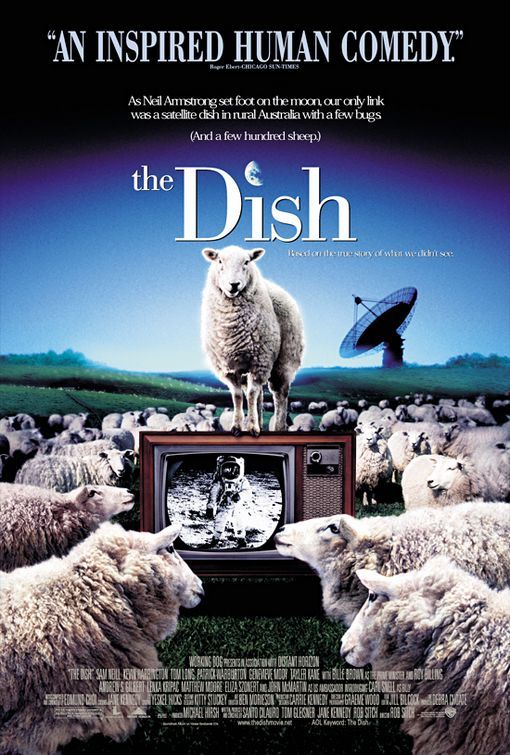
The Dish (2000)


The Aussie faux historical The Dish is a sweet, wholesome movie exhibiting much of the usual irreverent humanism that characterizes the region's more enduring comedies (think Strictly Ballroom or Muriel's Wedding).

The Dish centers around the Apollo 11 mission to the moon, and Australia's involvement via its satellite communication and televised broadcasting of Neil Armstrong's legendary first steps. In the usual style, a motley crew of gently quirky scientists are assembled - led by the wry Cliff (Sam Neill), with the young, spaced out Glenn (Tom Long) and the puckish Mitch (Kevin Harrington) in assistance - and advised by the boorish Yankee NASA representative, Al (Patrick Warburton, Elaine's boyfriend from Seinfeld). The tone is one of ad hoc genius and cobbled-together solutions for the curveballs these scientists encounter in their job to track and broadcast the Apollo 11 communications.

The humor is gentle, the history a bit tweaked and the vibe generally warm and bittersweet. It's a great movie for chilling out with tea (and maybe a blanket), and it leaves you with a warm fuzzy feeling inside. There's also - as with all mainstream films that deal with the Apollo missions - a lot of celebration of man stuff, a relishing of our technological achievements. Think long, loving shots of the satellite. Couple this with some Australiana nostalgia - doo-wop and flower power acoustic guitars feature heavily in the satellite-fetish shots - and the viewer is lulled into a comfortable, warm zone of easygoing optimism.

Sam Neill, one of the gods of our idolatry (OK, our pantheon is pretty big), is his usual craggy, sardonic self - and we love him for it, as we always do. This time we even get the bonus of sweaters and pipes! Oh, our hearts - be still! The people who are not Sam Neill are also fairly decent, but they suffer somewhat from the fact that they're not - in fact - Sam Neill.

We should also note that one character - the comical mayor's comically angry feminist daughter - was a little ruffling to our feathers. Every line Feminist Girl spouted was meant for ridicule, even though some of them were, well, pretty good points. Poverty alleviation or space exploration? It's a good point! And mocking the poverty of India - which was, essentially, the punchline of one of the jokes at her expense - wasn't very funny. Oh, Sam, why did you laugh? For money? We'll give you money!

Sunday, 5 September 2010

The Deal (2003)


Screenwriter Peter Morgan does it again for modern British history in the excellent BBC movie, The Deal. For anyone unversed in British politics, it's a brief, fascinating primer of the Labour Party's ascendancy in the 1997 elections.

We've already noted Morgan's work in The Damned United - our pick for best film of 2009 - and Frost/Nixon. As always, Michael Sheen is his preferred actor, and Sheen carries himself well as the whippet upstart Tony Blair. But the core of The Deal is really Gordon Brown (David Morrissey), and Brown's relationship with Blair. As in The Damned United, this relationship carries romantic and epic undertones - there's a Shakespearean, archetypal quality to the friendship and strains between the boorish, "saturnine" Brown and the wily Blair.


Some excellent details from Stephen Frears' direction.


Michael Sheen as whippet Tony Blair, the Early Days.


The imposing David Morrissey imposing some imposingness in one of the great Parliament scenes. I SAY!


The story begins in Thatcherite Britain, when the Tory Party is well in power and the Labour Party struggles, seemingly endlessly, in Opposition. Brown and Blair both join in the late 80s and, sharing an office, form a friendship despite their differences. And the differences are notable: Brown is an "old Labour" type, with his working class vibe and party loyalty, whereas Blair is posh, Oxford, English and seen as something of a cultural usurper. Indeed, this tension between the old, working class (and largely northern) order and Blair's southern, posher, politically correct "New Labour" movement is directly embodied in Brown and Blair. When Thatcher resigns, the Tories begin coming apart and well-loved Labour leader, John Smith, dies unexpectedly in 1997, a vacuum of power opens up - one in which Blair ambitiously moves in.


Not unlike a similar shot from The Damned United.


In the meanwhile, within this film, great visual paralleling.


A movie about politics, with no action, assassinations or violent intrigue, may seem like a bore, but trust us - all that other stuff is just distracting fluff. This is the good stuff. The core of this film is Blair's emotional treachery of Brown in the name of politics - and it is intriguing, gut-wrenching and absolutely compelling. The actors do a great job capturing their real-life counterparts and infusing them with the Shakespearean grandeur that we mentioned before: David Morrissey's scowling, bent-over Brown, his gait and his cadence, were great, as was Michael Sheen's slightly saccharine, artificial good humor. (In fact, their juxtaposition was not unlike the Nixon-Kennedy debate!)


More visual parallels between Blair/Brown here and Blair/Brian Clough.


And Brown.


And between this film...


...and reality!

We worry that this is one of those great little films that will get lost in the miasma of time. It is, after all, a brief 80-minute BBC docudrama thing. Please rescue it from the abyss! It is too good to be forgotten so soon.

Saturday, 4 September 2010

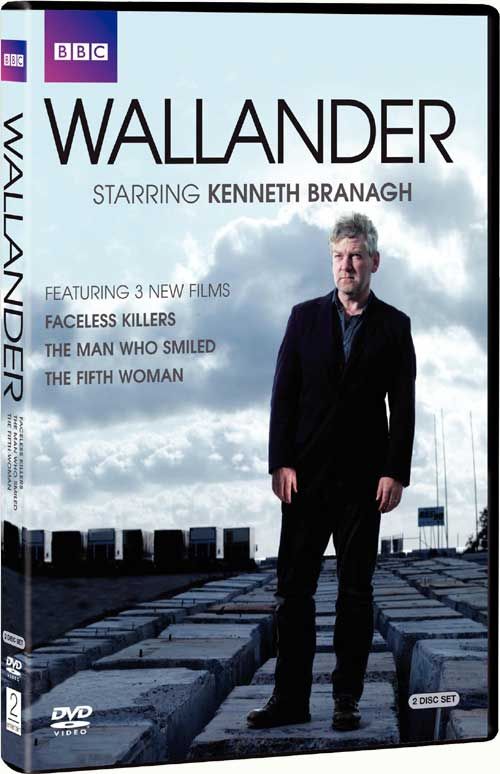
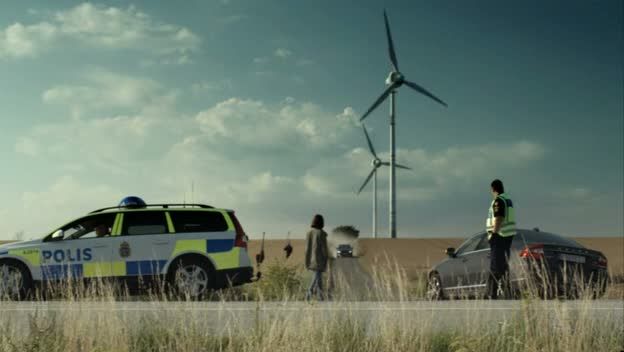
Wallander: The Fifth Woman (2010)


Ah, the Wallander series, where ace Swedish detective Kurt Wallander (Kenneth Branagh) relentlessly picks at the scab that is his life.

We can't help but think constantly to a description Kenneth Branagh gave of Wallander: the man's like an "open wound". And every episode features the same key scenes to show us just how psychologically wounded this teddy bear is: he sleeps only in awkward sitting positions (he broods himself to sleep, every. single. night. people!), is always awoken by the harsh siren call of his detective colleagues, who then take him to see someone who was murdered in some horrible way (in this episode: with spikes!), wherein Wallander becomes even more moody, irritable, depressed and fatalistic.


Kurt: historiam calamitatum.


Sweden is a sad place, apparently.


In this third installment of Kurt's Angst, The Fifth Woman, Wallander is busy trying to figure out who killed the birdwatcher (with spikes!) while - on the personal side of things - his father, Povel (the excellent David Warner), deteriorates even further into frailty and old age. In fact, the entire episode is about aging parents, vulnerable adult children, and the ancient wounds we leave on each other. And, in its usual style, it tells us about these scars and hesitant catharses with moody shots of a sagging, exhausted Kenneth Branagh as he drives through the desaturated Swedish landscapes. The murder mystery turns out to be just a convenient thematic parallel for Kurt's familial turmoil, and on the personal side - well - Kurt finally cries in front of someone and lets himself be hugged (thank God).

The genius of this show - the genius of Branagh's interpretation of Wallander - is, as we've mentioned before, his social awkwardness. Because while watching Wallander churn silently in his own self-loathing is compelling (to a point), watching Wallander try to mask this is much more poignant. Of course, he fails every time as his tense explosions or brittle unhappiness are obvious and, well, really out there. But he tries to cover it up - and that's just sad. Also, is it just us, or does Wallander's sympathetic friend, Nyberg (Richard McCabe), solve every mystery only moments after seeing the corpse? "Oh yes, it was Colonel Mustard with the wrench. You can tell by that piece of lint there. Ta!"


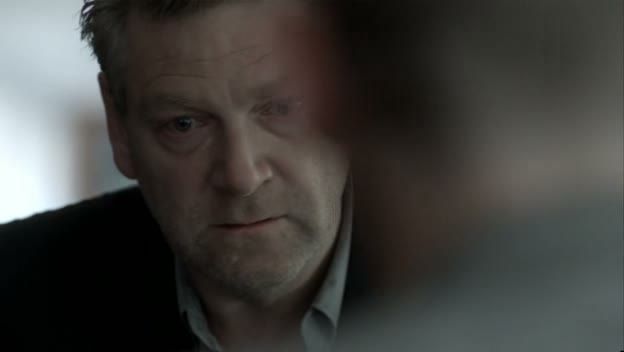
Pale and miserable.


Meanwhile: Kenneth Branagh's performance. Ah, Kenneth Branagh. There's something unique about his style of acting: a combination of naturalism with theatrical vulnerability. It worked so well in Henry V. Heck, it worked really well in that reincarnation movie with Emma Thompson which was, btw, totally fun! In Wallander, his pain is obvious - and his attempts to smother it, or hide it, or beat his way through it, are likewise obvious. It's not necessarily subtle, though it is… calming? What's the word? There's a comfortably sympathetic quality to it. An earnestness. That's it! Kenneth Branagh is terribly, terribly earnest. And that's awfully nice.