Showing posts with label hema malini. Show all posts

Wednesday, 27 August 2008

Kranti (1981)


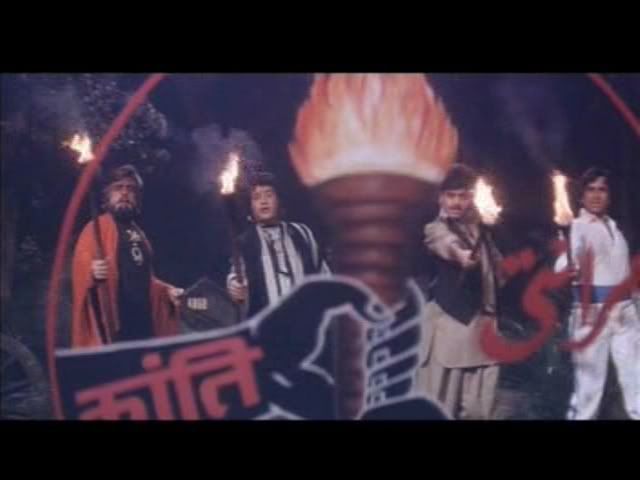
From left to right: Dilip, Manoj, Shatrughan and Shashi, all wielding the flame of revolution during the titular dance number.


We'll just get to the point. Kranti (Revolution) is bad. It's only a few notches above Mard, a similarly exaggerated fable of British Raj India. These films take place out of time, in a land where the British are all-powerful and all-evil, and Indians are perpetually victimized and ennobled by their suffering. Like Dhan Dhana Dhan Goal, Anglo-Indian race relations are painted with all the subtlety of a toddler's handpainting.

We at the PPCC are annoyed by these films because, apart from their racism, they also seem to dishonor the memory of the real Indian independence movement. Why invent all these ridiculous stories when the real one is more moving, more inspiring, and, best of all, true? What's the point of making inflammatory statements (Kranti's knock-out being the story of the evil British soldiers who denied a widow the right to burn herself on her husband's pyre only to then gang-rape her)? Don't you trust the real history of oppression, with all its complexity, to be more emotionally affecting than this beefed up grotesquery? Eh, Manoj?!

And who the hell is the target audience?

It certainly isn't the PPCC. And while we were happy to give Kranti more than a sporting chance - all-star cast! Manoj Kumar directs, writes, stars! epical! our beloved Shashi! - it quickly squandered that chance.
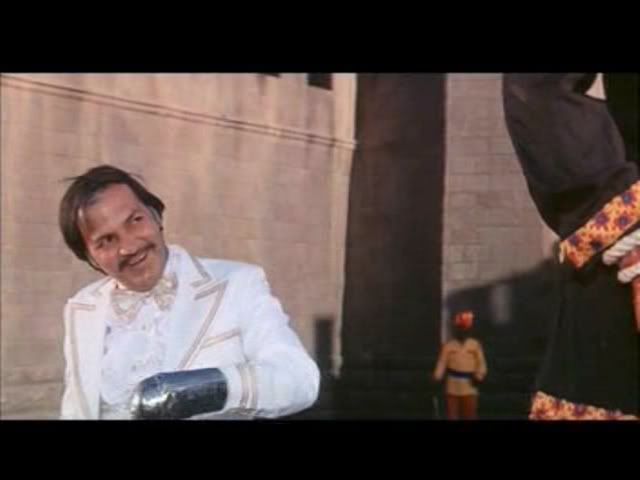

Evil collaborator Prem Chopra rules his land with an IRON FIST. (Ha, ha, ha...)


That's not to say it's all bad. It has some nice pro-girl moments; Parveen Babi and Hema Malini star as two kick-ass revolutionaries integrated into the boy's club of violence. The romance between Shashi Kapoor and Parveen Babi's characters is, while brief and mostly insinuated, also cute. Manoj and Shatrughan chew up the scenery in a most satisfying manner while Dilip Kumar seems to sail alone on the good ship Subtlety.

But even those rare lights of OKness are dimmed by the tired, unearned drama and endless vilifying. There are also - as in Mard - some bizarre and misused moments of eroticization. Whips, chains, oppression, racism - who gets kinky at a time like this?! Also, everyone - and we mean everyone - in this film kisses their weapons before using them, which becomes something of an unintended running joke/drinking game.

The plot structure is similar to several other films of the era, and indeed, most of the same people are involved. Sanga (Dilip Kumar) and Radha (Nirupa Roy) are two humble, God-lovin' folk trying to get by in 19th century India. After he inadvertently gets caught between the evil collaborator Indians (led by Prem Chopra, as usual) and their evil British overlords, Sanga finds himself on the wrong side of the law. After some twists and turns, Sanga, Radha, and their two infant sons are all separated, each believing themselves to be the only survivor in the family.

Fast forward some years, and Sanga is now a revolutionary pirate (yes, really) who goes by the name and flies the flag of Kranti (revolution). Meanwhile, his elder son, Bharat (meaning India, Manoj Kumar), is a Robin Hood-type revolutionary who also goes by the name and flies the flag of Kranti. The younger son, Shakti (meaning Strength, Shashi Kapoor), has gone Vichy on the family and is living the life of an Anglicized Indian prince in the palace. As per the required Hindi Movie Irony, Mother Radha labors in that same palace's kitchens as a slave.

Not enough stars for you?! Well then have some more! Spoiled Anglicized Princess Meenakshi (Hema Malini) is abducted by Young Kranti's gang, and she butts heads with salt o' the earth bombshell Sureli (an excellent Parveen Babi). Think you know which heroine ends up with which hero? Not so! The tables turn when Sureli is sent off to the palace, impersonating Princess Meenakshi by (she's instructed) acting rudely to everyone. There follows a too-brief and funny sequence where Sureli goes wild in the palace, getting drunk at a party and (yet again) wooing Shashi at the same time.
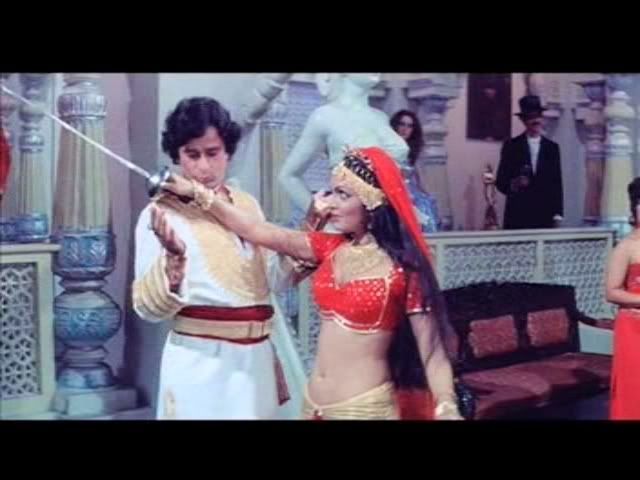

At one point, she gets him to kiss her weapon, that cheeky tart.


And let's not forget our Muslim freedom fighter and walking pep talk, Karim Khan (a bad-ass Shatrughan Sinha, as usual), who appears every so often to weild his bad-assery and give everyone a morale boost. OK, we admit it. Every time Shatrughan appeared onscreen, we were PUMPED. YEAH. YEEEAH! LET'S KICK SOME ASS! RAAAH!

Amidst all this, there is the occasionally touching romance between Manoj and Hema (who knew!), numerous scenes of imprisonment, a long and weird sequence on a galley ("Row, ya bastards!" - Eddie Izzard), numerous tales of the Britisher's debauched, purified EVIL embodied in nice guy Tom Altern, and the inevitable reunion of four severely misplaced family members.

The performances are all fun, but that's because all the stars - Manoj, Hema, Dilip, Nirupa, Shashi, Parveen, Shatrughan, Prem, even Tom Altern - are such likable and familiar faces. Indeed, our love for these people is the only reason we watched this silly film until the end.

Special note must be made of Dilip Kumar, who, unlike his fellow Krantites, refused to give into the outrageousness. While Shatrughan and Manoj achieved new heights of uber-drama ("Bastarrrrrd!"), while Shashi bawled with abandon in his Ma's arms (out-emoting even brother Raj, king of emo), Dilip put in a stubbornly authentic, softspoken, heartfelt performance. More than once, we wondered, "What is he doing in this movie!? He must think he's in Gandhi."
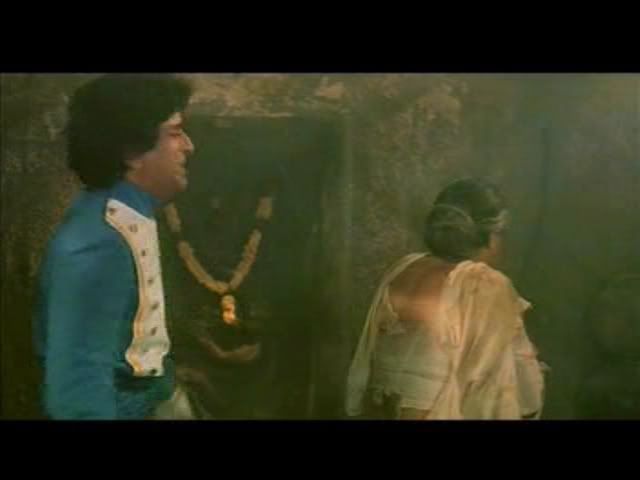

It was hard to catch Shashi's bawling, as he moves around a lot, but compare it to older brother Raj's tantrums in Anari.
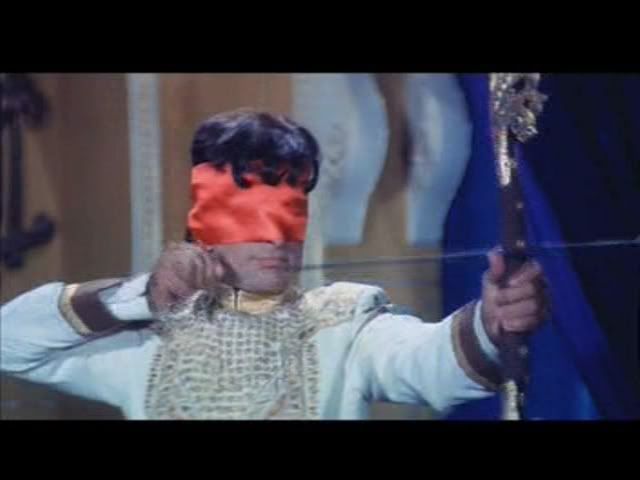

Actually, poor Shashi goes through the meatgrinder in this film. Here he's been forced to shoot the eye of a rotating mechanical fish, blindfolded, while his foster mother stands right behind the fish eye. Don't miss, my son!
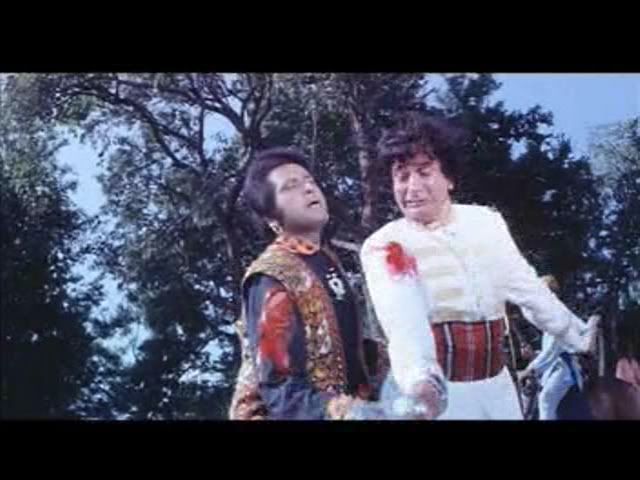

Here, he gets his ass kicked by older brother Manoj. As if that wasn't humiliating enough, some of Manoj's cronies then run him over using his own carriage. Fear not, Shashi Kapoor/Ben Hur fans, he emerges unscathed (well, excepting his pride). Heh! It takes more than some cloven hooves and a three-hundred pound carriage to knock off our big hero.


Another special note must be made of the Manoj-Shatrughan jodi. You know, some pairs just have it. That certain special something. That hint of magic. Much is made of Amitabh and Shashi (and, after seeing this, we would say Shashi and Whoever's Playing His Mom), but we must say Manoj and Shatrughan have something oddly and equally magnetic about them. At least, there's this silly sequence when they're both imprisoned in the galley of a random British boat together. After a single cut, they've both grown matching beards and it all turns a bit Monty Python. When Shatrughan starts despairing to the point of histrionic meltdown, and Manoj grabs him in a bear hug from behind, beckoning him to, "Take it easy, man!" - well, gosh, the PPCC was touched. These two are lovely together. They play off each other so well, feeding each other's melodrama: Manoj's hurt moans of "NAHIN!" coupled with Shatrughan's enraged roars of "NAHIN!" Have they made any more films together? Please say yes, internet!
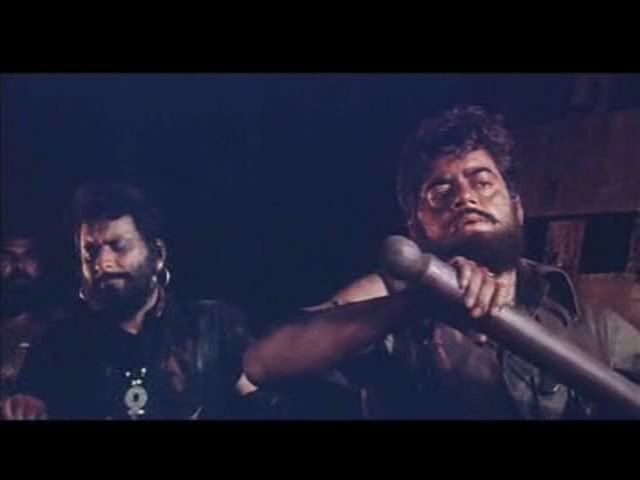

These two were an unexpected, happy surprise of this film. If the PPCC could make films on demand, we would demand that they make a special subfilm of Kranti called: Manoj and Shatrughan, The Galley Days.


But alas. An unexpected jodi can't save the rest of this film. This film came in at the low tide of ideas (and other things). Manoj's legendary patriotism - which we approved of in Roti Kapada aur Makaan - was misspent and tiresome. So were Dilip's naturalist acting, Shashi's maudlin tears, and Parveen's zaniness.

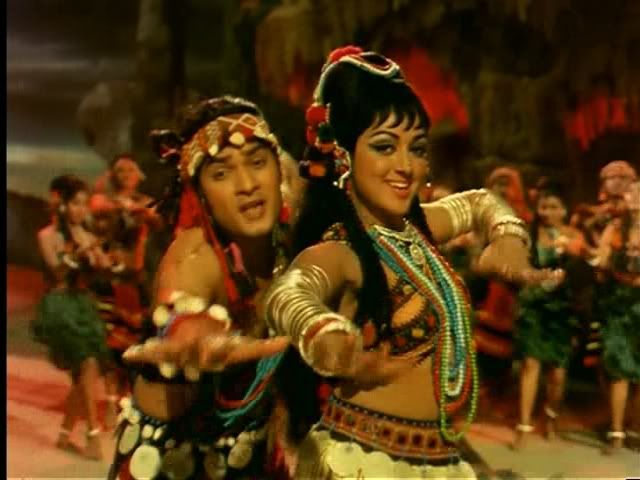
The songs were also pretty disappointing for Laxmikant-Pyarelal, though thankfully some of the picturizations were flamboyant enough to be entertaining. Manoj and Hema's kinky love duet on the boat, where he is strapped to the mast (a la Odysseus!) and she (a la Siren!) writhes around on the deck in front of him is... pretty shocking. We at the PPCC also really enjoyed Shatrughan and Hema's disguise song which they use to rescue Manoj (chained up, yet again) - Shatrughan, doomed and blessed to play the bad-ass that gets killed off in the end of every movie, is a lot of fun doing comedy.

This film's basic problem is that the emotional kicks - which are a masala film's life-source - don't work. We don't buy the faux historical context, and we're not particularly sold on the family drama either. Roti Kapada aur Makaan is an example where Manoj Kumar got his formula really right: a broad socially-minded context involving the Plight of Mother India, and, cast against that, a moving story of human relationships. Kranti, on the other hand, is an example where the formula went horribly, terribly wrong.
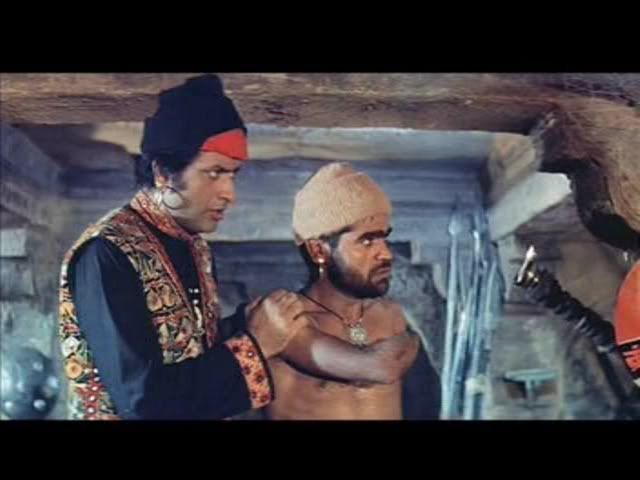

First: is Manoj wearing a ski cap? Let me tell ya, it was very distracting.
Second: the film went out of its way to empower this disabled guy with no arms. Manoj introduces him (in the above scene) as Yet Another Victim of British brutality (the British cut off his arms... just because he was Indian!), but then the guy ends up becoming an integral supporting character who saves our heroes from imminent death on more than one occasion. Indeed, we see this guy achieving amazing feats - climbing aboard the ship with a knife between his teeth, stealing guns and shooting British minions, rescuing Manoj and Hema, dancing in the big show-stopping numbers. It was like... YEAH, GUY, YEAH!

Sunday, 30 December 2007

Abhinetri (1970)


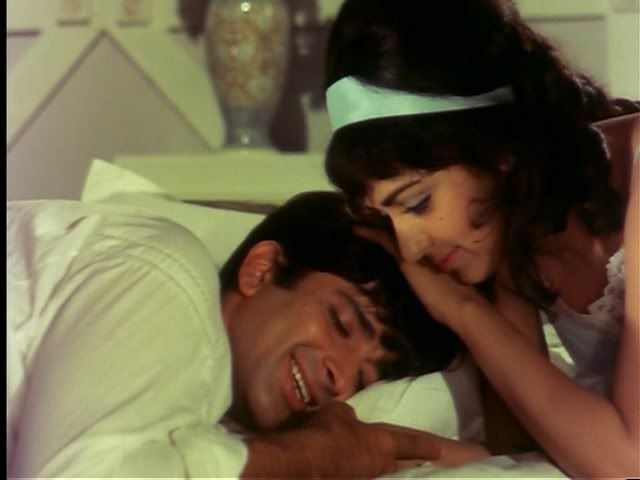
Cuddles. Cuuuuuddles.


The PPCC once mentioned that happy couples don't exist in th early parts of Hindi films. We'd go so far as to extend this generalization to most films, books, or oral epics; it's just not good narrative form to have a film about romance have the marriage take place within the first thirty minutes. In such a scenario, the only aesthetically logical conclusion is that one of the lovers must perforce die sometime later (but not too long later) in the film so that we can then talk about love as a grieving thing, not love as a troublesome courtship ritual. See, for example, Silsila or Kasme Vaade or Kuch Kuch Hota Hai.

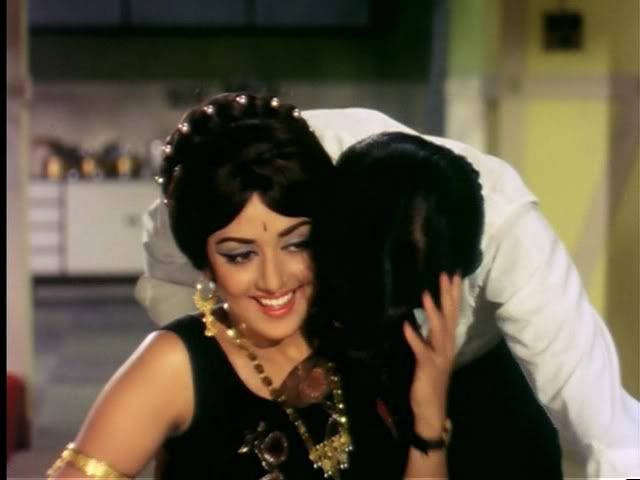
In Abhinetri, Anjana (Hema Malini) and Shekhar (Shashi Kapoor) meet and fall in love and get married within the first hour. They cuddle and proclaim how much they love each other. At one point, Anjana says Shekhar is so wonderful that she could gladly die in his arms. By this point, the PPCC was convinced: OK, Anjana's going to die. Probably in Shekhar's arms. It makes perfect narrative sense. She even foreshadowed it herself!


"Oh, my head! Oh, Shekhar! I'd be happy to just DIE. In YOUR ARMS."


So it was with increasing anxiety that the PPCC watched Anjana survive each scene. And then we started to doubt, "Wait... how can they kill off Hema's character anyway? Famous Shashi may be, but he cannot bear alone the weight of a double-billed Shashi-Hema film with no Hema! And the DVD cover makes no mention of double roles." Time ticked away, and eventually the threshold was passed, when it became too late in the story to have any deaths, unless of course Shekhar and Anjana blew up together à la Amar and Meghna (which would have just been weird in a romantic comedy).

Then we understood: "Oh, wait, this is a domestic rom com. Oooh." Now it all fell into place. Shashi was basically reprising Raja, except more educated and yet similarly unenlightened, and Hema was Mary Tyler Moore. The film, which is light and zingy like a key lime pie, explores these two quirky characters as they get married and then run into, well, basically Shekhar's total stupidity. Or, you could say, cultural constraints on married women in the rapidly modernizing bourgeoise of 1960s India.


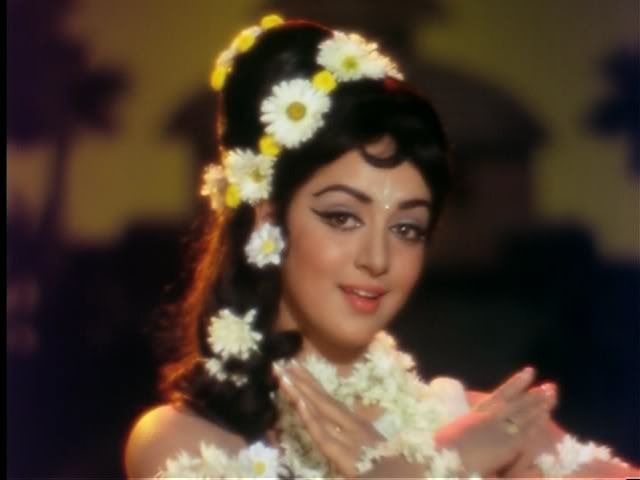
Awww, Hema was so cute.


Proper summary: Anjana (Hema Malini) is a kick-ass dancer, loved and adored by legions of cultural classicists and, well, yes, some horny philistines too. But she loves what she does. She is empowered and independent. One day she accidentally locks herself out of her home just as a handsome stranger, Shekhar (Shashi Kapoor), has also ran onto the porch to protect himself from the rain. Anjana, being assertive, asks Shekhar if he can open the jammed door, and Shekhar obliges, twisting his ankle in the process. They bicker with the familiarity of two people who are made for each other. Hence, when Shekhar leaves his jacket at her place, it's a perfect excuse for Anjana (!) to initiate the courtship. Take that, patriarchal society.


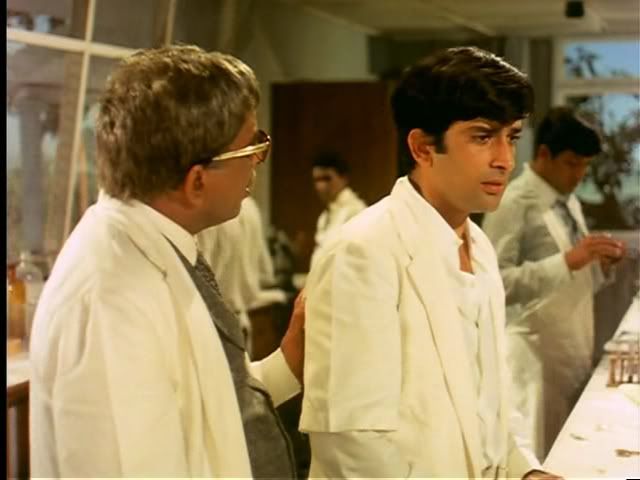
Something distracting you from your work, son? Need to go to the bathroom?


Shekhar, interestingly, is a chemist working in a fertilizer factory, and there are a number of bizarre and funny scenes when he and his boss discuss the state of apples and shake neon-colored test tubes and make jokes about washing your hands. Shekhar is a scientist of the Doctor Doolittle breed: lovably quirky, absent-minded and socially inept. Yet he is Shashi, and so Anjana falls for him and, well, she is Hema, and so Shekhar falls for her. When Shekhar introduces her to his mom (Nirupa Roy... of course), and Anjana, an orphan, takes to the mom like jelly to peanut butter, it's obvious that wedding bells are ringing (uh, between Shekhar and Anjana).


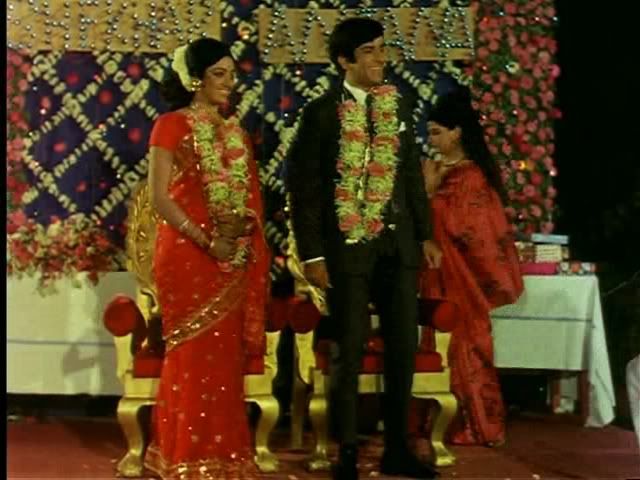
Marriage bells already ringing! This can only lead to DOOM.


Yet more cuddles at the kitchen table during Happy Domesticity. Note with alarm that Hema's character is not dead.


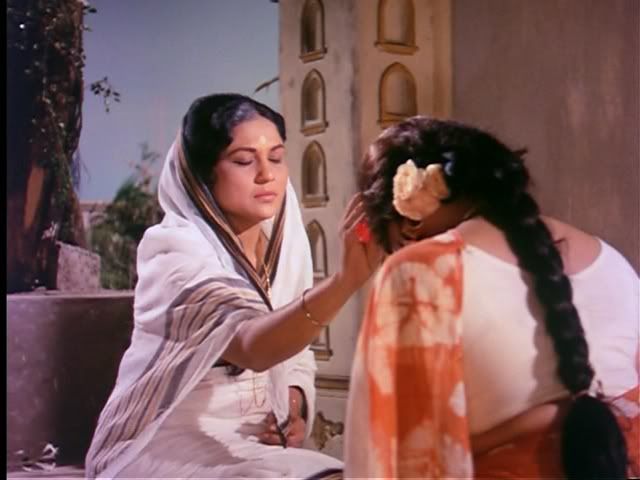
Ever-required Mom's Approval.


So Shekhar and Anjana get married and start living happily ever after. As mentioned above, neither die but instead putter about in the kitchen and talk about domestic things. What?! Clearly something is up. The drama comes when Anjana, who had given up dancing after marriage, decides she wants to start dancing again. Shekhar reveals himself to be a close-minded traditionalist, and he pouts and whines and becomes generally unpleasant, eventually driving Anjana to go live with her friend. There is much snapping at and avoidance during this separation, until Mom comes to visit Shekhar and, again because Shekhar and his Mom are apparently fervent traditionalists, Shekhar begs Anjana to come back home and pretend to be his wife. Mom will never accept a marital squabble, let alone separation! Anjana reluctantly agrees.

And indeed, just as they say behavioral changes lead to changes in thinking, Anjana and Shekhar begin to fall in love again as they pretend to be a happily married couple. What? It's Shashi and Hema! They're so cute, who could resist? And how could they resist each other? Impossible! When Mom makes her move to leave, the spouses, too proud to admit it to each other, both privately beg her to stay so that they can continue with the charade. Mom reveals this to each of them, and everyone is reunited again in a big, happy family.


I just want to dance!


In one respect, this is just as offensive and misogynistic as Jab Jab Phool Khile. Made during the same time, once again we are told that a "career woman" has no chance of being employed, empowered and happily married. And, once again, the woman chooses marriage over herself, hence implying that that's the 'natural' or at least 'desirable' conclusion. That said, Abhinetri is somewhat more forgiving to us girl folk. Jab Jab Phool Khile properly demonized Rita's attempts at modernization; they were, in the extreme, equated with alcoholism and prostitution, or, at the very least, an unnatural attempt to deny your Hindustani dil and play the Westerner. At least in Abhinetri, Anjana's independence takes the form of the objectifying (but nonetheless much more valid than just boozing and dancing with men) creation of art via classical dance. Also, thankfully, Anjana is allowed space to give her side of the story, and it seems that the film largely sympathizes with her plight: Shekhar's mom lends a supportive voice by mourning the loss of her own independence after marriage (she had been a singer). Hence both women say on several occasions that it was quite painful to give up something you love in order to conform to traditional gender roles. In fact, Shekhar's oppressive inflexibility seems partly a quirk, just another sign of how naïve and sheltered his workaholism has kept him.

The happy ending comes partly to fulfill the audience's wishes, but it is no resolution. Effectively, Shekhar and Anjana have just moved back in with each other; there is no mention of whether Anjana will or will not take up dancing again. It seems only that Shekhar and Anjana's love is strong enough to keep them together, even if they may bicker. Whether Anjana ends up conceding the fight and becoming 'domesticating' is left unsaid, though we at the PPCC think she was a strong enough character that she would have just accepted the quarrels in exchange for her right to a career. And Shekhar was as pliable as putty, so surely he would have eventually given in.

Peformance-wise, Shashi and Hema are as charismatic and cute as they always are. They have wonderful chemistry, and it was also refreshing to see Shashi in a more submissive position within a relationship. Usually he plays the playboy (see, for example, Trishul, Kabhi Kabhie, and Kaala Patthar) who, with the cunning skill of Austin Powers, makes you randy, baby, yeah. It was nice, then, to see him play the dorky, inhibited boyfriend who has to be reminded what foreplay is. We don't want this review to turn into the review for Satyam Shivam Sundaram, where everything turned into a sexual metaphor, but we at the PPCC simply must note the song where Anjana teaches Shekhar to sing. And by sing we actually mean "sing" (wink wink nudge nudge).


It's best if you don't think of The Sound of Music while watching this, because that just ruins the metaphor and makes it creepy. Anyway, this was the PPCC's favorite song and worth the price of the DVD alone.


Oddly, and we hate to write this, but Nirupa Roy, always so comforting and maternal, turned into a real pain during Abhinetri. First, she seemed much too young in 1970 to be playing Shashi or Hema's mother, and the make-up didn't even attempt to age her. Second, she had an air of such ethereal saintliness that we groaned every time she appeared in a scene. Ugh, spare us the sermon!

A Note on the DVD: We have a Super Digital Media DVD of Abhinetri and, for the love of all that is sacred, it has Special Features and these Special Features are so special that they feature an entire selection of Shashi and Hema's solo hit songs from their respective repertoires of awesomeness. The PPCC just died. Just died.

Friday, 30 November 2007

Trishul (1978)


The usual family argument with a hint of masala.


We saw a tagline for Trishul somewhere that called it (rather lamely): A Sequel to Kabhi Kabhie... Of Sorts. Well, yes, it is a sequel... of sorts. Both films are directed by Yash Chopra. Both films have lots of familial drama. And all the KK alumni are back: Amitabh, Shashi, Rakhee, Sanjeev Kumar. Wait, was Rakhee in Kabhi Kabhie? No, it was Jaya. No, it was... OK, we're too lazy to check, so whoever it was, a lot of people from Kabhi Kabhie are in this one again. Except for Rishi Kapoor, thank God. But apart from the same players, Trishul really is quite different from the earlier Chopra film. It has, for one, a much stronger plot, which centers on the elaborate revenge an illegitimate son takes on his father. A rarity in Hindi films, the drama centers on business takeovers and corporate espionage rather than tears and domestic fights. Yes, Amitabh does pack some punch for us, but he also packs some cheeky economics. How refreshing!


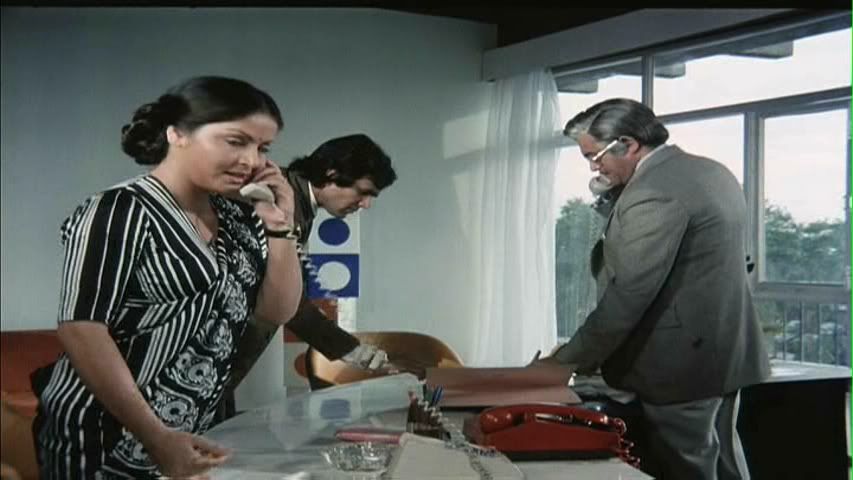
Instead of guns we use phones.


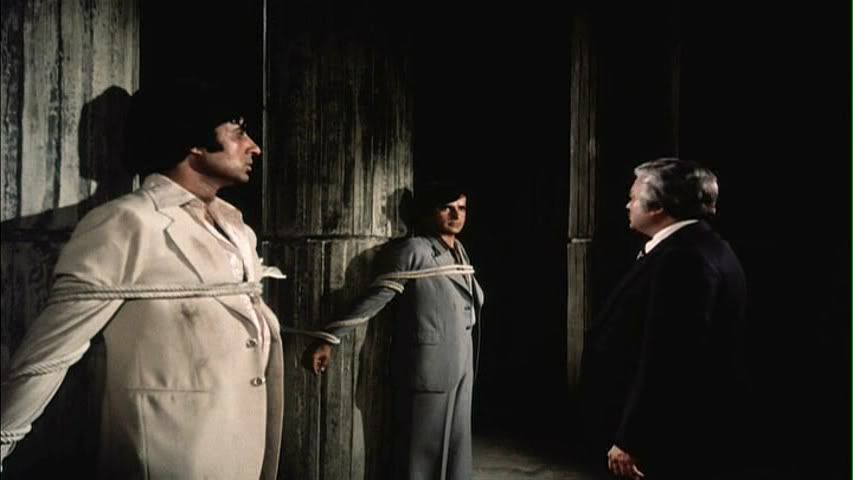
Cue the prologue. Once, long ago, an ambitious youngster hereafter named Patriarch (Sanjeev Kumar) loved a girl named Shanti (Waheeda Rehman). He loved her so much he wanted to marry her. But his mother would not approve: why get married for love, she said, when you can get married for riches and inherit a huge company? Touché, Patriarch said and dumped Shanti. Shanti, naturally stunned, gathered herself enough to put a curse on his family. And then she also had his illegitimate son, who, naturally, grew up into the hardened Angry Young Man of 1970s Bollywood (also known as Amitabh Bachchan, but we'll just call him AYM). AYM was so angry that he took an MBA and went into real estate. He also lit dynamite fuses with his cigarettes in a clever symbolism of his own short fuse. Once he came of age and Shanti expired from bitterness, he set off to find Patriarch and extract revenge. His modus operandi would be to slowly steal the market away from his father's construction company, so that, as AYM puts it, "The sign Shanti Constructions will be seen all over Delhi!" Patriarch, while admiring his young competitor's chutzpah and slightly bewildered by his ferocious competitiveness, never seems to put two and two together and recognize his illegitimate son: yes, it's Shanti Constructions as in your rejected girlfriend Shanti, dummy! "Huh, how strange," father says more than once, "it's almost like he has something personal against me." No shit, Sherlock.


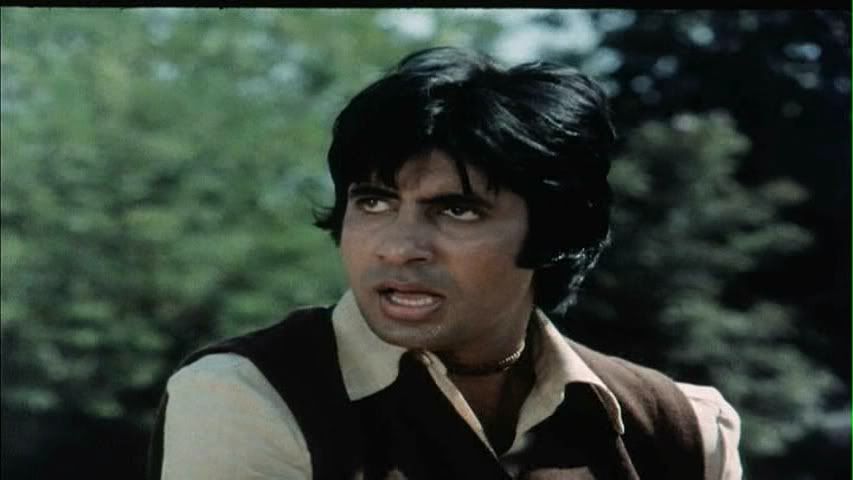
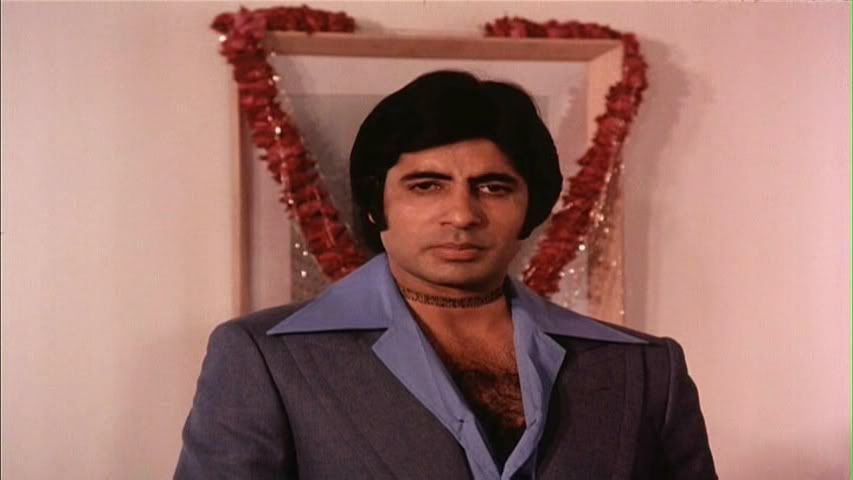
I am so... freaking... angry. (Note the choker.)


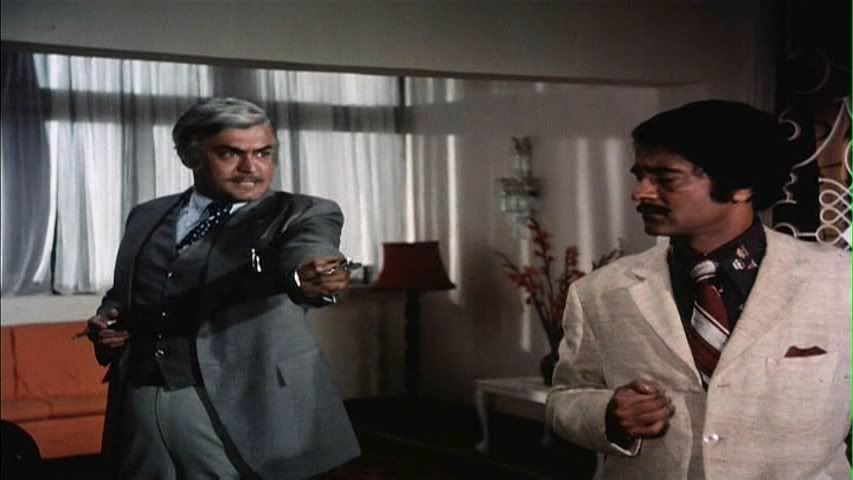
I am the pater familias! I must pay for my sins!


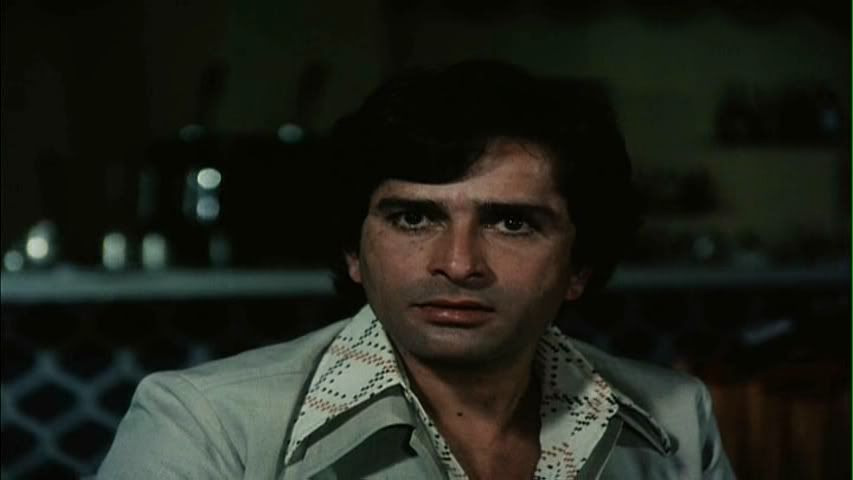
I am the legitimate son and certified dandy. All the buttons fell off of my shirt, sorreez.


The PPCC's favorite moment.


Meanwhile, Patriarch has been procreating some legitimate children: notably the pampered dandy Shekhar (Shashi Kapoor... of course) and the Hindustani-style valley girl, Bubbly (Poonam Dhillon). Both children have grown up in the lap of luxury, and it shows. Yet AYM feels conflicted. The pull of siblinghood is strong - and one of them is Shashi, after all, his trusty sidekick in so many other incarnations - yet AYM's hatred for Patriarch is stronger, so AYM decides to make his semi-siblings suffer too. He does so, meanwhile ensnaring the not-so-loyal former secretary of Patriarch. As AYM attempts to sabotage one of Brother's innumerable love affairs, Brother picks up on something being off. Sister is too lightheaded to realize.


The mom. I hex you! Hex, hex!


Visual pun. Nice.


Shashi is so good at registering shock. See Fakira.


Yes, it's all very epic, and, according to Iowa, there are shades of Kalyug, which had shades of the Mahabharata. It's a bit like Ridley Scott's Gladatior: star-studded, snappy, with vague, but satisfying, historical oomph to it.


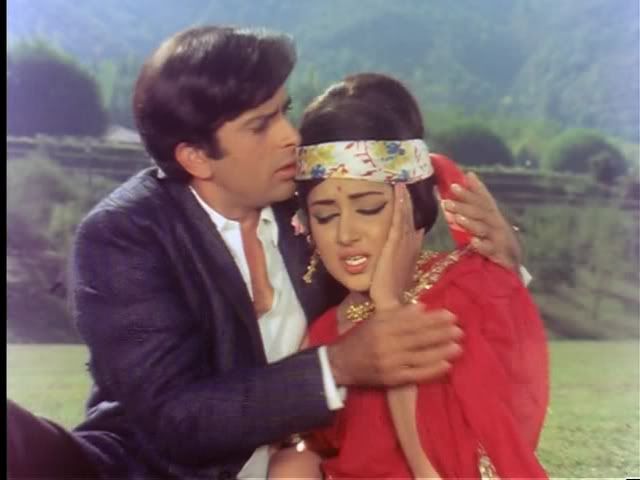
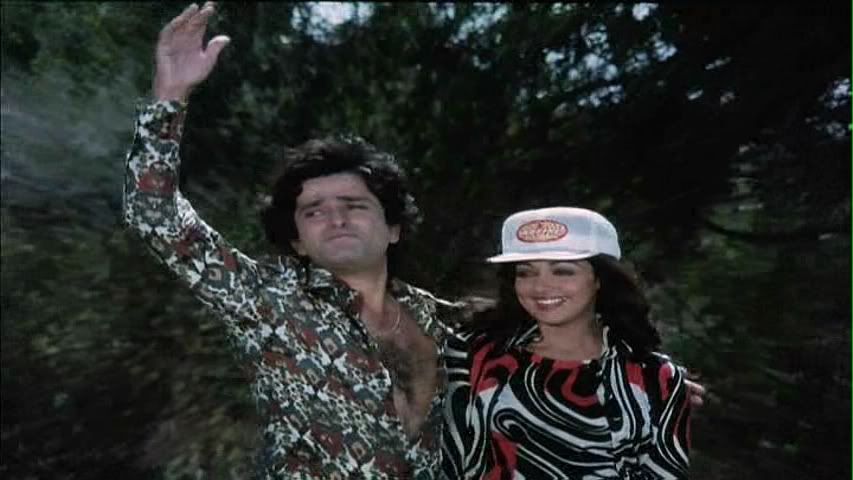
Shashi and Hema being cute, with Shashi starting to resemble his much older self.


Onto the actors, songs, and hooplah. Mostly everyone reprises their archetypes for Trishul: Amitabh, as usual, the working-class Angry Young Man we have all known and loved from such films as Zanjeer, Deewaar, and Suhaag, Shashi as his bourgeoise, romantic hero brother, Hema Malini as the frothy love interest, Sanjeev Kumar as the righteous patriarchal figure (see also Sholay or Silsila), Rakhee as the possible Amitabh love interest and goody-two-shoes, and then some young pups we didn't recognize and who didn't make much of an impression. The fact that everyone is playing their Cinematic Egos lends an air of comforting familiarity for anyone who knows 1970s masala. No one really deserves comment, though we do make special notice of Amitabh's choker (the man may be bitter, but he also had style) and Shashi's wonderful ability to register shock.


A classic with Shashi, Hema, yoga, and Shashi's chest hair.


Eagle ears Iowa note that this is the only song where Amitabh's AYM actually sings.


The dennouement is somewhat unsatisfying, even though we more or less saw it coming (Patriarch had crossed that moral threshold of recognizing legitimacy, after all). The film is most enjoyable in its moments of stereotypical masala goodness with a little more weight to it: all of AYM's interactions with Patriarch are juicy fun, and all of Shashi and Hema's songs are as sweet and lovable as they are.