Whoa! Big time!
Yes, the PPCC has got its grubby little hands on a bad-ass Chinese epic - before its international release! Mwahaha! And before you start all going, like, "OMG the PPCC is totally such a buyer of illegal DVDs!" We swear on our love of Shashi that this is the real deal, purchased from a reputable movie and music chain in China. Even more interestingly, this 2.5-hour film is merely part 1 of a promised four-hour epic (source: Red Cliff Wiki article). Outside of China, the international version will merely be a single 2.5-hour film. Envy us! Enveeeeee!
So. The film: Red Cliff.
Since the original rumors began, almost two years ago, that John Woo was going to direct some mega historical martial arts film, the PPCC had been in a tizzy of excitement. The original star line-up was practically a roll-call of our favorite Asian actors: Tony Leung Chiu-Wai, Chow Yun-Fat, Ken Watanabe... Unfortunately, the tide of rumors changed, and Chow Yun-Fat and Ken Watanabe eventually dropped out, to be replaced instead by that ultimate stud of hotness, Takeshi Kaneshiro. Totally OK by us.
Anyway, we knew that the Time of Red Cliff's Release was soon approaching, and when we were sent to China on an errand last month, we quickly carpe diemed the opportunity to buy anything - any-thing - Red Cliff and/or Tony Leung Chiu-Wai-related. (Whose name, incidentally, is not pronounced like that at all in Cantonese... and this led to much jocularity and confusion.) When we went down to the (legitimate!) movie store and browsed the Tony Leung stacks, we were surprised and delighted to see Red Cliff all prim and ready to be purchased. "Wow!" we thought, idiotically. "They really are technologically advanced here! They've got DVDs of movies that haven't even finished filming yet!" (Hmm.) So we bought it and petted it and hugged it and loved it. And then we watched it.
"Enough of this gonzo reviewing, what about the freakin' film?" you ask.

Sigh, Takeshi Kaneshiro... you look so fly when you get all contemplative and such.
Well, first, a couple disclaimers. Disclaimer #1: This is our first John Woo film. We reckon it always takes a bit of time to get into the rhythm of a director's style. John Woo's style, seemingly characterized by swooping, ultra-fast cuts and a general impatience in all matters action, was like a new language for us. Disclaimer #2: Maybe the international release (which you minions will be forced to watch, ha ha ha!) will be more non-Chinese-friendly and full of helpful exposition, but this film seemed to assume a whole canvas of background historical knowledge. We got heavy Trojan War-esque or Devdas-esque vibes - you know, this was the type of story that everyone (except us) is apparently familiar with. We, however, had no idea who Zhou Yu and Zhu-ge Liang were, and so we spent quite some time going, "Wait, what? Who? Where? WHY?!"
Here, then, are our (uneducated) thoughts.
What: So back in the day, there was the Han Dynasty. The Dynasty's Prime Minister was this super-corrupt dude named Cao Cao (Zhang Fengyi... resembling uenxpectedly Takashi Shimura). One day, Cao Cao was all like, "I'm gonna proclaim war on the world!" And the bird-loving twentysomething Emperor Xian was like, "Uh... okay." So Cao Cao embarked to kick some ass.
Who: Arrayed against him are a motley troupe of legendary awesomenesses, led by the rebel Liu Bei (You Young). There's the smooth-talking Chief Strategist, Zhu-ge Liang (Takeshi Kaneshiro). There's the wild-haired Zhang Fei (Zang Jinsheng). There's the stoic and heroic Zhao Yun (Hu Jun). With their forces combined, they are awesome... but they're still missing the key to magnificence. That key is discovered in the new-formed alliance with the southern state of Wu. When the uber-diplomatic (you'll agree with anything he says!) Zhu-ge goes off in search of some military help, he's introduced to Wu's commanding officer and viceroy, Zhou Yu (Tony Leung Chiu-Wai). Immediately, the sparks of recognition and awesomeness fly: apart from sharing a sort of good-humored meditative personality, a love of fans and music, both Zhu-ge and Zhou are military masterminds. When Zhou rocks out on his guqin (sort of like a lap guitar), and when Zhu-ge helps Zhou's horse give birth to a little horseling, the friendship is solid. Yay!
Where: Now, armed with the diabolically clever Zhou, the rebel army is ready to kick some butt. When Cao Cao's forces ride up along the Yangtze to Red Cliff, the final climax mounts up into an enormous battle.
Why?!: All to be continued in part 2!

Tony Leung Chiu-Wai as Zhou Yu (left) and Takeshi Kaneshiro as Zhu-ge Liang (right).
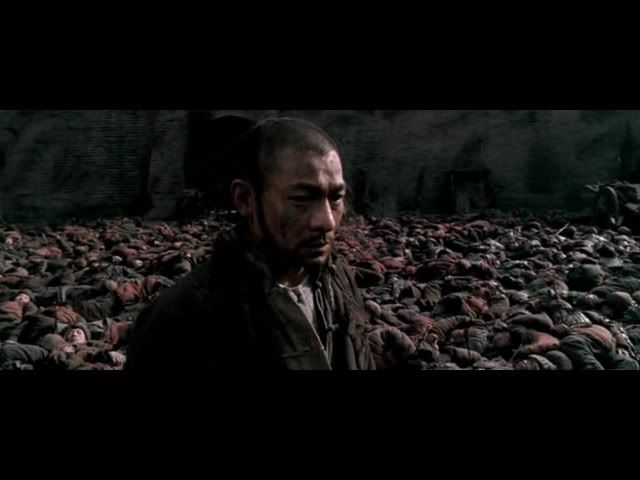
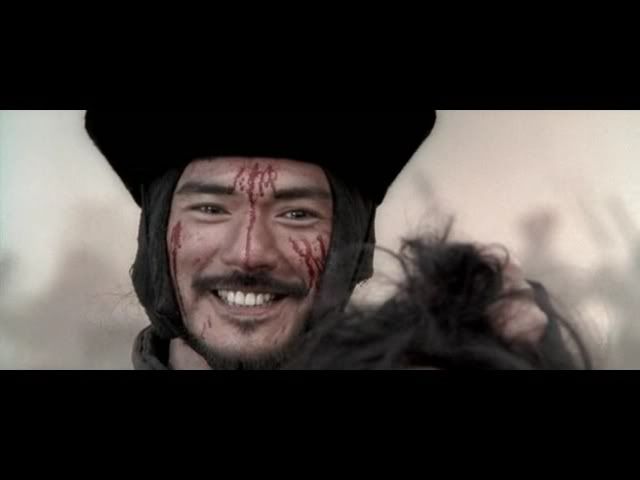
So what sort of impression did this film make to a person as ignorant in Chinese history as the PPCC? Generally, very good! It was a straightforward epic - calling to mind Lawrence of Arabia, Return of the King and anything else large and glorious. It was all sweeping shots of moving armies, sprays of blood and gold-tinted horizons. The music was similarly evocative, resembling more (to our ears) 60s-era Hollywood epic rather than, for example, the minimalist traditional Chinese of Tan Dun. The emotional tone was also fairly simple, in keeping with the unambiguous Legendary-ness of the story: no one was morally gray, everyone was brave and honor-bound to kick-ass. There were some half-hearted attempts to be gender friendly in a clearly very gender unfriendly historical context with the occasional, "Girls are people too!" line from the tomboy princess lady (who resembled very much Juhi Chawla, by the way).
That's not to say the characterizations weren't complex. Quite the opposite! Soaked in that Stuff of Legend vibe, Zhou Yu and Zhu-ge Liang leaped out from the screen as fully-formed and quite interesting heroic ideals. Both seemed more philosophical musicians than hard-bitten military commanders, carrying themselves like young Obi-Wan Kenobis (only with a sense of humor). Their interactions were also wonderfully sweet, such as in one scene, when Zhou approaches Zhu-ge while the latter is fanning his pigeons.
"What are you doing?" Zhuo asks.
"I just gave them a bath," Zhu-ge explains as he fans. "I'm drying them off."
"Won't they catch a cold?"
Zhu-ge quickly stops, a look of horror on his face.
These gentle, humorous exchanges were wonderfully juxtaposed against the harsh bloodbaths that were the battles. Indeed, when, in another scene, Zhou Yu sighs that, "After my first war, I never wished for a second," you actually believe him. Unlike the macho, strutting war heroes of the usual Western war epic, Zhou Yu and Zhu-ge Liang genuinely seem like easygoing pacifists with an ironic talent for war. Zhou Yu's not just paying lip-service to the world weary idea of "one too many battles" - he genuinely wants to just get back to rocking out on his guqin and tending to all things domestic with his gentle wife, Xiao Qiao (Chiling Lin).
Now we at the PPCC have no idea if these characterizations are in keeping with the legendary mythos, or if they've been colored by the performances and interpretations of Tony Leung Chiu-Wai and Takeshi Kaneshiro. Both actors are indeed known for their "strong, silent type" roles - they're both very good at exuding charisma and intensity with merely a glance or wry half-smile (especially in Tony Leung's case - oh, be still, our heart!). Note, for example, Kaneshiro as the earnest warlord in the previously PPCCed The Warlords. Note also Tony Leung Chiu-Wai as the evil-yet-vulnerable collaborator in Ang Lee's X-rated Lust, Caution or as the calligraphy-inspired, softspoken Broken Sword in Zhang Yimou's marvelous Hero. Suffice to say, both of these guys just ooze thoughtful reserve.
The rest of the cast unfortunately falls a bit by the wayside thanks to Tony Leung Chiu-Wai and Takeshi Kaneshiro's talents. Chiling Lin, as the reportedly "most beautiful woman in China", seemed nice and... well, cute. The fiery tomboy princess was a lot more fun - though we were a little annoyed to see her "tomboy" behavior ridiculed and relegated to sitcom-ish buffoonery. Thankfully, she gets to kick butt in the final battle and set off some sparks of mutual attraction with Zhu-ge (who knows awesomeness when he sees it!). Zhang Fengyi, who played the villainous Cao Cao, was pretty fun - chewing up some scenery here, lazily lopping off some messenger's head there, but we're still waiting to see that bombastic, warlord spirit we're expecting from that type of character.
Overall, the film drops us in media res and leave us hanging with a To Be Continued. The main plot arc centred on Zhu-ge convincing Zhou to come fight, but the film ends before we get to see a proper gloriously large (and thankfully inevitable) showdown between Cao Cao and the rebel forces. But no worries - this is, after all, Part 1 of a 2-part film series. And we expect that many of the Chinese viewers will already be familiar with the conclusion (?).
For those, like the PPCC, that tend to devour cultures like they were chocolate cake, this is a great and fun dip into Chinese history and culture, starring two of Hong Kong's most likable actors. Recommended!