Monday, 31 January 2011

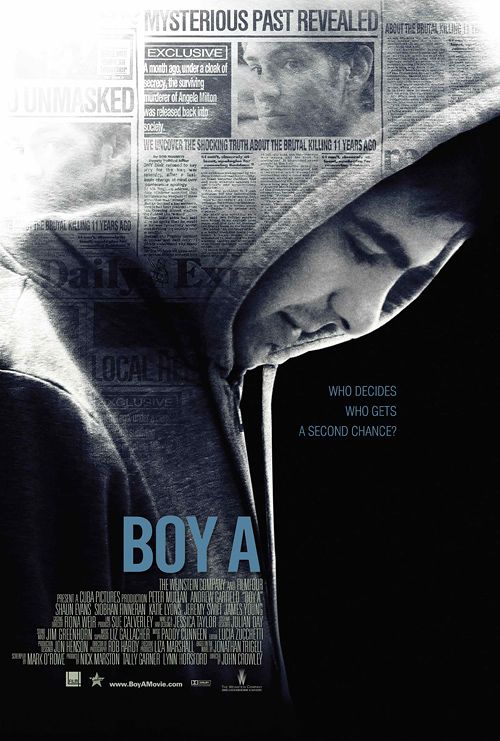
Boy A (2007)


Boy A is an emotionally charged, gritty film about redemption and the inability to escape the past.

It follows the life of Jack (Andrew Garfield), a young man recently released from prison for a murder he committed as an adolescent. Under the wing of his protective, gruff case worker, Terry (Peter Mullan), Jack takes on a new name, a new job, new friends and a new life. For a while, things seem to be going great: his assertive, gorgeous coworker, Kelly (Siobhan Finneran), courts him, his friends introduce him to the time-honored English tradition of going down the pub, and even, by a twist of fate, he manages to save a young girl from a car accident. Everyone is very forgiving of his mumbling shyness or his embarrassed insecurities, and everyone - the characters, the film, us - is quickly charmed by his shaky vulnerability.

Of course, Jack is vulnerable. Despite Terry's proclamations that the "past is moot" and "we only look forward", Jack's past is constantly threatening to submerge his present. Wracked with flashbacks and nightmares, Jack is constantly dodging a limelight that feverishly searches for him. "EVIL COMES OF AGE," a local newspaper headline screams, touting a picture of Jack as a child on the cover.

The film does a nice job of portraying Jack as innocent and damaged, building up - both in flashbacks and in the present - Jack's essentially gentle nature. We can't help but feel incredibly forgiving of whatever it is he did. Indeed, we were already inventing excuses for him. Then, just as things are turning sour for Jack's present, we flash back to the murder itself, and our slowly-fermented sympathies are given a good jostle.

An unexpected and tenuously successful parallel is drawn between Jack and Terry's biological son, a mediocre loafer who hangs around the house watching TV and cradling beers. Filial jealousy and paternal bewilderment hinted at classical themes - King Lear-ish? - but it felt forced and inorganic. The best thing about this part of the film was its portrayal of a vigilante society using ex-convicts as scapegoats for its own failings.

Andrew Garfield and Peter Mullan were perfect in their roles. Andrew Garfield's wispy boyishness struck us in the otherwise awful Never Let Me Go, while Peter Mullan likewise made an impression as the crusty, psychotic guard, Sid, from Children of Men ("Sid doesn't want to know. Sid doesn't care."). The filmmaking style was low-key and evocative, similar to Michael Winterbottom's Code 46 in tone and Dead Man's Shoes in the portrayal of a disaffected rural England where horrible violence bubbles under the surface. Recommended.

Saturday, 29 January 2011

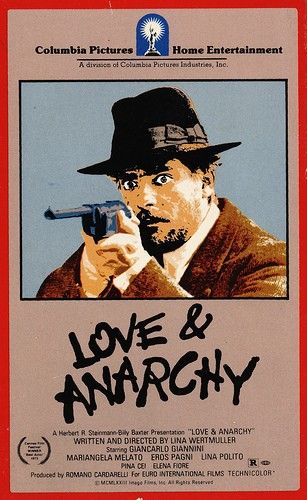
Love and Anarchy (1973)


Good God. Careful with Film d'amore e d'anarchia, ovvero stamattina alle 10 in via dei Fiori nella nota casa di tolleranza... (A film about love and anarchy, that is, this morning at 10 o'clock in Fiori Street, in the well-known whorehouse...; but more often, Love and Anarchy) - it's intense as hell.

It's also very good, and probably Lina Wertmüller's most gripping, gut-wrenching film. Stripping away all the bizarre humor that lightened and spiced up her later hits, Film d'amore e d'anarchia is a straight, sober look at one of Italy's most terrible periods: the rise of Fascism in the 1920s. We follow a few days in the life of the freckle-faced, wide-eyed country boy, Tonino (Giancarlo Giannini), who has come to the big city with plans to assassinate Mussolini. He's taken in by an anarchist prostitute, Salomè (Mariangela Melato). The whorehouse is a bawdy circus, full of sex jokes and impromptu guitar singing. Tonino, visibly out of his depth, is taken in by the prostitutes, who protect him and bicker over him and mock him. Eventually, he falls in love with the equally young Tripolina (Lina Polito).

But, even amidst this atmosphere of fun and frolic, the clock is ticking. The long shadow of Fascism looms, and things become increasingly edgy as the date of the assassination approaches. This slow crescendo of tension builds and builds, creating a sense of terrible foreboding.

A number of films have shown the quotidian nightmare of Fascist Italy: Una giornata particolare explored the day Mussolini and Hitler met in Rome, as seen via two "outsiders", played by Marcello Mastroianni and Sofia Loren, stranded in a deserted suburban apartment building. Roma città aperta and General della Rovere explored wartime, occupied Italy. Film d'amore e d'anarchia fits neatly into this subgenre, in that - like Una giornata particolare, we experience the city under Fascist rule: and it's alien, ugly, oppressive. We see extensive shots of Mussolini's planned communities, such as EUR, with their enormous, repressive architecture. The streets are all empty. Everyone seems unfriendly and on edge.

Also, like Roma città aperta and General della Rovere, Fascist power seems unconquerable, terrifying. The feeling of initial resistance followed by deep fear ("I'm shitting myself," Tonino repeatedly quails. "You can't imagine how scared I am.") followed by absolute desperation is perfectly captured in these films. Indeed, we spent much of the film anxious and upset, almost unable to watch it to the (inevitable) sorry conclusion. This isn't the post-war world of C'eravamo tanto amati, where the partisan fight - having been won - is suddenly seen as nostalgic and noble. Instead, this is narrow, terrifying insecurity. Indeed, that feeling of pervasive terror lingers - we still feel it now, having just finished the film, and we're reminded of another Antonio, the relatively luckier resistance fighter played by Nino Manfredi in C'eravamo tanto amati, who has a great few lines about it:
Listen, Luciana: when you've risked your life with someone, you remained attached to them. It's as if time doesn't pass, and that person could still save you. As if we're not out of danger yet.
Highly recommended. Follow with the lightest chaser you can find - something like this or maybe this or maybe just a glass of water and a nap.

Tuesday, 25 January 2011

Dramma della gelosia (1970)


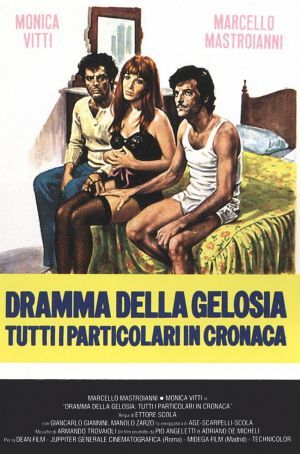
First thing's first: we loved Dramma della gelosia (tutti i particolari in cronaca) (Jealousy drama (with all the details), though its international title was The Pizza Triangle). It was everything we loved about Ettore Scola's other masterpiece, C'eravamo tanto amati, coupled with the zany, sexualized, politicized, over-the-top commedia all'italiana story akin to our favorite Lina Wertmuller movies. In other words, the perfect 1970s Italian film.

The story begins with the fidgety, disheveled Oreste (an amazing Marcello Mastroianni) being asked by the police and lawyers how it exactly happened. Aided by a sad-looking Nello (Giancarlo Giannini), Oreste, Nello and an older man reenact the accidental murder of Adelaide (Monica Vitti) - Oreste and Nello's former lover. There's a bittersweet pageantry to watching everything slow down and seeing the absurdity of this very human drama unfold.

The rest of the film makes us retrace the steps - via Rashomon-like courthouse interjections - of when Adelaide the florist and Oreste the bricklayer met, fell in love, and then met Nello the pizza chef, and fell in love with him too. This love triangle, and the three's extremes of ultimatums, aborted polyamory, attempted suicides and - yes - lots of jealousy and hurt feelings, make up the rest of this strange, touching film. In the vein of Ettore Scola's other PPCCed film, there is a heavy air of surreality (lots of fourth-wall breaking) coupled with compassionate humanism. It all seems so silly and forgivable in hindsight. Also, as per C'eravamo tanto amati and Lina Wertmuller's films, the Italian Left is a prominent supporting character, and the downtrodden, working class Oreste and Nello even meet after getting beat up by the police at a march. Like the bourgeois "padrone" in C'eravamo…, the rich Roman is again portrayed as fat, dull-eyed and very ignorant (played here by the hulking Hércules Cortés).

What was interesting about this film - and called to mind Giancarlo Giannini's later golden years in skeezy picaresque tales like Pasqualino Settebellezze and Mi manda Picone - was its high levels of "zozzeria" - that is, scumminess. The setting is Rome, but the city looks disgusting, and the characters frequent dumps, housing projects and ugly highways. Oreste is hounded by an enormous fly, and his entrances are signaled by loud buzzing. He twitches, his hair is greasy and his clothes are mismatched. In one of the most hilarious scenes, Adelaide attempts to list his pros and cons; when she gets to the cons, she admits, "And you're not very hygienic. Remember that one night? You even made a sound." Oreste and Adelaide meet when he falls asleep on a pile of paper and debris. They frolic on a polluted beach, have a picnic at the dump.

The script successfully juggles tenderness with a sharp wit; we found ourselves laughing often, even if it was so sad. And some of the lines were great! Example: when Adelaide first spots Oreste snoozing on a trash heap at a Communist fair (they have those, I guess?), she hops off the swings and goes to wake him with a kiss. They're both a little drunk and unsteady, and when he wakes, he looks at her, thinks for a bit, and says, "You lost a bet." What a first line! Or a wonderful scene when Adelaide seeks the aid of a therapist: "So what's the diagnosis? I'm traumatized, I've had a shock? It's a neurological disorder? Or am I a whore?" The therapist cuts in quickly: "Let's not get into scientific jargon!"

The most impressive of the cast was Marcello Mastroianni, who was playing heavily against type. We wouldn't have believed that Mastroianni would have been able to shed his dashing, Everyman persona to become someone as decrepit and bizarre (and Roman) as Oreste. The details of his performance - the tic around his eyes; his stubbed, broken fingernails; the general air of decay and hobo-ness - was amazing. In fact, we were so amazed that we had to check if he won anything for this; and he did! Best Actor at Cannes!

Giancarlo Giannini, our other favorite, was also playing heavily against type. Whereas he usually occupied the role of the wild-eyed, unhinged and in love laborer (see Wertmuller's Mimi metallurgico ferrito nell'onore), here he was young, upbeat and oddly tween heartthrob-esque. He was also playing a Tuscan, and the accent was awesome.

Monica Vitti's best moments were definitely the swings between carefree, joyous hedonism and the wracks of self-doubt. In fact, the latter almost seemed satirical of typical soap opera femininity (as was much of this film's treatment of sexual mores and gender norms in general). Yet, as with the writing and everything else, even when things bordered on satirical, they never lacked sympathy.

Highly recommended.

Sunday, 23 January 2011

The Company Men (2010)


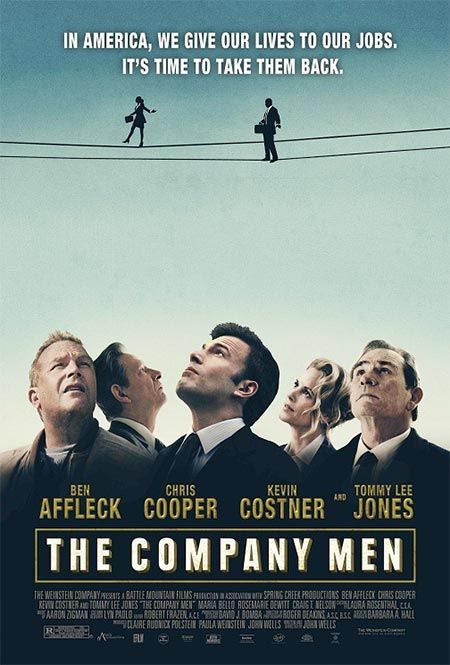
The Company Men is a fairly sober, paint-by-numbers portrayal of America's economic crises, as experienced by three recently-layed off upper middle class corporate suits. Its main value is less in its execution - which is straightforward bordering on bland - than in its peculiarity: you just don't see economics in Hollywood very much these days.

Indeed, that's endemic to American culture: a complete purging of labor issues and economic strife from the collective cultural consciousness. Whoa, did we just sound like Gramsci? Anyway, this film's novelty value, along with the strong cast, merits a viewing. And it's an interesting follow-up to the much more class conscious Look Back in Anger; here too, class is an issue, particularly the appearance of it. A common statistic (fact!) is that Americans tend to over-identify with the middle class: everyone seems to think they're in it, even when many are not.

In The Company Men, the facade of upper middle classness hides crumbling decay as three mid- to upper-level managers are progressively laid off from their cushy corporate jobs. Bob (Ben Affleck) is young and cocksure, but even his budding symbols of success - the huge house, the Porsche, the golfclubs - become a liability when he can't compete with fresh MBA grads, eager and able to work for lower salaries in a race to the bottom. Phil (Chris Cooper) is the old timey American Dream incarnate; a Vietnam vet who worked his way up from the factory floor to the six figure salary. And then there's Gene (Tommy Lee Jones), the heart and soul of the business and, it seems, the only honest businessman left in America (or Boston, at least).

The film's structure and sympathies mark it as very similar to the Italian film, Il posto dell'anima - except the latter, being, well, Italian, focused much more on working class issues in an explicitly Socialist light. But both films explore the decline and decay of manufacturing jobs in a post-industrial West, and both use the triptych of young - middle - old (which could just as well stand for brash - vulnerable - wisdom) characters. Indeed, in both films, the middle character - Silvio Orlando in Il posto dell'anima, Chris Cooper in The Company Men - is set up as society's sacrificial lamb; the guy who did everything right and yet still lost. "My life just ended," Chris Cooper laments, "and nobody noticed." Indeed, Silvio Orlando was the Ideal Comrade Worker - selfless, honest, hard-working, good-humored. He was like a natural extension of Nino Manfredi's Worker Ideal in C'eravamo tanto amati (OK, we just watched that again yesterday, so we had to find a way to get it in here). And yet he still lost. Similarly, Chris Cooper fought for his country, worked in its factories and climbed the ladder, sending his daughter off to a destiny of Ivy League intelligentsia. But in the end, he gets screwed. (That's not to say the film's ending isn't inherently upbeat, promoting the hard-work can-do attitude of pulling yourself up by your bootstraps.)

This focus on the pain of the upper middle class is restrictive, in some senses, but also very contextual; as we said above, most of America identifies with this class. The common laborer - here embodied with a pleasantly low-key, sardonic wit by Kevin Costner as Jack the Carpenter, Bob's brother-in-law - is given a much reduced role. He appears - and is decent, hard-working and honest. But his story is never really told, or even acknowledged.

The cast is uniformly appealing and strong, even if the narrative doesn't allow them much nuance. It was great to see Chris Cooper, who we are most fond of; especially since we've been cultivating a fantasy film in our head starring him as a 1900s Chicago union organizer, David Strathairn as a slaughterhouse laborer and Paul Giamatti as a driven, exploitative yet compelling beef baron. Best movie evar?! You bet. And this one? Decent. Wait for DVD. Cultivate your fantasy Upton Sinclair adaptation instead.


eventually, you will be able to buy the movie here...

Look Back in Anger (1989)


There's something perversely compelling but ultimately tiresome about Look Back In Anger, the classic "kitchen sink drama" about an Angry Young Man. In fact, the protagonist's name, Jimmy Porter, has become something of a shorthand for "the Angry Young Man" - or, if you're like the PPCC, "self-important misogynistic asshole".

What's amazing about Look Back in Anger is how autobiographical it purportedly is. John Osborne, the playwright, was also notoriously horrible to his loved ones - after repeatedly insulting her, he threw his teenage daughter out of the house and never spoke to her again. Like Jimmy Porter, the cruelty of his language was infamous. And what's amazing is that someone so, well, self-involved and dick-ish, could have been able to write anything remotely three-dimensional at all. It's a wonder he managed to create characters other than Jimmy Porter - especially Jimmy's long-suffering wife, Alison, and friend, Cliff.

Anyway! Jimmy Porter (Kenneth Branagh) is a working class candy shop owner somewhere in an anonymous English town. He seethes at the unfairness of it all, particularly classism and, uh, the existence of women. His hatred for these two things he takes out with relish on Alison (Emma Thompson), his passive, upper class-slumming wife. A diarrheic talker, Jimmy hates the complacency, the conformism, the hypocrisy of modern English everything. He rails and rails… and rails… and rails some more, for good measure. His (only remaining?) friend, the adorable puppy-like Cliff (Gerard Horan), tries to keep the peace between Jimmy and Alison. Eventually, Alison's childhood friend, the righteous and churchy Helena (Siobhan Redmond), comes to visit and attempts to bark back at Jimmy.

All of this building tension - a tension that goes from being pleasantly coiled to excruciatingly awful to watch - is punctuated by rare moments of sweet, almost needy, affection: when they're not screaming at each other, Jimmy and Alison cuddle and coo about being a "bear and a squirrel", Alison and Cliff cuddle and coo ("My lovely!" Cliff always exclaims), and Jimmy and Cliff wrestle and rough-house like schoolboys. It's a strange, compelling roller coaster of ups and… well, not so much downs, as when the roller coaster breaks off the tracks and goes flying away.

Kenneth Branagh and Emma Thompson are always reliably good in theater-driven stuff. Judi Dench directs, but it's a limited, anemic direction, still speaking theater language when it should be speaking movie.

The play itself has been lauded for bringing realism (and, we guess, nihilism and rebellion) to the English stage back in the 50s. It is certainly shockingly gritty by even today's standards - again, not so much because of the poverty or unwanted pregnancy stuff, so much as the cruelty of Jimmy and Osborne's relatively sympathetic treatment of it. It's as if Osborne is trying to tell us Jimmy is a prophet, someone who (as the "citation needed" intro of Osborne's wiki tells us) "argued for the cleansing wisdom of bad behavior and bad taste, and combined unsparing truthfulness with devastating wit." Now, we have a personal bone to pick with such a philosophy: mostly because we think compassion is the only universal wisdom, and behaving like an asshole isn't so much shaking off the shackles of a hypocritical, stifling society, as it is, well, being an asshole.

If we may go a bit Tiger Beatdown on Osborne and Jimmy for a moment, as well, we've always heard this ultra-individualistic, pessimistic philosophy proselytized by, well, angry young men. Angry, desperate egotism and self-pity of this sort, when coupled with disenfranchised young white men (as Jimmy and Osborne are), always makes us think of (1) misogyny! and (2) racism! And, indeed, you can read Look Back in Anger as a post-colonial play: Jimmy as a broken-down, post-imperial UK, with nothing else to conquer, wallowing in ennui and feelings of low self-worth. (Hey, Laurence Olivier, who was all about injecting patriotism into theater, thought Look Back in Anger was an offense to his "sense of patriotism and theatre".) In that respect, as a self-aware sympathetic satire of wounded, post-imperial British pride, Look Back in Anger is almost acceptable - but we're wary of giving Osborne too much self-reflective credit, especially since he was kinda right-wing and it smells throughout that he agrees with Jimmy. He certainly seems to think Jimmy's categorical hate of anyone upper class or female (or, worse, upper class and female!) is righteous and true. And he wasn't totally self-aware: as demonstrated in the completely ridiculous moment when another character, the father-in-law, listens to Alison describing Jimmy's various abuses and then compliments Jimmy on his "way with words" (?!). Why doesn't he just say, "Good heavens, that Jimmy fellow should become a playwright! He could revolutionize the stage with his witticisms!" Dude, he put a sockpuppet in his own play. What a troll...

Monday, 17 January 2011

Shakespeare in Love (1998)


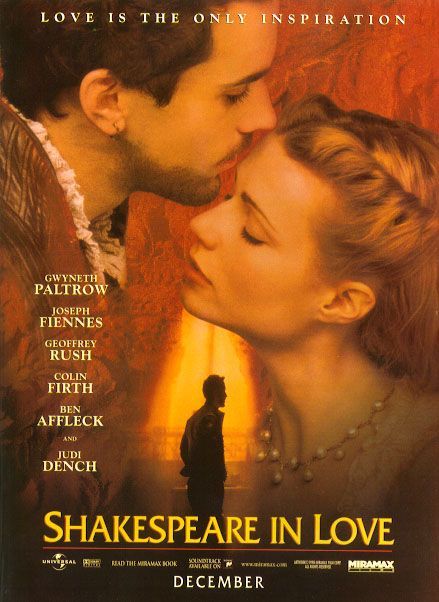
Shakespeare in Love is a grand celebration of the creative drive and the pleasure of fiction. It's also what we consider a Perfect Film - much like Rashomon or Ladri di biciclette.

Fictions layer over each other in Shakespeare in Love - and the way we approach this fundamental deceit is explored. Are we like the enraged, indignant preacher, waving his hat at the fact that "vice is in the show!"? Or are we like the passionate theater-goer Viola de Lesseps (Gwyneth Paltrow), who admits that her love affair with William Shakespeare (Joseph Fiennes) "is not life - it is a stolen season", or, even better, is a "flattering dream - too sweet to be substantial", but revels in it nonetheless?

Because fiction abounds - fiction as the transformative, cathartic, passionate release for our transcendental drive. The fiction of Viola as "Thomas Kent", an actor for the down-on-his-luck Henslowe (Geoffrey Rush) and his struggling theater company. The fiction that Shakespeare is writing Romeo and Ethel the Pirate's Daughter - no, Romeo and Rosalind - no, whatever - and that this play is for Henslowe… no, his competitor, Burbage (Martin Clunes). The fiction of Viola and Will's love for each other - she, already bound to the blunt, unimaginative Lord Wessex (Colin Firth); and he, exiled from his wife and children in Stratford. The fiction of the final play - Romeo and Juliet - and how it interweaves with the stolen romance Viola and Will enjoy.

You could call it lies or deceit, but everyone is definitely living in a fantasy in this film - deception, masks, costumes and dissembling abounds. Yet - just like in the Neopolitan underworld and its circus-like, surreal atmosphere in Mi manda Picone - this essential non-reality is accepted by everyone. It's like structured play. Everyone agrees that this isn't real, and everyone still operates within these bounds of non-reality.

The result is priceless: whimsical, funny, heartfelt and, ironically, very true. Early in the film, Queen Elizabeth (Judi Dench) accepts to judge a wager between the hard realist Wessex and the dreamer Shakespeare that true love could never be captured in a play. In the end, even though everything on which that love was built was a lie, we see that the love indeed was true. It's a cunning meta turn. And, just like Will and Viola or the audience of the play, the audience of the film - i.e. the PPCC - suffers a big letdown when we leave Narnia and return to reality. The dreamscape was so much… realer. At least, it felt so! (Ironically?)

Of course, the strength and intelligence of this film relies almost entirely on the strength and intelligence of the script by Tom Stoppard. The actors are all uniformly strong; it's a veritable tour of RADA talent. The music and direction support and give accent to what is essentially an emotional story (much as dreams have their own emotional logic!) and, of course, it's great as just a celebration of Shakespeare (expect lots of puns and references). It also does something which is rare, but delightful, to behold: it shows us the creative process at its most fluid and prolific. Like Amadeus, this film captures the verve and alive-ness of producing something creative, especially when that something just pours out of you. As if you were a conduit to something greater. The best part of being human? We'd wager Wessex his fifty pounds on it.

Highly recommended.

Tuesday, 11 January 2011

La cagna (1972)


Ugh. What a piece of misogynistic pap.

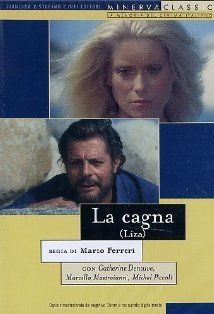
Other reviews of La cagna (literally, The Bitch, though the international title is Liza) have mentioned it being "highly symbolic" - but surely the director, Marco Ferreri, could have made these same symbolic points using a less rubbish story.

Liza (Catherine Deneuve) and Giorgio (Marcello Mastroianni) are directionless misfits, fleeing from society in an ad hoc, haphazard way. They both end up on a tiny, remote island in the Mediterranean - Liza having swam away from her friend's yacht, Giorgio having established himself as a hermit there with his dog, Melampo. Shortly after Liza's arrival, they "fall in love" - or something, at least. Giorgio then drives Liza back to civilization in his motorboat. Liza then promptly returns, kills Melampo, and takes the dog's place.

There are obvious, striking similarities between this and Lina Wertmuller's far superior Swept Away - the remote island setting, the sadomasochistic love affair, even the actors' looks. But what Wertmuller achieves is a subversion and criticism of La Cagna's central conceit: bourgeois ennui, and how men and women react to it by retreating into primal roles of dominance and submission. Heck, even the uneven Adam Resurrected, which featured a similar nurse/patient, dog/master-roleplaying love affair, was more subtle than this. Both Wertmuller and, to an extent, Adam Resurrected satirized this patriarchal fantasy of "natural"/"savage"/"in the wild" gender roles - La cagna instead embraces them, presenting them as the real thing, as enviable, even.

La cagna also unfortunately relies on lobby room jazz muzak coupled with moody shots of Mastroianni and Deneuve to denote profound philosophical depths. But honestly, Ferreri's not fooling anyone: the characters are paper-thin, the attempts at backstory sloppy and unconvincing ("Ludwig is wrong! No, Ludwig is wrong!" Liza insists - sparing us who Ludwig is or what he's wrong about; the blunt flashback to Melampo as Giorgio crouches over another dead dog - how much more obvious do you need to be? WE GET IT). There's no sense of how much time is passing, no investment in the relationship, and no build and release of dramatic tension. Instead, we trudge along with inane dialogue and, at its worst, tediously stupid gender politics. And those sunglasses! Self-described "Robinson Crusoe" Giorgio springs for Yves Saint Laurent sneakers, but not sunglasses? Oh, come on.

No, we're sorry, but we really don't care about Giorgio's deep guilt over his abandoned, unstable family at home and their bourgeois restrictions on his creativity. Melampo - Pinocchio's dog - may indicate that Giorgio is Pinocchio, but Peter Pan might be more appropriate.

Monday, 3 January 2011

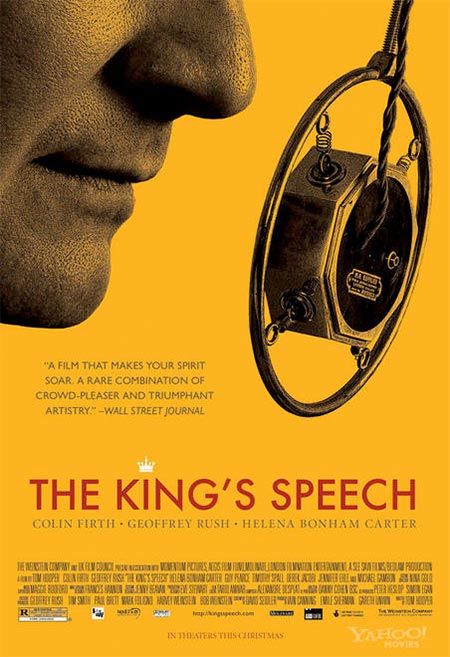
The King's Speech (2010)


The King's Speech is a solid film which never attains the greatness to which it aspires. By choosing the easy route, and smothering the darker, crueler core of its story under a tidy triumph, it ends up a good film, where it could have been a great one.

The King's Speech is essentially a sports film, and sports films are usually the same. They start with our hero, the underdog, undergoing a humiliating defeat. After licking his wounds (and it is usually a 'he'), the underdog discovers the key to his reformation and success - usually an inspiring mentor or coach. After a rousing training montage, we build up to the inevitable denouement - usually a rematch with the earlier opponent - which, after some tense last-minute uncertainties, ends in (inevitable) glorious victory.

The best sports films are those that bend the genre - films like Eight Men Out, that open with victory and end with the abyss. Director Tom Hooper is no stranger to such films - just see his work from last year, The Damned United, which used the harsh clarity of defeat to really examine our ambition to win. The King's Speech should have been such an innovative sports film - a film that let our character, King George VI (Colin Firth), wallow in his misery and explore it. Instead, we get the trials and complexities of England's waning royalty under the gathering storm of World War 2 shoe-horned into a feel-good movie complete with Disney-style pop psycho-analysis.

Behold:

Our hero, underdog Duke of York, is second son to King George V (a spot-on Michael Gambon) and an embarrassment to the family. In an age of the radio, where the royal family has been "reduced to ingratiating" themselves into England's living rooms via the "Pandora's box" of wireless technology, the Duke - Bertie to his wife (Helena Bonham Carter) and family - is a terrible public speaker. He suffers from a stutter and paralyzing stage fright. The film's opening defeat shows him giving a cringe-worthy speech to the crowds at Wembley (?) in 1925.

Ten years later, Bertie meets his mentor and coach - the unorthodox, transplanted antipodean Lionel Logue (Geoffrey Rush - nice to see you again!). Logue insists on equality in the counseling room, and couples his speech therapy with some pop Freud as well. Bertie's stutter will never improve, Logue reckons, if we don't unearth some of the anxieties which eat away at him from the inside. Bertie - clinging to the formalities and automatic distance that his title engenders - rebels. But then comes around. Then, after his father dies and his older brother abdicates in favor of a Baltimore divorcee, becomes king. And then war breaks out. And then he gives his speech.

The best parts of The King's Speech, as we've hinted at above, are the darker parts. Logue's non-speech therapy might be a bit Good Will Hunting, but there is a real edge to seeing the surreal, dehumanizing effect royalty has on everyone involved, not just Bertie - the cavernous palace rooms, the stiff ritualism of family affairs, the easy bullying. Bertie is, of course, the most obviously wounded of the lot - his stutter a paper-thin disguise to the deep insecurities he has been raised to feel. In one harrowing scene, Logue - ever awkward in reconciling his everyman conviviality with the formalities required in dealing with Bertie - attempts to console Bertie shortly after the latter's father's death. Bertie then haltingly describes his gruesome "personal affairs" - up to this point, taboo - and we hear of abuse, neglect, alienation. It's ironic that Geoffrey Rush's performance in this scene - that is, his reactions - almost outshines Colin Firth's. Another excellent detail is the tempestuous anger which Bertie exhibits - and how he explains away his sudden explosions as "one of my many faults".

It's these hints at dysfunction and decay that round out both the character of Bertie and the story of England's royalty under the war. And as war brews and Bertie is faced with his most important public speaking event yet - a cry to rally the troops - we can't help but feel like forcing the complicated private and public issues into one mishmash of "Hurrah for perseverance!" is facile.

Phew.

Anyway, on the purely movie front: Timothy Spall's spot-on Winston Churchill impression was stunning in the lengthier scenes and distractingly funny in the shorter moments, where it began to feel like a caricature. Turning the Archbishop of Canterbury (Derek Jacobi) into a thorny old guard antagonist was uninspired, as were the easy jokes about snobbish, stiff upper lip English royalty looking down on Australians. That said, it was nice, in a meta way, to have Australian actor Guy Pearce, as the dandy older brother and very-briefly-King Edward VIII, speak in the poshest accent ever. Helena Bonham Carter was wonderfully sympathetic as, well, the Queen Mother (what are these people's names, anyway?! Bertie said his at one point and it had, like, ten names in there), while Geoffrey Rush was his usual Geoffrey Rushy self. Colin Firth is a dreamboat as ever, and of course we felt a great rush of tenderness for him, as he was indeed incredibly vulnerable (and often humiliated!). Trivia: He played a WWI vet with a stutter in the glorious A Month in the Country.

Other movie stuff: Tom Hooper's direction was reminiscent of his work in Damned United - canned saturation, geometrical compositions emphasizing dizzying wallpapers, symmetrical perspectives and a tendency to use off-center close-ups. It was nice in Damned United, but we were distracted this time. The use of Beethoven's 7th was DIVINE, I tell you - but then, that music is divine. There was a whole 'nother movie in there. And hearing Bertie describe Hitler as advocating the "primitive doctrine that Might is Right" threw us right back to The Once and Future King - so that's what T.H. White was referring to: Bertie's speech! Oh my God, ARTHUR IS BERTIE, WE SEE IT NOW. Well, that is just something.

So: see it? Yes, definitely, but perhaps wait for DVD.

Sunday, 2 January 2011

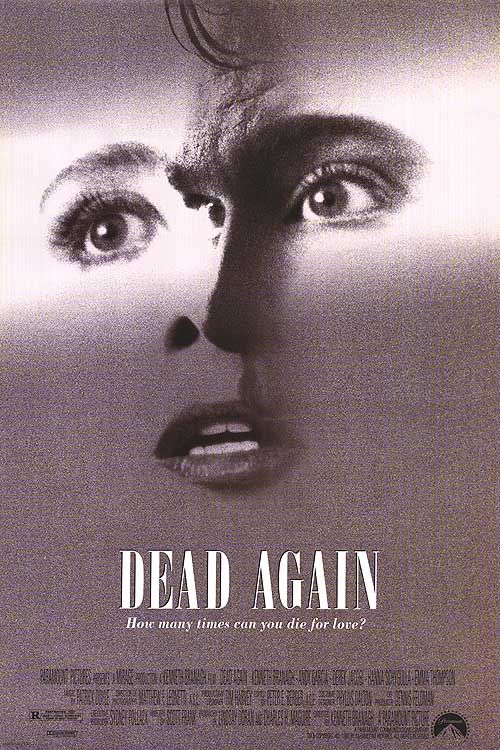
Dead Again (1991)


Dead Again is a fun, weird romp through reincarnation, melodrama, and Kenneth Branagh-Emma Thompson's Greatest Hits. A fluffy murder mystery dressed up in classical Hitchcock-style aesthetics with a dash of Branagh-style theatricality, it is whimsical and not too gory and very silly. Expect much intentional and unintentional humor.

One day, detective Mike Church (Kenneth Branagh, in an American accent) agrees to help his old orphanage out with a bag lady problem they're having: a mysterious mute woman (Emma Thompson), suffering from amnesia, has wandered onto the grounds and keeps having screaming nightmares. Mike takes the lady in and tries to find out where her memory went; his friends, Pete (Wayne Knight (!)) the forensics guy and Dr. Carlisle (Robin Williams, in a very good beefed-up cameo) the former psychiatrist quack, try to help. But the biggest help comes when the dapper, take-charge hypnotist Frank (Derek Jacobi) enters the scene. After just a few sessions with Frank, the woman - now called Grace - has regained the ability to speak and is busy reliving her past life as Margaret Strauss (Emma Thompson, again), eminent pianist and wife to the dashing European composer, Roman Strauss (Kenneth Branagh, in a (sexier) German accent this time), way back in post-war LA. The same Strausses who ended up all over the 1940s newspapers after Roman was convicted of murdering Margaret with a pair of scissors. What does it all mean?! Will Mike and Grace fall in love as per their predetermination? Or will karma catch up with them, as Dr. Carlisle insists it will, and they'll just murder each other all over again?! And what is Grace's real name anyway!?!?!

It all comes together in a delightful, unexpected conclusion that we'll not spoil here. But suffice to say it includes jarring cross cuts (our favorite filmy thing ever!), blood-pumping choral music (our favorite Kenneth Branaghy thing ever!) and lots of gasps and close-ups and unexpected laughter (from us, that is).

The charm of Dead Again is that it doesn't take itself too seriously, even though everything is played straight. Everyone looks like they're having a rollicking good time swaning around the 1940s black-and-white scenes (all white tie events, mind you) or engaging in some earnest, cringe-worthy 1980s rom-com-style flirting ("I can read tea bags, you know?" Mike schmoozes; OH GOD). Robin Williams' glorified cameo is a great performance filled with hilariously vulgar dialogue; it's worth it just to see him in this cross between The Fisher King and Good Will Hunting. Kenneth Branagh and Emma Thompson are at their charmingest peak (this was their period, after all!), and the whole film is like a tribute fest to their past and future work: the masked ball which we'll see again in Much Ado About Nothing, the domestic horrors reminiscent of Look Back in Anger and Patrick Doyle's rousing, bombastic score straight out of the goosebump-inducing St. Crispin's Day speech from Henry V. Andy Garcia has a nice role as the tobacco-addicted journalist, while Campbell Scott's cameo made us laugh and laugh and laugh.

Our conclusion? Definitely see it. And then write Kenneth Branagh and tell him he is and always will be King Arthur.

Saturday, 1 January 2011

La tête en friche (2010)


La tête en friche (My Afternoons with Margueritte) tries to be a charming sketch of bittersweet village life, but instead it falls flat. It was just embarrassing.

In a small town somewhere in France, the stout Germain (a gone-to-seed Gérard Depardieu) unwillingly occupies the position of village idiot. Slow to read, slow with numbers and painfully conscious of this, Germain spends his days trying to find simple pleasures - his vegetable garden, his girlfriend, drinks with the mates - and trying to keep at bay the ridicule and disdain of the other villagers and, most especially, his indifferent, shrewish mother (Claire Maurier). Things take an upturn when he befriends the coquettish, patient, 95-year-old Margueritte (Gisèle Casadesus), and they spend their lunches sitting on the park bench, reading Camus to each other. Under Margueritte's loving care, Germain gets (1) the mother he wanted, and (2) the confidence to blossom like a little intellectual flower.

The core of the story is sweet enough, and might have made a charming piece. Instead, things are handled so bluntly that we wondered if the film wasn't trying to go all meta on Germain's bumbling, clumsy ham-fisting. Example: the distracting and unnecessary flashbacks, where a school-age Germain - in the same outfit! and the same haircut! - is regularly mocked by his teachers and mother for being slow. Or Margueritte and Germain's execrably banal conversations. Or the fact that Depardieu, bless him, is about thirty years too old for this part, and his relationship with the beautiful bus driver, Annette (Sophie Guillemin), strains credulity. Or their awful (AWFUL) pillow talk. Or the Italian stereotype, Gardini (François-Xavier Demaison), complete with oily hair and hands flying around.

French films about the honest, humble "la vie est belle!" glory of the village have been done before - and, presumably, there must be some good ones. But all the ones we've seen - this, Chocolat, Amélie - rely on a sort of maudlin sentimentality, as well as a romanticized notion of the rich, golden-toned Frenchness of living in France, that we can't stand. Let Nanni Moretti glorify the mundane and the good life.