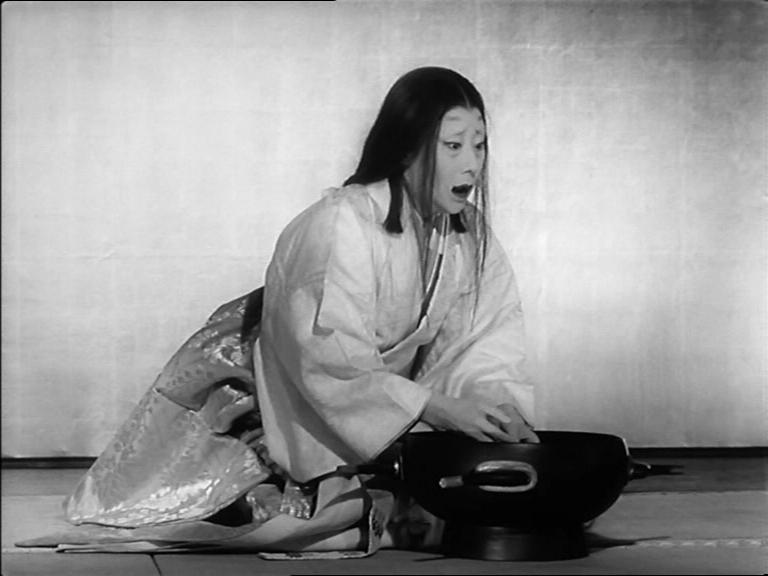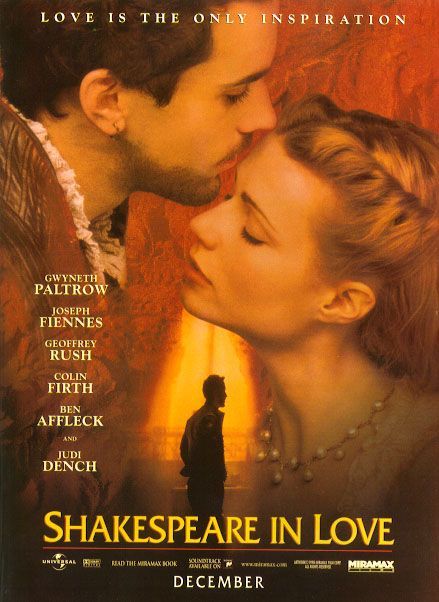
Shakespeare in Love is a grand celebration of the creative drive and the pleasure of fiction. It's also what we consider a Perfect Film - much like Rashomon or Ladri di biciclette.
Fictions layer over each other in Shakespeare in Love - and the way we approach this fundamental deceit is explored. Are we like the enraged, indignant preacher, waving his hat at the fact that "vice is in the show!"? Or are we like the passionate theater-goer Viola de Lesseps (Gwyneth Paltrow), who admits that her love affair with William Shakespeare (Joseph Fiennes) "is not life - it is a stolen season", or, even better, is a "flattering dream - too sweet to be substantial", but revels in it nonetheless?
Because fiction abounds - fiction as the transformative, cathartic, passionate release for our transcendental drive. The fiction of Viola as "Thomas Kent", an actor for the down-on-his-luck Henslowe (Geoffrey Rush) and his struggling theater company. The fiction that Shakespeare is writing Romeo and Ethel the Pirate's Daughter - no, Romeo and Rosalind - no, whatever - and that this play is for Henslowe… no, his competitor, Burbage (Martin Clunes). The fiction of Viola and Will's love for each other - she, already bound to the blunt, unimaginative Lord Wessex (Colin Firth); and he, exiled from his wife and children in Stratford. The fiction of the final play - Romeo and Juliet - and how it interweaves with the stolen romance Viola and Will enjoy.
You could call it lies or deceit, but everyone is definitely living in a fantasy in this film - deception, masks, costumes and dissembling abounds. Yet - just like in the Neopolitan underworld and its circus-like, surreal atmosphere in Mi manda Picone - this essential non-reality is accepted by everyone. It's like structured play. Everyone agrees that this isn't real, and everyone still operates within these bounds of non-reality.
The result is priceless: whimsical, funny, heartfelt and, ironically, very true. Early in the film, Queen Elizabeth (Judi Dench) accepts to judge a wager between the hard realist Wessex and the dreamer Shakespeare that true love could never be captured in a play. In the end, even though everything on which that love was built was a lie, we see that the love indeed was true. It's a cunning meta turn. And, just like Will and Viola or the audience of the play, the audience of the film - i.e. the PPCC - suffers a big letdown when we leave Narnia and return to reality. The dreamscape was so much… realer. At least, it felt so! (Ironically?)
Of course, the strength and intelligence of this film relies almost entirely on the strength and intelligence of the script by Tom Stoppard. The actors are all uniformly strong; it's a veritable tour of RADA talent. The music and direction support and give accent to what is essentially an emotional story (much as dreams have their own emotional logic!) and, of course, it's great as just a celebration of Shakespeare (expect lots of puns and references). It also does something which is rare, but delightful, to behold: it shows us the creative process at its most fluid and prolific. Like Amadeus, this film captures the verve and alive-ness of producing something creative, especially when that something just pours out of you. As if you were a conduit to something greater. The best part of being human? We'd wager Wessex his fifty pounds on it.
Highly recommended.