Showing posts with label 1940s. Show all posts

Sunday, 30 May 2010

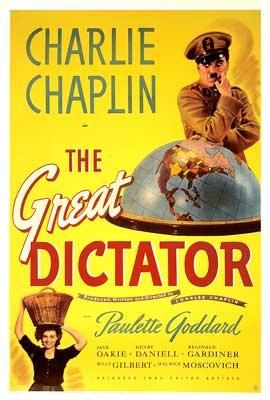
The Great Dictator (1940)


Strange, surreal and impassioned, Charlie Chaplin's The Great Dictator is part satire, part slapstick, part indignant humanitarian rage. It's still an edgy film seventy years on, because it's always rare to see a gutsy director take a direct jab at current events. Hitler invaded Poland in 1939. A year later, The Great Dictator came out. And no one in this film had any idea how the war would turn out (!).

With the fictional "Tomania" and "Bacteria" standing in for Germany and Italy, respectively, The Great Dictator follows the dual lives of Tomania's maniacal dictator, Adenoid Hynkel (Charlie Chaplin), and a Jewish barber (Charlie Chaplin, again) living in a Tomanian (or should we say Tomaniac?) ghetto. Beginning in World War I, the unnamed barber - a bumbling klutz of a soldier - manages to save a Tomanian pilot, Schultz (Reginald Gardiner). After some clowning around and a plane crash, the barber suffers memory loss and spends most of the interwar period in a hospital. When he returns, he finds his neighborhood radically different: it's now a violent, volatile ghetto where stormtroopers regularly harass shopowners and families, threatening them with concentration camps.
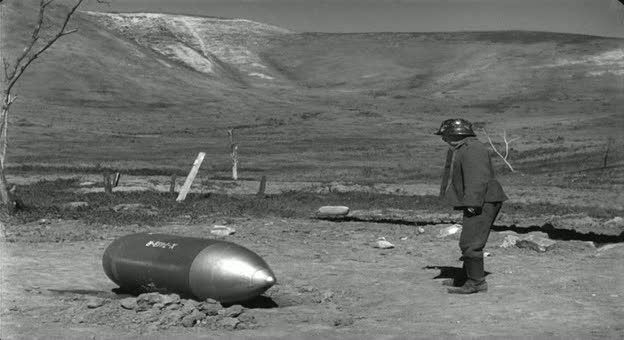

Man at war. Sort of.
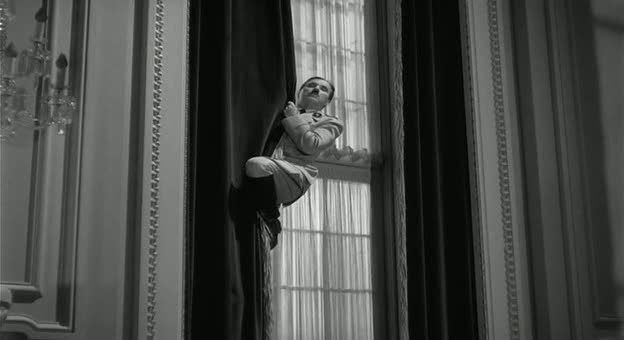

Hitler, er, Hynkel, in a private moment.


While the barber's story is at best tragicomic, and follows a genuine narrative arc full of suspense and suffering, Hynkel's story is just a blow-by-blow mockery of Hitler's Greatest Hits. There's his infamous speeches to the screaming hordes, which Chaplin performs in full-on pidgin German ("Der bratwurst und der saurkraut!" Hynkel screams). There's his meeting with "Benzino Napaloni" (Jack Oakie), and the (very funny) ego war between them ("Der cheesy ravioli!" Hynkel seethes). And there's a bizarre, ridiculous sequence in which a daydreaming Hynkel dances daintily with an inflatable globe.
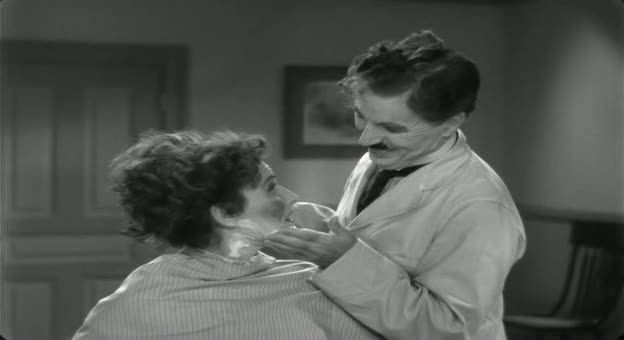

We were about to comment on the oddly smoking chemistry between Chaplin and Goddard, and how oddly sexy Chaplin was as the barber, but then we read about Chaplin's ladykilling on Wikipedia, so... um, I guess we're not the only ones who were a bit charmed.


All of the Hynkel scenes are genuinely funny; they are bizarre, eviscerating, silly and smart, such as when Hynkel's propaganda man, "Garbage" (er, Goebbels), instructs Hynkel in the psychological warfare they intend to wreak on Napoloni to ensure the latter's feelings of inferiority. Napoloni's easy evasion of their tactics, such as putting him in a low-seated chair ("They've-a put me in-a the toddler chair!" Napoloni mutters), is whimsical and fun.
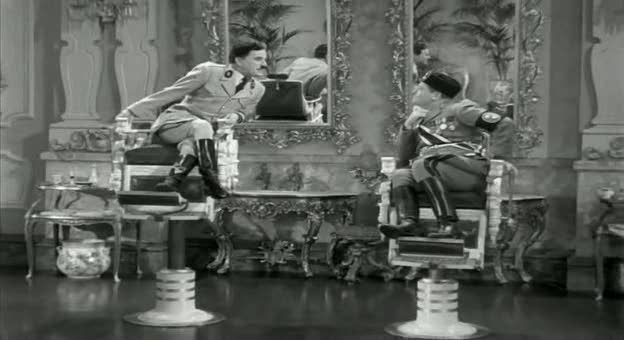

Some great moments between Hynkel and Napaloni. That cheesy ravioli!
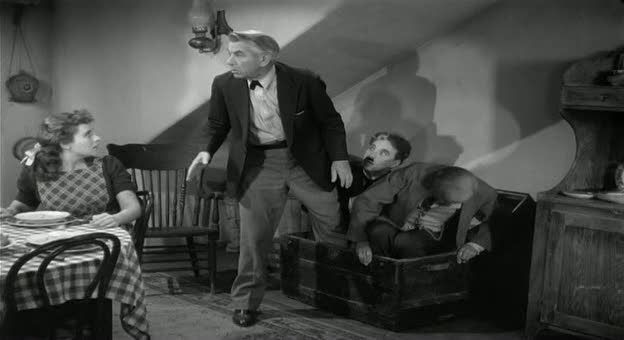

A rare funny moment from the Jewish barber plotline; Mr. Jeackel (Maurice Moscovitch) was absolutely lovely, and him climbing into the crowded trunk was the best!


All of the barber scenes, on the other hand, cut too close to be funny. In a post-Holocaust world, it's hard to keep your hackles down when the barber is beaten up for refusing to paint "JEW" on his windows. Chaplin goes for some jokes here, mostly of the slapstick kind (the barber being a very close relative of the disaster-prone Tramp), but the real-life references are too somber. Chaplin is aware of this too, and indeed the barber's story is allowed to be frightening and sad at times, such as when the barber and his crush, the feisty laundry girl Hannah (Paulette Goddard), have their first date interrupted by a declaration of Kristallnacht. Watching their falling expressions while the terrified crowds flee into their homes, effectively emptying the street behind them, is truly horrible.
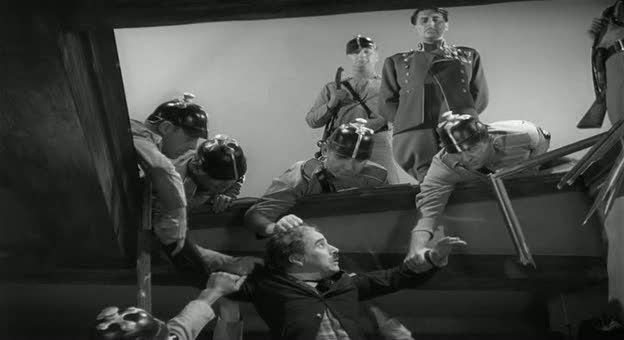

Some less funny scenes. The Jewish barber is captured and sent to a concentration camp (!).
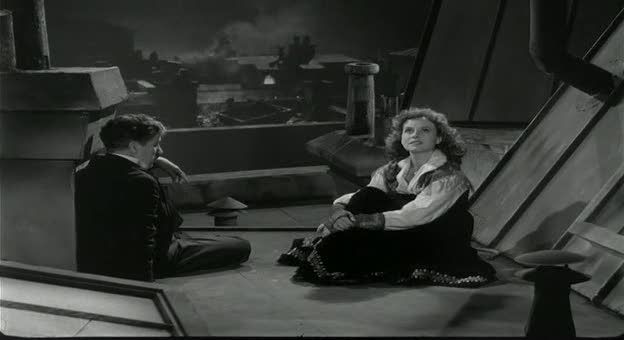

Things become progressively more somber...


The film is more message than joke, and so it ends with the barber - and his (in)famous sermon to the masses in the name of peace and love. Some critics, such as Ebert, say this ruins the film - basically turning it into a mouthpiece for Chaplin's personal political beliefs. (Other people, like zany Slovenian philosopher Slavoj Žižek, note the interesting parallels between Hynkel and the barber in how they sway the masses.) Our take was much more meek, partly because we were feeling a little emotionally bruised by the end of this film, and earnest pleas for justice and humanity were a welcome respite from all the preceding fictional and non-fictional insanity.

Thursday, 29 April 2010

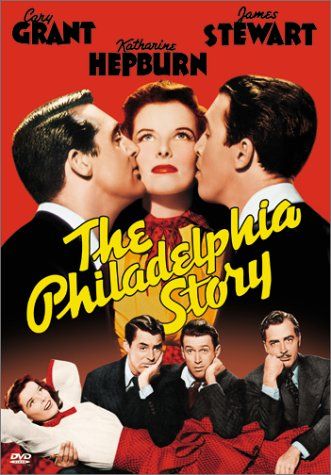
The Philadelphia Story (1940)


1940's The Philadelphia Story starts slowly, with some creaking of the joints, and it initially feels like it's going to be a heavy morality play about an older, purer notion of dignity, equated with privacy and modesty, leading us to write a review about how this generation has become crass with rank exhibitionism (this) and voyeurism (Simon Pegg's tweets). And maybe there'll be some commentary on class too. But then everything gets derailed into farce, seasoned heavily with rapier wits and rivers of champagne. And it's wonderful.

Young divorcée, Tracy Lord (Katherine Hepburn), is old Philadelphia money and kind of intimidatingly amazing (those mile-wide shoulder pads don't help) and she's getting married again - this time to up-by-his-bootstraps self-made man George (John Howard), who everyone agrees is a total bore. As the wedding day approaches, ex-husband C.K. Dexter Haven (Cary Grant) ("What kind of name is that?!" Jimmy Stewart will later yelp) hires two young reporters from a Philly gossip rag, Macaulay Connor (Jimmy Stewart) and Liz Imbrie (Ruth Hussey), to be reluctant paparazzi spies in the fancy Lord estate.


Mon Dieu! Le petite pox?


Now see here... and other expressions.


When the Lords find out they have two seedy media types in their midst, they initially decide to put on a good show indeed. Little sister Dinah (Virginia Weidler, great) comes pirouetting into their room in a tutu, speaking French and slamming away at the piano, before Tracy sends her away for possibly having "le small pox". The reporters are properly horrified, but then, it's time for the party, laaaaa -

And everyone gets wasted and goes crazy. And it all ends happily.


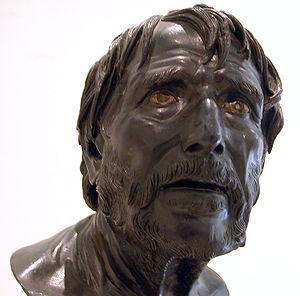
The bromance between these two was too cute. And keep your eyes peeled for Cary Grant's bust of Pseudo-Seneca! His cool-and-fineness factor just multiplied.


So this movie was, like, a big deal back in the day. We mean 1996, when we first saw it and were all about that foreign land called The Past. The dialogue is just exotic enough to intoxicate us present day types. These people hadn't even seen the end of World War II yet! (Leading to an incidentally bizarre moment when a drunk, gushing Jimmy Stewart likens the radiant Hepburn to "hearth-fires and holocausts!") They also hadn't done the whole political correctedness, second wave feminism, alcohol-for-breakfast-is-bad thing. They were wild! Such creatures.

But ultimately lovable, very much so. Especially for how articulate and inventive the screenplay was. People said things like, "You're so cool and fine and always so much your own. There's a kind of beautiful purity about you." Well, golly. What else? Go on!

The actors in this were all heavy-weights, and it shows in their easy glamour and tremendous confidence. Watch your retinas don't detach when they flash one of their sparkling, superstar smiles. And take the character of C.K. Dexter Haven, who is a self-described alcoholic and should be a tragic figure, as all he does for much of the film is mope, brood bitterly and accuse Tracy of cruelly ditching him. But played by Cary Grant, he has a sort of edgy dashing thing going. You're like, double whiskey in the morning? How sexy! Jimmy Stewart is great in this self-righteous "intellectual snob" role - it's almost a cheeky commentary on his sugary idealism with Frank Capra. He also, oddly, reminded us of Obama. Or vice versa? Cary Grant and Jimmy Stewart also have amazing chemistry, especially in the late-night scenes.


Gee!


Katherine Hepburn! Vah! Luminous and fierce, she was just great - much like Nargis in the Hindi remake of It Happened One Night, Chori Chori. It was entirely understandable that all three men were periodically reduced to whimpering piles of mush in her fiery presence. Gosh, she was like a real, live Galadriel. The other ladies were also very "cool and fine" - especially the cynical Ruth Hussey and the puckish Virginia Weidler.

So was the film talking about dignity, celebrity and class? Sort of, but it just concludes that the upper class aren't all evil, the media is a totally not-classy weapon, not Big Brother, and if you want to be a "first class human being", you need to learn to forgive a little human frailty... including that time your alcoholic ex-husband punched you in the face, he's, like, really sorry about that. Have any of you read F. Scott Fitzgerald's Tender is the Night? Because this movie sure looks like that book, with its dizzying fortunes and near-constant drunkenness. Except here, it's a fun, frothy fantasy where everyone is fundamentally good, only a little cheeky from time to time. Given that Tender Is the Night left us in a bad mood for days, and Philadelphia Story made us sigh with happy satisfaction, we'll take the latter.


Help us, readership, you're our only hope!

It's a Cary Grant movie. It's black and white. It's not really a comedy, more like a bittersweet war or post-war romance with strong Manchurian Candidate (minus the psycho) vibes. An exotic locale - a bar. South America? Panama? Cary Grant in a uniform and some lady. Cary Grant punches an obnoxious dude at the bar, and it hurts his hand. He and the lady make bittersweet, cynical and witty exchanges. What movie was it? (Because we have no idea.)

Thursday, 2 April 2009

Roma città aperta (1945)

The tense, devastating Roma, città aperta (Rome, Open City) is perhaps famous for being the First Neorealist Film (*fanfare*). But does it hold up after all these years?


Well, yes. But not for its gritty realism aesthetically - there have been grittier and more documentary-esque films since then, improving on the genre it inaugured - so much as for its story filled with moral ambiguity (avant garde for films at the time?), and its contextual power. That is, while the filmmaking still carries some vestiges of pre-neorealist aesthetics (melodramatic music, a melodramatic performance by the Nazi villain), the story itself is not only completely plausible in its emotional complexity, but it also is a patchwork of real stories. Indeed, the meta of Roma, città aperta is more neorealist than its style: that is, filming began two months after Rome's liberation by the Allied Forces, many of the characters are based on real people (for example, the priest, Pietro Pellegrini, was based on real-life resistance fighter, Pietro Pappagallo) and many of the film's scenes are direct reproductions of events which took place during Rome's occupation by the Nazis. Knowing this is far more powerful than the "aesthetic" realism which director Roberto Rossellini first experimented with. To our 21st century eyes, shots of the streets of Rome aren't so impressive - though they must have been, back in the day when everything was filmed on fabricated sets. But the meta - the way the historical context informed so many aspects of the film itself - is stunning and emotionally wringing.

The story follows a small ensemble of characters who range along the moral spectrum. There's resistance leader Giorgio (Luigi Ferraris), who is currently hiding from the Gestapo in the apartment of his friends, the widowed single mother Pina (an amazing Anna Magnani), her young son, Marcello (Vino Annichiarico), and her vacuous, airhead sister, Lauretta (Carla Rovere). Also helping is Giorgio's friend and Pina's fiancee, fellow resistance fighter Francesco (Francesco Grandjacquet), as well as the secretly anti-Fascist, resistance-aiding priest, Don Pietro (Aldo Fabrizi). The Gestapo leader is the ruthless and effete Major Bergmann (Harry Feist), who is using Giorgio's ex-flame, the drug addict Marina (Maria Michi), to uncover the resistance cell. An interesting minor character is a nameless Austrian Nazi deserter (Ákos Tolnay), who is sheltered by Don Pietro.


Don Pietro (Aldo Fabrizi) and Pina (Anna Magnani).


As we said, this is a very powerful film. Powerful because (1) almost all the details are based on true events, and (2) an entire moral spectrum is presented. While Don Pietro and Major Bergmann are the polar opposites of good and evil, each purely one or the other, respectively, the rest of the characters are interestingly nebulous. And actually even Don Pietro, who is the paragon of heroic virtue, is allowed moments of humanity: anxiety, fear, doubt. Indeed, the only purely cinematic creation is the Gestapo commander, Bergmann, who is so uniformly EVIL (in capital letters) that he sticks out. Even his fellow Nazis and collaborator friends are more human - in one wringing moment, a drunken Gestapo officer cynically and scathingly criticizes the Third Reich, saying that now he gets drunk every night to forget what he does and, as he drinks, he sees more and more clearly. Painfully, this same Gestapo officer is then the chief executioner in the film's final scene. There are other interesting moments when the Austrian deserter comforts an orphaned resistance fighter.

Our copy of the DVD came with a little booklet talking about the film's significance. One of the interesting things the booklet mentioned was how this film marked a schism between the "old" censored cinema and the "new" cinema which didn't hesitate to show gruesome realities. The key scene is the torture scene when, rather than focusing only on the horrified Don Pietro's reactions to what he is forced to watch, director Rossellini cuts to the torture itself. Again, to 21st century eyes, this torture isn't much worse than a PG rating. But the significance of showing violence in order to drive home a point - in this case, the cruelty of the Third Reich - is interesting, and it made us think (again) of gratuitous violence and this year's Watchmen. Portraying gruesome, gory explosions of Vietnamese soldiers at the hands of morally ambiguous American superheroes is one (somewhat roundabout) way of criticizing American military interventions and American imperialism. But using gruesome, gory explosions just to "up the ante" of a film's "hardcore"-ness cheapens things. In particular, it seems to cheapen the whole point of what violence in cinema, as Rossellini used it, is supposed to achieve: it's poetry of witness, a condemnation of real-life cruelty. Rossellini wasn't out to shock his viewers just for the sake of it: he wanted to shock them into awareness of what the occupation of Rome had entailed, all the terrible things that had happened just a few months prior to the film!


The final, iconic shot.


The stars of the show, performance-wise, were Anna Magnani as the working class, world-weary Pina, and Aldo Fabrizi as the brave, bumbling priest Don Pietro. The Catholic Church is badly in need of a good PR campaign at the moment, and this film gives us the coolest priest since Father Mulcahy. Don Pietro provides also an inspiring reminder that not all the clergy abided by the Vatican's controversial "hear no evil, see no evil" policy during the occupation (just as Pina demonstrates that not all disempowered housewives were mindlessly Fascist). We practically cheered when Don Pietro stood his ground during the Gestapo interrogation scene:
Major Bergman: Then I'll tell you who [Giorgio the resistance fighter] is. He's subversive, he's fought with the Reds in Spain. His life is dedicated to fighting society, religion. He is an atheist... your enemy...
Don Pietro: I am a Catholic priest. I believe that those who fight for justice and truth walk in the path of God and the paths of God are infinite.

Definitely recommend this one - as an intense and intimately real portrait of life in occupied Rome, and as a moving story of human courage and human weakness.

Saturday, 28 March 2009

Ladri di biciclette (1948)


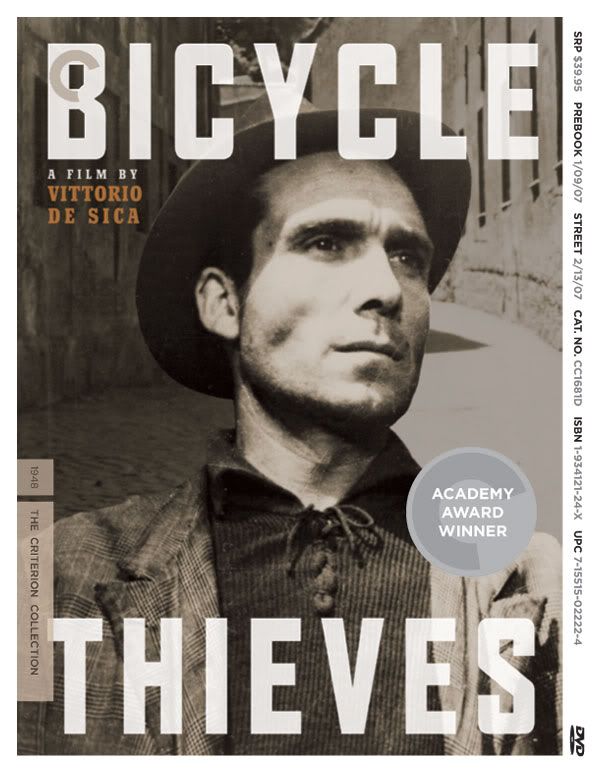
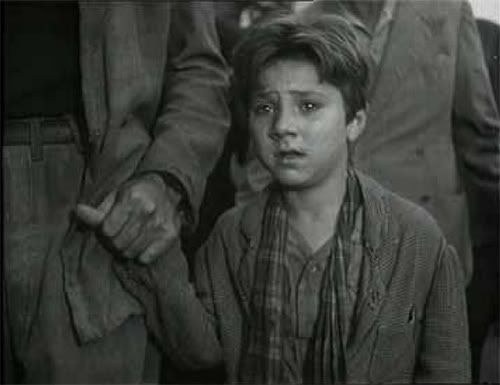
Ladri di biciclette (literally, Bicycle Thieves, though sometimes called The Bicycle Thief) is often cited as one of the greatest films of all time and certainly the best example of Italian neorealism. While it's difficult to ascertain whether it's the best film ever, it's certainly - like Akira Kurosawa's Rashomon - a perfect film. It is entirely flawless, and it manages to infuse its ultra-simple premise - a poor man's search for his stolen bicycle - with tremendous power and grace. We weren't sure what all the fuss was about but now, having seen it, we can understand why it has had such an impact. It's just heartbreaking.

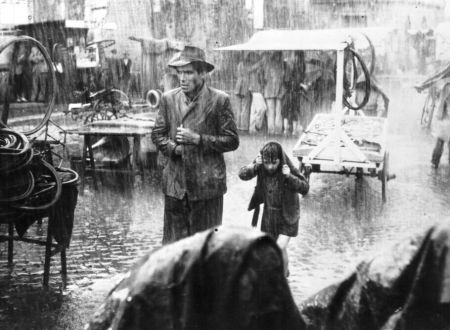
The plot seems thin on paper: in poverty-stricken post-war Rome, Antonio (the gaunt non-actor Lamberto Maggioranni), finally manages to get a job. His new boss informs him that owning a bicycle is a requirement for the job and so, after his wife pawns their matrimonial bedsheets, he gets a bicycle. On his first day on the job, the bicycle is stolen. And for the rest of the film, he searches for the thief, with his seven-year-old son, Bruno (the cherubic non-actor Enzo Staiola), throughout a hot, hostile, Sunday Rome.


The long search.


Many people comment on the richness of the neorealist details - on how accurately post-war Rome is portrayed, or how interesting it is that the cast was made of non-actors - but we think the universality and simplicity of the humanity is the best part of this film. It could be anywhere, about anyone who is stuck in poverty. Thanks to the excellent narrative structure, the gentle pacing and the background score, we found ourselves swept along completely by the doomed search for the bicycle - our heart soared when Antonio and his son made up after an argument, and we cried during Antonio's final, desperate attempt to fix the situation.

Neorealism is all about not calling attention to the act of filmmaking, and indeed we didn't notice any symbolism, any fancy framing or quirky storytelling device. The story is told with great clarity and earnestness, and it leaves it up to you whether you want to turn bicycles into a symbol for something. During the film itself, we were propelled entirely by emotion rather than intellect. And in the end, we only said, "Good!" We can thus add our voice to the consensus: this is a must-see for any cinephile.


:(


A fun thing to note is the effect the film had on popular culture. First, it has plagued many a conversation we've had with various intelligentsia wherever we go. We once attended a screening of Satyajit Ray's Pather Panchali which drew interesting parallels between the neorealist portrayals of poverty in both cases. (Yes, they are very similar aesthetically - both even feature cherubic little child actors!) And, of course, it was a huge hit for Italian films abroad, during that golden age when new Italian films were hip and groundbreaking. (Le sigh.) We reckon Italian cinema is still riding the high of being "the place that made Ladri di biciclette and La dolce vita."

Within Italian pop culture, we've seen Ladri di biciclette pop up in interesting ways. Our favorite was during (our recently faved) C'eravamo tanto amati, where one character is so moved by the film that he decides to abandon his career and family in order to dedicate himself to writing film criticism/cultural commentary and basically promoting this film as the end-all, be-all film. "This is what they should show schoolchildren!" the character declares. The character is a caricature of the socioculturally-minded intellectual and, later in the film, he loses a fortune during a game show since he can't answer the final question (on, of course, Ladri di biciclette) in the time allotted. It's a funny little tribute to how when a film is too good or maybe just too admired, people (especially us intellectuals!) can get a little too enthusiastic and tend to lose perspective. (Goodness, like the Slumdog mania!) We wouldn't say this changed our reality or inspired us to abandon our career, but it is really, really good (much better than Slumdog!).

Wednesday, 28 May 2008

Barsaat (1949)

Disclaimer: The PPCC watched Raj Kapoor's Barsaat (Monsoon) with fellow blogger and owner of our single brain, Beth. As a result, the PPCC was a bit distracted by the fun chatting and we spent a lot of time going, "STUD IN THE HOUSE!" instead of actually listening to what Raj Kapoor or Prem Nath were saying. Well, what can ya do? STUDS.


We're always so charmed by Raj Kapoor's visuals.


Or just visuals of Raj Kapoor. Young, thin, Byronic. Triple yeah!


The plot: Gopal (Prem Nath) and Pran (Raj Kapoor) are two studs on the prowl, cruising along the Indian countryside in their trendy wheels. It should be noted that both are phemonally good-looking. Anyway, Gopal is a bit of a dallier - he's got a girl in every hamlet, you know what I mean? Meanwhile, Pran is the sensitive poet of the two. So far so standard. Every year they rock up to a hillstation or something. Gopal pays a visit to his frequent lay, Neela (Nimmi), a poor mountain girl who does nothing but wait for him to return. Pran, like the PPCC, is disgusted and highly disapproving of Gopal's dallying, but, well, what can ya do. The two rent a house from some dude whose daughter happens to be the likable Reshma (a gorgeous, young Nargis). Both men are taken with Reshma - as would anyone, she's just so cute! - but for Pran, it becomes something more, and soon enough, the Raj-Nargis energy supply source is activated. Honestly, the heady scenes of their courtship are reason enough to watch this film, and the PPCC spent most of the time gushing to Beth about how gorgeous Raj is, how wonderful Raj-Nargis are, and - OMG - are those the looming Sitars of Sex, I hear?


The Raj-Nargis chemistry, on high.


Prem Nath's looking quite the stud himself these days.


They're actually not, we were just having Dum bhar jo udhar munh phere flashbacks. Pran and Reshma have a platonic-yet-passionate courtship, and soon enough the wedding sitar - no, violin - no, shehenai - is playing. But one evening, when Reshma's father catches Reshma on her way out to meet Pran, he assumes - like the PPCC did, honestly - that she's going to get some Raj some'n some'n. There follows a bizarre scene that ends with Reshma sort of drowning.

Now begins the usual forced separation of intensely-in-love lovers. Reshma is fished out of the river by the huge brute, Bholu (K.N. Singh, who plays Jagga the Dacoit in Awaara). Bholu, struck by Reshma's prettiness, decides he will wed her as soon as she comes round. Meanwhile, Pran, presuming Reshma is dead, spirals down into the usual unwashed, unshaven lover's depression/madness thing. The lovers get to sing matching his and hers songs of painful longing, as well as a gorgeous duet - Chodd Gaye Balam (My beloved has left). Several close calls occur, according to the Law of !ncredible Indian Irony, where the lovers are almost reunited. Much drama occurs of the usual La Traviata style and we should note that, in the end, the PPCC cried.


Whoa, diagonal.


Barsaat shares many similarities with Raj Kapoor's later work, Awaara. Both feature strong, stylized visuals that make ample use of dramatic lighting, sharp diagonals, textured black and white, and frequent shots of the sky. The music in both includes at least one large choral number and a couple longing solos - as Philip Lutgendorf's review aptly describes, these songs are like arias which lend an operatic-feel to both films.

Indeed, Raj, when he was on top of his game, had a humanistic grandeur that is just immensely satisfying to watch. When Raj was good, he was really good. Better than his brother, the PPCC's beloved Shashi. Better than anyone else in the Kapoor clan. Better even than Naseeruddin Shah, the PPCC's benchmark for Best Indian Actor. Raj was transcendental.


Do you feel the drama? FEEL THE DRAMA.


Unfortunately, Raj was also highly, highly variable. The PPCC has seen 5.5 of his films so far: this, Awaara, Teesri Kasam, Sangam, Aag, and half of Shree 420. And our verdict on these films and, specifically, Raj's performances, has ranged from transcendental to, well, astonishingly bad. It's not that he was an incapable actor. It was just that he was clearly very talented, and he seems to have become very well-appreciated at a very young age (his first film as a director was Aag, which came out when he was 24), that his performances could sometimes feel incredibly self-indulgent. A bit like the Kenneth Branagh effect (though, OK, Kenneth gets a lot of flack and Indulgent Ken has never been as difficult to digest as Indulgent Raj).

Also, his most famous persona - the Chaplinesque tramp character of Shree 420 and some scenes in Awaara - now rings annoyingly cheesy to our 2008 eyes. As a result, the PPCC has never liked over-the-top comedy Raj, nor have we liked over-the-top melodrama Raj - both performance types are so loaded with affectations and self-conscious posturing. Instead, when Raj was restrained - Teesri Kasam is a perfect example - he was so good. SO GOOD. In Barsaat, we would estimate that he was about 60% amazing Awaara Raj, and about 40% OTT Raj. This is a tolerable mix, and makes for generally fine viewing.


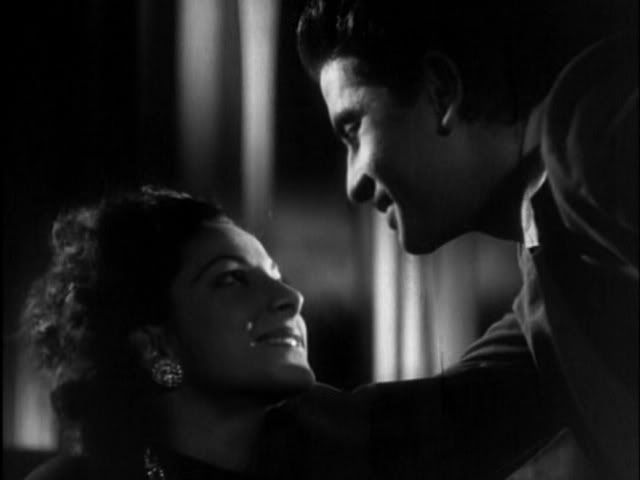
Aww, Nargis was so pretty in this.


The Mao hat, which Beth spotted first. Later in the film, the actor who plays Bholu's local pandit looks Chinese, too.


But that's only talking about his performances. Director-wise, we have enjoyed all of his films (with the possible exception of the overused two-tone color filters he used in Satyam Shivam Sundaram).

The music of Barsaat is, as usual for Shankar-Jaikishen, top-notch. There was an interesting selection of classical Western pieces which serve as background music - we're philistines, so we can't tell you who they were. Uh, Chopin? Beethoven? Liszt? Honestly, it could be anyone. We have no idea. But we do know that our favorite song was Chodd Gaye Balam - such bittersweet melancholy! Such transcendental bliss! Clearly, Chodd Gaye Balam is the new Ham Tujhse Mohabbat here at the PPCC. Chodd Gaye Balam is like Madeleine L'Engle's A Wrinkle in Time, if the latter was an old Hindi film song and not a young adult book. You know what we're saying? SUBLIME FROM ANOTHER DIMENSION.

Exploring further:

Thursday, 20 March 2008

Aag (1948)


AAAAH!


This one goes out to you, maxqnz!


AAAAAAH!


We are reminded of a scene from Dazed and Confused. The nerds are driving to the party and, on the way, they are discussing their futures. Tony asks Mike, "So, you're not gonna go to law school? What do you wanna do then?" Mike, played by the excellent Adam Goldberg, hesitates a moment and then exclaims melodramatically, "I wanna dance!"

That... is the passion of Aag. Except Raj Kapoor's breakthrough film didn't mean it ironically, but rather was earnest in its desire to live, to act, to be! Yes, it's all very passionate, in a very 525,600 minutes way. Already early on, as Raj Kapoor's Kewal entered the matrimonial bedroom and gave an effette flick of the wrist, and we were flashed back to vivid memories of Kenneth Branagh and yet more Kenneth Branagh, it was clear that this would be a movie about acting and passion and writing in italics.

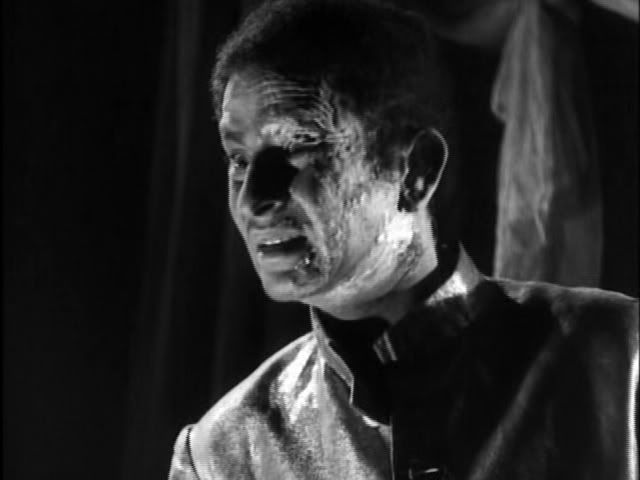
The Quest for Nimmi, Part One: Kewal (Raj Kapoor) enters the matrimonial suite and frightens his nameless bride and us by giving us a scarily-lit view of his hideously scarred face. Alas, alack, he cries, drama queen that he is. Back in the day, he was a handsome man... (Wayne's World sound effects).


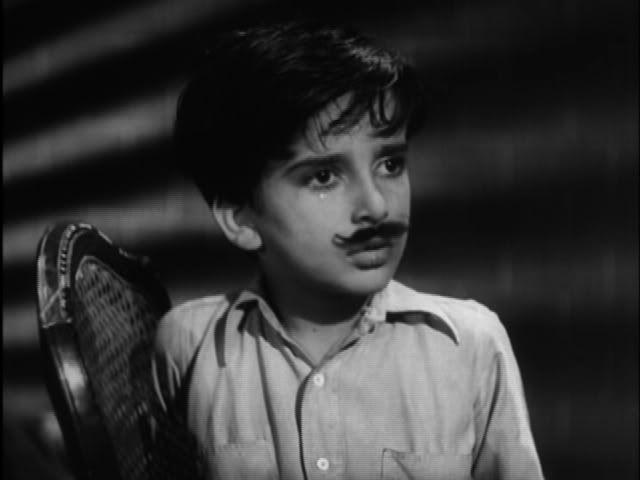
Mini-Kewal (an outrageously adorable and sassy Shashi Kapoor) honing his technique of looking SHOCKED, I say, SHOCKED.


The Original Search for Nimmi: Enter teeny, tiny Shashi Kapoor, playing the young Kewal. Side note: Shashi is so freaking adorable in these scenes. Anyway, mini-Kewal is big friends with little Nimmi, and he is also a theatre freak. After the local theatre troupe comes to town, mini-Kewal decides he too must be a theatre person, and so he dons a moustache and some managerial skills and sets up his own show. But alas, his leading lady, Nimmi, is nowhere to be seen! News arrives: she has moved away!


University-age Kewal (a moustacheless Raj Kapoor) is still perfecting that technique. I think we need to throw that head back a bit further for the full SHOCKED effect.


The Post-Adolescent Search for Nimmi: Enter university-era Kewal, now moustacheless and strangily lacking his usual Raj Kapoorness. Maybe it was the moustache, after all. Anyway, Kewal still has his head in the clouds, and he still yearns to be free of the shackles of bourgeois normality. One day, a cute girl arrives on campus. Kewal, smitten, asks her to be his Nimmi. She agrees. He stages the play again. She doesn't show up again - this time because she got engaged the day before!


Rajan (Prem Nath), the model Successful Bohemian. Yes, it can be done!


The Adult Search for Nimmi: Kewal fails uni and decides on a career path as a professional drama queen. His father (Kamal Kapoor, who looks an awful lot like Narang) is appalled, but his mother does the usual Hindi Movie Mom thing and cries and cries and, well, cries. Kewal meets a fellow bohemian artist type, Rajan (Prem Nath). Rajan is a painter with money and a strong jawline. They become friends. They decide to stage a play. But they need a leading lady! After sifting through every girl in Bombay, a dark, brooding girl (Nargis) with a mysterious past which involves violence in the Panjab appears. Both men are smitten and Kewal, without fail, asks her to be his Nimmi. She agrees. The play is finally staged! But Rajan is so sad he puts a damper on the play's successes, and Kewal is forced to burn his face off, thus alienating Nimmi #3.


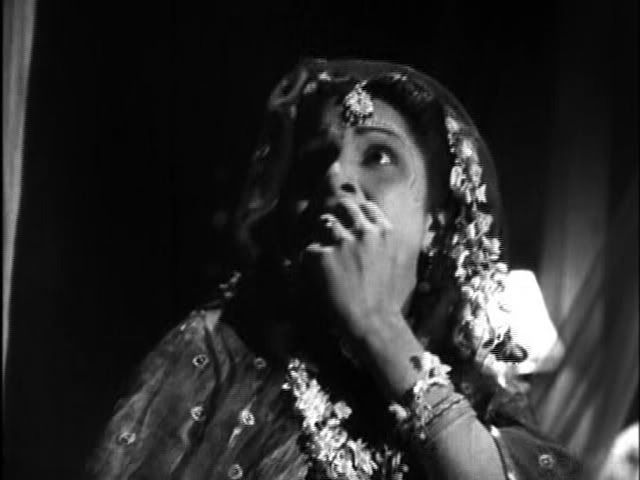
Nimmi #3's helpful response to seeing the injured Kewal? "Aiiiieeeeeee!!!"


The Burn Victim's Search for Nimmi: But will Kewal ever find his Nimmi, especially now that he has been burnt beyond recognition?! The quest continues.


This scene was actually incredibly poignant.


Raj Kapoor said this film was about youth's Carpe Diem-style ambitions, seeking more from their lives. In that respect, the film certainly succeeds. It still carries the rough edges of silent era cinematography, and so we are loaded down with dramatic lighting and overly theatrical scowls. To the modern viewer, it all seems a bit melodramatic, and while the melodrama fits in well with the character of Kewal, it's difficult to emotionally engage with it. This film is a bit like a rougher, earlier Awaara - it hasn't aged as well as the later film, though it has several similarities (poverty, an adult reunion with the childhood friend and girl-next-door). When the film really works are in the more understated moments of poignancy: for example, the scenes when an exhausted and starving Kewal meets Rajan, and the two kindred spirits immediately strike up a friendship. The interactions between Raj Kapoor and Nargis are electric as ever. Generally, all the scenes of the theatre business chugging along are wonderfully put-together and evocative. It all crumbles into melodramatic mush during the climaxes: when Kewal learns Rajan's feelings for Nimmi3, or when Kewal is burned. In this respect, we think Awaara is a much better film - because during its climaxes, things never spill out over the top. And Raj Kapoor's reaction to the arrival in Nargis is much more beautiful in Awaara. Gush, our favorite scene!


Raj Kapoor and Nargis; watch the sparks fly!


That said, while the filmmaking has aged, the structure of the narrative is very good. In particular, even if the ending is logically unbelievable, it is still very emotionally and aesthetically satisfying - it just makes sense on a gutsy level. Also, the constant symbol of fire is used well to capture the vibe of a smoldering youth, ready to give sparks and explode.

It goes without saying that the music is fab; but then, they always say how Raj Kapoor had an ear for melody. Sunie.