Showing posts with label ajay devgan. Show all posts

Wednesday, 31 December 2008

Lajja (2001)

Some movies end with "Thank You!" instead of "The End", and the epic, dismal, nominally "feminist" misfire that is Lajja (Shame) should give us some gratitude too, wethinks. Gratitude for sitting through three hours and twenty minutes of a relentless, ham-fisted grotesquerie about the Plight of Women, where the scenes swing from fantasy-style empowerment to incredibly distressing violence. We'll just say up front that we found the recent Chak De! India and the zany, emancipated Beta much more succesful feminist Hindi films. Lajja, for however hard it tries, ultimately left us with a bad taste in our mouth - it wasn't challenging, subversive or uplifting. It was just angry and angering. In short, Lajja was to misogyny what Dhan Dhana Dhan Goal was to racism: both films tackle an unsavory, real life topic in a clumsy and ultimately ineffectual way.

The first red flag, for us, was director Rajkumar Santoshi's well-meaning but subtly offensive disclaimer:


Last line, in particular: "After all, the greatness of a civilization can only be measured by the status of its women."


Ahem. Okay. Right. This annoys us because why can't society also be measured by the status of its men? Why are women relegated to this "special" role, serving as representative tokens? In particular, the film itself criticizes Indian culture's "hypocrisy" in putting women on a pedestal - for example, Sita of the Ramayana, or the eternal "Maa" of filmidom - worshipping them while simultaneously imprisoning them in highly restrictive ideals of purity, chastity, morality, and so forth. Yet the film seems to suffer from this very thing, if we're measuring freaking civilizations by the size of that pedestal! Also, very importantly, notice that the harrassed heroine, Vaidehi (Manisha Koirala), is a stereotypical filmi Good Indian Wife: that is, she is distressed not only by her husband's physical abuse and philandering - as anyone would be - but she is also alarmed by seeing her emancipated friend, Janki (Madhuri Dixit), drinking, smoking and whistling. And the Good Indian Wife gets the happy ending, whereas Janki is the victim of mob violence! We got the distinct feeling that, as much as director Santoshi wanted to emancipate and empower women, he still suffered from that particularly male-centric desire to define the terms in which women can be emancipated. Apparently it's okay to want to be free from domestic abuse, but it's not really okay to try things, have vices, make mistakes or, gosh, not want children (shudder at the thought!) as every woman in this film is associated with being a (potential) mom.

The odyssean tale begins with Vaidehi (a gloomy Manisha Koirala), imprisoned in the first ring of misogynistic inferno: her husband, the schmoozy, boozy Raghu (Jackie Shroff), gives her a lot of material wealth and a lot of problems. He openly flirts with other women and hits Vaidehi behind closed doors. When Vaidehi finds the strength to escape, she flees to her parents' home in India - and her parents, in what will become a running leitmotif of the film, offer practically no sympathy and urge her to return to Raghu. Meanwhile, Raghu has been in a car accident and found that he's sterile and Vaidehi is pregnant. His desire to track Vaidehi down therefore becomes much more intense, as she becomes - clang! another blunt note! - importantly and merely a "baby-producing machine" that he can dispose of once the baby is born. He sends his two goons (a highly restrained Johnny Lever and Razak Khan, thank goodness) to track her down.

Vaidehi now runs around the subcontinent fleeing from her evil husband's evil goons' evil clutches. And along the way, she runs into every Representative Problem of Indian Women that director Santoshi could think of. First: dowry. Vaidehi gate crashes a wedding in order to hide from the cops. There, she runs into the first (of two) good guys, the thief with a heart of gold, Raju (a very cute Anil Kapoor), as well as a gaggle of unexpected 1970s masala comedians (Asrani! Jagdeep! a Johnny Walker lookalike!). Vaidehi and Raju and the comedians witness the evil conniving of the groom's family as it tries to extort as much dowry money as possible from the harried father of the bride (Anjan Shrivastav).


A special note about Asrani: he looks AMAZING for his age! A special note about Jagdeep: we secretly hard-core love Jagdeep and think he was an untapped potential of humanistic, tragicomic genius. We have also decided that he will be playing Anil Kapoor's father in the film we're writing.


Next up: the working woman. Hindi films have a long tradition of showing the theatre woman's doomed attempts at love and marriage due to society likening her to little more than a prostitute. Vaidehi indeed runs into the feisty, fun Janki (Madhuri Dixit), who is pregnant, unmarried, a drinker, a smoker, a whistler and the star of a local theatre company. When the jealous and evil theatre owner (Tinnu Anand) plants the seeds of doubt in Janki's lover's mind, lead actor Manish (Sameer Sodi), Janki is quickly dumped and asked to have an abortion. In retaliation, Janki becomes a little wasted and - in the film's most blunt but also most satisfying mini-climax - rewrites the Ramayana play they're performing to demand why Sita must be tested by fire, why not Ram too?! Good one. As Carla noted, this nugget is representative of the entire film: that is, it is a criticism of Sita's famous trial by fire, on which so much of Indian culture's gender relations are based. (Nota bene that all the heroine's names are variations of Sita's.)


You made Sita cry! BESHARAM!


Anyway, third problem: infanticide (and a little wollop of casteism). Vaidehi's next stop is in a tiny village ruled by an evil thakur type, Gajendra (Danny Denzongpa). The village's midwife, Ramdulaari (Rekha), is progressive and empowered - uh oh, this doesn't bode well in a film where all except two of the male characters are violent, stupid and evil. As Ramdulaari welcomes her computer geek son back from university, she is horrified to learn that he has fallen in love with Gajendra's daughter. This gives Gajendra the perfect pretext to get rid of Ramdulaari once and for all. Yet with the arrival of the second (of two) good guys, the dacoit with a heart of gold, Bulwa (a very studly Ajay Devgan), a full-scale dishoom dishoom is unleashed. The remaining half hour of the film sounds like this: dishoom! whack! aarghhh! wahh-pshhhh! splash! gurgle! thump!

And the PPCC of course: siiiigh.

Just when we were thinking, "Hey, it's been over an hour and no sign of Anil or Madhuri. Did Santoshi just forget about them!?" Santoshi proves that, no, he didn't - as he ties everything up, a little haphazardly, in a hasty "happy" ending.


Man, we wish we could just chill out with Rekha sometimes.


We've already described the film's main problem above. Basically, it's a dangerously oversimplified, one-sided view of a complex and deep-rooted problem. In this film, all women are pure, virginal and true, and all - except two - of the men are either stupid, evil or both. While Santoshi's disclaimer notes that things have been "amplified for deaf people to take note", we think he undermines his own message by being so "loud". Awful things happen to women in this film, and it seems like anything less than perfection - both in terms of personal strength and purity - is severely punished. Often, even perfection itself isn't enough, and then it's up to Anil Kapoor and Ajay Devgan to sweep in and save the damsels in distress.


Manisha and Madhuri. One of the few moments when they're not CRYING ABOUT BEING A WOMAN in this evil man's world.


Which segues nicely into a note about the two sole "good guys". We thought it was interesting that both good guys are "anti-socials", a thief and a dacoit, operating outside of the system. Way to the stick it to the Man! Anil's Raju openly criticizes the establishment as a hateful society, noting that going to jail would be a respite from its wretchedness (ha! we liked that line, btw), while Ajay's Bulwa seems to embody a fiercely independent (notable in itself) and proto-feminist Jai Santoshi Maa! mentality. One of the most notable scenes (slight spoiler), we think, is when Bulwa has the chance to behead Raghu the evil husband. As he raises his machete, Vaidehi screams in horror. Bulwa stops himself and, angry, bellows at Vaidehi that "you women are your own worst enemies!" and only an "Indian woman" would still be apalled by the decapitation of her clearly evil husband. We think this scene is interestingly saying that Indian women's culturally-approved devotion to the sanctity of marriage (sometimes embodied in their inability to remove their mangalsutra or, you know, watch their husband get decapitated without flinching) is against their own interest. A fascinating, weird scene.


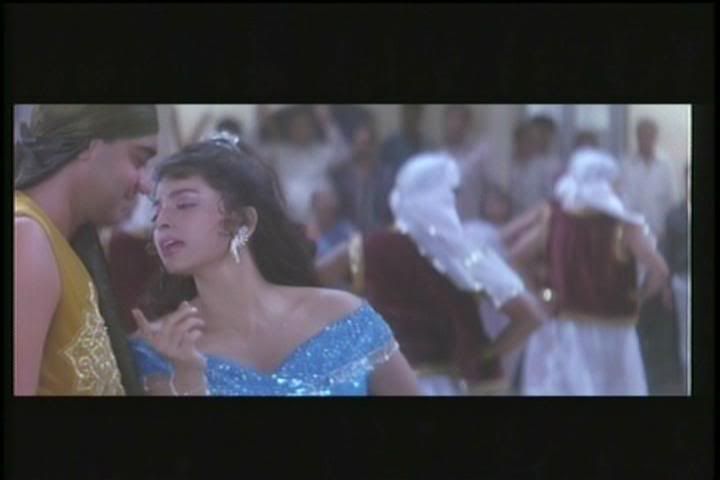
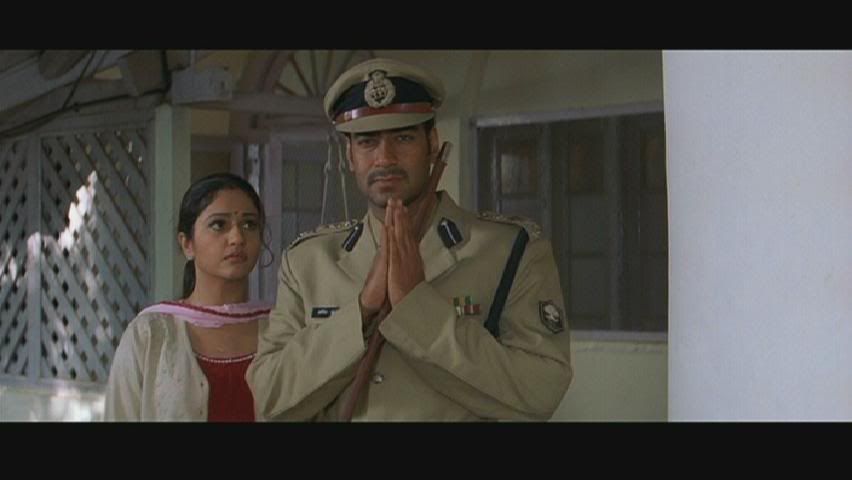
Shameless Ajay Devgan pic, but, goodness, he looked divine in this film. STUD! And Good Guy #1.


That said, our heart belongs to Anil Kapoor these days. Awwww! Good Guy #2. Dilsquish!!


We wanted to like this film, because anything pro-woman gets big brownie points at the PPCC. Unfortunately, we found this like a much more bloated Mirch Masala - a facile, unhelpful look at "how women suffer". We highly recommend, however, that you watch it yourself as it can certainly stimulate useful debate.

Friday, 11 May 2007

Omkara (2006)


The bad-ass trailer.


Vishal Bhardwaj's Bollywoodized Othello-remake, Omkara, is a strutting, masculine ride through the raunch and jealousies of men, and the havoc these men wreak on the woman who love them. More hypnotic and spacious than his previous Shakespearean joyride, the moody Maqbool, Omkara is set in the 'Wild West of India', the region of Uttar Pradesh. Perhaps Bhardwaj has a fascination with the lawless, but once again Shakespeare has been teleported into a criminal organization. This time, it's the rootin' tootin' gang of Omkara (Ajay Devgan), second banana and chief thug to Boss Bhaisaab (an eerie Naseeruddin Shah).


The sweaty, raunchy, boozed up dance party.


Omkara has two lieutenants of his own: the grimy and thick Langda (Saif Ali Khan), and the boyish and also thick Kesu (Viveik Oberoi). When Bhaisaab wins a seat in Parliament (shudder at the thought), he nominates Omkara to be official Crime Boss, leaving Omkara then to pick his General. Or Captain. Or whatever, we don't really understand the military metaphors. Anyway, if you know Shakespeare's original, you know that Omkara picks Kesu over Langda, much to Langda's chagrin. Langda then decides that the only way he can ease the pain of rejection is by destroying everything that is beautiful around him. Namely, the illicit love story between "half-caste" Omkara and his (presumably full-caste) fiancee, Dolly (Kareena Kapoor).

What follows is a train crash, protracted over nearly three hours. If you know the original, you know what to expect and, inevitably, you sit in grim anticipation as Langda manipulates Omkara's jealousies and creates an imagined world of sweaty adultery. If you've never seen the original, let's just say things don't really work out.


The haunting romantic melody. Doomed indeed.


Ajay Devgan is stiff and lumbering as the Othello character. But he does what he's supposed to, which is smolder for two hours, and then briefly weep. Likewise Kareena Kapoor is just Holy and Spotless enough that we feel genuinely sorry for her end, even though we didn't like her throughout the film. The milk and coal joke certainly seems... erm, apropos.

Perhaps the biggest surprise of Omkara is how amazing Saif Ali Khan is as Iago. Iago is generally a difficult character to play; too easily he becomes a charicature of the devil, all cackles and twirling black moustaches and no depth whatsoever. What Saif manages to do, even with the prototypical Shakespearean device of a bad leg, is invest Iago with a sort of sinister depth. Here is a man who hates himself, and, by natural extension, everyone around him. We at the PPCC don't like Saif Ali Khan at all, or thought we didn't, but now... Hmmm. He was certainly the only one, apart from Naseer, who was willing to look positively ugly for the film, what with his yellow teeth and lurching gait. And there's a tragic undercurrent to his behavior, a genuine and justifiable pain at being the loyal servant too-often overlooked.

Stream the lovely soundtrack.

Wednesday, 21 March 2007

Naajayaz (1995)

Previously on the PPCC, we mentioned that Naseeruddin Shah is particularly adept at playing paternal figures who like to drink and cry a lot. We were so right.


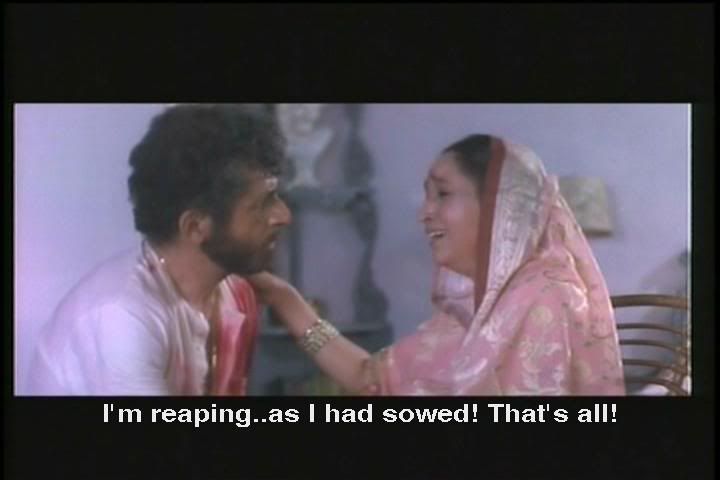
I'm still alive, so let me live. It's raining, so let me drink. Repeat 10x.


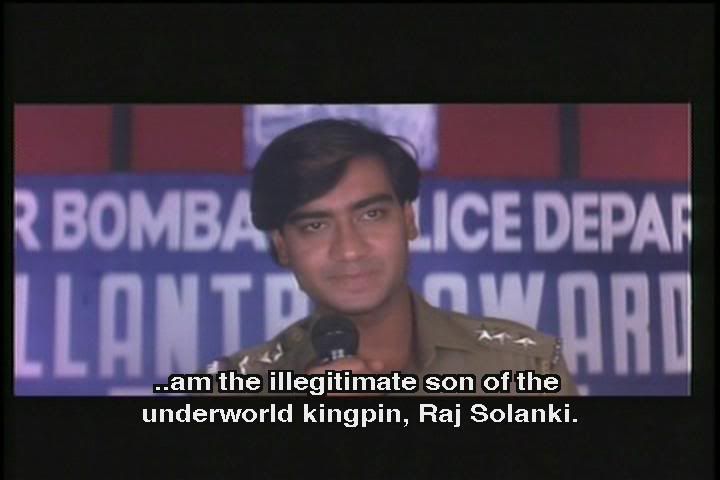
Imagine that it's fifteen years after Masoom. Adulterous D.K. has now turned to the underworld and become a kingpin crime-boss named Raj who prays at the alter of Ganesh. Beautiful little Rahul has grown into a brooding, mullet-ed police officer, Jai (Ajay Devgan). They've all moved to Bombay, and Jai has no idea that the king of crime he seeks to defeat is actually - in an irony Shakespeare or George Lucas would have applauded - his father! (Obi-Wan never told you what happened to him, after all.)

Naajayaz isn't really the sequel to Masoom, though we like to pretend it is. Once again, Naseeruddin Shah plays an adulterous husband who learns that he has an illegitimate son. Once again, the son is adorable and perfect, and the son's presence will wreak havoc in Naseer's otherwise pleasant life. Except now by "wreak havoc" we actually mean people will get kidnapped and shot. And by "adulterous husband" we also mean "criminal lord". And by "pleasant life" we mean about as pleasant as a life of crime can be. So a little violent (beware, lots of jam). Add some Bollywood song-and-dance numbers, and voila! - you have Naajayaz, a highly entertaining film.


Maybe now's not the best time to come clean about paternity issues.


Naseer does this a lot.


The movie starts with some flashbacks interlaced with brooding Naseeruddin Shah shots. We learn that Naseer climbed the ranks of crime by hitting a lot of people on the head with a rock. But he's a victim too! His brother literally lost his tongue to vague gangster types, and his wife's honor was threatened. Life was hard.

Fast forward to the Present Day, and Naseer is now the Marlon Brando Figure presumably cutting other people's tongues out. He lives in a huge Bombay flat with his frail wife, whiny son, loyal mute brother, and an army of henchman. He wears gold chains. He is clearly a bad-ass in the vein of gobstopper candies or Paul Simon songs: hard on the outside, squishy on the inside. Life is a bit better, though still pretty tragic.

Enter an old flame. "Raj, you have another son and he's totally not into crime." He's a police officer, in fact! A police officer obsessed with bringing down the Raj Underworld Empire, indeed! (Raj Raj? Nyuk nyuk nyuk.) Oh NO. What will HAPPEN?


Dear, there's no need to be so dramatic.


Interesting composition! Notice she's at the Golden Ratio!


How it all began. And by "began" we mean "went horribly wrong".


Let's get one thing straight: melodrama can be good sometimes. The Aficionada is very careful about using the term, generally preferring to call something "melodramatic" only if it crossed the threshold of believability and just became silly. Naajayaz teeters precariously close to that threshold - one could say it hugs it; OK, makes out with it - but it never quite topples into the abyss. Yes, we laughed most of our way through the film, but we were also secretly bummed out for poor ol' Raj and his reign of Really Sad.

We like to think this is because of Naseer's uncanny actor skillz, but mayhap we are biased. Suffice to say he is excellent. There's a despairing fatalism to his Raj that makes everything take on that hint of Lear-like tragedy. Stop throwing yourself in front of the bullets, man. Choose life!

Ajay Devgan is highly enjoyable as well; he seems to have perfected the art of crying to the point where he can direct the trails of his tears. Young and soft as he is in this, it's a far cry from Gangaajal - but not too far. Indeed, one could consider Gangaajal the Return of the Jedi of this trilogy; with young Luke (Jai, Rahul)maturing into a grim, bad-ass Jedi master police inspector. You will return Captain Solo and the wookiee to me.


My favorite scene.


I am a pretty flower, la di dah.


As per Bollyusual, the film is long and everything that could be remotely interesting is squeezed out of the plot-idea. We dare not go into everything, but mention only that we also enjoyed all the various sub-subplots: the sneezy police chief, Ajay and his perky girlfriend as they frolic through forests, the middle-aged love triangle, Naseer's paradoxical religious devotion (like the Italian mob boss' Catholicism), and, of course, the mute and loyal bro. It was all very rich, very fun, and tinged with a satisfying sadness. All in all, a highly enjoyable movie. Why, if Naajayaz was a dessert, it would be a massive piece of ice cream cake!

Saturday, 17 March 2007

Gangaajal (2003)

Many an Indian film has dealt with the great bane of the subcontinent: corruption.

While some films have told a story of corruption through the lens of comedy (Jaane Bhi Do Yaaro) , others have taken a more serious route (Ardh Satya), often to critical acclaim. Gangaajal is in the latter category, though we critics of the PPCC neither acclaim or condemn it.


Straight from our lair.


First, we must put our cards on the table: we at the PPCC crush on Ajay Devgan like whoa, and the only reason we agreed to watch this film was because we were promised lots of brooding Ajay Devgan shots. In this respect, the film delivered. Huzzah!

Second, we at the PPCC have stoically sat through many an ancient Hindi flick - some with questionable camera technology, some with questionable fashion, and some where the audio slipped off right during our favorite song! Seeing something slick and post-2000 was, we admit, a breath of fresh air, so we might be a bit more forgiving than usual.


Lush shots of rural India. Joy.


Gangaajal follows Subinspector Amit Kumar (Ajay Devgan), a stern-looking hunk who probably irons his underwear, as he is assigned to a district out in rural India where lawlessness reigns. Bringing his perky wife and their perky furniture in tow, Amit sets up shop with one goal in mind: clean out the crime and corruption of District Boondock! His task is made difficult when he sees that everyone and their mom has their hand in everyone else's pockets. It's all very confusing, but also fascinating, as all the shades of corruption (and morality!) are presented. We at the PPCC were particularly taken with the sub-subplot of the corrupt lower caste police officer who bought the job in an effort to move up in the world - he turned out to be a pretty nice guy.


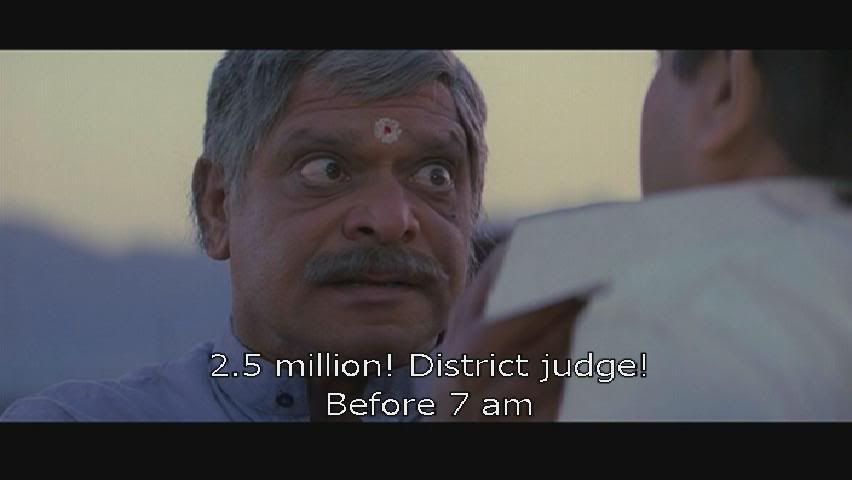
Welcome to a land where the crime boss and chief of police buy and sell jail time. Do not pass Go. Do not collect 2.5 million rupees.


The morality becomes further entangled when some police officers under Amit take to his Upright and Bad-ass example with just a little too much zeal and end up pouring battery acid into criminals' eyes. This gives rise to a wave of horrific vigilantism throughout the district. So poor Amit has to juggle two problems: clear out the sticky web of organized crime and quell the tide of acid-wielding fanaticism.


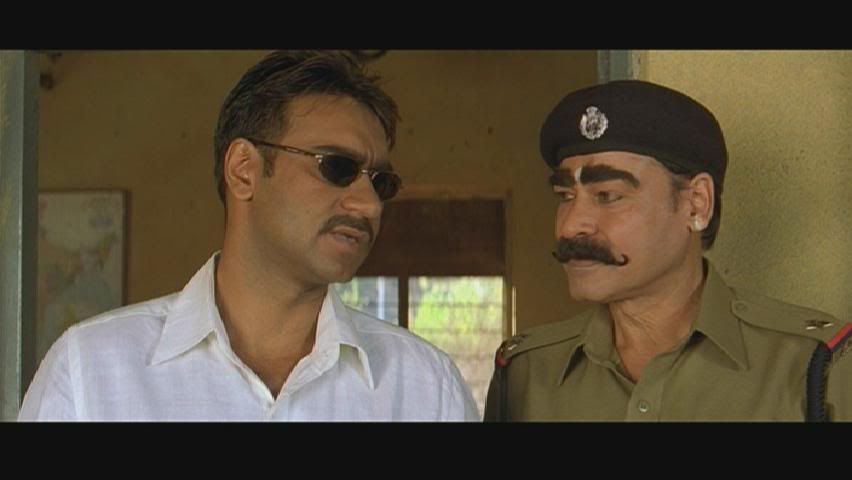
Ajay and Captain Spectacular.


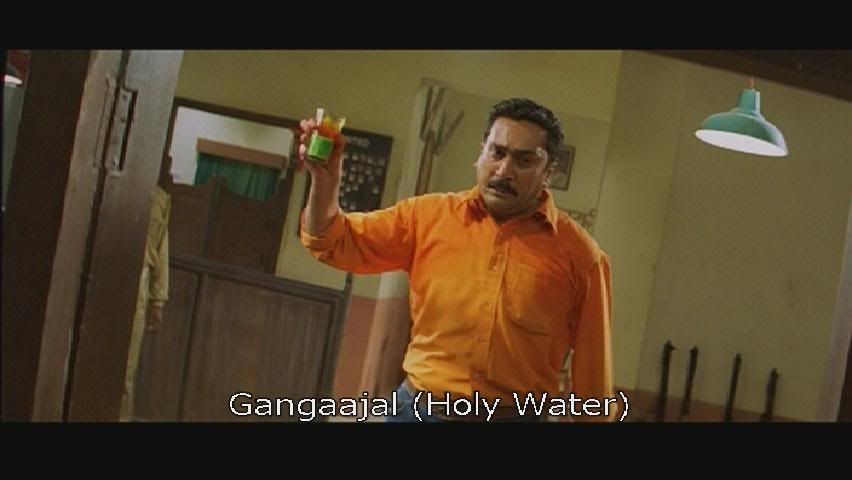
'Gangaajal' - literally, the holy waters from the river Ganges - refers to everyone's weapon of choice: car battery acid. Apparently, the film refers to a real life incident, and you'd think with such grim historical background, the movie would take care to present it in a sensitive, serious light. It tries to, but ultimately the director's choices undermine this seriousness; turning a gross violation of human rights into what looks like a madcap romp complete with green smokey liquid, field hockey bats, and video game sound effects (wah-pssshhh!).

Because of this semi-serious, semi-silly presentation, the viewer is left bewildered. The Aficionada's emotions were in turmoil: on one hand, giggling hysterically at the fight scenes, on the other hand, aghast at the degenerating situation. Add to that the fact that the plot was like sitting down to a Monopoly game already in its fifth hour, and you have a very uneven story.


Oh, Ajay.


Mob madness!


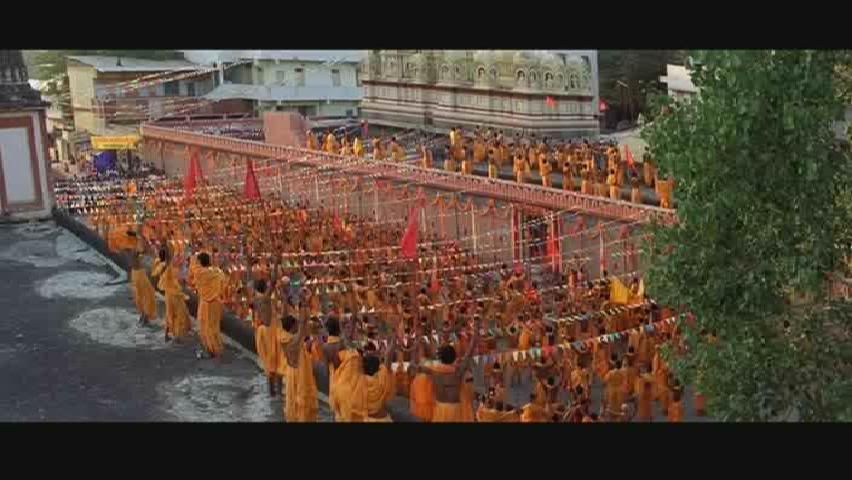
All that said, there were moments when everything came together and the movie became what it should be: turbulent, but beautiful. The shots of the town bridge at dawn and dusk were particularly effective, as were snatches of the music. There were even scenes when Ajay's Amit waxed philosophical about Society and Human Dignity. But then everything would just collapse again into a gory mess of B-movie clichés and inadvertent silliness.