Showing posts with label jackie shroff. Show all posts

Saturday, 10 January 2009

Trimurti (1995)


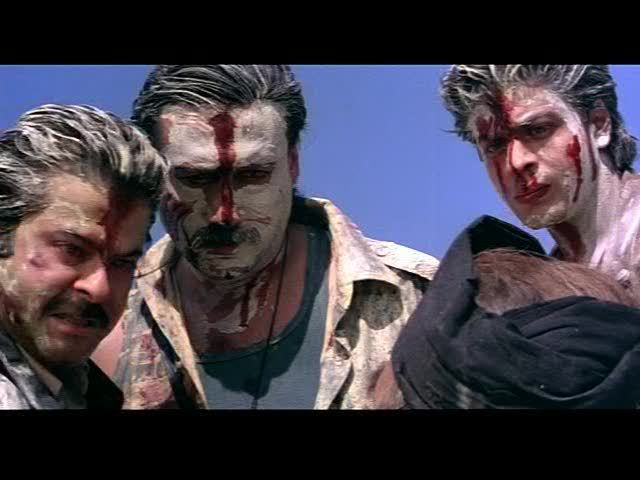
"Trimurti" also means "three statues" - and, look, the "destroyer" brother, "preserver" brother and "creator" brother have been caked in clay and adorned in the markings of the temple divinities! Hmm, subtle!


The epic flop Trimurti (a Hindu concept "in which the cosmic functions of creation, maintenance, and destruction are personified by the forms of Brahmā the creator, Viṣṇu the maintainer or preserver, and Śiva the destroyer or transformer") is good for a number of laughs, some epic pulpy spirit and the usual "awww!"-inducing glorification of brotherly love. Don't go into it expecting Subhash Ghai's usual masala fireworks, as you'll just be disappointed. The narrative is clunky, you could lose a Pinto in the plot holes, and the few sparks of life are quickly doused in pure badness. That said, if we at the PPCC were in the habit of grading films, we would give this a C. It's not good, but it doesn't FAIL as spectacularly as some other films.

The entire narrative relies on the stupidity of Saeed Jaffrey's character, Uncle, and the quasi-funny, quasi-melodramatic love between young Romi (Shah Rukh Khan) and Radha (Anjali Jathar). But wait - we should start at the beginning. Back in the day, there was a bad-ass female (!) police officer named Satyadevi (Priya Tendulkar). Satydevi's arch-nemesis was the kooky Kooka Singh (Mohan Agashe), who, apart from his wild fashion sense and facial tics, annoyed Satyadevi by being violently territorial over for the local Kali shrine. The Satyadevi/Kooka face-off escalates to increasingly grisly heights - he kills her husband, she kills his son - and Kooka eventually wins this round by framing Satyadevi and having her sent to jail. While in jail, Satyadevi gives birth to her third son, Romi, and, rather than placing him in the care of her brother, who we'll call Uncle Bumbling Idiot (Saeed Jaffrey), she tells him to give the baby to her prepubescent sons, Shakti and Anand. "Tell them they must raise their little brother!" she says.

Now, this may sound outrageous, but you'll see that Uncle Bumbling Idiot really is a bumbling idiot, and you wouldn't want him raising your children either. In particular, his most egregious idiocy and the one thing that drives the whole story forward: He forgets to tell the kids about Kooka Singh, the villain of the film! This would have saved everyone a lot of grief.
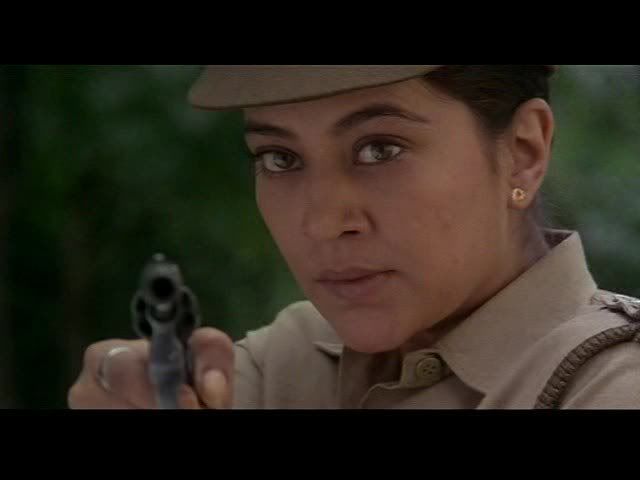

Strong, martial women - YES!
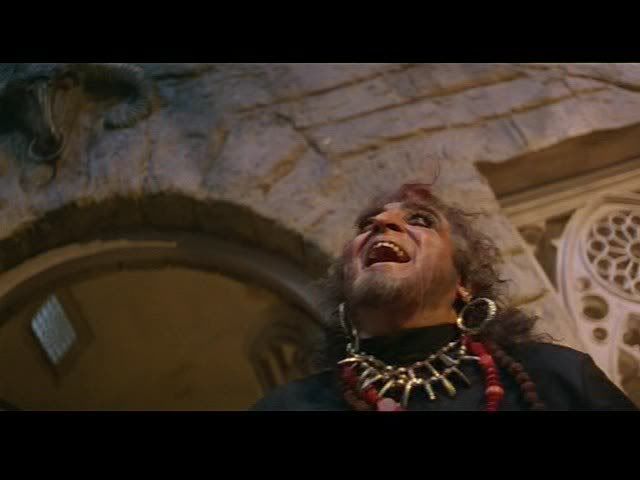

Mohan Agashe hams it up as the monstrous, ridiculous Kooka. Man, we last saw Mohan kicking it in the excellent Mississippi Masala. This was certainly a change.


Anyway, the little boys do what they can with their new little brother but eventually, as parents are wont to do, they disagree over how he should be raised. The eldest Shakti insists that their little brother follow the straight-and-narrow path: working hard, earning little and keeping his moral principles intact. The middle brother, Anand, instead thinks that they should get right down to opening liquor joints and selling cocaine as that's the only way to get ahead in the big, bad world. After one final argument, Anand storms out, moves to Mumbai and reinvents himself as Sikandar (Alexander/"conqueror"), the foster son of a low-level gangster (Satyendra Kapoor). Anand is, like, eight years old or something. Clearly a total bad-ass! (And guess who he grows up into? Yessss.)

Fast-forward to the present. Shakti (Jackie Shroff) is a now a poor, hardworking truck driver for the military. Little Romi (Shah Rukh Khan) has just completed his IB and is now very keen on marrying his childhood sweetheart, Radha (Anjali Jathar). Radha's family (among them, Tinnu Anand) is richer than Romi's, and so they refuse the brothers' proposal and humiliate them. An enraged Shakti flips out and breaks their Ming vase while a despairing Romi decides to abandon his brother's hard-work ethic and join the underworld in a hasty "get rich-enough-to-marry-Radha quick" scheme. And whose crime syndicate should he join but... yes, Kooka's! After a hilarious job interview in Kooka's dungeon lair, where Kooka sucks rooster bone marrow and scoots around on an office chair he's decorated in fur and horns, Romi gets the job. A few days later, at the similarly hilarious office party, Romi meets... yes, the legendary Sikandar (Anil Kapoor)! Romi and Sikandar immediately hit it off and become best friends, and it's only a matter of ninety minutes for identities to be revealed, families to be reunited and Kooka's demise via a trimurti of "land, sea and air" to come.

Honestly, if the story had been better-told, this film had the potential to be a really spectacular pulpy masala classic. Alas, the tone was often mishandled, and this made the logical inconsistencies all the more glaring. Part of the problem with tone was the mismatch between Shah Rukh Khan's performance and the performances of Anil Kapoor and Jackie Shroff. They were just on different wavelengths: Jackie and Anil playing it straight, SRK playing it... well, like mid-1990s over-the-top SRK. So much of the narrative depended on Shah Rukh Khan's character, too: it's because of his love for Radha that he joins Kooka's gang, meets Sikandar, causes Sikandar and Shakti to meet and everything to come to a climax. Furthermore, it's for Romi's love and Romi's loyalty that the older brothers fight. Should Romi follow the moral righteousness of Shakti, or the criminal rebellion of Sikandar? Yet, as we've argued before, Shah Rukh Khan has never had particularly good chemistry with his male co-stars. Since the masala genre depends so critically on believable fraternal love, SRK's failure to convince us of Romi's love for his brothers compromised the entire emotional weight of the story. Jackie Shroff and Anil Kapoor - veterans of fraternal love - were much more convincing.

The next problem with the film's tone was the hollow romance: the script couldn't decide whether Romi and Radha's relationship was lighthearted and funny, or melodramatic and intense. On this front, we can't really blame SRK: if there's one thing he is good at, it's romance.
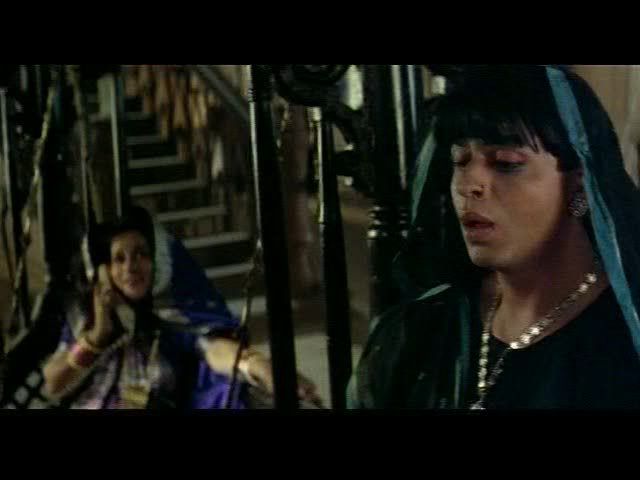

A rare opportunity to see SRK in drag! See, the romance should have just gone for comedy. It was certainly making us laugh.


Now, we bought this film for Anil Kapoor and, while not really paisa vasool for an Anil Kapoor fan (his bombastic entrance cues intermission), he is one of the film's saving graces. Anil Kapoor worked extensively with director/producer Subhash Ghai and he has a particular skill at being consistently excellent, even in Ghai's poorer efforts. As this review notes, it is only during Anil's scenes that we have any sense of emotional realism (or sweet pulpy goodness - tears! breakdowns!). Anil's scenes with SRK are also the best in the film: SRK playing the adulating and worshipful younger brother, Anil the macho elder brother with a distinctly dorky hidden side. These scenes are broadly comic, and some moments - SRK fanning himself while Anil works the Stairmaster, SRK walking in on Anil's private jam out to old Hindi film songs - were very funny and very cute.
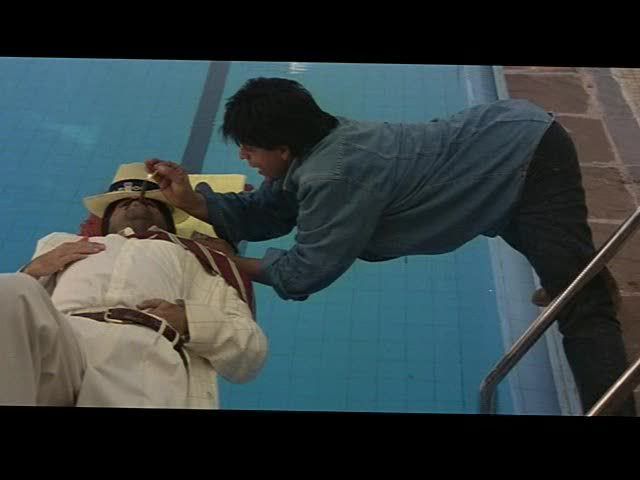

The scenes of Romi's growing devotion and love for his brother were the film's sweetest and most charming scenes.
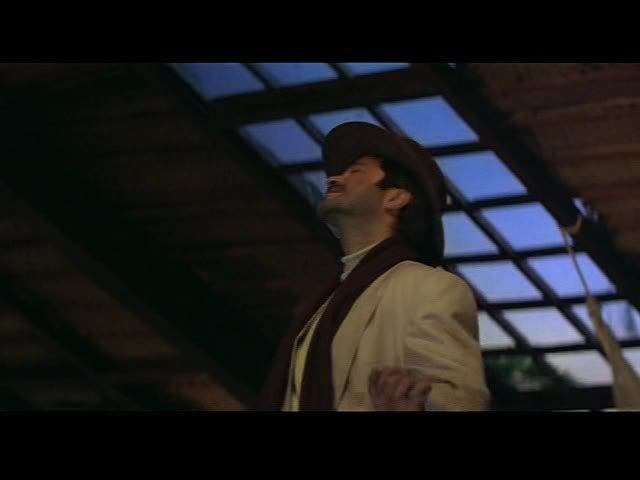

And the hard-ass Sikandar's not-so-secret dancing dorkiness was also very cute.
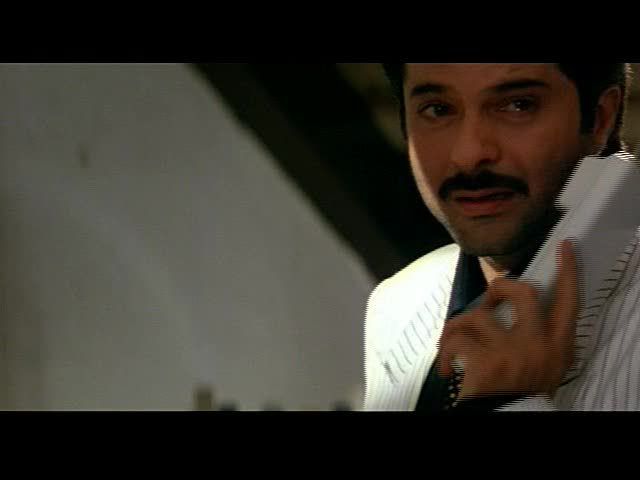

Not only dorky, but a woob as well! Oh, Anil Kapoor, don't cry. The PPCC loves you!


We at the PPCC consider ourselves very forgiving of trashy films. The one thing we cannot tolerate are trashy films with stupid, regressive messages - that combination of shoddy aesthetics and evil message-mongering is toxic for us. Trimurti is that rare case of a trashy film with an almost empowering message: the film is positively awash in feminine power, from the hardcore Satyadevi - who is more "Angry Young Lady" in the Amitabh Bachchan mode than the typical long-suffering Mom of masala films - to the constant thematic references to the goddess Kali. Even the eldest son's name, Shakti, refers to "divine, feminine power". In a genre which is rife with male-centric tales of passive, victimized women, it was very nice to see a more martial, kick-ass femininity (though it is, alas, the brothers who end up saving the day in the end... well, you can never have everything!).

Anyway, now that the review's done with, PPCC Readers in Delhi, we have a mission for you. Our current house favorite Anil Kapoor is auctioning a date with himself in Delhi (dinner and a movie!) for charity. One of you must bid in this auction, win it, and convey the PPCC's love and regards (and website address) to His Stacheliness himself. And then you must report back. Go, loyal minions!

Wednesday, 31 December 2008

Lajja (2001)

Some movies end with "Thank You!" instead of "The End", and the epic, dismal, nominally "feminist" misfire that is Lajja (Shame) should give us some gratitude too, wethinks. Gratitude for sitting through three hours and twenty minutes of a relentless, ham-fisted grotesquerie about the Plight of Women, where the scenes swing from fantasy-style empowerment to incredibly distressing violence. We'll just say up front that we found the recent Chak De! India and the zany, emancipated Beta much more succesful feminist Hindi films. Lajja, for however hard it tries, ultimately left us with a bad taste in our mouth - it wasn't challenging, subversive or uplifting. It was just angry and angering. In short, Lajja was to misogyny what Dhan Dhana Dhan Goal was to racism: both films tackle an unsavory, real life topic in a clumsy and ultimately ineffectual way.

The first red flag, for us, was director Rajkumar Santoshi's well-meaning but subtly offensive disclaimer:


Last line, in particular: "After all, the greatness of a civilization can only be measured by the status of its women."


Ahem. Okay. Right. This annoys us because why can't society also be measured by the status of its men? Why are women relegated to this "special" role, serving as representative tokens? In particular, the film itself criticizes Indian culture's "hypocrisy" in putting women on a pedestal - for example, Sita of the Ramayana, or the eternal "Maa" of filmidom - worshipping them while simultaneously imprisoning them in highly restrictive ideals of purity, chastity, morality, and so forth. Yet the film seems to suffer from this very thing, if we're measuring freaking civilizations by the size of that pedestal! Also, very importantly, notice that the harrassed heroine, Vaidehi (Manisha Koirala), is a stereotypical filmi Good Indian Wife: that is, she is distressed not only by her husband's physical abuse and philandering - as anyone would be - but she is also alarmed by seeing her emancipated friend, Janki (Madhuri Dixit), drinking, smoking and whistling. And the Good Indian Wife gets the happy ending, whereas Janki is the victim of mob violence! We got the distinct feeling that, as much as director Santoshi wanted to emancipate and empower women, he still suffered from that particularly male-centric desire to define the terms in which women can be emancipated. Apparently it's okay to want to be free from domestic abuse, but it's not really okay to try things, have vices, make mistakes or, gosh, not want children (shudder at the thought!) as every woman in this film is associated with being a (potential) mom.

The odyssean tale begins with Vaidehi (a gloomy Manisha Koirala), imprisoned in the first ring of misogynistic inferno: her husband, the schmoozy, boozy Raghu (Jackie Shroff), gives her a lot of material wealth and a lot of problems. He openly flirts with other women and hits Vaidehi behind closed doors. When Vaidehi finds the strength to escape, she flees to her parents' home in India - and her parents, in what will become a running leitmotif of the film, offer practically no sympathy and urge her to return to Raghu. Meanwhile, Raghu has been in a car accident and found that he's sterile and Vaidehi is pregnant. His desire to track Vaidehi down therefore becomes much more intense, as she becomes - clang! another blunt note! - importantly and merely a "baby-producing machine" that he can dispose of once the baby is born. He sends his two goons (a highly restrained Johnny Lever and Razak Khan, thank goodness) to track her down.

Vaidehi now runs around the subcontinent fleeing from her evil husband's evil goons' evil clutches. And along the way, she runs into every Representative Problem of Indian Women that director Santoshi could think of. First: dowry. Vaidehi gate crashes a wedding in order to hide from the cops. There, she runs into the first (of two) good guys, the thief with a heart of gold, Raju (a very cute Anil Kapoor), as well as a gaggle of unexpected 1970s masala comedians (Asrani! Jagdeep! a Johnny Walker lookalike!). Vaidehi and Raju and the comedians witness the evil conniving of the groom's family as it tries to extort as much dowry money as possible from the harried father of the bride (Anjan Shrivastav).


A special note about Asrani: he looks AMAZING for his age! A special note about Jagdeep: we secretly hard-core love Jagdeep and think he was an untapped potential of humanistic, tragicomic genius. We have also decided that he will be playing Anil Kapoor's father in the film we're writing.


Next up: the working woman. Hindi films have a long tradition of showing the theatre woman's doomed attempts at love and marriage due to society likening her to little more than a prostitute. Vaidehi indeed runs into the feisty, fun Janki (Madhuri Dixit), who is pregnant, unmarried, a drinker, a smoker, a whistler and the star of a local theatre company. When the jealous and evil theatre owner (Tinnu Anand) plants the seeds of doubt in Janki's lover's mind, lead actor Manish (Sameer Sodi), Janki is quickly dumped and asked to have an abortion. In retaliation, Janki becomes a little wasted and - in the film's most blunt but also most satisfying mini-climax - rewrites the Ramayana play they're performing to demand why Sita must be tested by fire, why not Ram too?! Good one. As Carla noted, this nugget is representative of the entire film: that is, it is a criticism of Sita's famous trial by fire, on which so much of Indian culture's gender relations are based. (Nota bene that all the heroine's names are variations of Sita's.)


You made Sita cry! BESHARAM!


Anyway, third problem: infanticide (and a little wollop of casteism). Vaidehi's next stop is in a tiny village ruled by an evil thakur type, Gajendra (Danny Denzongpa). The village's midwife, Ramdulaari (Rekha), is progressive and empowered - uh oh, this doesn't bode well in a film where all except two of the male characters are violent, stupid and evil. As Ramdulaari welcomes her computer geek son back from university, she is horrified to learn that he has fallen in love with Gajendra's daughter. This gives Gajendra the perfect pretext to get rid of Ramdulaari once and for all. Yet with the arrival of the second (of two) good guys, the dacoit with a heart of gold, Bulwa (a very studly Ajay Devgan), a full-scale dishoom dishoom is unleashed. The remaining half hour of the film sounds like this: dishoom! whack! aarghhh! wahh-pshhhh! splash! gurgle! thump!

And the PPCC of course: siiiigh.

Just when we were thinking, "Hey, it's been over an hour and no sign of Anil or Madhuri. Did Santoshi just forget about them!?" Santoshi proves that, no, he didn't - as he ties everything up, a little haphazardly, in a hasty "happy" ending.


Man, we wish we could just chill out with Rekha sometimes.


We've already described the film's main problem above. Basically, it's a dangerously oversimplified, one-sided view of a complex and deep-rooted problem. In this film, all women are pure, virginal and true, and all - except two - of the men are either stupid, evil or both. While Santoshi's disclaimer notes that things have been "amplified for deaf people to take note", we think he undermines his own message by being so "loud". Awful things happen to women in this film, and it seems like anything less than perfection - both in terms of personal strength and purity - is severely punished. Often, even perfection itself isn't enough, and then it's up to Anil Kapoor and Ajay Devgan to sweep in and save the damsels in distress.


Manisha and Madhuri. One of the few moments when they're not CRYING ABOUT BEING A WOMAN in this evil man's world.


Which segues nicely into a note about the two sole "good guys". We thought it was interesting that both good guys are "anti-socials", a thief and a dacoit, operating outside of the system. Way to the stick it to the Man! Anil's Raju openly criticizes the establishment as a hateful society, noting that going to jail would be a respite from its wretchedness (ha! we liked that line, btw), while Ajay's Bulwa seems to embody a fiercely independent (notable in itself) and proto-feminist Jai Santoshi Maa! mentality. One of the most notable scenes (slight spoiler), we think, is when Bulwa has the chance to behead Raghu the evil husband. As he raises his machete, Vaidehi screams in horror. Bulwa stops himself and, angry, bellows at Vaidehi that "you women are your own worst enemies!" and only an "Indian woman" would still be apalled by the decapitation of her clearly evil husband. We think this scene is interestingly saying that Indian women's culturally-approved devotion to the sanctity of marriage (sometimes embodied in their inability to remove their mangalsutra or, you know, watch their husband get decapitated without flinching) is against their own interest. A fascinating, weird scene.


Shameless Ajay Devgan pic, but, goodness, he looked divine in this film. STUD! And Good Guy #1.


That said, our heart belongs to Anil Kapoor these days. Awwww! Good Guy #2. Dilsquish!!


We wanted to like this film, because anything pro-woman gets big brownie points at the PPCC. Unfortunately, we found this like a much more bloated Mirch Masala - a facile, unhelpful look at "how women suffer". We highly recommend, however, that you watch it yourself as it can certainly stimulate useful debate.

Sunday, 28 December 2008

Karma (1986)

Subhash Ghai's hit film, Karma, is a silly and entertaining masala romp whose high point includes a scene with Anil Kapoor dressed as a cross between a Mexican bandito and a bumblebee.


Olé!


Karma is a mish-mash of xenophobic nationalism and the old Dirty Dozen-esque "reformed convicts go on a suicidal mission" cliché. Our hero is Vishwapratap Singh (Dilip Kumar), a jailer who believes in rehabilitating prisoners (and family members) via rousing patriotic anthems. One day, he catches the dastardly quasi-British, quasi-Pakistani, quasi-something foreigner, Dr. Dang (Anupam Kher), who - along with token White Masala Villain (Tom Alter) and a John Lennon lookalike (Shakti Kapoor) - runs an "evil empire" whose only goal is to destroy India. Dr. Dang vows to escape from Vishwapratap's clutches - and indeed, he does so, setting off a series of explosions which destroy Vishwapratap's home and work, killing off most of his family and all the prisoners. Dang, Dr. Dang!


Dilip's disguise. Part one.


Part two.


Vowing for revenge, Vishwapratap officially retires and adopts the alias of "Dada Thakur", secretly recruiting three death row convicts - the murderous Baiju (Jackie Shroff), ex-terrorist Khairuddin (Naseeruddin Shah), and... clumsy goofball Johnny (Anil Kapoor) - for a suicidal mission to destroy Dr. Dang once and for all. Don't ask us what Johnny did to get on death row; it's never explained, and we kind of think he just accidentally bumbled his way into prison in that kooky, ridiculous way of his. Maybe he was there for crimes against fashion? Anyway, as the three convicts begin their special training - which mostly involves driving around the Himalayas in an armored truck, sneaking sips of Johnny Walker and teasing each other - Baiju falls in love with the fiery Radha (Sridevi), while Johnny is ensnared by a superstitious village belle, Tulsi (Phoonam Dhillon).

The story's not really about destroying Dr. Dang, which is just a flimsy gimmick meant to string along what we're really interested in: the bromance and eventual redemption of the three "anti-socials" Baiju, Khairuddin and Johnny. In a touching parallel, Vishwapratap's two sons were killed by Dr. Dang's bombs and, little by little, he begins to see them in Baiju and Johnny. (Indeed, one of the sons was even named Anil! Eerie.) Meanwhile, humorless Khair is full of rage due to a past tragedy, and he eventually becomes the trio's older brother figure. The chemistry between these three actors is great and the only reason we enjoyed this film as much as we did. No one else in the cast has that much to do - even lovely Dilip Kumar, Sridevi, Phoonam Dillon, Bindu (?!), Anupam Kher - since so much time is spent with the trio and their massive charisma. And even within the trio, the Jackie/Anil jodi power tends to overshadow Naseer. That said, poor Naseer is saddled with maybe the heaviest, gloomiest role in the film, so that he mostly shouts a lot and his rare smiles are like shafts of sunlight on a cloudy day. Oh, Naseer!


These three were making GOLD in the 1980s: Anil Kapoor, Naseeruddin Shah, Jackie Shroff.


The Jackie/Anil fraternal love is always so sweet.


For more, see Ram Lakhan and Parinda.


Normally, when films talk about terrorism or feature villainous, dictatorial foreigners intent on destroying the desh, we at the PPCC have ample commentary to make. This time round though, we can't really critique the film's sociopolitical themes since they seem so blatantly... silly. Even the over-the-top Kranti was a more thoughtful film, since it was addressing - in its zany, one-sided way - a real historical event: the British Raj. Karma's foreign villains, instead, are paper-thin inventions. Where is Dr. Dang from, anyway? His "evil empire" has its own flag, uniform and small fort - they just seem like loons with too many coconut bombs, not real threats to the Indian nation. Heck, even Mogambo did a better job of destablizing the country - who knows what the rupee's inflation rate was with all that adulterated food on the market! The cackling Dr. Dang seems pretty useless by comparison; he just has a personal beef with Vishwapratap, probably because the latter didn't give him a cushioned seat when he was in his prison.

Most of the songs were unremarkable, though some of the picturizations were fun. Subhash Ghai's direction was generally good and his camerawork just sucked in the Himalayan background - the colors, compositions and everything were beautiful and striking. Overall though, this film wouldn't be half as good as it is if it wasn't for the studly Jackie Shroff, the incredibly lovable Anil Kapoor and the subtle Naseeruddin Shah, so if you're a fan of any of them - and goodness, you should love all of them, they're so fab! - we recommend it.


Oh, Subhash Ghai, you win our hearts with compositions like this!

Monday, 15 December 2008

Ram Lakhan (1989)

Ahhh, there's nothing quite like well-cooked masala. Why did this beautiful, wonderful genre have to die? Well, as with all things this season, we think the fault rests squarely on Shah Rukh Khan and Aditya Chopra. If it wasn't for Dilwale Dulhania Le Jayenge and the advent of NRI romance cinema, our precious masala wouldn't have been abandoned, dammit. In the 90s and 2000s, Bollywood starting churning out weepy melodramas about rich, jet set NRIs living in international capitals - that's fine if you're targeting the lucrative diaspora market, but what about all of us who want something set in India? With poor people? And outrageous coincidences? And estranged brothers? And a Mom who grabs her hair and shrieks,


"NAHIIIIIIIIIIIIIIIIIIIIIIIIIIIIIIIN!!!!!!!"


When Rakhee does that in Subhash Ghai's Ram Lakhan, the PPCC sighed in happiness. All was right in the world.

They just don't make masala like they used to. Using Filmi Girl's term, the "post-modern" masala genre - Farah Khan's films, Jhoom Barabar Jhoom, Tashan - isn't really the same. It's squishy heart is all calloused. There's a self-aware, slightly tongue-in-cheek, slightly cynical vibe to things - it teases the genre even as it mimics it. But real, wholesome, honest-to-God masala - that which you find in the 70s and 80s, and that which we love - was earnest and righteous and pure. It was Shakespearean. It had other fish to fry. It didn't worry at all that the probability of two estranged brothers running into each other in the heaping, super-populated Mumbai is close to zero. They do. Of course they do! They always will! Real masala wasn't about reality, it was a fable - a LEGEND - and always the same story, too: There are two brothers. One is a little morally ambiguous. One is a policeman. They have a hard time in the prologue and live on the edge of poverty. Their mom suffers for a really long time. Their dad dies, or is otherwise unavailable (e.g. he might be in his criminal lair). Amrish Puri will probably show up at some point. There is revenge, romance, great songs, lots of tears and laughter. Sometimes, in the sad-sala subgenre, one of the brothers will die. But most of the time, all ends well.

This is what we want. Nothing more!

Another reason real masala is dead: since the origin fable of masala depends on two brothers and the very important connection between them, a good jodi is critical. The angry, young Amitabh Bachchan had great jodi power with our beloved Shashi Kapoor, Vinod Khanna, Dharmendra. In Ram Lakhan, Jackie Shroff and Anil Kapoor have similarly great chemistry. But nowadays? Well, SRK's basically a one-man show, and while there are some feeble sparks of jodi potential in the current generation, it's just not the same - Akshay Kumar and Saif Ali Khan, as ..so they dance! is slowly convincing us, are decent together; we also enjoyed Nana Patekar and Anil Kapoor's vibe in the otherwise dismal Welcome (then again, we like anything Anil Kapoor these days), but what else? Nuffin'. SRK and Zayed Khan? Cute, but come on. They're like a caramel soy latte, when we're talking about Vat 69!


The Jackie-Anil jodi magic again!


Anyway, Ram Lakhan is buttery, bloated masala, a veritable feast of operatic enormity. An epic three hours, its Standard Prologue lasts an astounding forty minutes (!)... heck, it even takes us twenty minutes just to get to the title! While this sort of long-windedness usually merits some criticism - I mean, come on, we all know the story, so let's be efficient, naaaa? - we were very beguiled by everything, from Amrish Puri's droopy Lazy Eye of Evil, to Rakhee getting splattered in blood and going properly demented, to the exuberant introduction of the young, rapscallion Anil Kapoor (complete with a curled mustache and scruffy mullet, YES!). There were even more major brownie points: Saeed Jaffrey (if ever there was a case of "What the hell am I doing in this movie?!"...), Madhuri Dixit (yay!), a surprisingly super-hot Jackie Shroff (our knees went wobbly when he appeared all svelte and stoic in that police uniform of his), and faaaaabulous songs. And the direction! Subhash Ghai's direction is hit and miss with us, but he was definitely on his game in Ram Lakhan. The emotional climax was so gargantuan that the film threatened to explode, yet Ghai managed to hold it all together - creating something that was loud, fast, fun, anarchic and EXTRA-LARGE.

The story is all the standard stuff. Evil relatives, led by Amrish Puri and his drooping eyelid, plot a massive, intra-familial coup, killing off the noble father (Dalip Tahil), stealing the family home and sending the widow (Rakhee) and two sons, Ram and Lakhan, into the gutter. This fairly straightforward plot point takes, as we said, forty minutes. Anyway: Ram and Lakhan grow up into the super-fine Jackie Shroff and the super-fly Anil Kapoor. Ever since they were kids, Ram was the upright maintainer of rules and justice, whereas Lakhan was a cheeky little bugger who skipped school to go dancing in the streets. Now, as adults, Ram is an upright maintainer of justice - in other words, a cop - while Lakhan spends his time ogling Radha (Madhuri Dixit), waxing the tips of his stache (good move) and basically loafing around with his tapori crew. The story gets interesting when Lakhan weasles his way into the police force to become an inspector - like his brother. Except - unlike his brother - Lakhan becomes immediately corrupt, schmoozing and conning the enemy, and just crashing from crazy idea to crazy idea. Clearly, he's on the road to disaster, but you'll never guess what happens during the final show-down (except for the marching band with secret machine guns, which we saw coming a mile away).


Trying to contain Anil Kapoor's REAL, ULTIMATE POWER (!!!). Good luck! Anil is a mammal and his purpose is to FLIP OUT.


As Rum hilariously notes, the villains are eco-mindful and carpool. Good for them! As Beth wisely put it, "Why bother taking over the world if there's no planet left to enjoy?"


This film is really the Lakhan/Anil Kapoor show. Naturally, the bad brother of masala movies is the one we root and cheer for - whether that's Amitabh Bachchan in Deewaar, Amitabh Bachchan in Suhaag, or... well, Amitabh Bachchan in Amar Akbar Anthony. And it's the same here: Ram Lakhan's entire narrative depends on the choices of hot-headed, tumultuous, Puckish Lakhan and, even as he is mischievous and corrupt and irreverant, the audience loves him. Anil Kapoor delivers an absolutely awesome performance - channeling a sort of weird combination of Amitabh Bachchan's Angry Young Man, Shashi Kapoor's schmoozing charmer, Toshiro Mifune's flipped out samurai and Goofy the cartoon. More than once, Lakhan's character receives a grand entrance full of pageantry, build-up and booming drums. He even has a couple great mottos: "My name is Lakhan!" and "1, 2 ka 4!" Believe us, every time Lakhan kicks ass or takes bribes or hustles and then tips his hat with, "My name is... Lakhan!" you just wanna give a big ol' cheer.


Some cute Anil-Madhuri jodi moments of pure pyaar.


Subhash Ghai gives himself a cameo. But hey, we'd give ourselves a cameo too if we had made a kick-ass masala movie like this!


We should also just say that we love, LOVED this film. Maximum masala! It was massive and hugely satisfying and hilarious and pitch-perfect. It toed that intoxicating line between the sublime and the ridiculous - and we just couldn't get enough! Three hours? How about ONE MILLION MORE! We watched it with the volume way up, because we wanted to just soak in all the glorious, endless choral reprises of, "RaaaaaaamLAKHAN! (boom boom boom) RaaaaaaaamLAKHAN!" There was silliness galore - that enormous man who works for the evil Sir John (Raza Murad), the marching band with hidden machine guns, the Tapori vs. Sleazy Man dance-off - and there was feel-good fun galore as well - demented Rakhee becoming an action hero mom, girls with machine guns, the silly mottos ("India is great!", "Hey, bad man!", etc.). And the dishoom! It was maximum late 80s, high octane, full of mud battles and force-feeding and explosions and one awesome, vicious fight between the brothers. It was mental! We loved it!

The operatic excellence was only enhanced by the fantastic use of music throughout the film. Apart from the Ram Lakhan anthem which was the standard leitmotif punctuating all the many moments of extreme emotion, the background score was also full of pounding, crashing percussion. This near-constant aural barrage made our heart go dhadak-dhadak - it was fab! The songs were great as well. Our favorite might be Madhuri's melodramatic dance extravaganza, Beqadar Bekhabar - which was part of the enormous dennouement and thus might contain spoilers, though, honestly, the plot takes many more unexpected left turns after this song, so you may as well just watch it. And behold! Madhuri's pointy hat! Her and Anil shooting hateful, suffering glances at each other! The sweeping cameras! The compositions! The pageantry! The worst aspect, of course, is those back-up dancers in blackface (?!), but we just pretend they're not there. And our second favorite song was the other melodramatic Madhuri dance extravaganza, O Ramji, which took a more Courtesan's Ghazal of Doom-esque flavor (and ends with one of Lakhan's mega-entrances).

Overall, heaps and heaps of fun. Highly recommended!