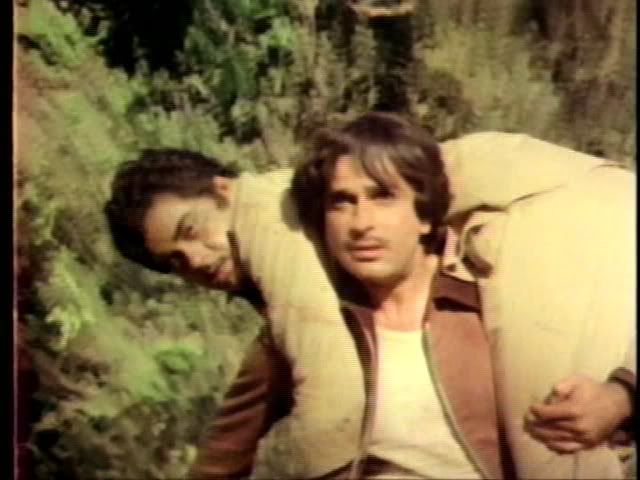
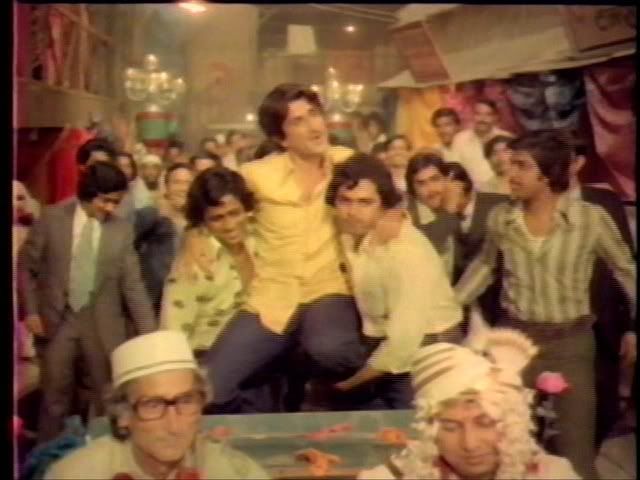
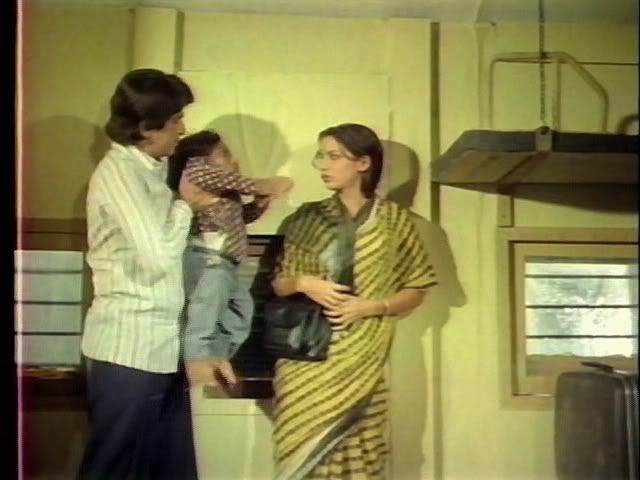
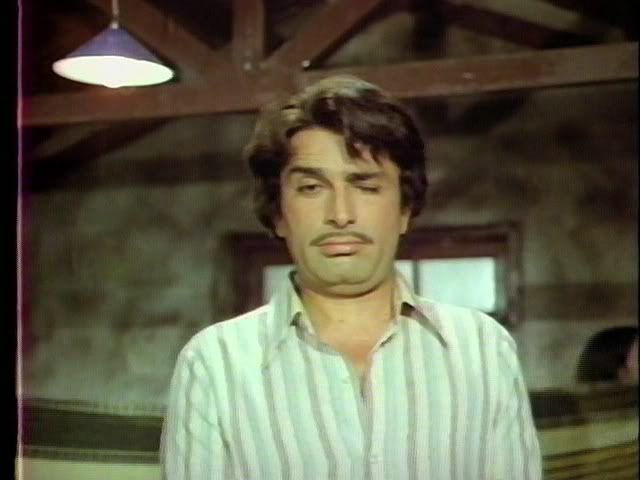
Showing posts with label shabana azmi. Show all posts

Sunday, 18 May 2008

Junoon (1978)

It took the PPCC more than a year to finish Junoon (Obsession, not by Calvin Klein). We started it in the spring of 2007, watched 3/4ths of it and then went, "Meeeeh..." turned it off, went to eat a Ploughman's sandwich, and never returned.

Have you ever had a Ploughman's? It's really good. Cheddar cheese, pickles or onion relish and, if you're kinky, a pear. It's probably not very healthy, except emotionally. Lovely comfort food.


Have you brought me a Ploughman's?


What were we talking about? Oh yes. So Junoon. It was one of the first Hindi films we had seen, we were still virginal viewers. But we did know enough to recognize key figures such as the Shabana, the Naseer, the Kulbhushan (who was still "that guy" back then), the Tom Alter, the guy from Swades (still that guy, unfortunately), and, of course, the Shashi. We were like the proto-PPCCC back then.

(An excellent complement to a Ploughman's sandwich is one of those thick organic fruit drinks.)

Another problem with Junoon, apart from it testing our attention span on an epic scale: we misunderstood who was married to who, and thought "Jennifer Kendal" was actually Nafiza Ali, and so we thought it was doubly interesting that a real-life husband, Shashi Kapoor, should play an obsessed stalker of his real-life wife. How meta!

Until we realized she wasn't his real-life wife. And then we were like, "Lame." Moving on.

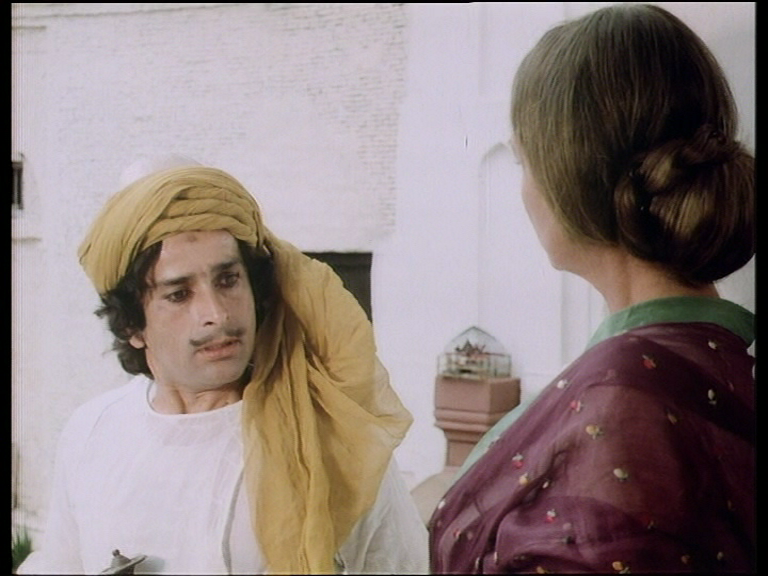
The year is 1857, the land is India, the air is as thick as the cheddar slice in my Ploughman's. You could cut it with a knife, and you'd need a pretty sharp knife. On one side, you have the Indians, angry, fomenting rebellion, led by a henna-haired Naseer looking fabulous. On the other side, you have the British, living in a bubble of colonialism and segregation. One day, a super-fine nawab, Javed Khan (Shashi Kapoor), ambled along and spotted a pretty young thing, Ruth (Nafiza Ali), on the British side. Shashi, being Shashi, started junooning up a storm - I must have the saucy wench! Or, as Wayne would say, "She will be mine. Oh yes. She will be mine."

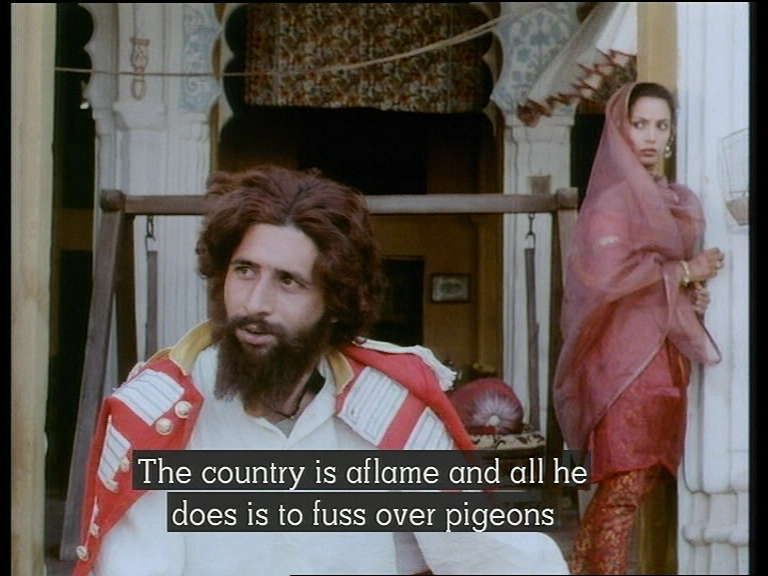
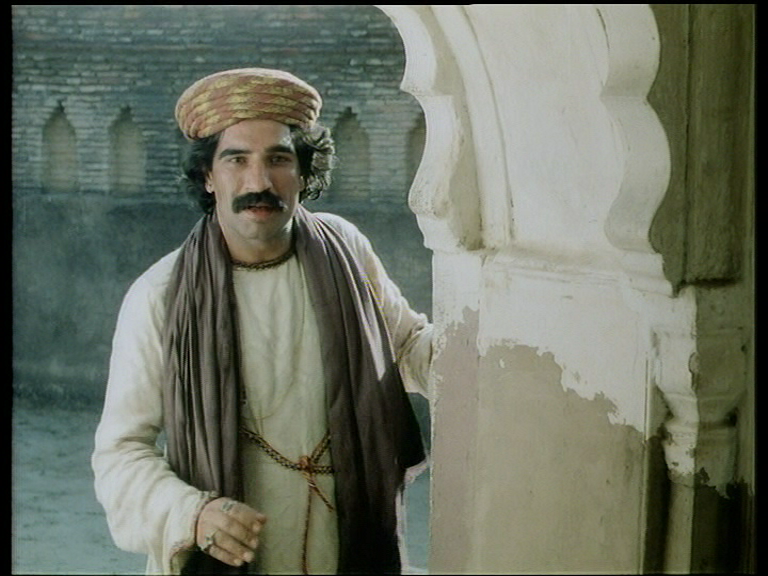
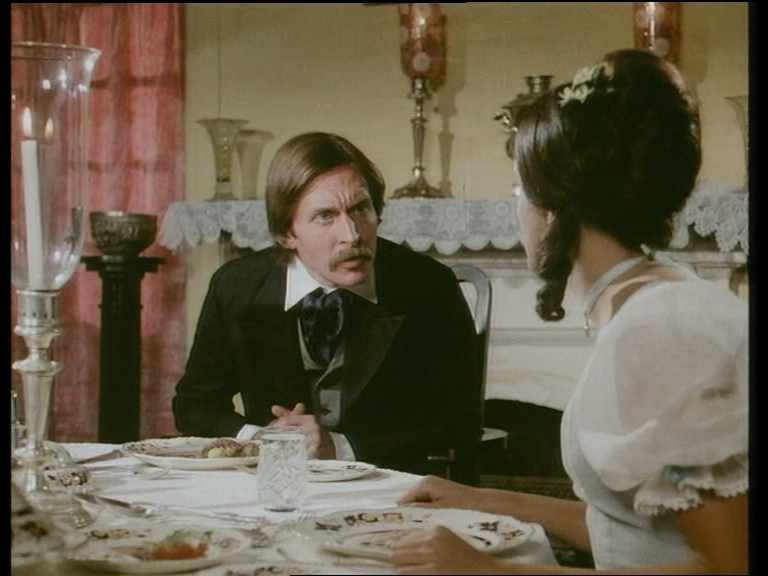
Thanks to Naseer spreading violence, Ruth's father, Mr. Labadoor (Tom Alter! yeah!), is killed, along with a number of other British people. Chaos ensues. The family - Ruth's mother (Jennifer Kendal, THIS is Shashi's wife), Ruth's grandmother - quickly flee with the help of a noble-hearted guy, Noble Guy (Kulbhushan Kharbanda, looking quite handsome). Amidst all this macro tension, Javed the Nawab's micro obsession is growing more and more unwieldy. When he captures the Labadoor family, he practically pops a blood vessel in excitement and declares he will wed little Ruth as his second wife. His first wife (Shabana Azmi) is not so pleased. And his brother-in-law, Sarfaraz (Naseeruddin Shah), is also annoyed at his distractedness.


Shashi has a thing for pigeons in such films.


The two families - Indian and British - live in growing tension, with the Shashi's predatory, nearly maniacal desire for Ruth causing everyone much grief. Meanwhile, the storm of the 1857 is growing, and soon the household is sucked in as well.

Junoon is a very cerebral film and, on an intellectual level, it is great. The juxtaposing of this microcosm of Anglo-Indian relations against the macro strife of 1857 is very stimulating; particularly in the eroticization and aggression of these relations, which lead one immediately to think of Edward Said. That is, in Said's Orientalism, he discusses how Orientalism typically defined the "Eastern" male as an effeminate Other, weaker and more passive than his macho Western counterpart. Even today, the PPCC would argue, you still see this theme of virile Western men seducing the exotic Oriental beauty - for example, read Slate's notes on race in Wes Anderson's Darjeeling Limited. Having the genders and power structure reversed - in Eastern Javed's constant attempts at possessing Western Ruth - as well as, all throughout, subverting them - Javed's ultimate vulnerability, his own possession - makes for some great Thinking Person filmmaking.


Kulbhushan, so young and handsome!


But what the film has in intellectual terms it lacks in emotional involvement. That is, the PPCC likes a good postcolonial or Orientalism-examining/Orientalism-subverting film as much as the next post-punk, but we are also warm-blooded human beans. While a film like My Son the Fanatic works on both the intellectual and emotional levels, Junoon remains suspended and austere. Partly, this is the fault of the characterizations. The only characters we invest any time in are Javed, Ruth and Ruth's mother. Javed is singularly unlikable, and, as fascinating as he is in a moralistically misshapened Quasimodo way, he's not someone we care about (or, for that matter, want to "win"). He's basically the villain. (Side note: we cannot avoid mentioning that Shashi looked FAAAHine in his nawab get-up. He was lush like the mountains of Switzerland under James Bond's skis. Just luush.) Ruth, the object of his obsession, remains a non-entity - she is given hardly any lines and, apart from fearing Javed and liking pigeons, we get little insight into her thoughts and feelings. As a result, she ends up becoming a symbol and little else. Ruth's mother is perhaps the real hero of the film in that the audience is on her side, and she demonstrates courage and action throughout the film. But, again, she remains blandly straightforward. For a film so loaded with political and cultural potential, it would be good to have a bit of provocation here and there, some graying in the characterizations. Instead, we have exactly what we expect: the savage, obsessed villain, the tremulous damsel, her brave mother.

So, dammit, when the PPCC can't be provoked, it goes a-lookin' for provocation! We tried noticing if, as in Bombay, there would be any prejudices hidden beneath the text. The only things we can come up with are:
  • Benegal's treatment of the British characters is mostly sympathetic. OK, Tom Alter's patriarch figure is your run-of-the-mill stern colonialist, but the rest of the family are sinless victims. Most notably: Benegal goes to great pains to humanize the British before their slaughter in the church. There is the goofy guy who keeps peeking over the woman's shoulder. There is the bored, little girl who rests her head on her mother's shoulder. There is the helpful soldier, who indicates to Tom Alter which psalm they're on. Benegal uses these scenes to let the audience invest in the characters, however peripheral they are. Maybe because, from an Indian perspective, it would be easier to demonize the colonial power - Benegal instead goes to the other extreme: showing us human, vulnerable and greatly victimized British characters. Furthermore, thanks to Ruth's mother, the British characters have the clear moral upper hand in the microcosm tale of Javed's obsession. This is, of course, in stark contrast to their macro villainy: Sarfaraz's reports of British soldiers strapping Indians to cannons, for example.
  • Benegal's treatment of the Muslim characters is mostly negative. In particular, Javed and Sarfaraz are both fairly villainous and unlikable characters. One is driven nearly mad with sexual desire, while the other is uncontrollably bloodthirsty. That's not to say they are one-dimensional characters - Sarfaraz's pain after losing Delhi is, after all, often cited as a wonderful scene, and it's because we care about Sarfaraz in that moment. But neither of them are given any chance to demonstrate compassion; their few moments of frailty tend more towards cowardice or madness rather than anything a bit kinder.
  • The sole sympathetic Indian character is a Hindu. That being Kulbhushan's character. We at the PPCC don't know enough about this period in history, but we were just told that an oligopoly of Hindu families ruled moneylending in 1850s north India. Any PPCC readers have more info? All we did notice was that Kulbhushan, the only harmless Indian, who helps the Labadoor family without hesitation, and who seems an awful lot more even-tempered and gentle compared to the warmongering Sarfaraz and the lusty Javed, is also the only recognizable Hindu in the film.
What do you think, PPCC reader? Is it faux neutral? Does it propagate stereotypes about hot-tempered Muslims? Or are we just being ignorant? Discuss! Anyway, suffice to say, the PPCC is having more fun reviewing the movie than we actually did while watching it.
Tom Alter's an interesting guy overall.
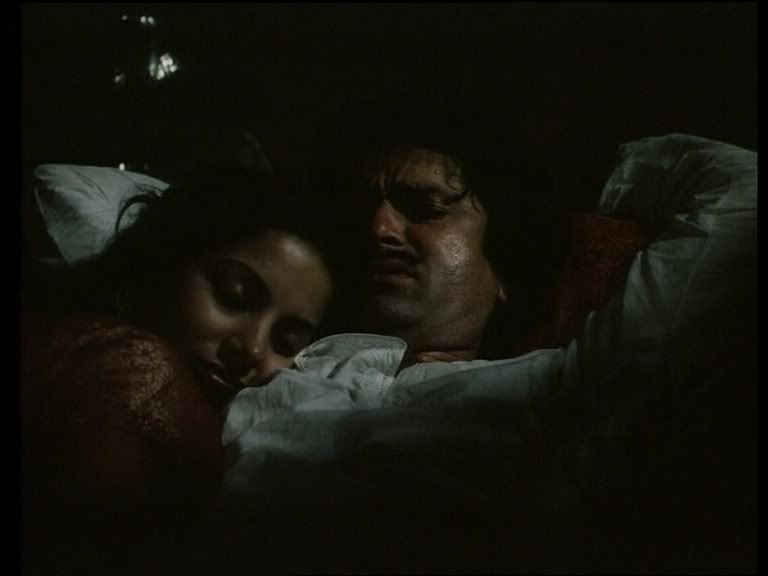
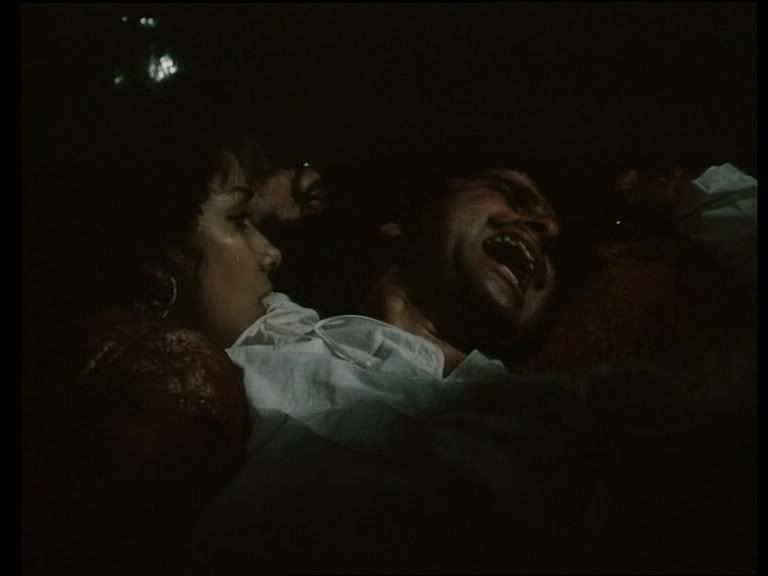
In terms of performances and filmmaking style, the film comes with such a pedigree - Kapoor! Azmi! Benegal! Nihalani! - that we were already predisposed to approve of it. Shashi is wonderfully different in this compared to his usual masala persona: his Javed is completely enslaved by his obsession, and Shashi is not afraid to portray Javed in as ugly a light as possible. Some revealing scenes include the childish, cornered-rat snapping arguments with his first wife, and the moment when, in bed, his first wife comes in for a cuddle - he starts keening more and more loudly until finally snapping and letting loose a scream. Ha! Poor Shabana. "How was it for you, dear?" "AAAAAARGHHH!"
We love short scenes with little context, like this one.
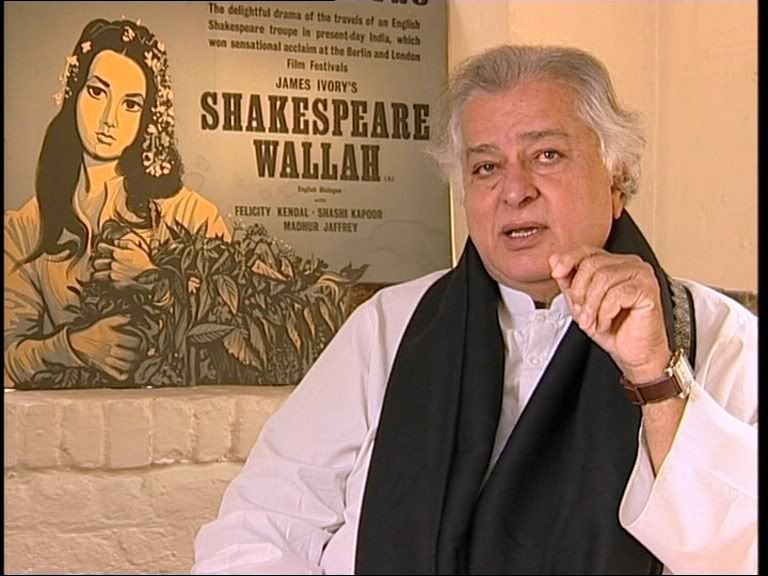
Jennifer Kendal portrays, as we said, the most bad-ass character in the film, in that she appears to have the strongest will - apart from, perhaps, Sarfaraz. Despite being in a state of complete vulnerability, held hostage in hostile territory, where any wrong move could lead to death, it is wonderful to watch her crafty maneuvering. Indeed, as Javed becomes more and more consumed by his obsession, it appears easier for Ruth's mother to use it against him. We especially loved her entrapment of him: "You can marry Ruth if the British lose Delhi." No way to get out of that one with manly pride intact. Naseeruddin Shah and Shabana Azmi give excellent performances as Sarfaraz and Javed's wife, respectively. They both are parts of the scenery of hostility, but both also display the real vulnerability beneath their aggressive exteriors. Sarfaraz may be a bit of a bloodthirsty maniac, but his nationalist passion and his despair at the British treatment of Indians are genuine and easy to sympathize with. Once again, the scene when he returns from a conquered Delhi, exhausted and defeated, immediately humanizes him (though he's still pretty scary!). Likewise, we see Shabana's humiliation at being usurped by a reluctant, teenage English girl thanks to her husband's sudden infatuation. Added DVD bonus: There's a brief interview with a visibly good-humored Shashi Kapoor on our copy of the film (a UK distributor). He talks about making the film - from the inspiration to finding the money - and it's really interesting to hear him speak English (with a posh British accent, no less!) and to hear him, well, be himself! Both are PPCC firsts as this is our first Shashinterview!
Bonus on UK copies of Junoon!
Time for that Ploughman's.

Sunday, 11 May 2008

Amar Akbar Anthony (1977)


Amaaaaarakbaaaaarantoneeeeeee.


There's not much left for the PPCC to say on Manmohan Desai's classic extravaganza, Amar Akbar Anthony (or, thanks to the titular song's refrain, as we keep calling it: "Amaaaaarakbaaaaarantoneeeee"). Everyone's already covered every single thing we wanted to say. Carla has already noted the sweetness of Hamko Tumse Ho Gaya, the sweetness of Rishi Kapoor, and Shabana doing laundry. Bollyweird's review has already looked at the narrative structure and the gender issues. And, of course, Philip Lutgendorf's review has basically said everything and anything that the PPCC could have possibly thought was relevant, and done it in a more informed way, too. Not only that! But everyone seems to have screencapped the same scenes, so even that we could not give you!

Well, goodness, the PPCC fretted. Maybe we shouldn't even review this movie!?

But then we thought, NO, we cannot deny our loyal readership a movie review simply because we're not the first ones to gush about it. Similarly, we've recently ordered a ton of really obscure Shashi movies (justifiably, by the looks of 'em), so we'll have ample untreaded territory to tread soon enough. Ergo, voila.


Rrrrright!


Amar Akbar Anthony is the story of three brothers, separated as children: Amar, Akbar, and Anthony. By a series of circumstances that only Manmohan Desai, in his infinite genius, could cook up, each boy has been raised by someone of a different religion. Eldest son Amar is raised by a Hindu policeman, and he becomes the usual upright, middle class maintainer of mainstream Hindu India played ironically by current BJP politician, Vinod Khanna (see Prof. Lutgendorf's review for lots more interesting stuff on the whole religious majority/minority issue). Middle son Anthony is raised by a Catholic priest, and he becomes a super-trendy (like SUPER SUPER trendy), super-rascally, Anglicized, Goanized Amitabh Bachchan. This movie is worth its price alone for Amitabh's performance. The third son, Akbar, is raised by a Muslim tailor, and he too becomes a stereotype of his religious minority: a passionate romancer Insha'Allah-ing left and right, also SUPER SUPER trendy, and a bad-ass qawwali singer, played by a (surprisingly lovable! more below) Rishi Kapoor.

The trio's parents are - of course - the inimitable, the wonderful, the perfection on celluloid PRAN (!!!), and Nirupa Roy. Did Nirupa Roy ever not play a mother? Discuss.


OMG! You make Pran suffer? You pay!!


One of our favorite moments: these two are so stylish!


The trio's religious-appropriate heroines are: plucky Neetu Singh for Akbar/Rishi (of course), gorgeous Anglicized bombshell Parveen Babi for Anthony/Amitabh (of course), and comes-already-domesticated good Indian wife Shabana Azmi for Amar/Vinod (yeah, Shabinod!). Alas, unsurprisingly, the heroines are given little to do apart from get into trouble and be rescued.

Any masala fan will know that despite the film's wildly veering path, we are sure to end up at a dennouement which involves fisticuffs, villains getting their comeuppance, and the family's reunion. So what can the PPCC say that hasn't already been said? Well, not much. But we'll try. Here goes:

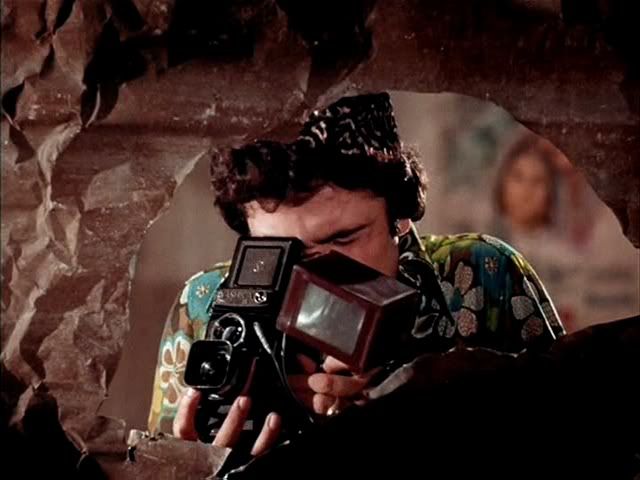
1. Have you ever noticed that Rishi Kapoor's camera is really awesome?


Why, Rishi, is that a Lubitel in your hand or are you just happy to see me?


2. OMG but have you ever noticed that Rishi Kapoor is super trendy and super awesome in this?


Rishi, you are KICKIN' it.


Maybe we were wrong about Rishi. The first time we saw him (in Kabhi Kabhie), we hated him with a passion. Then we saw him in Fanaa and softened considerably, figuring it was just because he was more suited as a father figure than a romantic hero. He impressed us mightily in Duniya Meri Jeb Mein, but we still thought he looked like an idiot. But mayhap anyone would look like an idiot next to the fire of the Shash.

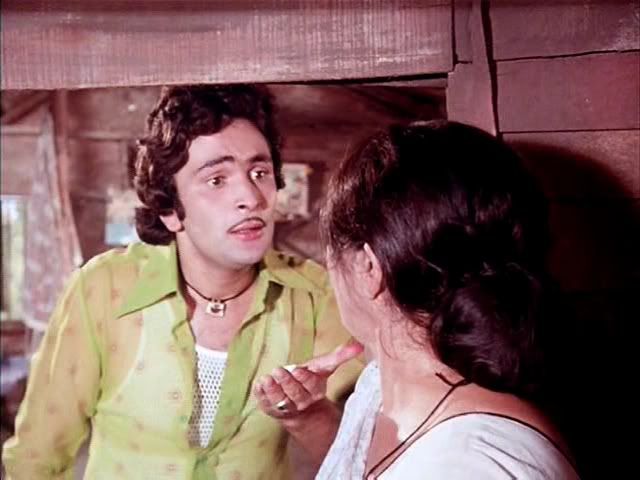
Ergo, what a pleasant surprise to see how fashionably awesome Rishi is in this! Apart from being an infinitely lovable, infinitely sweet bad-ass, his wardrobe also stands the test of time very well. Sure, Amitabh's kicking it in Coptic crosses and leather jackets and floppy hats, but at times he seems a little ridiculous. But Rishi! With his pencil-thin moustache and mad hair and floral-patterned see-through shirts. OMG he looks FAB! We don't mean that ironically, we mean that genuinely!

3. OMG they just mentioned the World Bank?!

Did they really mean the World Bank?! THE World Bank?! Did the movie just suddenly acquire an incredibly contextual, realist detail?!

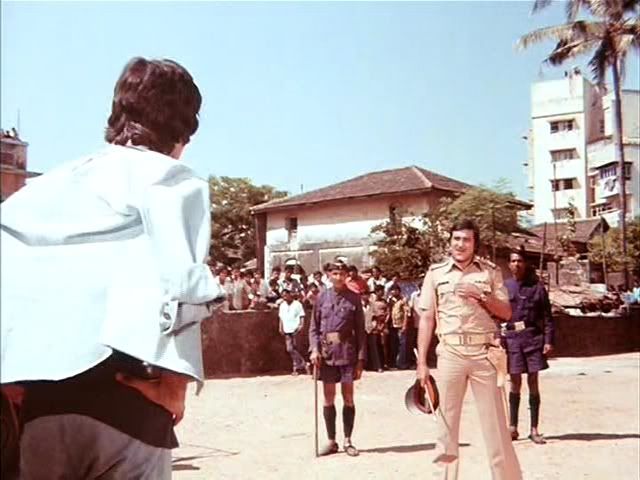
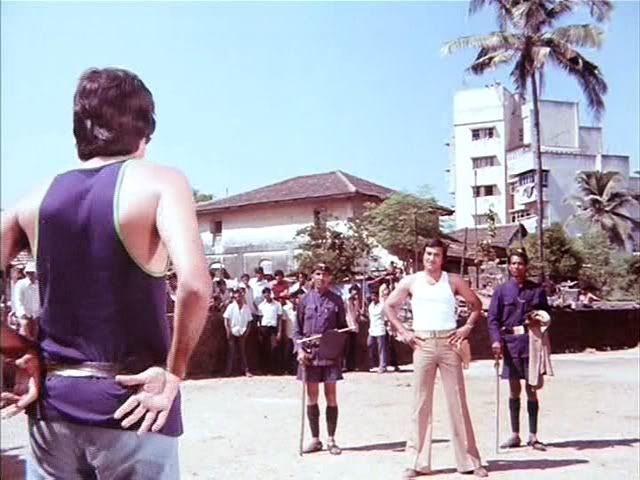
4. Hey, so Vinod is super-fit.


Vinod challenges Amitabh.


Amitabh agrees to the challenge.


Check out his bod. Yeah.

And we love that he kicks ass. Sure, it's also because he's the eldest son and ergo it is proper that he kick even lambu Amitabh's ass, but, actually, we've never seen Vinod lose in a fight. Consider: he is introduced to us as a fighting man whose brawny skills impress Amitabh in Muqaddar ka Sikandar; even Shashi cannot sway Vinod from his path in Chor Sipahee when Shashi smashes a chair on Vinod's head - to no effect!

5. PRAN!!!

PRAN!!!

6. Consider Hamko Tumse Ho Gaya, our favorite song, as an exploration of typical romantic ideals.

In this song, the three brothers have fallen in love with their respective heroines. Though they all say basically the same thing, the brother's language reflects their upbringing: Christian Anthony using English phrases (including our favorite: "God promise, main saach bola huun!"), Hindu Amar using Sanscritized-sounding Hindi and swearing by Ram, and Muslim Akbar favoring Urdu words and a cool qawwali beat.

But apart from the narrative structure, each brother represents a stereotypical "love" ideal appropriate to their status in the family. Older brother Amar's ideal is domestic bliss; he reads a book in the hammock, she takes the laundry in. Middle brother Anthony gets the highly cliché romantic love: horse-drawn carriage, sunset, beach. And meanwhile, baby brother Akbar gets a muppety, raucous, joyous puppy-love ideal: cavorting with Neetu atop a moving train.

Whatever your preference, you are satisfied! The PPCC personally prefers Shabinod's set-up, because you can have fun cavorting atop trains with anyone, but domestic bliss comes only with real, honest-to-God love. Remember, our favorite scene in Swayamvar was when Shashi and Moushimi enter domestic nirvana. Sigh! And indeed, we are not ashamed to admit that we got a bit verklempt during the final bits of Hamko Tujhse.

That's all we got. We hope we've illuminated yet another little corner of this fab movie. And we highly, highly recommend that you just watch it for yourself.

Saturday, 10 May 2008

Atithee (1978)


Your frickin' welcome.


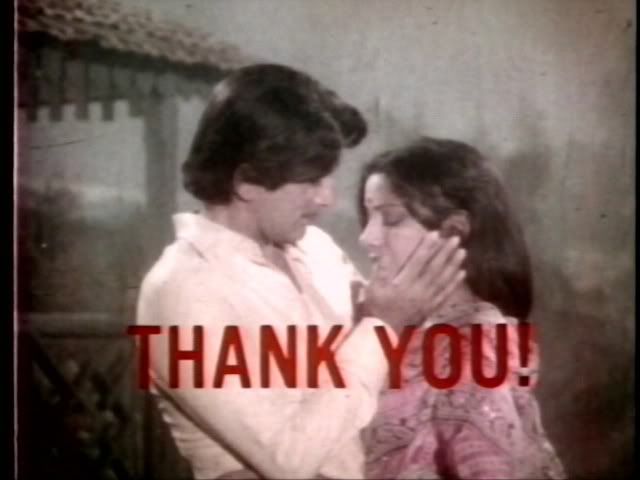
This is the first film we've ever seen where instead of The End they tell you Thank You! But, boy, the audience deserves to be thanked after sitting through a stinker like this one. Already in the first scene, our reaction was:


Now while we've reacted like that before, it's previously been a good kind of horrified shock. A delighted horrified shock. But alas, today we were well and truly horrified in the original meaning of the word. Because this is what we saw:


Naaahiiiiiiiiiinnn!!!!


Yes. Yes, PPCC readership. They really did it. They put Shashi in a wig.

At this point, the PPCC already threw its hands up and went, "Bas! This is trash! The film is ruined!" But then we thought, OK, no, that's cruel and superficial. In Custody is, after all, an excellent Shashi film, and he is absolutely unrecognizable by 1970s Shashi standards. He's not wearing a wig, but he is, like, 40 kilos heavier and in a perm, no less.

But no, we should have just turned this off at that first shot. Because this film isn't bad like Kanyadaan or Bezubaan, where it's filmed well, and the songs are excellent, but the message is awful and the story kind of stupid. This isn't bad like Chor Machaye Shor, where it's a bit trashy B-movie, but is generally entertaining (and the songs are excellent). No, this is like Mukti bad. But worse than Mukti. Much, much, much worse. Exponentially worse. This should be a form of torture.


The whole sorry gang. Note that Shatrughan always wears the same wide-collared khaki outfit. Did he just walk off the Kaala Patthar set?


A lot of our hope was in the songs, since the music was by Kalyanji-Anandji, a legendary brothers of 70s funk. These guys did the music for Don (yeah!) and Muqaddar ka Sikandar (yeah yeah!) and Tridev (yeah yeah yeah!). To an extent, the few songs did deliver the minimal pleasure we received from watching this film. But that was really it. When the final Thank You appeared on the screen, we were so relieved.

The story begins promisingly enough, yet even in the first few moments, there are clanging signs that something dodgy is afoot. Anand (Shashi Kapoor, in a frickin' wig, a WIG! WTF?!) is a shifty, mysterious character who is implied to be an alcoholic and an insomniac. He also picks up disabled people and shakes them in women's faces. Yes, really. One day he runs into Neela (Shabana Azmi, thankfully looking normal) on a train. She matches him in shiftiness. By happenstance, both have the same destination: the home of the Kumar family - Anand arrives as a guest, Neela is the eldest daughter of the house. Anand has arrived from Bombay, sent by his friend, Navendhu (Shatrughan Sinha). Navendhu is the eldest son of the family, but he has been temporarily exiled (though the subtitles keep saying "extradited") from their village because of an intervillage rivalry with some random villain, Avinash (Utpal Dutt). Navendhu's family is now destitute. Neela is forced to engage in vaguely illicit activities which involve parcels, cash, and secret meetings with Mac Mohan. Meanwhile, Navendhu's father is bedridden and his mother is despairing that the younger children no longer go to school.


Shashi and Shatrughan get off to a rocky start. Though check out Shash's costume!


But soon enough they are friends.


Really good friends.


As expected, Anand is happily absorbed into this home, assuming the role of eldest son and caretaker. He arranges a marriage for the younger sister, he buys a wheelchair for the father, etcetera and so forth. Meanwhile, he also falls in love with Neela, though we only know this because the back of the DVD cover told us so. (OK, that's a bit cruel, their one love duet - which comes very late in the film - is actually very sweet. More on that later.)


A lot of people get carried around in this film. Shashi.


This guy on the train.


But the dodginess continues. All throughout the story, we are treated to flashbacks from Bombay: Anand and Navendhu's first meeting, their growing friendship, Navendhu confiding in Anand all his familial problems at the hands of evil Avinash. The PPCC was thinking, by this point, that the film would take a typical French psycho thriller turn and reveal that Anand had actually killed Navendhu in an effort to assume his role in the family. Anand certainly goes on and on about how the only thing he wants is a family, and this desire - common enough in Hindi films - gets such a sinister treatment, that we figured Anand was probably a psycho or something in disguise.

Or maybe it was just the wig.

Anyway, after some needless violence which includes a suicide (!), the film ends, and we were never so grateful. Ughhh.

First of all, as Shashi fans, we were annoyed. Shashi looked terrible. Not dorky in a cute, 1960s way. Not paternal in an overweight, 1980s way. He just looked bad. And he looked uncomfortable as well.


OMG Shashi, you look so bad.


Second of all, as Shatrughan Sinha fans, we were annoyed. His face appears prominently on the cover of the DVD, and the description seems to imply that this is Shatrughan's story first, Shashi's second. False advertising.

Third of all, as Kalyandji-Anandji fans, we were annoyed. Four songs in the span of an interminable 2+ hours, only two of which were up to their usual par.

Fourth of all, as Shabana Azmi fans... well, actually, she was fine. And her saris were gorgeous!

But what was the director thinking? Did this guy even know what an establishing shot was?! Apparently not! And why the 1-second close-ups?! This was terrible filmmaking. Terrible, bottom of the bucket. Uughhh. Claw your eyes out.

Attempting to find some good in this, we can say that the cross-cutting between the now-storyline and the flashbacks was good narrative structure. We always like cross-cuts. Unfortunately, we didn't realize the flashbacks would end up being so boring.

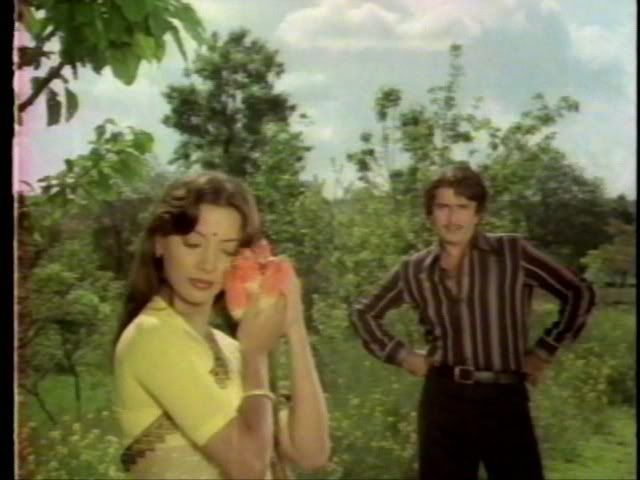
Another pretty good aspect of the film was the Shashana - that is, the Shashi-Shabana chemistry. It's sweet from a Brechtian perspective to watch them cavort, because Shabana apparently had a crush on Shashi when she was young. As a result, we always get a small, vicarious kick watching them team up in these 70s movies. It must have been a dream come true! And indeed, they've never let us down - neither in Fakira, nor Junoon, nor in In Custody. Even here, in this mire of trash, they are wonderfully sweet together. Their love duet, Rang Birange, was also quite explicit by Hindi standards - at least, they seemed to be enjoying themselves, and they seemed comfortable with each other.


The only good song.


They do a lot of nuzzling.


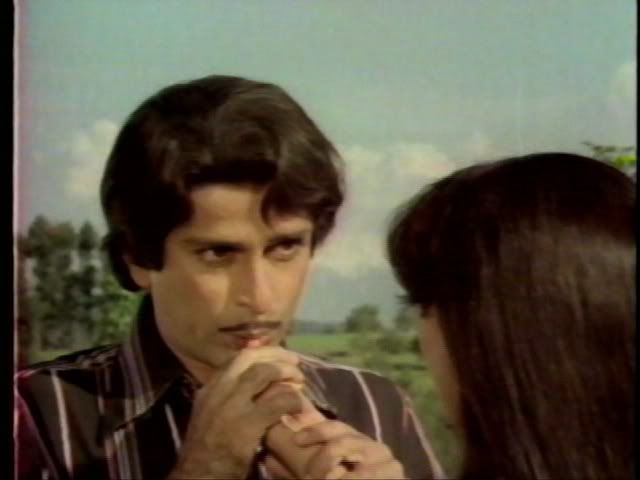
He sucks her finger at one point.


But the rest of the film? Uuughhhh.

Tuesday, 18 December 2007

Chor Sipahee (1977)

Before The Departed, before Infernal Affairs... there was Chor Sipahee. Warning: long review!
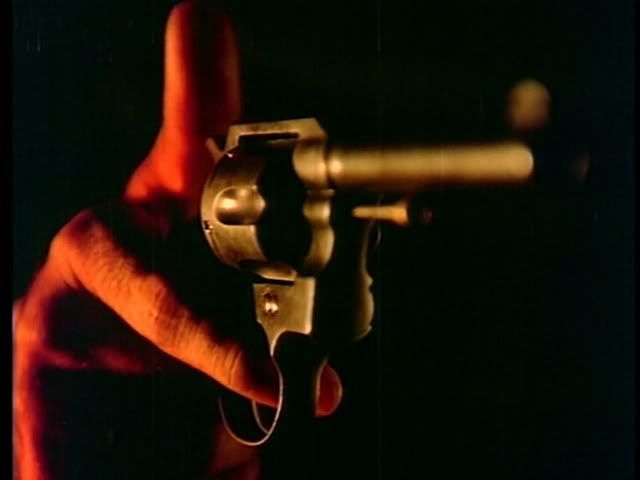

Happiness, the warm gun.


Remember how the PPCC enjoyed the moral ambiguities of the double agents in Infernal Affairs, most particularly the cop who's been undercover for so long he's becoming confused as to his moral core? And remember the absolute cuddly satisfaction of the gangster's ultimate conversion to goodness, as in Kasme Vaade? Well, in Chor Sipahee, the cop is played by a bearded Shashi Kapoor who starts to resemble more and more Naseeruddin Shah (especially in the first item number). And the gangster is played by Vinod Khanna with an awesome haircut, still wearing those high-heeled shoes from Parvarish. Naturally this is already proving to be wonderful.

Further particulars on Chor Sipahee (Thief-Cop): crime lairs without walls, a Saudi prince stereotype who also wears riding boots (?) and has a striking resemblance to Shah Rukh Khan, the fifteen minutes of fame of Macmohan - where we learn that he is very wiry and a fast runner and can do more than just dress up the background, and the altogether bizarre aesthetic experience of Shashi Kapoor's costume design (provided, of course, by his wife, Jennifer Kapoor).

We really need to get the costume design thing off our chest first, or else this will review will never make any sense. Bollywood Fugly, are you listening?

Shashi's sipahee (cop, soldier, trooper), Shankar, is introduced to us as a bearded ragamuffin chain-smoking undercover world-weary bad-ass. He even twists his wrist in weary resignation and smiles sadly - all very much a la Naseer in Naajayaz. It's delightful! The first item song is sublime, where Shankar sings, "Don't ask me my name. Even I don't know who I am," and then, when the melody becomes painfully, beautifully melancholy, tells the pickpocket on the train, "You were not what you turned out to be. You've become such a coward." (And the ultimate poignancy is how the lyrics seem directed to Shankar's father! See below.) Oh, the humanity!

Unfortunately, the Cruelty of the Internet has struck again and we at the PPCC cannot show you this truly lovely, evocative, masala perfection song because no one has had the forethought of uploading it to YouTube. Hmm.

Anyway, we were talking about aesthetics. First, Shashi Kapoor playing Naseeruddin Shah:
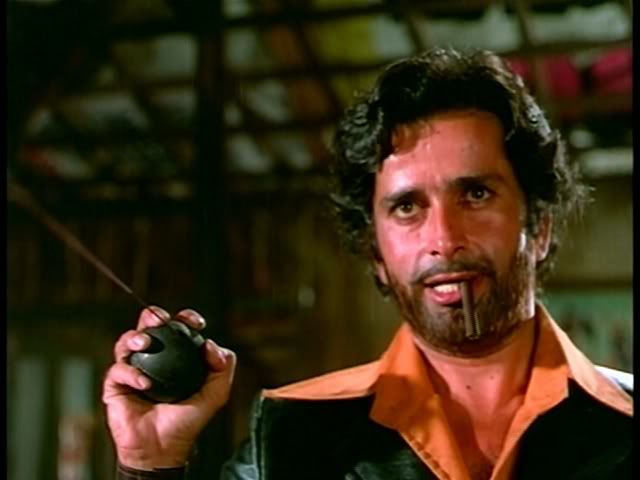

An unwashed, proletarian Shashi? Who knew he could pull it off so well!


Then, Shashi Kapoor playing his older brother Raj Kapoor, circa Awaara. That is, with a moustache, matinee idol soft focus close-ups, and cigarette smoke slowly curling from his lips. That's choice, right there.
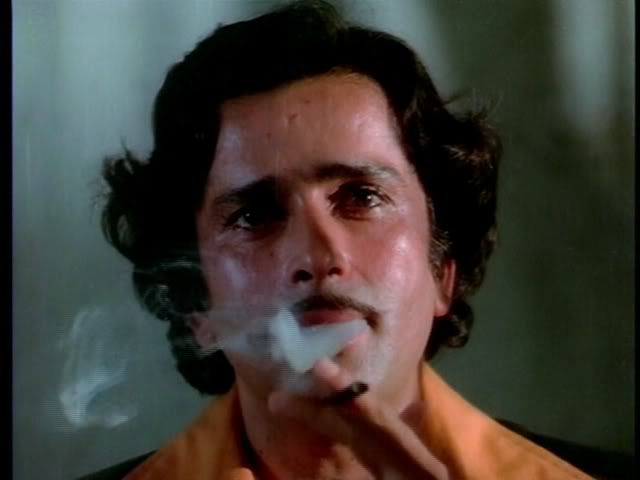

Of all the gin joints in all the world...


Then, briefly, a little bit Sufi.
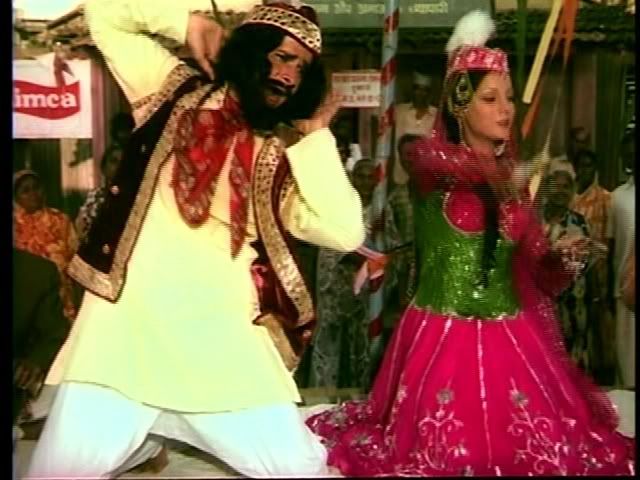

Kickin' it qawwali style!


A little bit Saudi.
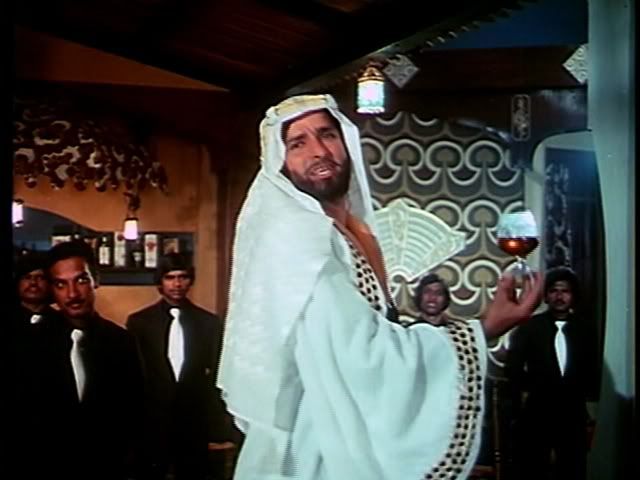

Kickin' it OPEC style!


Then a quick and violent decline into muffin tops and bandanas and, Bollywood Fugly writers, if you need more pictures, just ask.
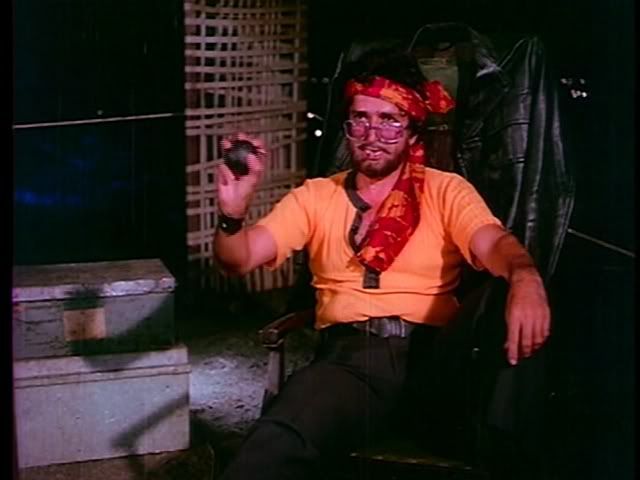

Not kicking any style anymore.


And then a spectacular ascent into sights unseen of aesthetic perfection. It's really the big tinted glasses and the pipe that does it in for the PPCC. Could he be any sexier? The answer is no.
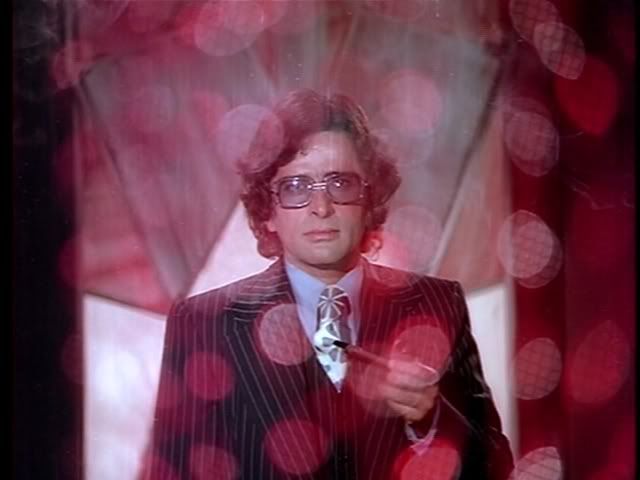

Kickin' it bad-ass groovy suave style.


The plot of Chor Sipahee is a joy. First, there is the bestial, boyish Raja (Vinod Khanna), a petty crime boss, always in and out of jail. His mother (Durga Khote) and sister, Bharti (Parveen Babi), are getting desperate: they beg Raja to give up his life of crime. Bharti even goes so far as to throw Raja out of the house; she's a newspaper reporter of the blackmailing, muck-raking variety, and she can support the family if need be. Raja hence moves into his criminal lair: the floor of an unfinished building which interestingly has no walls. Enter Shankar (Shashi Kapoor), described above, who has just returned to Bombay after slumming it around India, trying to clean up the urban centers (so far, he's had success in Delhi and Calcutta). Shankar is a maverick in the police force; his father was a convicted criminal who was hanged, the grief of which led his mother to kill herself. This dark and disturbing past has given him sympathy for and identification with the criminal underworld, as well as a strong anti-capital punishment stance, obviously. Shankar is completely against punishment, and completely for rehabilitation via an appeal to the criminals' humanity. After all, that chor (thief) was probably someone's father (Vijay and Ravi certainly know about that!) or husband or brother or son.

When Shankar meets Raja, he immediately sees a chance to belatedly and spiritually save his father, and so embarks on a quest to rehabilitate Raja. Raja, however, remains unenlightened and brutish: he slaps his sister, he drinks and steals, and, when Shankar makes the ultimate sacrifice of burning evidence in order to get Raja out of jail, Raja merely runs back to the Saudi crime boss whose business he covets. (Parenthetically, the crime boss, Jamal (Ranjeet), looks a lot like SRK circa Hey Ram.) Things become emotionally complicated, as per filmi usual. Raja misinterprets Shankar's help as the hand of friendship, and yet Shankar dismisses these appeals in the song, "Chor Sipahee mein hoti dosti nehi!" A thief and a policeman can never be friends. Raja is understandably hurt. And Raja is then bewildered when Shankar joins the criminal gang, rises to the top, and begins to out-evil the evil Jamal. (Wait, does this mean we can be friends now?) What he doesn't realize is that Shankar has decided to disgust Raja by showing him the logical extremes of being a villain: he proclaims that family means nothing anymore, he lets Bharti demean herself by dancing the booty-shake to a room full of lecherous goondas. As Shankar takes on more and more of Raja's sins, Raja is effectively wiped clean (like a Clean Slate - Kora Kagaz! see below), eventually rebelling against a life of crime altogether. Once Raja is purified, Shankar must pay for his criminality, even it is was faux, and he goes to prison. By this point, it has been revealed that Shankar's intentions were sacrificial - he was a "mirror" for Raja to see himself objectively in, he even sang in the initial song that if only criminals could see themselves from the outside, they would turn good - and hence Vinod Khanna is compelled, once again, to cry.
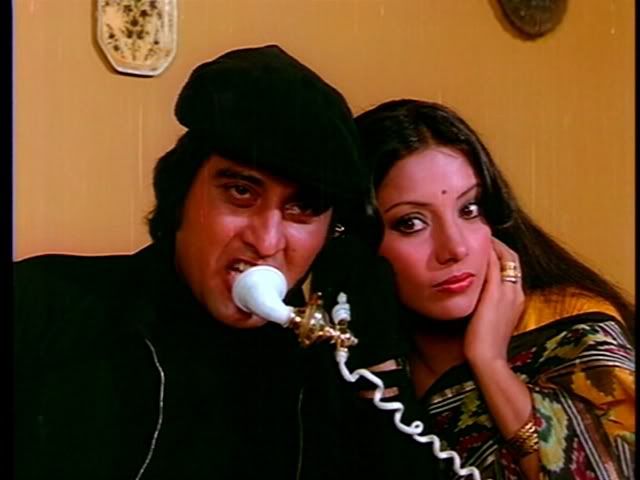

Vinod and Shabana. Shabinod? Vinabana?
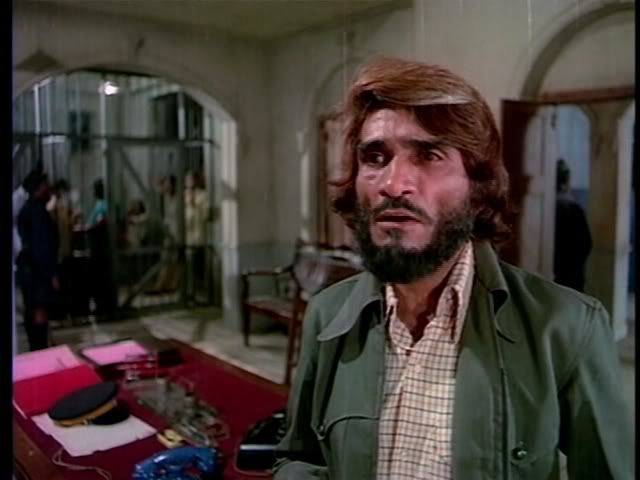

Sometimes I too can rock. MAC THE ROCK.
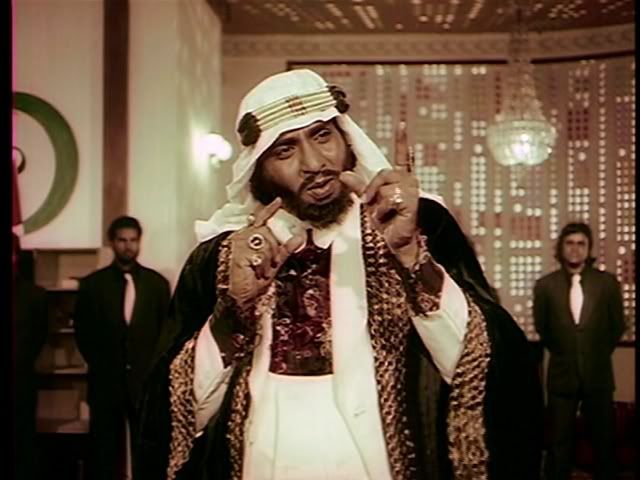

Ranjeet? Or Shah Rukh Khan?


Thematically, it's all very Dostoyevsky, very crime and punishment. The savage subject under study is Raja. He's brutish, yet lovable in that it's not cruelty that drives him but childish greed. In the opening credits, he is immediately identified with children: he gets into a faux stand-off with a cheeky, fatherless kid named Kora Kagaz (Clean Slate) from the slum. Raja is, for all intents and purposes, a grown-up little boy. He pouts when his mother and sister refuse to accept his criminal activities, he throws tantrums, and he doesn't seem to understand what all the fuss is about. It's just stealing, who cares? In this respect, Shankar, the fallen angel character (and we shudder to type that because it's so cheesy-sounding but it is also accurate, so, well), is on the other end of the spectrum: the same age as Raja, and yet many years older. Indeed, Shankar is more often identified with father figures; whereas Raja is fatherless like little Kora Kagaz, Shankar has an uncle to report to (literally, his uncle's in the police force) and he lives eternally in the shadow of his father's mistakes and his father's death.
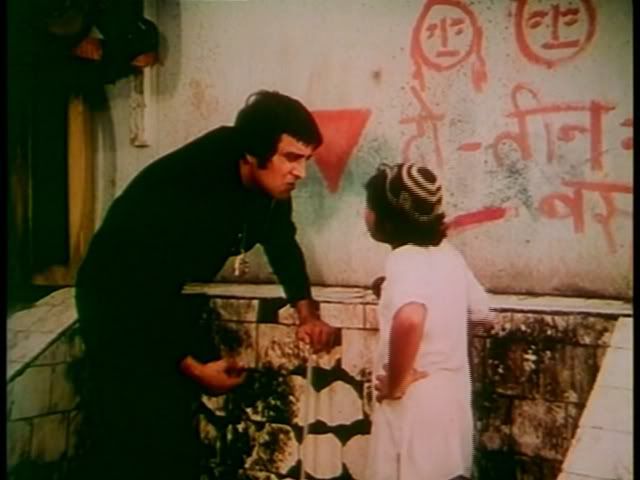

Raja, identified with children.
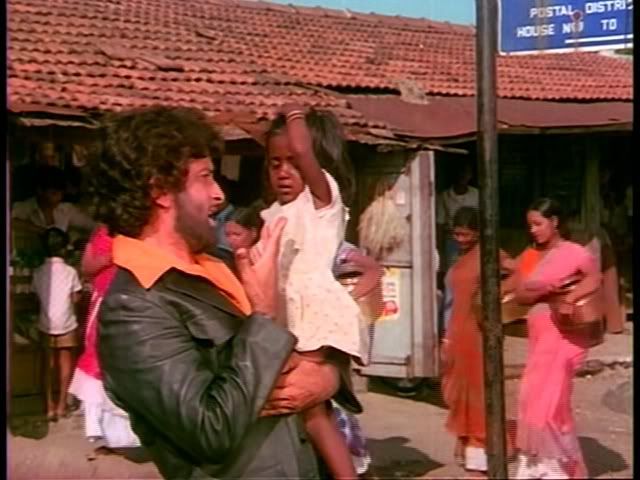

Shankar, identified with father figures.


Things become ironic in both text and aesthetics when, after Shankar sets Raja free, Raja joins the luxurious world of Jamal's gang, while Shankar rots away in jail, re-growing that beard of his. This juxtaposition between wealth and poverty, and this identification of wealth and poverty with immoral and moral, respectively, also gives the movie a Christian feel. And yeah, Shashi looks like a Tuscan-style Jesus, what with that beard and those curls and that look of sad, tired pity. Forgive Raja, society, for he knows not what he does! This "Godliness" is, naturally, intentional:

Raja's mother: Shankar!
Shankar: Shankar is the name of God. Only my name is Shankar. But I promise you, Mother. The line I have taken... I may burn in it, but I will bring back your Raja from that life of sin and crime.
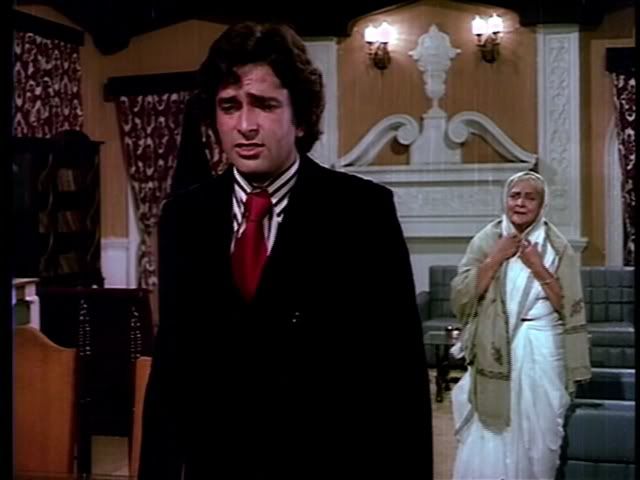


Sacrificing himself for others' sins? Hmmm.


We can take the Jesus parallels even further: Shankar's "lost years" wandering India, his return to Bombay at circa 33 where he proclaims that he has come to preach (the first song's lyrics: "I have come to you people, to teach you a lesson!"), his initial prison stint as the forty days in the desert, the ending where he allows himself to be "crucified" (well, prosecuted) for Raja's sins, descending briefly into hell (prison) before rising to heaven (his release from prison and his marriage and acquisition of a long-sought for family and, one would assume, peace of mind). OMG the more we think of it, the more it makes sense. Shankar is turn-the-other-cheek embodied, champion of forgiveness and champion of the poor and second chances! Why, this might be the most Christian-themed film we've seen since Children of Men!

For once, all these interesting themes and complexities are wonderfully mirrored in the female characters as well. Unlike Shankar, Raja's sister Bharti has reacted against familial thievery by becoming an ultimate punisher: she snaps photos of pickpockets at work and then exposes them in her newspaper. Meanwhile, the rich, bourgeoise Priya (Shabana Azmi) is the daughter of a legitimate yet immoral businessman, and she immediately joins up with Raja, seeing crime as the only way to achieve any real sense of social justice (this is all very Fakira, yes). Naturally, the four of them keep bumping into each other, and Raja falls for Priya (their courtship, by the by, is brief but very sweet), while Bharti falls for Shankar, as does her mom (what? it is Shashi!).

So we have four very interesting characters:
  • Raja, who turns to crime due to his moral vacuum.
  • Bharti, who turns to vigilante punishment due to her brother's crime.
  • Shankar, who turns to vigilante forgiveness due to his father's crime.
  • Priya, who turns to crime in the illegal sense due to her father's crimes in the immoral sense.
So just like Shankar says at one point, crime and punishment affect many people, directly and indirectly. Bharti obviously falls into a lot of danger due to her vigilante justice. Likewise Shankar bends and bends until he almost breaks during his quest to get Raja back to the good side; at one point, after he has lost his job as a policeman and is infiltrating the Saudi crime gang, he is asked to kill his lovable informer (Kader Khan, who by the by plays Jaggi in Suhaag). Honestly, the film would have been many times more interesting, but of course much darker, if Shankar actually did kill the informer and effectively "take on" Raja's sins; it would have brought up some serious peccadillos about morality and ends vs. means and undercover cops (a la Droh Kaal or, again, Infernal Affairs) and, well, Shashi's likability. Yet, this is mainstream Hindi cinema, and so thankfully Shankar has just enough time to fiddle around with poison pills and save his hapless sidekick. Close one, though! All this may make the film feel quite dark and heavy-handed, and, yes, there is a pervasive sense of alienation and existentialism (as the qawwali song subtitles read, "You don't give away your heart, then life is meaningless, only lovers live!" Considering that neither of the four leads seem very interested in romance, this is pretty sad!). It's masala with a pretty big helping of bitterness. Yet there are also several genuinely funny moments, such as the first fistfight-to-friendship between Raja and Shankar ("Go, All India!") and Mac always getting carried around by a gang of goons. The absurdist, ironic comedy bits work very well (e.g. Shankar smashing a chair over Raja's head, while the latter stands unperturbed), but the slapstick - mostly in the form of the corrupt Doctor - unfortunately fall very flat. The performances range from heartbreakingly good to, well, heartbreakingly bad. Shashi, whose character drives the film and also is one of the most complex, is so good, and we're not just saying that because we live in Shashi Pradesh, Shashiland. The Shashi Kapoor mystique was largely based on his appeal as a bourgeoise romantic hero, much as Amitabh's was the proletarian Angry Young Man. When Shashi did play slightly rougher or less educated characters (Chor Machaye Shor, Jab Jab Phool Khile), that particular appeal has been missing. So what's surprising is how effective and charismatic Shashi is as a beaten down, brooding bad-ass from the wrong side of the tracks. For once, the PPCC actually did believe that he was a tough guy, and there was poignancy to it. And we can definitely see how Naseer was influenced by Shashi - just watch this and then watch Naajayaz. Similarly, watch Junoon, with both of them. They both even do the croaky voice thing! It's like listening to toads converse! (Tangential remarks considering Naseer vis-a-vis Shashi: we at the PPCC must admit, we still think Naseer is the best actor in India. Meaning better than Shashi, even. Shashi may be beautiful, but in more than one film he's seemed uninterested. This may have been due to that whole whoring period when he worked in anything and prompted older brother Raj to call him a "taxi" who stops for any producer who sticks out his hand. Naseer, on the other hand, is consistent quality, less of a taxi and more of a German-made car. Also Naseer is a more effective weeper; consider Monsoon Wedding for some fat, juicy, hyperrealist tears, as compared to Shashi's tears in, for example, Mukti, which include a lot of Shakespearean flailing. End tangent.)
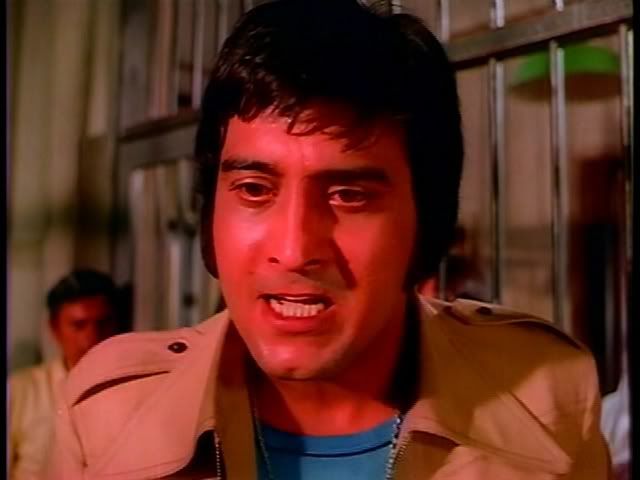
Vinod can't see what's the problem with thieving.
Vinod Khanna, who the PPCC sometimes likes (Muqaddar ka Sikandar) and sometimes dislikes (Parvarish), was likable in this and was particularly good at acting like, well, a handsome beefhead. Just as he did in Muqaddar ka Sikandar, he was also very effective at registering grief, especially in the end. Shabana Azmi has barely anything to do (sorry, Filmi Geek!), though what she does do is interesting. Her character is very sympathetic and fun - the whole stuck-in-a-gilded-cage thing coupled with rebellion based on ethics. Parveen Babi was generally much more enjoyable in Suhaag, though we must say we at the PPCC loved (!) her journalist outfit. If only our hair curled like that! Ranjeet-the-SRK-lookalike was pretty terrible and no doubt offensive to anyone from Saudi Arabia, and Asrani, who appears in so many of these Shashi 70s vehicles, was absolutely awful as the corrupt doctor. Partly this was a mistake in casting (why put a slapstick comedian in the role of the evil doctor?) but this was also Asrani's ineptness when push came to shove. He was the one clanging note that never meshed with the rest of the film's vibe. (Fab segue into...) The music! The music was enjoyable, with Shankar's intro item, Mujhse Mera Naam Na Puccho (Don't Ask Me My Name), standing out. The lyrics and melody were both beautiful and they captured Shankar's character perfectly; the PPCC just loves when the songs are such efficient, evocative storytelling devices. Also, we enjoyed the numerous references within the song. At one point, Shankar jumps onto a zooming truck filled with women, much as his brother Raj did in Awaara's Awaara Huun (I'm a Tramp). In both songs, there's a feeling of conspiratorial joy, of sharing an instant comraderie with the poor, except Shankar is a sad force of good in the slums and Raj was, for better or worse, a happy force of evil (well, he was a tramp). Another fun reference is when Shankar goes down to the cinema to nab the ticket scouts; what movie should be playing but Bobby, directed by older brother Raj, and starring Shashi's nephew, Rishi, with music by Laxmikant-Pyarelal (who, incidentally, composed the music you are currently hearing). Similarly, later on in the film, Bharti buys a rakhi for Raja, and the rakhi wallah informs her that "this one's called Satyam Shivam Sundaram!" Is your head spinning yet?
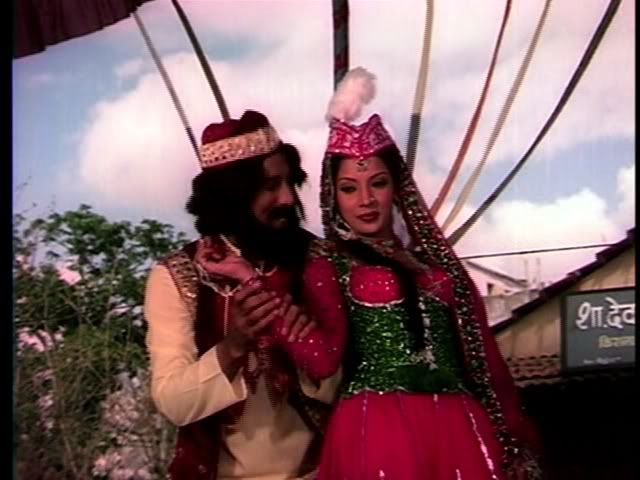
Duniya Hai Aati Jaati.
Anyway, back to the music: the second item, Duniya Hai Aati Jaati (The World Goes On) is wonderful too, but we always enjoy qawwali showdowns or, well, any qawwali. The lyrics capture the characteristically Sufi questioning of reality and perception ("What is good? What, evil?/What is sorrow, what is joy?"; see Rumi and Mirza Ghalib for lots more on this) coupled with a devotional, transcendental love of Allah that drives everything (as the lyrics say, this love is "an excuse to live" an otherwise bleak life in this "world that just keeps going on"!). Coupled with the earlier Christian parallels of Shashi's character, the PPCC muses that this film might be the cinematic equivalent of Yann Martel's Life of Pi: both feature a love of humanity, genuine pain for our human weaknesses, and an argument for pluralistic theism as an antidote to and coping mechanism for an otherwise difficult reality. We say pluralistic because Pi was a practicing Hindu, Christian and Muslim; and it seems Shankar is Christ-centric, while Raja is a Hindu with Muslim ties. Also, incidentally, the bridge in this song is transcendetal enough that the PPCC once again reaffirmed its love of Sufism. It almost sounded, oddly, like something out of Arcade Fire's Neon Bible, or even a little Explosions in the Sky-esque. Sad and beautiful and immense. (And it was hilarious to watch Shashi pull off one fake moustache to reveal a second one underneath.) Overall, as you can tell by the length of this review and the depth with which we dug in our viewing of it, this is a fascinating and addictive blend hiding in a standard masala packet. We've watched the first two songs already more than a dozen times each. We've evaluated the dialogue in some scenes to a silly degree. To paraphrase Shakespeare, for once, there is past but no prologue. For once, we can see no place where Amitabh would fit in. The tragicomedy of the four leads is pitch perfect, as are the songs, as are Shashi and Vinod's costumes, as are the fascinating undercurrents of existentialism and despair and pluralism, as are the fun details (e.g. Mac! Kora Kagaz!). DVD Warning: the subtitles on the Sky DVD of this (produced in the States, we think) go mental towards the end, appearing about 30 seconds before the actual dialogue is spoken. Some scenes also have tiny snippets missing, which cause the subtitles to experience even more grief. It's watchable and comprehensible, but it's annoying. Good for those Main Pratap Hoons out there who need listening comprehension exercises.

Friday, 28 September 2007

Fakira (1976)


A pretty awesome remix of one of the film's songs. This is the sexy, bed-breaking bit.


Low-budget and uneven, Fakira was bound to be awful. The fact that instead it tickled the PPCC people pink - especially during that middle bit - proves that either the Shashi Kapoor-Shabana Azmi (Shashana?) combination, or just Shashi himself, or just seeing D.S.P. D'Silva from Don (Iftikhar) don a wacky fake beard for a qawwali showdown is really enough to please us.

The beard... is huge.


Hi, I'm Iftikhar, playing a policeman again and looking much as I looked in Don.


Hey, KOOKY DISGUISE!


Hey, QAWWALI SHOWDOWN!


Like the much sleeker Parvarish, Fakira follows the usual 1970s cops 'n robbers Bollywood mold that teaches us that love is more important than money. See Bluffmaster for an update. As per usual, evil good-for-nothings maim and destroy a happy family, leaving two brothers to inexplicably wander their separate ways before a happy reunion much later in the film. One brother, Vijay (Shashi Kapoor), grows up into the notorious Fakira - a Robin Hood character who lives in the Batcave and is a massive headache for the cops. He's also phemonemally goodlooking, but no matter, this will merely serve as a plot point later on. The other brother, Ajay (Danny Denzongpa), is likewise criminal and has just been released from jail. One day, the local police inspector (Iftikhar, who else?!), decides he's going to send his ninja-skills daughter, Neeta (Shabana Azmi), undercover into Fakira's organization. Neeta takes the name of Geeta (insert Mahabharata reference here) and, despite her best efforts to resist, soon melts in the heat of Shashi's hotness. Swooning and faint, she ends up marrying him in his lair. (insert your own 'undercover' pun here)

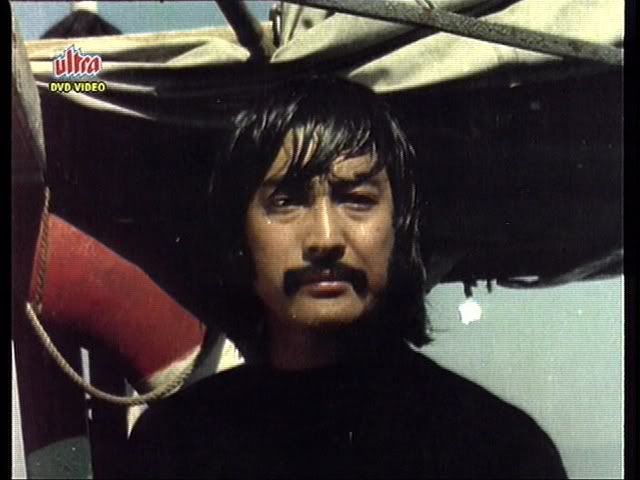
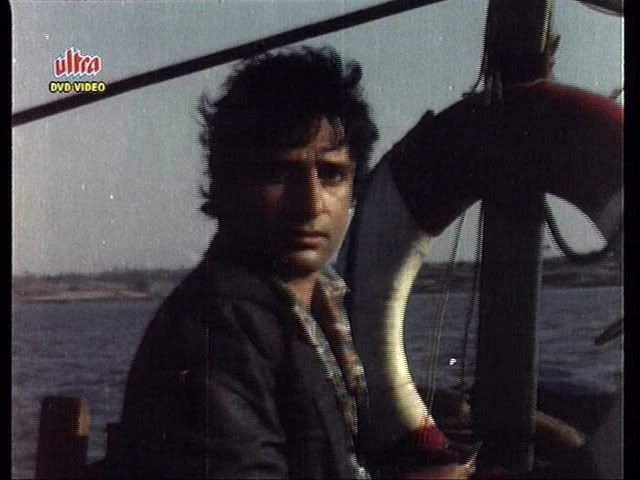
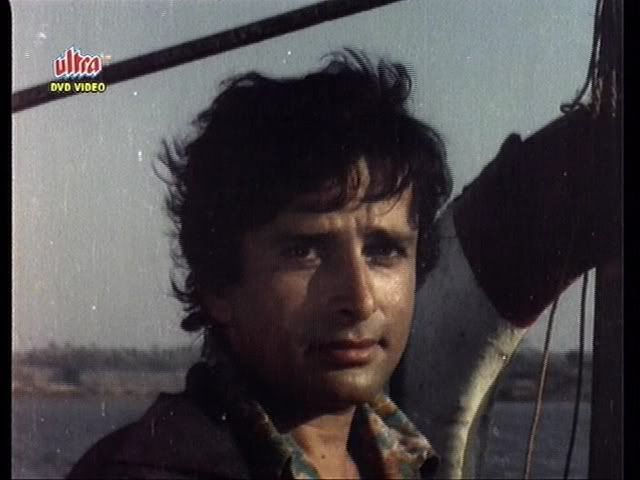
Meanwhile, an evil local politician hires an assassin - who turns out to be the younger brother Ajay - to hunt down and capture Fakira. He does so, and the evil politicians throw Vijay into the "torture chamber", which is actually quite a nice - if extravagantly decorated - room where ninjas fly out at you with knives. Vijay naturally disarms them, but still ends up at the bottom of the ocean with rocks tied to his ankles. By this time, Ajay has learned that Vijay is actually the Vijay, his older brother, and so he rescues him from inevitable drowning. Thanks to Vijay's yoga, he's fine - despite having been underwater for 30+ minutes. We have a happy reunion on the boat (which is, in cinematic terms, transcendentally glorious), and then the brothers - with Neeta/Geeta - unite to... well, we're not actually sure what they were doing, but they fight the politician guy a lot. And there's the qawwali showdown bit, when the police, headed by Iftikhar, and the robbers, headed by Shashi, all disguise themselves (coincidentally?) as ghazal singers and then spend a lot of time going, "Hey, isn't that the Commissioner Sahab under that big beard?"


Why am I in this movie? Why?


Fakira is not really a "good movie", per se. It is rather a bad movie with some very good moments. These good moments (the reunion on the boat, the silly disguises, the Emperor's New Clothes bit, the sexy bit) are sometimes even very good. Example: when Vijay wakes up on the boat to meet his long-lost brother, the look on Shashi's face, the flute-and-female-vocals, the setting sun...


Yes, Vijay, this is your long-lost brother. (cue flute-and-female-vocals)


Yes, Vijay, it is I: Ajay. Your long-lost brother. (music continues)


Really? My brother? (beautiful sunlight)


Yes, really.


Maybe it's time we at the PPCC confess something. Like many other Bollywood fans, we were initially sucked into the vortex of Hindi cinema by That Which We Could Not Find in our "conventional" Hollywood films. We had singing and dancing, though not always in that cheesy self-conscious style of American musicals. We had goodlooking actors, a whole slew of 'em (Allah be praised). We had the trademark Ironic Dialogue, the Domestic Disasters, the Familial Reunions, the Long-Lost Brothers. We had big and flashy stuff like Don, we had socially-conscious microcosms in Chakra. There was so much to explore, there still is so much to explore (pre-1970s, Kollywood, Tollywood, etc.), that we were so happy to become familiar with (and destroy our original conception) what had previously been that sitar-playing, peace-loving mystical-guru Indian Other.

And while we at the PPCC believe that much of the alternating infatuation and disdain for "Bollywood" (often ill-defined; e.g. "any Indian movie I happen to have heard of") that Westerners have is derived from its position as The Other's Entertainment, and while we at the PPCC are indeed Westerners who thus probably suffer from this latent ethnocentrism in ways we don't even realize, we at the PPCC also experience a weird sort of deja vu when watching Indian movies, especially 1970s and 1980s movies.

It's like, man, when we watch some of these movies - there's a vibe, man. It touches us in a very deep place (insert your own vulgar joke here), it reaches sublime heights. No longer is it through the Other-goggles, quite the contrary! There's a sort of intense familiarity. Especially when flutes and sitars feature. Almost as if we've seen this all before, we've lived and breathed it! Could this be latent childhood memories re-emerging from random stimuli? Or could this be a sign that, in some previous life, we were living back in Mother India, apparently proficient in the flute and tabla and sitar?

Yes. We at the PPCC believe we are reincarnated NRIs.

And now that we've got that out of the way, Fakira hits all our reincarnation deja vu buttons. We just KNOW IT, MAN. It just IS, MAN. It truly and deeply IS.


Hey, another Don fighting cameo!


"But, PPCC!" you say. "I do not believe that I too am an NRI reincarnate, and hence how can I enjoy Fakira, if I am missing this intense undercurrent of sublime familiarity and instead am merely a layperson viewer type?"

Never fear, reader, Shashi is here! And my, my, if Shashi is not a handsome Shashi in this film. With the hair, the smile, the etcetera, etcetera. Trust us, you'll love him. Shabana also features, and she is always a delight to see in mainstream Bollywood, if only because she's got that (in our mind) "What the hell am I doing here?!" look about her, and yet she still seems to enjoy all the jump-kicks and bitch-slaps. The songs are all right, if not particularly memorable, and, apart from having to suffer through some early scenes with that truly abysmal child actress from Mukti, Fakira really is an entertaining romp. Just don't worry too much about plot points or character depth.


Moments of bliss.


P.S. Other bloggers have noted the bitch-slap catfight scene, with its cunning use of a Clap On lighting system, and yes, it's pretty awesome.