Have you ever had a Ploughman's? It's really good. Cheddar cheese, pickles or onion relish and, if you're kinky, a pear. It's probably not very healthy, except emotionally. Lovely comfort food.
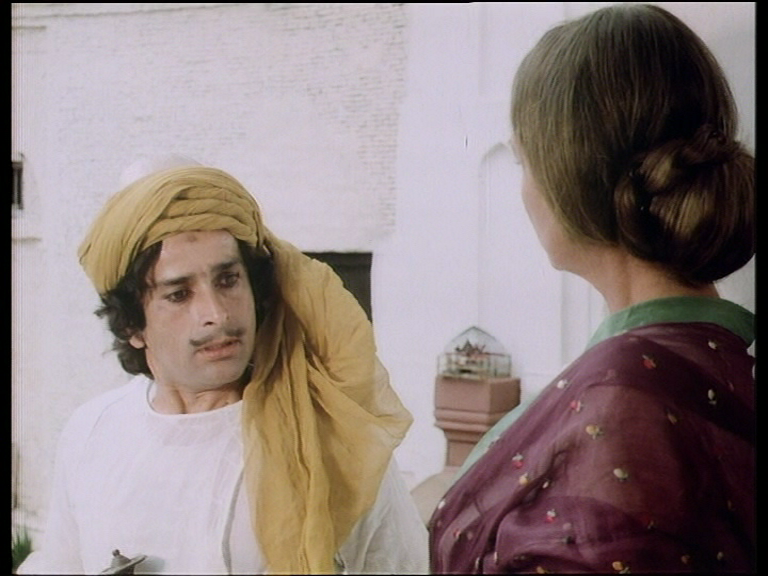
Have you brought me a Ploughman's?
What were we talking about? Oh yes. So Junoon. It was one of the first Hindi films we had seen, we were still virginal viewers. But we did know enough to recognize key figures such as the Shabana, the Naseer, the Kulbhushan (who was still "that guy" back then), the Tom Alter, the guy from Swades (still that guy, unfortunately), and, of course, the Shashi. We were like the proto-PPCCC back then.
(An excellent complement to a Ploughman's sandwich is one of those thick organic fruit drinks.)
Another problem with Junoon, apart from it testing our attention span on an epic scale: we misunderstood who was married to who, and thought "Jennifer Kendal" was actually Nafiza Ali, and so we thought it was doubly interesting that a real-life husband, Shashi Kapoor, should play an obsessed stalker of his real-life wife. How meta!
Until we realized she wasn't his real-life wife. And then we were like, "Lame." Moving on.
The year is 1857, the land is India, the air is as thick as the cheddar slice in my Ploughman's. You could cut it with a knife, and you'd need a pretty sharp knife. On one side, you have the Indians, angry, fomenting rebellion, led by a henna-haired Naseer looking fabulous. On the other side, you have the British, living in a bubble of colonialism and segregation. One day, a super-fine nawab, Javed Khan (Shashi Kapoor), ambled along and spotted a pretty young thing, Ruth (Nafiza Ali), on the British side. Shashi, being Shashi, started junooning up a storm - I must have the saucy wench! Or, as Wayne would say, "She will be mine. Oh yes. She will be mine."
Thanks to Naseer spreading violence, Ruth's father, Mr. Labadoor (Tom Alter! yeah!), is killed, along with a number of other British people. Chaos ensues. The family - Ruth's mother (Jennifer Kendal, THIS is Shashi's wife), Ruth's grandmother - quickly flee with the help of a noble-hearted guy, Noble Guy (Kulbhushan Kharbanda, looking quite handsome). Amidst all this macro tension, Javed the Nawab's micro obsession is growing more and more unwieldy. When he captures the Labadoor family, he practically pops a blood vessel in excitement and declares he will wed little Ruth as his second wife. His first wife (Shabana Azmi) is not so pleased. And his brother-in-law, Sarfaraz (Naseeruddin Shah), is also annoyed at his distractedness.
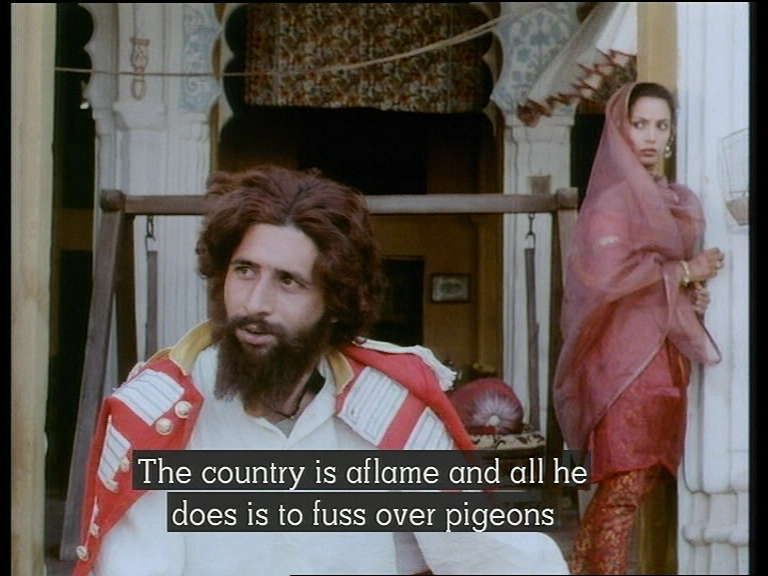
Shashi has a thing for pigeons in such films.
The two families - Indian and British - live in growing tension, with the Shashi's predatory, nearly maniacal desire for Ruth causing everyone much grief. Meanwhile, the storm of the 1857 is growing, and soon the household is sucked in as well.
Junoon is a very cerebral film and, on an intellectual level, it is great. The juxtaposing of this microcosm of Anglo-Indian relations against the macro strife of 1857 is very stimulating; particularly in the eroticization and aggression of these relations, which lead one immediately to think of Edward Said. That is, in Said's Orientalism, he discusses how Orientalism typically defined the "Eastern" male as an effeminate Other, weaker and more passive than his macho Western counterpart. Even today, the PPCC would argue, you still see this theme of virile Western men seducing the exotic Oriental beauty - for example, read Slate's notes on race in Wes Anderson's Darjeeling Limited. Having the genders and power structure reversed - in Eastern Javed's constant attempts at possessing Western Ruth - as well as, all throughout, subverting them - Javed's ultimate vulnerability, his own possession - makes for some great Thinking Person filmmaking.
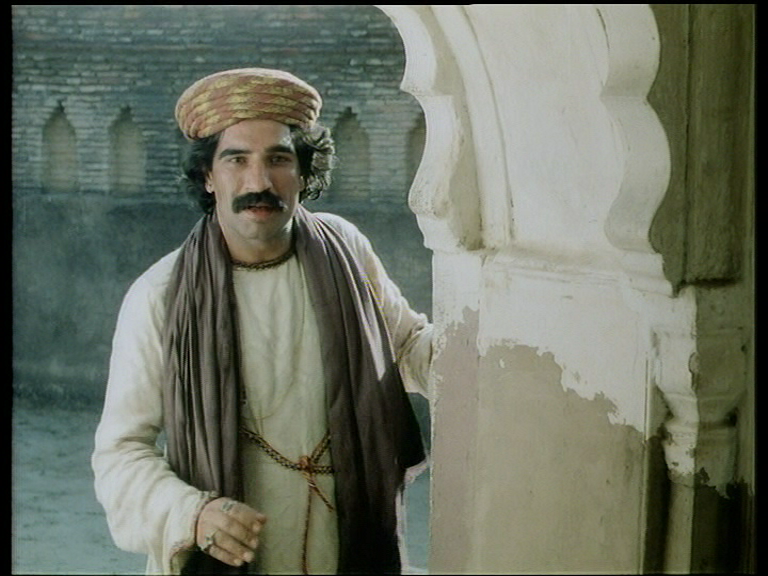
Kulbhushan, so young and handsome!
But what the film has in intellectual terms it lacks in emotional involvement. That is, the PPCC likes a good postcolonial or Orientalism-examining/Orientalism-subverting film as much as the next post-punk, but we are also warm-blooded human beans. While a film like My Son the Fanatic works on both the intellectual and emotional levels, Junoon remains suspended and austere. Partly, this is the fault of the characterizations. The only characters we invest any time in are Javed, Ruth and Ruth's mother. Javed is singularly unlikable, and, as fascinating as he is in a moralistically misshapened Quasimodo way, he's not someone we care about (or, for that matter, want to "win"). He's basically the villain. (Side note: we cannot avoid mentioning that Shashi looked FAAAHine in his nawab get-up. He was lush like the mountains of Switzerland under James Bond's skis. Just luush.) Ruth, the object of his obsession, remains a non-entity - she is given hardly any lines and, apart from fearing Javed and liking pigeons, we get little insight into her thoughts and feelings. As a result, she ends up becoming a symbol and little else. Ruth's mother is perhaps the real hero of the film in that the audience is on her side, and she demonstrates courage and action throughout the film. But, again, she remains blandly straightforward. For a film so loaded with political and cultural potential, it would be good to have a bit of provocation here and there, some graying in the characterizations. Instead, we have exactly what we expect: the savage, obsessed villain, the tremulous damsel, her brave mother.
So, dammit, when the PPCC can't be provoked, it goes a-lookin' for provocation! We tried noticing if, as in Bombay, there would be any prejudices hidden beneath the text. The only things we can come up with are:
- Benegal's treatment of the British characters is mostly sympathetic. OK, Tom Alter's patriarch figure is your run-of-the-mill stern colonialist, but the rest of the family are sinless victims. Most notably: Benegal goes to great pains to humanize the British before their slaughter in the church. There is the goofy guy who keeps peeking over the woman's shoulder. There is the bored, little girl who rests her head on her mother's shoulder. There is the helpful soldier, who indicates to Tom Alter which psalm they're on. Benegal uses these scenes to let the audience invest in the characters, however peripheral they are. Maybe because, from an Indian perspective, it would be easier to demonize the colonial power - Benegal instead goes to the other extreme: showing us human, vulnerable and greatly victimized British characters. Furthermore, thanks to Ruth's mother, the British characters have the clear moral upper hand in the microcosm tale of Javed's obsession. This is, of course, in stark contrast to their macro villainy: Sarfaraz's reports of British soldiers strapping Indians to cannons, for example.
- Benegal's treatment of the Muslim characters is mostly negative. In particular, Javed and Sarfaraz are both fairly villainous and unlikable characters. One is driven nearly mad with sexual desire, while the other is uncontrollably bloodthirsty. That's not to say they are one-dimensional characters - Sarfaraz's pain after losing Delhi is, after all, often cited as a wonderful scene, and it's because we care about Sarfaraz in that moment. But neither of them are given any chance to demonstrate compassion; their few moments of frailty tend more towards cowardice or madness rather than anything a bit kinder.
- The sole sympathetic Indian character is a Hindu. That being Kulbhushan's character. We at the PPCC don't know enough about this period in history, but we were just told that an oligopoly of Hindu families ruled moneylending in 1850s north India. Any PPCC readers have more info? All we did notice was that Kulbhushan, the only harmless Indian, who helps the Labadoor family without hesitation, and who seems an awful lot more even-tempered and gentle compared to the warmongering Sarfaraz and the lusty Javed, is also the only recognizable Hindu in the film.
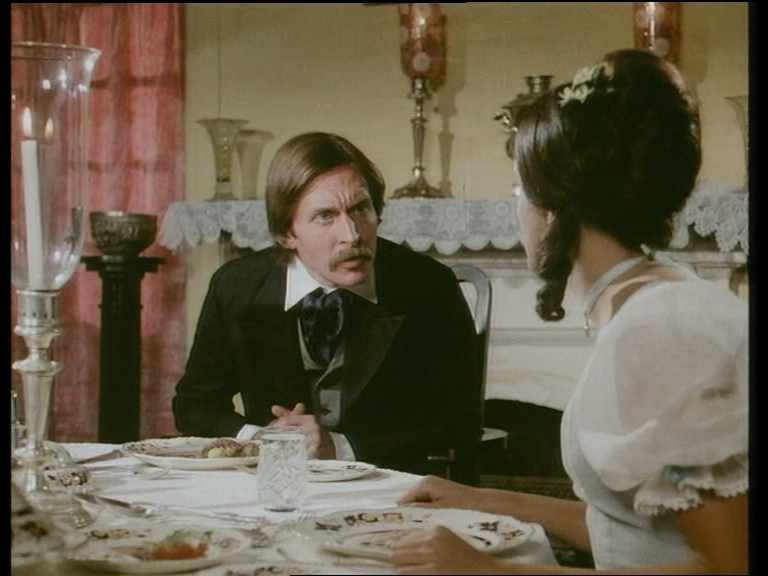 Tom Alter's an interesting guy overall.
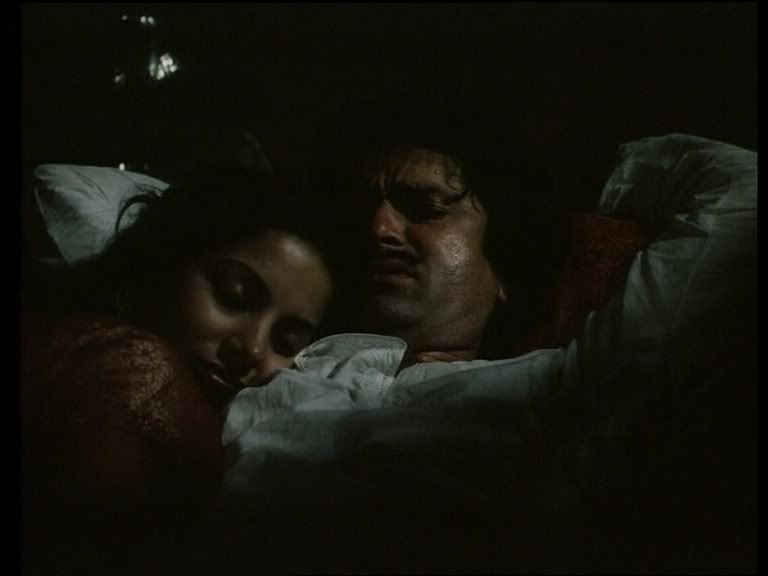 We love short scenes with little context, like this one.
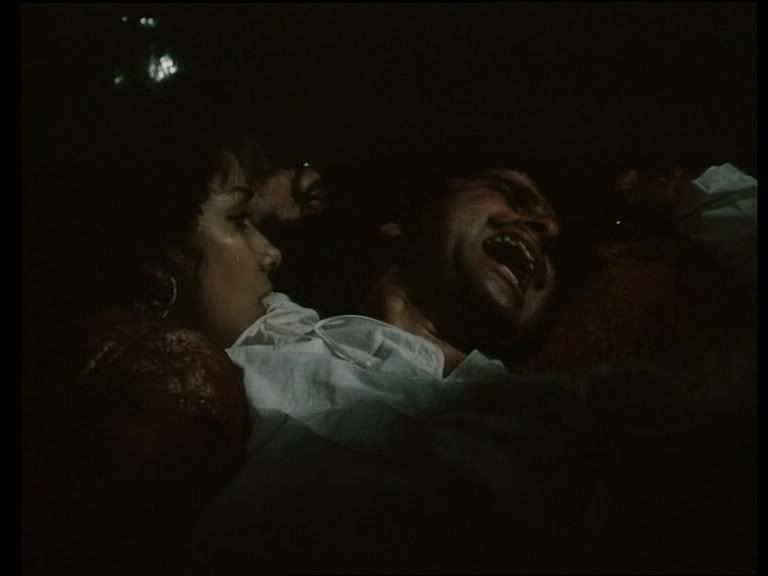
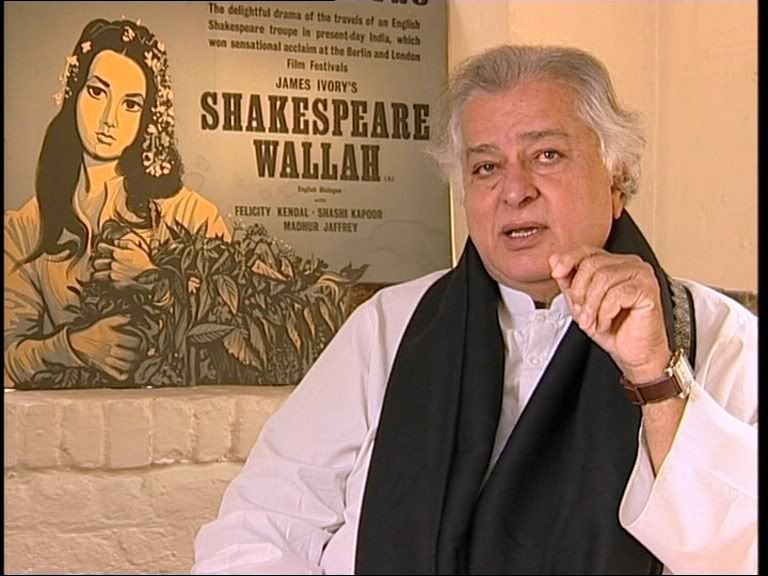 Bonus on UK copies of Junoon!