Tuesday, 28 April 2009

Make this movie, universe!: Lord of Light

Many people in the West think that, in my country, because of our religions, because of our history, because of I don't know what, somehow we are more in tune with our spirituality, more at one with the forces of Nature. Well, we are! So well done, all those people who said that!
- Guru Maharishi Yogi, Goodness Gracious Me

His followers called him Mahasamatman and said he was a god. He preferred to drop the Maha- and the -atman, and called himself Sam. He never claimed to be a god. But then, he never claimed not to be a god. Circumstances being what they were, neither admission could be of any benefit. Silence, though, could.
- the first lines in Roger Zelazny's Lord of Light

A new project here at the PPCC: Make This Movie, Universe!
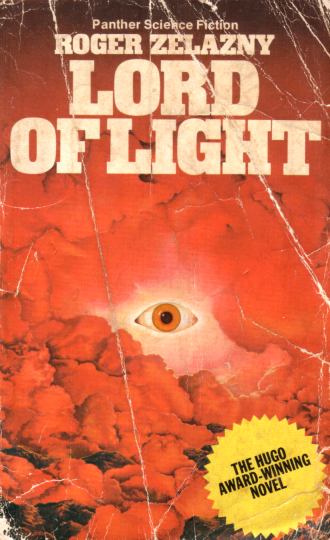


Roger Zelazny's Lord of Light is one of our favorite books. It combines cross-cultural pollination, spirituality and wacky science fiction with irreverence, comedy and genuine humanism. It is RIGHT up our alley.

Plot: In the far, far, far future, Earth is dead and a nameless new planet has been colonized by the crew of an old ship (the "Star of India"). Living in a post-Singularity-type world, they use advanced technology to transfer consciousness from body to body, as well as get up to other fancy tricks (nuclear-powered chariots, for example). Many generations have passed since the original colonizing of the planet, and the original ship crew (the "First") have now manufactured a literal Hindu reality: they've taken on the roles of gods, reincarnating themselves into Brahma, Vishnu, Kali and so on, and meanwhile keeping the rest of the population (their descendants) stuck in a superstitious, pre-industrial society.
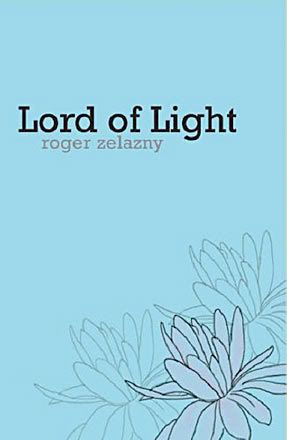

The new British (?) cover. Classy.


One of the "gods" becomes disgusted and disappointed with this endless, unfair cycle of reincarnated oppression, and he decides to shake things up a bit by repeating Earth history and introducing Buddhism. Adopting a new body and calling himself Prince Siddhartha, he goes through the motions of the original story of Buddha - who, for those a bit rusty on their 2,500-year-old Indian history, rose to be one of the main challengers to the Brahmin/Hindu hegemony of the time. Annoyed, the other gods exile him and eventually there is a great battle over the fate of the new planet's humanity and - especially - its soul (if, well, Buddhism believed in a soul).

The book is chock full of hilarious anachronisms and philosophical ironies that turn your brain pretzel-shaped. Shiv Sena's probably not going to like it - the crew member currently reincarnated as an ultra-macho Brahma was a lesbian originally. Similarly, Christian fundamentalists might be annoyed by the subplot of the ship chaplain who rebelled against the faux Hindu hegemony and attempted to mass convert the planet to Christianity using an army of zombies, meanwhile earning the moniker "Prince of Darkness" for himself. And what would Buddhists think of the idea that you can "fake it 'til you make it" on the way to Enlightenment? Or the mish-mashing of the critical atman/anatman (i.e. soul/no-self) discussion?

Well, the book's vibe is more comedy than provocation, and its gentle probing of philosophical issues and ambiguous interpretation should make it stimulating and palatable to anyone who likes to think about this sort of stuff. Such as the PPCC!

"For a spur of the moment thing, you came up with a fairly engaging sermon."
"Thanks."
"Do you really believe what you preached?"
Sam laughed. "I'm very gullible when it comes to my own words. I believe everything I say, though I know I'm a liar."


The film: Now the ever-enthusiastic PPCC is not the only one who thinks this would make a great film. Indeed, Zelazny sold the book rights way back in the 70s, and a truckload of money was set aside to film it and then later market the sets as a science fiction theme park (!). This idea was shelved and then - another twist in the increasingly weird story - the script was used by CIA agents, who posed as film producers, in order to rescue Americans during the Iran hostage crisis! REALLY!

Gosh! They could make a movie about making this movie!

The dream: What would make this movie the end-all, be-all coolest movie ever? Well: the perfect cast and crew, of course! And who would they be? We'll tell you.

Director

Since a Lord of Light film would require a sort of primordial, steampunk-ish, Vedic/pre-Vedic-era India setting, as well as the sci-fi spectacle that is the "Mount Olympus" heaven zone, we need a director with a strong, saturated, zany vision.

Our top choice would be Terry Gilliam. He of former Monty Python fame, we think his bizarre, LSD aesthetics (as seen in Fear and Loathing in Las Vegas) would be perfect for the acid trip that is this neo-Hindu/neo-Buddhist world of fakes and charlatans. We also think hippie-fying the proceedings would add an interesting meta critique of the whole Karma Cola hippie trail "New Age"-ist misunderstanding of Hinduism and Buddhism. Eh? EH?!

Otherwise, Mira Nair... no, not because of Monsoon Wedding or (our beloved) Mississippi Masala, but because of her oft-overlooked Vanity Fair, which featured flamboyant fashion (Jonathan Rhys-Meyers' hairstyle, ho ho ho!) and the most spectacular, elephant-riding "oh, dammit, let's just move to India!" ending ever found in film.

Cast

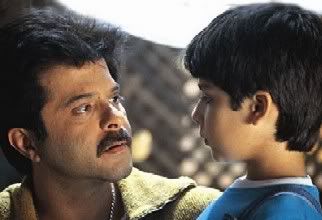
The "hero" role of Sam would require someone who is at once down-to-earth and epic. Someone who can project a sense of superheroics coupled with Everyman good humor. And who is the best Everyman superhero? Duh. Anil Kapoor.

And if Anil Kapoor's going to be Sam, then clearly the role of Kali - who was Sam's wife in previous incarnations, but is now his arch-nemesis - must go to Madhuri Dixit.
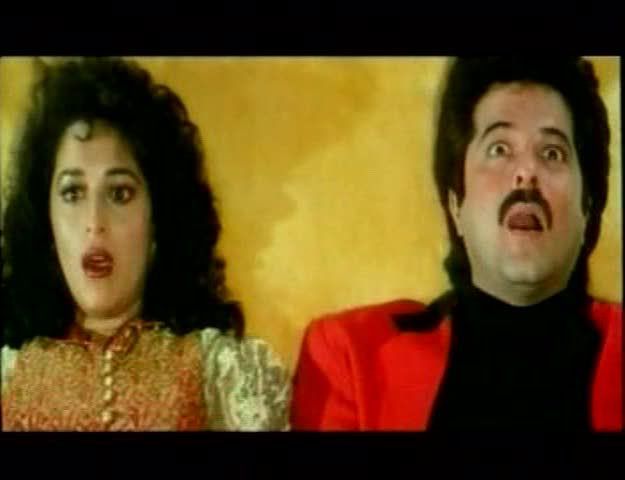

No, we never miss an opportunity to sell Anil/Madhuri. And what a comeback vehicle this would be!
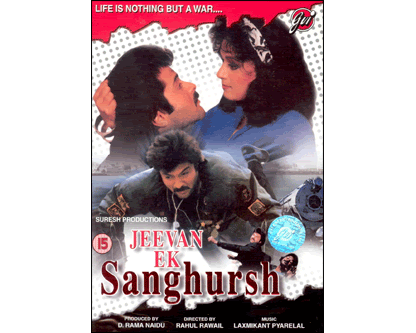

Jeevan Ek Sanghursh = Life is a struggle. AKA the First Noble Truth, according to Buddhism. Coincidence? WE THINK NOT! This film - this cast - clearly, it was meant to be!


Now that basically seals the movie's coolness for us, but perhaps there are some philistine unbelievers out there who are not so easily swayed by seeing the Anil/Madhuri pairing in a cheeky film about sci-fi Buddhism. Well, all we can say to such tough nuts is...

A pox on you! Hex, hex!

Goodness gracious us, edited to add: We forgot to talk about one of the main determinants of a film's awesomeness: its soundtrack! No doubt we'll spend the rest of the week fiddling with our iTunes playlists to make the Greatest Most Excellently Awesome Lord of Light Soundtrack Ever... but, off the top of our head, we can say such a soundtrack is likely to include:

1 part Philip Glass or Michael Nyman
1 part Explosions in the Sky or Radiohead in Kid A mode or Sigur Ros
season with old school 1970s masala to taste
a dash of carnatic vocals
and a pinch of George Harrison learning the sitar from Ravi Shankar

...and voila! It would be delicious.

Sunday, 26 April 2009

Feroz Khan RIP

FEROZ KHAN
1939 - 2009


Welcome (2007)
Janbaaz (1986)

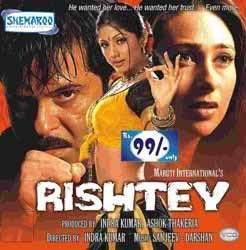
Rishtey (2002)


Inoffensive and sweetly trashy, we didn't mean to watch all of Rishtey (Bonds)... but we ended up sticking with this film to the very end, cheering our beloved Anil Kapoor on as he boxed against an evil, towering white man named "Scorpio" (or, as Scorpio himself would prefer, "SCORPIOOOOOO! RAAAH!") in the film's finale. What can we say? Watching Anil Kapoor perform is like receiving a direct injection of opium to the heart. It's addictive, and we LOVE IT.

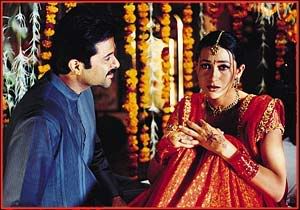
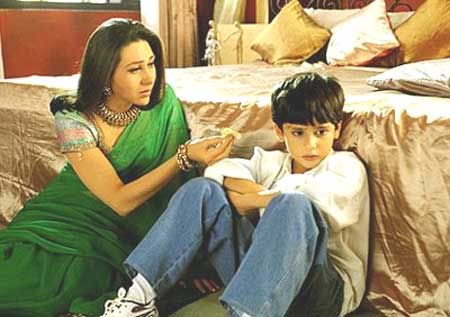
There were other addictive ingredients to Rishtey - plot twists reminiscent of the lovely Aa Gale Lag Jaa or the gloriously pulpy Calcutta Mail - as the film follows the beleaguered, working class Suraj (Anil Kapoor) in an extensive and violent custody battle against his evil, rich in-laws (led by Amrish Puri, of course). Suraj's brainless, estranged wife, Komal (Karisma Kapoor, lacking a lot of charisma indeed), gets entangled in her evil father's evil attempts to keep her apart from her loving husband and son because, as he sees it, it's better to be dead than poor. The film and we, the audience, naturally side with the poor all the way through - for example, Komal's family pad is a cheesy Art Deco mansion (yuck!), while Suraj and son live in maybe the coolest slum/chawl neighborhood ever (complete with Ferris wheel and a step well! in the middle of Mumbai!). Clearly interior decoration is a sign of moral righteousness, and tackiness is far from godliness! Throw in one PPCC audience stand-in, a plucky working class fish-seller, Vyjanti (Shilpa Shetty), who falls for Suraj big time and begins to see Anil's smiling face superimposed on random babies and butter-churners (insert your own comedy sequence here), and you have an enjoyable junk food film.


Pre-problems.


The best-made Custody Battle Hindi film, we reckon, is 1973's Aa Gale Lag Jaa (Come and Embrace Me), whose glorious gloriousness relies on the son and father's matching cutenesses. Master Tito and Shashi Kapoor were at the height of their adorableness in 1973 - and, heck, even the evil, rich father-in-law (Om Prakash) and easily-confused wife (Sharmila Tagore) were sympathetic.

Rishtey, unfortunately, is peopled by less charismatic types, all of whom are in their decline. Indeed, the entire film's quality rests on Anil Kapoor's shoulders. Thankfully, we love Anil Kapoor - BIG TIME - and we think his particular post-2000 brand of barrel-chested, mustachioed, father-as-superhero charisma is perfect for a role like this.

"Go, Anil, go!" we cheered, as he punched goons into orbit while bellowing No one touches my son!

"Awww!" we sighed, as he wept over the endless court cases and had various emotional breakdowns on the shoulder of his sympathetic Punjabi stereotype friend.


Mom?


Or Dad? Clearly Dad. Hello!


There was also an appealingly stupid side plot in which poor old Suraj, who used to compete in World Wrestling Federation-esque boxing matches (rings of fire! pits of spikes! artificial rain!), decides, damn it all, to perform one last time in order to get money to pay for the court fees. Or something. And all of this when, uh oh, Suraj's ancient injury from an old WWF match has left him with brain damage! "If you get hit right here again," the doctor informs Suraj, pointing to his forehead, "you may be paralyzed... or be left a vegetable... or DIE!" Of course, the evil father finds out about this and swiftly hires "SCORPIOOOOOOOOO! RAAAH!", a mercenary American WWF wrestler (not Mickey Rourke... alas), to punch Suraj repeatedly in the forehead.

Hmmm, a hardened ex-wrestler with a gooey center and Achilles-like weakness who, after familial estrangement, steps into the ring again for one final, possibly fatal fight? Clearly The Wrestler was a remake of Rishtey! We rest our case.

Music-wise, Suraj and Komal's love anthem, Har Taraf Tu Hi, was well-filmed and catchy - we've been singing, "Hai... hai-hai-hai-HAI chaahata ho itna tujhe!" all the way to the elevator and local Indian restaurant, where it's been playing on loop as well. And Anil's school-boy haircut in the song? The jerky posing? The columns?! The priceless.

And guess what sign we are? SCORPIOOOOOOO, RAAAH! Anil: plz make more boxing melodramas. Perhaps a remake of Crying Fist? We've already noted that Anil and Choi Min-Sik are the same person.

We love you, Anil Kapoor!!!

Thursday, 23 April 2009

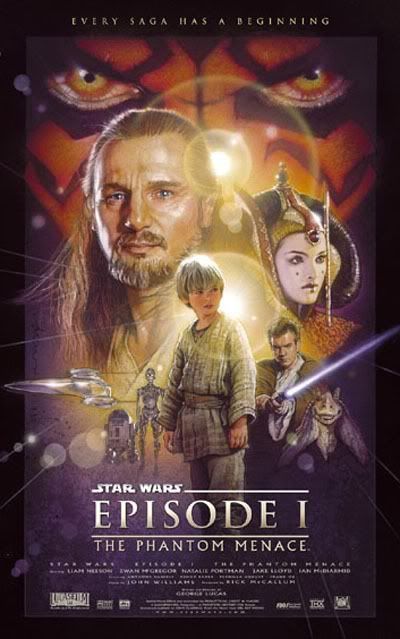
Star Wars: Episode I - The Phantom Menace (1999)

Where has the PPCC been this week? We'll tell you. We've been:
1. In the bathroom. We are trying (and failing) to drink the suggested three liters of water per day. I tell you, it's impossible! It cannot be done!
2. Developing a radical new theory of metaphysics based on an Obi-Wan Kenobi quote. (Seriously!)

In working on (2), when not busy with (1), we decided to revisit the classic sci-fi adventure, and the primary god of our idolatry, the Star Wars universe. Being completist types, we decided to begin at the beginning: the widely-considered low point of the series, Star Wars: Episode I - The Phantom Menace.


"Noooooo!" we hear the PPCC readership cry.


Now, first of all, we think all the hate and ridicule Phantom Menace has accumulated since its 1999 release is somewhat unmerited. Yes, it's bad. No, we don't know what a "phantom menace" means (a threat that doesn't actually exist?). But must it be so uncharitably vilified? In particular, we came to a surprising conclusion: Jar-Jar Binks is oddly funny once you give up on the film. Just give up. Let go. Then the humor will come. We-sa serious!!

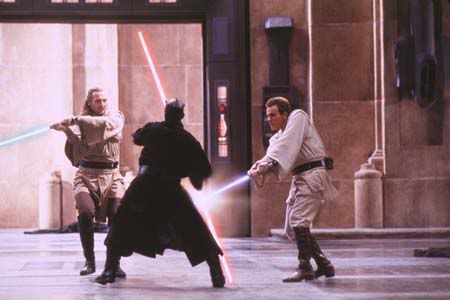
Okay, so we-sa lying a little bit too (oh, doo-doo). We actually lost interest about forty minutes into the film, skipped forward to watch the magnificent lightsaber duel during the finale (wherein we pepped up quite a bit... go, John Williams!), and then quickly skipped even more forward to the lightsaber duel in the finale of Episode II - Attack of the Clones. Verdict: Episode I's lightsaber duel is more deliciously, magnificently glorious.


Obi-Wan: tragic Greek non-hero? Or tragic philosophical innovator? Essay coming soon to a PPCC near you!


Phantom Menace begins during a time of confusing political unrest in the galaxy. The gorgeous planet Naboo, a land of waterfalls, Renaissance Italian architecture, fantasy-novel throwback fashions and the dreaded Jar-Jar, is under a trade embargo (or something) by evil "Trade Federation" aliens carrying unfortunate "Asian stereotype" accents. George loses early points for Jar-Jar and the accents.

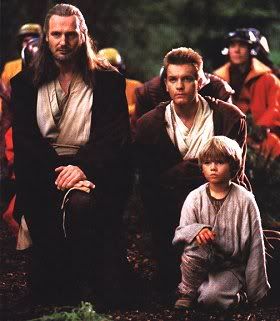
In come our dashing Jedi, Qui-Gon Jinn (Liam Neeson, he of the interesting bone structure), and his "Padawan" learner, a young and clean-shaven Obi-Wan Kenobi (Ewan McGregor, he of the hot). The Jedi, nominally peacekeepers, look more like militaristic interventionists who choose to side with Naboo's Queen Amidala (Natalie Portman sometimes, Keira Knightley other times) because of some vague notions about sensing the "Dark Side of the Force" in the Trade Federation. It all sounds a bit Crusader-ish to us, but then we've never understood Jedi morality (more on that later).


The Jedi and their munchkin.


So: After a lot of indecipherable political stuff - in which one important player, Senator Palpatine (Ian McDiarmid), deftly maneuvers himself into power - and after a protracted detour on the sandy planet of Tatooine - wherein the (potential) "Chosen One" is identified in a cherub-like little slave boy, Anakin Skywalker (Jake Lloyd), much to Obi-Wan Kenobi's chagrin - we return to Naboo to settle the score between the Trade Federation and the Jedi-backed local government. The mysterious Darth Sidious (err... Ian McDiarmid, hello), semi-secret puppermaster behind the Trade Federation, sends his most badass Sith warrior, Darth Maul (Ray Park), to kick some Jedi butt. Which he does, with gusto! The film ends with the perfect set-up for the next five films:
1. Obi-Wan Kenobi is Anakin Skywalker's reluctant master. Fail forseen.
2. Anakin Skywalker worships the beautiful Queen Amidala. Double trouble!
3. No one knows who the powerful, evil Darth Sidious could possibly be, even though his main disguise is a hooded robe.


As a wee proto-PPCC, we never thought about Star Wars in any deep way. We just liked it, plain and simple. But now, with the keen, penetrating intellect of adulthood, we can shrewdly ask two important questions. These can be divided according to each trilogy:
1. Original trilogy (1977-1983): Why is the Empire considered so evil?
2. Prequel trilogy (1999-2005): Why are the Jedi considered so good?

There seems to be a stark moral dichotomy at work here, without any evidence to back things up. We just don't buy it, George!

Look: Both the Empire and the Jedi are powerful, violent and interventionist. Both of them use other planets in their galaxy-wide martial chess game. A lot of interesting talk has gone into how George Lucas added a strong touch of Zen to the Jedi - Yoda's teachings in Empire Strikes Back, for example. But what monastic order has its own characteristic weapon? Indeed, the Jedi seem to be much more samurai than Zen monks (Obi-Wan Kenobi was inspired by archetypal samurai actor Toshiro Mifune's character in The Hidden Fortress, and Mifune was apparently briefly considered for the role before it went to Alec Guinness). And the samurai were a class of politically-aligned warriors: not a moral order! So why all this moral indignation on the part of the Jedi? Are they a religion? They keep insinuating that an ultimate "good" is on their side... but their actions are just as morally ambiguous and politically motivated as any other group!

So there.


Apart from dressing in black and growling, what does this man do which is so evil? What does he do which the Jedi don't do? We just don't get it, man.


If there's one great thing that came out of Phantom Menace, apart from Ewan McGregor's spot-on interpretation of a soon-to-be-Alec-Guinness Obi-Wan Kenobi (McGregor seems to be the only one in the prequel trilogy who "gets" it, or are we distracted by his hotliness?) AND apart from the glorious sound effects during the Tatooine pod race (ka-chunk-chunk-chunk, whizzzz!), it was John Williams' bombastic, energizing score - in particular, the glorious track Duel of the Fates. And guess what! They're singing in Sanskrit! Yes, really. A Sanskrit translation of an ancient Welsh poem! How about that, eh? We can also say that Duel of the Fates is great for pumping iron in the gym: as a friend of ours once said, it "makes you want to punch someone" (he was actually talking about Simba's return to Pride Rock in Lion King, but the feeling is similar - get pumped!).


Even just a single picture, such as this one, gets the PPCC positively pumped. Daaaa-daaaaa! Daaaa-DAAAAAA! DA-DAAAAAAAA!


Completely unrelated, but worth a mention: We're reading Roberto Saviano's disturbing book about the Neopolitan mafia, Gomorrah, and we came across this passage:
A well-calibrated nickname, such as Francesco Schiavone's famous, ferocious Sandokan, can make or break the media fortune of a boss. He earned it for his resemblance to Kabir Bedi, the [Indian!] star of the Italian television series Sandokan, the Tiger of Malaysia, based on Emilio Salgari's novel.

First we discover that Roshan Seth once starred in an Italian mini-series about Aldo Moro, and now this! Cultural cross-fertilization, indeed.

Friday, 17 April 2009

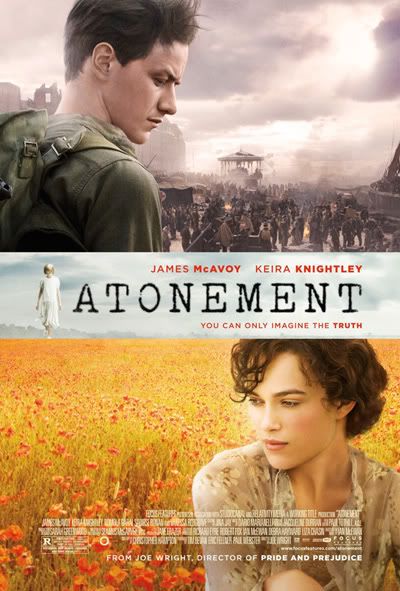
Atonement (2007)


In our Hindi assignment for today, we wrote a little review for the most recent movie we saw: Atonement (which we dubbed to be "माफ़" in Hindi). We're always threatening Beth with posting movie reviews in crappy Hindi and today, in celebration of our recent publication in Filmfare magazine (current issue! out now!), we would like to present our beloved loyal readership with...

The PPCC's First Hindi-Language Review
(Errors included. English transliteration below.)


Enjoy.

फ़िल्म का review: "Atonement" (माफ़)

[The plot.]
आज मेरी सहेलिने मुझे एक फ़िल्म देखने के लिए दी। वह फ़िल्म अंग्रेजी है और उसका नम Atonement है। हिन्दी में "माफ़" कह सकता है।

फ़िल्म की कहानी अंग्रेजी इतिहास के बारे में है। दो-तीन साल WW2 से पहले एक अमीर अंग्रेजी परिवार था। उस परिवार में दो बहिन थीं - "सी" और "तालीस" । उस परिवार का घर बहुत बड़ा था और कई नौकर उसमें काम करते थे। एक सुंदर और होशियार लड़का था जिसकी माँ रसोईघर की नौकर थी। उस लड़का का नाम "रोबी" था।

रोबी और सी के बीच में बहुत प्यार था लेकिन कहानी में छोटी बहिन तालीस सोचती है की रोबी बुरा लड़का है। एक रत तालीस की सहेली को molested है और तालीस सब परिवारवालों को कहती है की रोबी वोह बदमाश था। इसके कारण रोबी jail को जाता है।


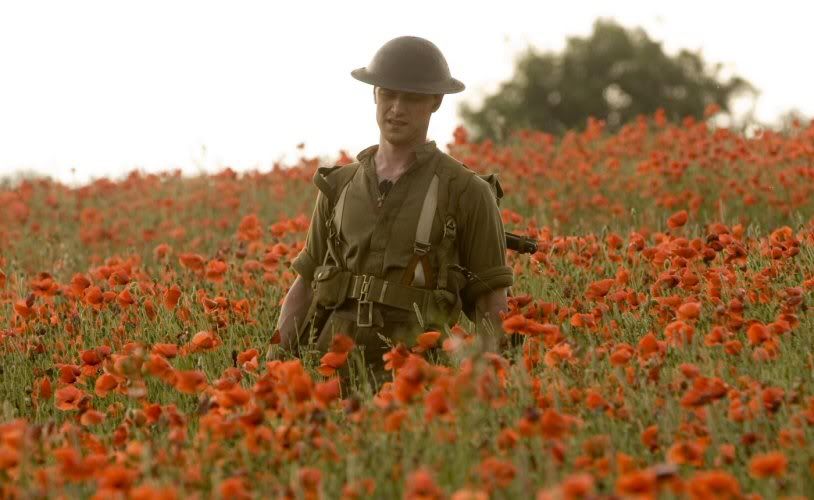
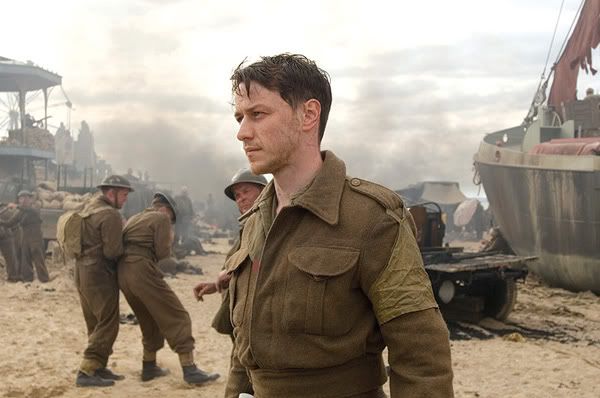
रोबी लढाई में.


फिर WW2 हो गया है और रोबी फ्रांस को जाता है अंग्रेजी सेवे के साथ। Meanwhile सी और तालीस दोनों लन्दन शहर के आस्पतालों में काम करती हैं। लेकिन सी अपनी बहिन के साथ बहुत गुस्सा करती है क्योंकि उसको हमेशा मालुम था की रोबी मासूम था। पाँच साल बाद तालीस समझती है की उसने बचपन में एक बहुत बुरी गलती की। अंग्रेजी-जर्मनी लढाई बंद कर रही है और सभी सी, तालीस और रोबी लोनोदं में रहते हैं। तालीस अपनी बहिन के घर को जाती है माफ़ी मांगने के लिए। वहां रोबी भी है और वोह बहुत परेशान है। तिन लोग रोते हैं लेकिन लगता है की सी-रोबी तालीस को माफ़ करेंगे।

English transliteration, preserving errors.

Today my friend gave me a film to watch. The film was English and its name was "Atonement". In Hindi it can be called "maaf".

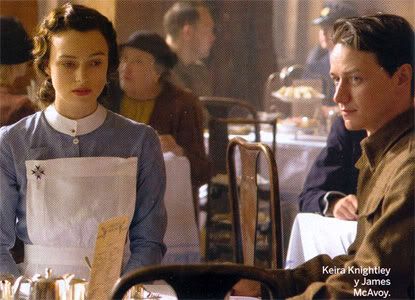
The film's story is about English history. Two-three years before WW2 there was a rich English family. In that family there were two sister - "See" [Keira Knightley] and "Talis" [Saoirse Ronan]. The family's house was very big and several servants worked inside it. There was one beautiful and clever boy whose mother was a kitchen servant. That boy's name was "Robee" [James McAvoy].

In between Robee and Si there was much love but in the story the little sister Talis thinks that Robee is a bad boy. One night Talis' friend is molested and Talis tells all the family-people that Robee is that rogue/ruffian. Because of this Robee goes to jail.


Robee in war.


Then WW2 has happened and Robee goes to France with the English armies. Meanwhile Si and Talis both work in London city's hospitals. But Si is very angry with her sister because she forever knew that Robee was innocent. Five years later Talis understands that she made a bad error in childhood. The English-German war is closing and everyone Si, Talis and Robee lives in London. Talis goes to her sister's house to ask for forgiveness. Three people cry but it seems that Si-Robee will forgive Talis.

[The feeble attempt at an analysis.]

यह कहानी थी। फ़िल्म मुझे काफी अच्छी लगी कई reasons के लिए। पहली बात है की बहुत सुंदर थी - मतलब जगह, लोग, रंग, वगैरह। सभी चीजें अच्छी लग रही थीं। दूसरी बात है की फ़िल्म में कई interesting Christian symbols थे। उदाहरण के लिए एक scene है जिसमें तालीस अपनी हाथ साफ़ कर रही है while वह अपनी पुराणी गलतियों के बारे में सोचती है। यह बहुत classical Christian बात है क्योंकि Bible में जो रोम का आदमी यीशु को मार डाला famously कहा "मैं इसके बारे में अपनी हाथ साफ़ करता हूँ!" उसका मतलब था की अगर यीशु criminal नहीं था और उसको मार डालना गलती हो तो उस रोम आदमी का fault नहीं होगा। उसके बाद पच्छिम संस्कृति mein जब कोई भी बोलता है "मैं अपने हाथ साफ़ करता हूँ।" तो मतलब है की वह बुरी बातें न देखना न सुनना न करना चाहता है।


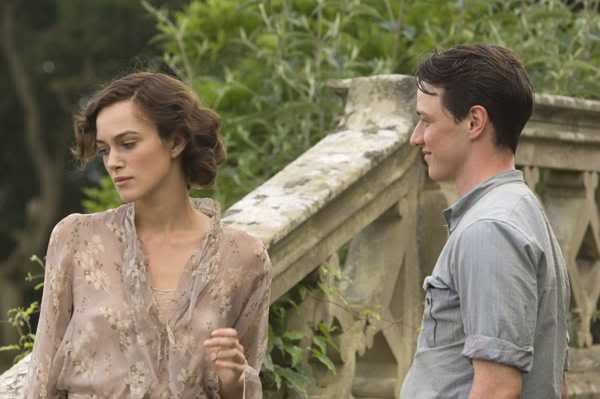
सी-रोबी खुश समय में.


तीसरी फ़िल्म की बात जो मुझे अच्छी लगी फ़िल्म का storytelling style था। मतलब फ़िल्म में कई repeated scenes हैं और style बहुत geometrical और साफ़ था। उदाहरण कई लम्हे थीं जिनमें पहले एक character के perspective से था फिर दुसरे character के perspective। इस लिए देखनेवालों के लिए सभी characters समझना आसान है। वह भी पुराणी फ़िल्म की बात है - बिल्कुल एक पुराणी जापानी फ़िल्म की तरह है। वह जापानी फ़िल्म प्रसिद्ध थी क्योंकि लगाई की रियलिटी सिर्फ़ एक इंसान का point of view है। दोनों फिल्मों में वाही दर्शन की बात और वाही स्टाइल है।

English transliteration, preserving errors.
This was the story. I liked the film for several reasons. The first thing is that it was very beautiful - meaning place, people, color, etc. Every thing was looking good. The second thing is that there were several interesting Christian symbols in the film. For example there is one scene in which Talis is washing her hands while she thinks about her old errors. This is a very classical Christian thing because in the Bible the Roman man who kills Jesus famously said, "I clean my hand about this!" The meaning of that was that if Jesus was not a criminal and to kill him was wrong then it will not be the Rome man's fault. After that in Western culture when someone or other says, "I clean my hand." then the meaning is that he doesn't want to see nor hear no do bad things.


Si-Robi in a happy time.


The third thing of the film which I liked was the film's storytelling style. Meaning there are several repeated scenes in the film and the style was very geometrical and clean. Example there were several moments in which it was from one character's perspective and then another character's perspective. Because of this it is easy for watching-people to understand all of the characters. That is also a thing of an old film - it's absolutely like an old Japanese film. That Japanese film was famous because it [showed] that reality is only one human's point of view. In both films it's the same thing of philosophy and the same style.

[Phew!]

Sunday, 12 April 2009

Signore & signori (1966)

(300th post! Arbitrary yay!)


If the north of Italy has a La dolce vita, it is Signore & signori (Ladies & gentlemen). Just as La dolce vita exposed the debauched, immoral (night)life of the Roman bourgeois, Signore & signori does the same for northern Italy - and it uses the same style of vicious satire. A key difference is that, unlike La dolce vita's underlying melancholy, Signore & signori believes the proper response to the outrageous hypocrisy on display is laughter. And indeed, it is very, very funny. Another key difference is that northern Italy has historically been more "bourgeois" than southern Italy - that is, it has been historically richer and more empowered (e.g. Renaissance Venice or the Duchy of Savoy, to the Kingdom of Naples) - so this film could just as easily be set in the 1960s as the 1560s.

Signore & signori is funny in a scathing, dark way. No character is better than any other character, and all of them are pretty awful: selfish, mean-spirited, hedonistic. The film is divided into three distinct sections, each focusing on a particular problem among the bourgeois of a northern Italian city (most likely Treviso). The first story focuses on the loud, over-the-top Dr. Castellan (Gigi Ballista) and his blonde, airhead wife, Noemi (Beba Loncar). On an evening before a major party, one of Castellan's friends, the nervous-looking Gasparini (Alberto Lionello), comes to Castellan in confidentiality with a medical problem: he is impotent. Yet at the party, Castellan repeatedly sets Gasparini up for group mocking, as well as spreading the rumor to everyone (eventually reaching Gasparini's wife, the fearsome moral police lady Ippolita (Olga Villi)). But Castellan is the one being duped when, upon returning home, he finds Gasparini and Noemi together!


(You'll notice that exclamation points, adultery and mean-spirited mockery are themes of this film.) One of the various adulteries.


Like La dolce vita, the Church is shown to be just as morally bankrupt as everyone else!


The second story follows the tall, oafish Osvaldo Bisigato (Gastone Moschin). Bisigato's shrewish, nagging wife complains to him all day, so he typically wears earplugs. His children ignore him, his job in the bank is boring. His only respite from this wearying existence is the cute girl, Milena (Virni Lisi), who works at the coffee shop downstairs. Under the eyes of the gossiping Treviso elite, Bisigato visits Milena every day, eventually beginning a relationship with her. Eventually it all comes crashing down: he leaves his wife and children, provoking the wrath of the Catholic morality police, led by Ippolita; his "friends" begin to send anonymous letters to him insinuating at Milena's moral weaknesses; and everyone in town basically conspires to juice the situation for all it's worth, teasing both Bisigato and his family in their weakest points.


Aldo Puglisi, who plays the only non-Venetian character and only honorable character, the Neopolitan police officer, Mancuso. Question to the PPCC: is Aldo Puglisi the Doppelgänger/lookalike of Ranvir Shorey, or is it just us?!


The third story, by far the most disturbing, follows a gorgeous, young country girl, Alda (Patrizia Valturri), as she comes to town to buy some goods. One by one, the town's bored, womanizing men - from the shoe shop salesman to the pharmacist to Gasparini and Dr. Castellan as well - seduce (rape?) her in exchange for pretty shoes, some headache medicine, and so forth. Prostitution? Rape? The insinuations are not very pretty - and things get even worse, when Alda's enraged, drunken father comes to town, accusing the men of statutory rape: Alda is only 15 years old! The guilty group, meanwhile, panics and - with the help of Ippolita, and therefore the approval of the Catholic morality police - they bribe Alda and her father in order to "save the face of the good town citizens".


The guilty group.


Each outrageous twist in this already over-the-top film is punctuated by loud, silly, 1960s dance music: emphasizing the harshly satirical take on the moral bankruptcy of the Northern provincial elite. It is sometimes very funny (Bisigato's tale in particular), sometimes cringe-worthy (Gasparini's), and sometimes disgusting (the statutory rape case). It is also very broad and very obvious: with slapstick, sight gags and caricatures instead of characters.

That's actually okay. Despite the seediness of the content, and the broad brushstrokes in which it's presented, we really enjoyed this film. It tickled us pink to see the Veneto region - so often ignored by Italian cinema, which is dominated by artists from Rome, Naples and Palermo, stories about the Mafia or Cinecittà, and a particular emphasis on the Southern experience. Signore & signori's characters speak in the thick Venetian dialect, hover around the familiar architecture of the region. The regional setting is important since, as we never tire of saying, Italian culture is dominated by regionalism: there are distinct stereotypes concerning what a Neopolitan looks, sounds and thinks like, as compared to a Roman, Milanese or whatever. It was therefore interesting to read that director Pietro Germi had actually considered casting this film with well-known southerners Marcello Mastroianni and Nino Manfredi (especially baffling since we think Nino Manfredi epitomizes "Roman irony"). The film's regionalism is also fascinating since it shows the relative wealth and moral bankruptcy of the Veneto, as compared to the intense poverty still experienced in Campania, Calabria or Sicily at that time (the 1960s).


The wonderfully handsome Giulio Questi, as the lecherous pharmacist. Giulio Questi went on to win acclaim as a director of ultra-violent spaghetti westerns such as Django, Kill! He also played one of the aristocratic princes in La dolce vita.


The performances and presentation are all fun and frothy and self-consciously horrible. No one plays for any sympathy - these characters are not supposed to be liked. The cinematography, with its lazy, drooping shots of Treviso's Piazze dei Signori (Gentlemen's Square, where much of the action takes place of course!), its spinning cuts and sight gags, also seems "in" on the joke.

Brutal and shamelessly one-dimensional, we definitely recommend this film as yet another examination of Italian regional sociopolitics in the postwar era - after Ladri di biciclette, La dolce vita, Io la conoscevo bene and C'eravamo tanto amati. Will we ever get tired of this genre? Not when the movies about it are so good!

Monday, 6 April 2009

East is East (1999)

Everyone's got buttons. And the PPCC's biggest button is the one marked "postcolonialism". Although we love all films of all types, films about migration and cultural mixing are our special favorite.

It is for this reason that we reserve a special, Om Puri-shaped space in our heart: an excellent actor known predominantly in India for his work in the Parallel Cinema with contemporary Naseeruddin Shah, or his frequent "Uncle" or villain roles in the mainstream Bollywood cinema, Om Puri also made a series of films in the UK about the British-Asian experience. My Son the Fanatic, where he plays an exasperated, flawed, humanist Pakistani taxi driver in northern England, is one of our most favorite films. Similarly, who else but Om Puri could play our favorite character (Samad the disgruntled Bangladeshi waiter) from Zadie Smith's pop postcolonial masterpiece, White Teeth? We still feel pangs of heartache that the BBC 4 TV movie still hasn't made it to DVD (apparently because it featured too much awesome music). Oh, universe! Oh, woe!


As a balm to our White Teeth-shaped wound, today we'll review for you one of the other notable Om Puri postcolonial films: East is East. Taking its title from a poem by the archetypal colonialist, Rudyard "White Man's Burden" Kipling:
OH, East is East, and West is West, and never the twain shall meet,
Till Earth and Sky stand presently at God’s great Judgment Seat;
But there is neither East nor West, Border, nor Breed, nor Birth,
When two strong men stand face to face, tho’ they come from the ends of the earth!

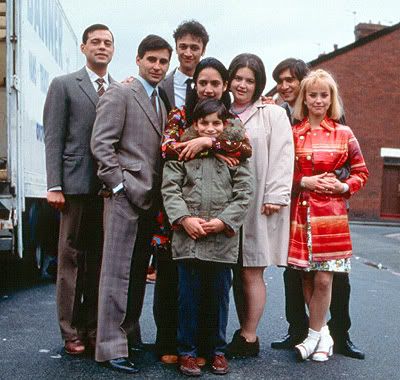
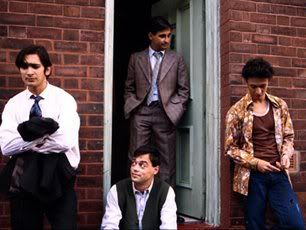
East is East follows the biracial Khan family, headed by Mr. George Khan (Om Puri) and Mrs. Ella Khan (Linda Bassett) and followed by their seven children. It plays upon the tensions between George's Pakistani culture, and the anxiety he experiences trying to preserve it, and the wife and children's attempts to lead more secular, Westernized lifestyles. Much of the drama centers around George's various attempts to get his sons married, though none of them - Tariq (Jimi Mistry) is a hedonistic swinger who calls himself "Tony", Saleem (Chris Bisson) is a grungy artist, Maneer (Emil Marwa) is a conservative and naive recluse, Abdul (Raji James) is the peacemaker and the exiled eldest, Nazir (Ian Aspinall), is gay - are very keen on the idea. Meanwhile, when not forcing his sons into arranged marriages or oppressing his tomboy daughter, Meenah (Archie Panjabi), into wearing a salwar kameez, George insists that his youngest son, nine-year-old Sajid (the adorable Jordan Routledge), have a belated circumcision.


George (Om Puri) and Ella Khan (Linda Bassett).


The kids.


Much less subtle and pandering much more to stereotyped notions Westerners have about South Asians than other films in the genre (My Beautiful Laundrette, Mississippi Masala), this film is nonetheless pretty entertaining. It could be ostensibly interpreted as a tragicomic portrait of George Khan, a man stuck between two seemingly incompatible cultures, but George Khan is mostly a caricature and so the portrait is a cartoon. He is an immigrant struggling to preserve his culture in a radically different environment, but we don't get any idea of why he wants to preserve his culture (often at the expense of his family's happiness and even health!) or what sort of environment he came from. We get no idea of what it's like to be an immigrant, what Pakistan is like, what it's like to be George. Why does he freak out about his youngest son's circumcision? Why does he ostracize his eldest son for being gay? Why does he angst about his children ignoring Islam? "Because he's from Pakistan!" the movie seems to say.

Which is not much of an answer. Culture is important and culture is pervasive and can be brainwashing, yes, but people are people, and there is some choice in the matter, too. For someone who chose to marry an English woman (presumably in the 1950s, given the film's time period), surely he wouldn't be so single-mindedly and restrictively "Pakistani"... or would he? But if so, why? There's an interesting story to tell, culture anxiety and resistance to assimilation, which is just clumsily handled. Important things are skimmed over for the easy solution: "Because he's from Pakistan, and that's what they do in Pakistan! Isn't that funny and yet tragic?!"


The arranged marriage brides-to-be are, of course, cartoonishly ugly. Because if they were pretty, intelligent and nice, it would be a little harder to ridicule their cultural practice, na?


Four of the brothers.


Compare George Khan to Om Puri's similar character in the similar (but superior) film, My Son the Fanatic. In My Son the Fanatic, Om Puri is once again playing a working class Muslim South Asian immigrant in a northern English city. Yet in My Son the Fanatic, cultural tensions and racism are much more subtly expressed. For example, there's a great scene when Om Puri's character, Parvez, discovers that his increasingly fundamentalist son has just dumped his white fiancee. Parvez storms to the girl's workplace and, in desperation, invites her over for lunch and asks what went wrong. The girl, clearly upset, explains that she was dumped. Seething, Parvez declares, "I will break his face until he agrees!" This is a stunning declaration, yet it's not so easy to judge: Parvez is, in the same moment, enraged at his son's close-mindedness and threatening to use some old-fashioned, close-minded disciplining to get him to be more tolerant. Parvez's relationships with his son, his wife, his lover, his religion and alcohol are all much more interestingly presented.

My Son the Fanatic is also much more illuminating on the difficulties an immigrant might face in such a different culture - the difficulties even for well-intended assimilation. That is, notably, the characters in East is East don't face any real racism - Enoch Powell makes brief appearances as a straw man, and Salford just doesn't seem very threatening at all - instead, all of the tension is internal, self-created. We're not saying you need to categorically demonize whites (as Dhan Dhana Dhan Goal did), but racism is a hairy reality which should be acknowledged in films which purport to be about race, such as East is East.

So is East is East good? Well, it's okay. It's simplistic, it's a cartoon, and we had the distinct feeling that we, as a white viewer, were being pandered to. Om Puri is great, of course, and does what he can with the material he's given. But things aren't really as simplistic as East is East portrays. Indeed, as Om Puri himself says (in My Son the Fanatic): "They say east and west can't mix. But look - they can hardly keep apart!"

P.S. What was up with Om Puri's accent? That's not his natural accent, nor is it the already-caricatured accent he uses in My Son the Fanatic. It sounds like just another part of the "evil, ignorant George Khan" caricature: "Why you stupeh?!"

Sunday, 5 April 2009

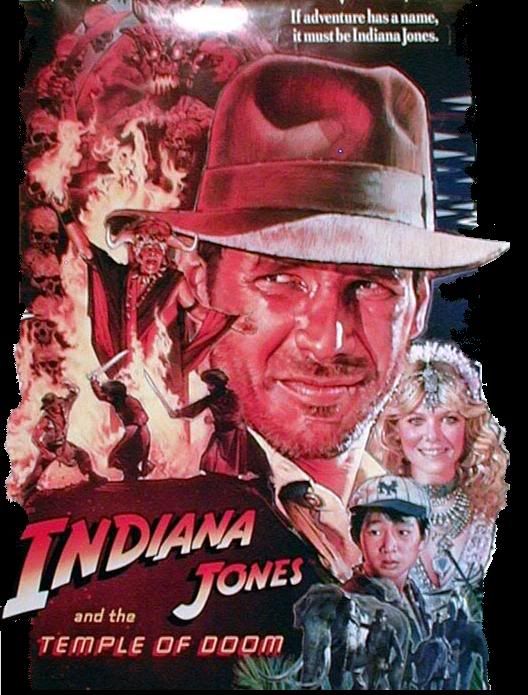
Indiana Jones and the Temple of Doom (1984)


Like a great looming shadow, so is Indiana Jones and the Temple of Doom. It's impossible to write a blog on Hindi movies without mentioning the film a kabillion times - if only because of its outrageously offensive Orientalism, and the fact that Amrish Puri is in it. Yesterday, after a full-on Harrison Ford bonanza of film-watching, which included much of the Star Wars sixology as well as the underwhelming What Lies Beneath, we watched Temple of Doom. It was like the "oogledy boogledy!" icing on a crazy cake.

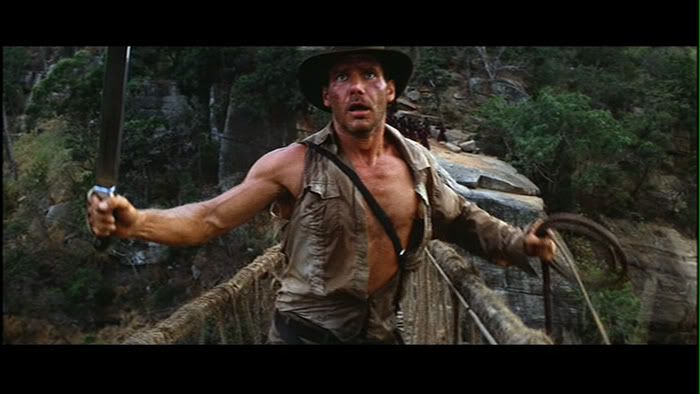
The last time we had seen it, we were young, impressionable Harrison Ford worshipers who didn't worry about things like Orientalism and just focused on how glistening his biceps were. Now, older and wiser, we can say: his biceps are so shiny! And his chest...! Ooh, la la.

Many apologies. This is a SERIOUS review about a SERIOUS problem: the wrongness of Temple of Doom. Because, as one of our viewing companions noted, if the government won't let you film in their country because your story is too racist and your top-choice screenwriter refuses to work on it because he finds it "ugly and mean-spirited", maybe it's time to rethink the story? Apparently not, Spielberg and Lucas decided.

In Temple of Doom, which could be titled Indy Takes On Asia, we follow the continuing adventures of Dr. Indiana Jones (Harrison Ford, He of the Heroical Jawline), archaeologist, adventurer, stud. The story opens in China, where, after an unfortunate run-in with some Shanghai-based gangsters, Indy is almost poisoned to death, but saved by his sidekick, Short Round (Jonathan Ke Quan), and an antidote buried deep in the bosom of the blonde, vacuous Willie (Kate Capshaw, a self-proclaimed feminist - who knew!). Boarding the first plane they find, they fly off into the Himalayas, where the evil pilots parachute away, leaving them in charge of a plane without fuel. (An expensive way to kill someone, but no matter.) Indy and the gang are saved by the cunning use of an inflatable raft.


A KEY SCENE for worshipers of Harrison Ford's body. For the love of Harrison Ford, LOOK at that arm! That jawline!


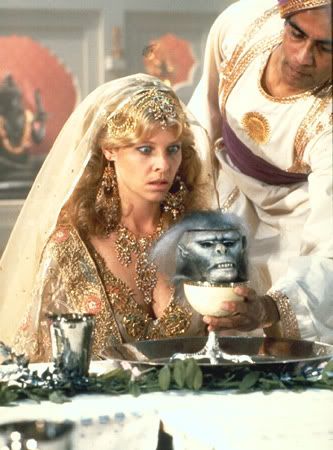
After careening down the Himalayas, they flop into a river (the Ganges?!) and are swept into a poor, starving village. The despairing villagers inform Indy that one of their Shiva lingam stones has been stolen by the dastardly residents of the nearby Pankot Palace. Indy et al. assure the villagers that they will get their lingam back. After meeting the bespectacled, Anglicized "Prime Minister" of Pankot (Roshan Seth... who else?), eating monkey brains, beetle bums and snake-filled-with-snakes, the gang gets lost in the labyrinthine palace cellars. There, they witness a thundering, blood-smeared Kali worship session, complete with human sacrifice and Amrish Puri (yay!) in a feathered headdress. They also witness child slavery, and this is clearly not gonna fly. So after a very, very long and violent denouement, Indy gets the lingam back, curses Amrish Puri in his own Hindi ("Tum vishwas karte ho!" Harrison seethes, again and again), frees the children and manages to boost the village's agricultural yields in the meantime! Who needs the World Bank and Amnesty International when you've got Indy!?

One tiny point in this film's favor on the Sensitivity Scale was the moment when Indy, Willie and Short Round are welcomed to the village. Fed some paltry curry on a banana leaf, Willie refuses because it looks gross, and Indy starts to lose his patience: "This is more than these people eat in a week. Eat it. You're offending them and embarrassing me." We've actually faced some similar situations before (minus the demonic cult bit), and it's actually a nice little moment showing the inadvertent offensive behavior people can have, especially in places of poverty.

But that moment of enlightenment feels more like an accident than anything intentional.


When we go to India, we want (1) to have Roshan Seth greet us in spectacles with "PPCC, the eminent blogger?" and (2) chilled monkey brains for desert.


So: were we really offended by Temple of Doom? Is it really so SERIOUS? Its outrageously unrealistic representation of India is about as outrageously unrealistic (and in the same, zany, mish-mash aesthetic!) as the representations of the British in masala films like Mard or Kranti. A key difference is that, with confident and optimistic American-centric machismo, Indy just wants to help these poor north Indian folk... speaking not-Hindi... in a palm-treed village... by the Himalayas. That - this fuzzy feeling of wanting to help people - is already a lot more palatable for the PPCC than the underlying anger of Mard and Kranti, which uses the real historical problem of colonialism to make a film filled with racist violence and mutual ridicule. Of course, silly, racist Hollywood films and silly, racist Hindi films will probably have different tones (optimistic vs. pessimistic racism?) given the different historical contexts. Or are we being silly and racist?!

After all this talk, we weren't really personally offended by Temple of Doom. We knew what we were getting into. Because not only is it ignorant and, well, stupid, but it's also just bad. It does itself damage by the ridiculousness of its premise and presentation - over-the-top even for Indy! - and we're pretty confident that anyone of average intelligence who is older than 12 will recognize that you can't get your ideas about the world from the Indiana Jones series. Trying to apply logic or subtlety to Indy is like trying to make cheese ice cream: it's just not gonna happen! It won't work! What's more important is: does the stupidity and racism of Temple of Doom have possibly damaging consequences in real-life? We at the PPCC don't think so - apart from feelings of annoyance, like the caricatures of Americans in Karan Johar films - we trust in people to know that Indy is not really a good guide to the world. Are we too optimistic? Are we too optimistic because we're white? Do we sound like Harrison Ford when he speaks Hindi ("Row-kow!"
he tells people when he wants them to stop)? We'll let the reader लोग decide.

Thursday, 2 April 2009

Roma città aperta (1945)

The tense, devastating Roma, città aperta (Rome, Open City) is perhaps famous for being the First Neorealist Film (*fanfare*). But does it hold up after all these years?


Well, yes. But not for its gritty realism aesthetically - there have been grittier and more documentary-esque films since then, improving on the genre it inaugured - so much as for its story filled with moral ambiguity (avant garde for films at the time?), and its contextual power. That is, while the filmmaking still carries some vestiges of pre-neorealist aesthetics (melodramatic music, a melodramatic performance by the Nazi villain), the story itself is not only completely plausible in its emotional complexity, but it also is a patchwork of real stories. Indeed, the meta of Roma, città aperta is more neorealist than its style: that is, filming began two months after Rome's liberation by the Allied Forces, many of the characters are based on real people (for example, the priest, Pietro Pellegrini, was based on real-life resistance fighter, Pietro Pappagallo) and many of the film's scenes are direct reproductions of events which took place during Rome's occupation by the Nazis. Knowing this is far more powerful than the "aesthetic" realism which director Roberto Rossellini first experimented with. To our 21st century eyes, shots of the streets of Rome aren't so impressive - though they must have been, back in the day when everything was filmed on fabricated sets. But the meta - the way the historical context informed so many aspects of the film itself - is stunning and emotionally wringing.

The story follows a small ensemble of characters who range along the moral spectrum. There's resistance leader Giorgio (Luigi Ferraris), who is currently hiding from the Gestapo in the apartment of his friends, the widowed single mother Pina (an amazing Anna Magnani), her young son, Marcello (Vino Annichiarico), and her vacuous, airhead sister, Lauretta (Carla Rovere). Also helping is Giorgio's friend and Pina's fiancee, fellow resistance fighter Francesco (Francesco Grandjacquet), as well as the secretly anti-Fascist, resistance-aiding priest, Don Pietro (Aldo Fabrizi). The Gestapo leader is the ruthless and effete Major Bergmann (Harry Feist), who is using Giorgio's ex-flame, the drug addict Marina (Maria Michi), to uncover the resistance cell. An interesting minor character is a nameless Austrian Nazi deserter (Ákos Tolnay), who is sheltered by Don Pietro.


Don Pietro (Aldo Fabrizi) and Pina (Anna Magnani).


As we said, this is a very powerful film. Powerful because (1) almost all the details are based on true events, and (2) an entire moral spectrum is presented. While Don Pietro and Major Bergmann are the polar opposites of good and evil, each purely one or the other, respectively, the rest of the characters are interestingly nebulous. And actually even Don Pietro, who is the paragon of heroic virtue, is allowed moments of humanity: anxiety, fear, doubt. Indeed, the only purely cinematic creation is the Gestapo commander, Bergmann, who is so uniformly EVIL (in capital letters) that he sticks out. Even his fellow Nazis and collaborator friends are more human - in one wringing moment, a drunken Gestapo officer cynically and scathingly criticizes the Third Reich, saying that now he gets drunk every night to forget what he does and, as he drinks, he sees more and more clearly. Painfully, this same Gestapo officer is then the chief executioner in the film's final scene. There are other interesting moments when the Austrian deserter comforts an orphaned resistance fighter.

Our copy of the DVD came with a little booklet talking about the film's significance. One of the interesting things the booklet mentioned was how this film marked a schism between the "old" censored cinema and the "new" cinema which didn't hesitate to show gruesome realities. The key scene is the torture scene when, rather than focusing only on the horrified Don Pietro's reactions to what he is forced to watch, director Rossellini cuts to the torture itself. Again, to 21st century eyes, this torture isn't much worse than a PG rating. But the significance of showing violence in order to drive home a point - in this case, the cruelty of the Third Reich - is interesting, and it made us think (again) of gratuitous violence and this year's Watchmen. Portraying gruesome, gory explosions of Vietnamese soldiers at the hands of morally ambiguous American superheroes is one (somewhat roundabout) way of criticizing American military interventions and American imperialism. But using gruesome, gory explosions just to "up the ante" of a film's "hardcore"-ness cheapens things. In particular, it seems to cheapen the whole point of what violence in cinema, as Rossellini used it, is supposed to achieve: it's poetry of witness, a condemnation of real-life cruelty. Rossellini wasn't out to shock his viewers just for the sake of it: he wanted to shock them into awareness of what the occupation of Rome had entailed, all the terrible things that had happened just a few months prior to the film!


The final, iconic shot.


The stars of the show, performance-wise, were Anna Magnani as the working class, world-weary Pina, and Aldo Fabrizi as the brave, bumbling priest Don Pietro. The Catholic Church is badly in need of a good PR campaign at the moment, and this film gives us the coolest priest since Father Mulcahy. Don Pietro provides also an inspiring reminder that not all the clergy abided by the Vatican's controversial "hear no evil, see no evil" policy during the occupation (just as Pina demonstrates that not all disempowered housewives were mindlessly Fascist). We practically cheered when Don Pietro stood his ground during the Gestapo interrogation scene:
Major Bergman: Then I'll tell you who [Giorgio the resistance fighter] is. He's subversive, he's fought with the Reds in Spain. His life is dedicated to fighting society, religion. He is an atheist... your enemy...
Don Pietro: I am a Catholic priest. I believe that those who fight for justice and truth walk in the path of God and the paths of God are infinite.

Definitely recommend this one - as an intense and intimately real portrait of life in occupied Rome, and as a moving story of human courage and human weakness.