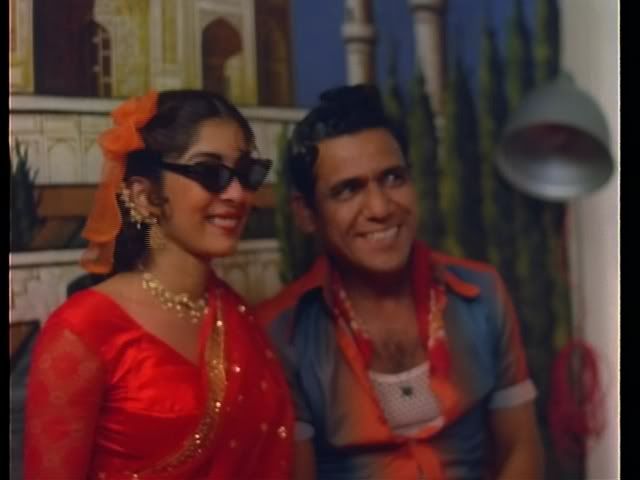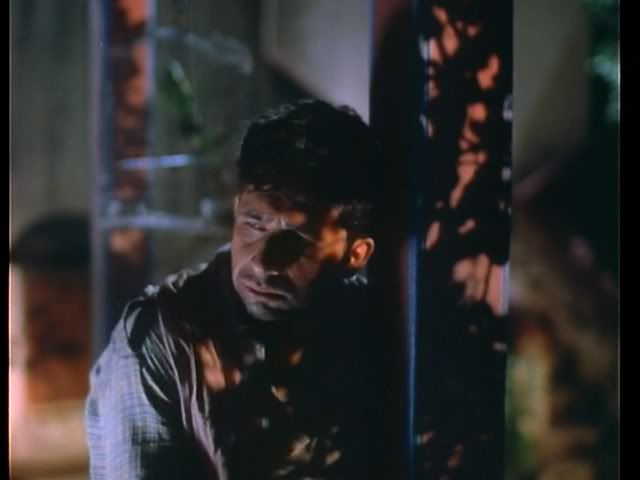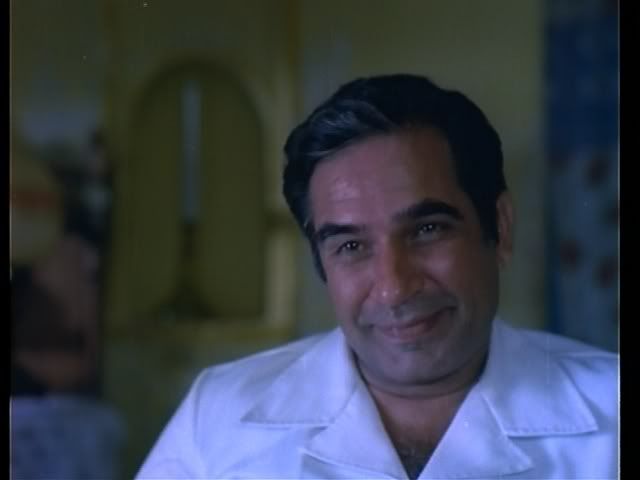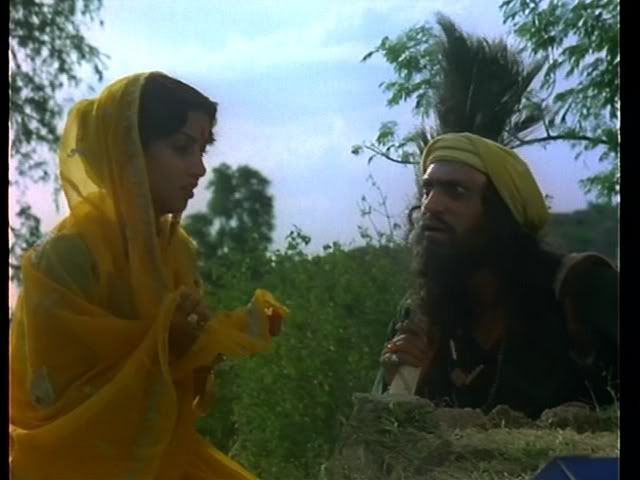
Showing posts with label smita patil. Show all posts

Sunday, 1 June 2008

Ghungroo (1983)


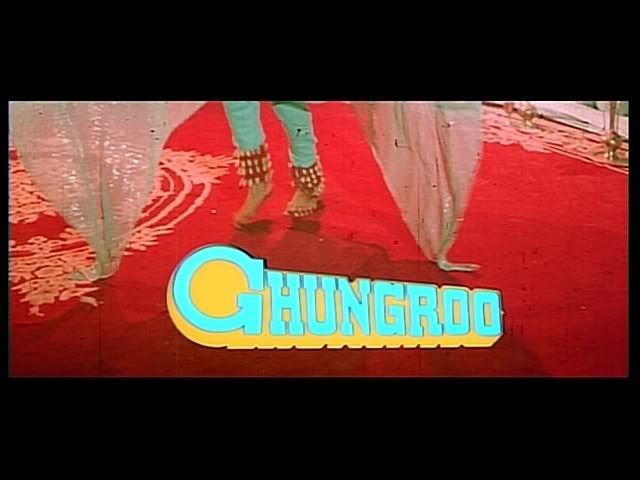
The classy, retro title.


We loved Ghungroo (Jingly Anklets; our crappy translation, here's a better one). We loved it so much. As we watched it, we kept having to periodically thrash around and grab our hair and exclaim, "I love this movie!"

It worked on many levels: from enlightened and progressive gender relations (yeah!), to pitch perfect details (yeah yeah!), to beautifully understated and poignant acting from Shashi and Smita (yeah yeah yeah!). Ever since Naseer commented that the tragedy of Shammi is that he never made a great movie, we've been looking for the "great movie" of Shashi's, as well. While it's definitely not perfect, Ghungroo is great!

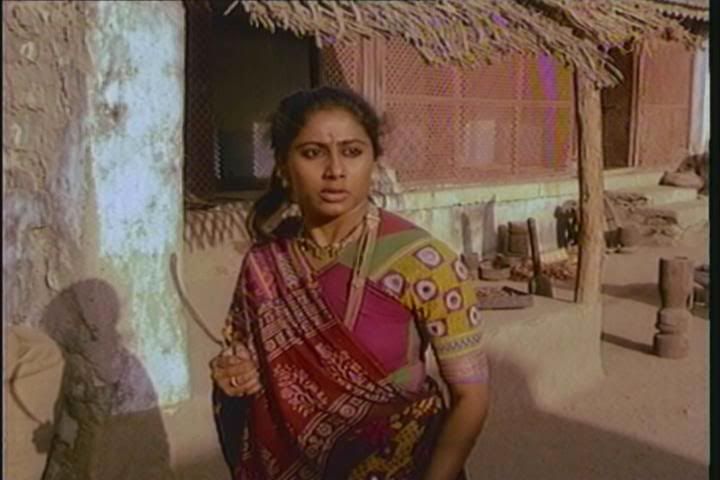
In the last years of the British Raj, the local Dewan (Chief Minister) Vikram Singh (Shashi Kapoor) stops under the window of a courtesan's parlor and admires her voice. He is hearing the voice of Kesarbai (Smita Patil), your usual, put-upon courtesan of historical Hindi movies. Think Umrao Jaan, Pakeezah, and so forth. Vikram is destined to run into Kesarbai again, when she visits the palace to perform for the young prince's birthday. She does her song and dance thing, and he is absolutely smitten, and they begin an illicit affair, wherein he promises her that he'll release her from the shackles of courtesanliness. Symbolically, he buys her ghungroo and gifts them to her. You are free now!
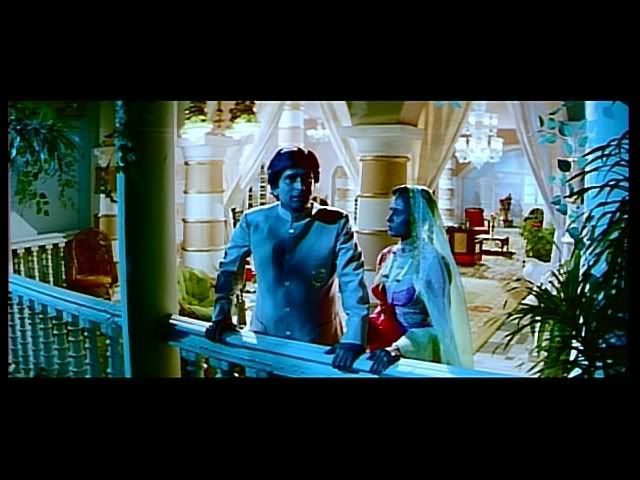

We liked the super-saturated look of this scene.
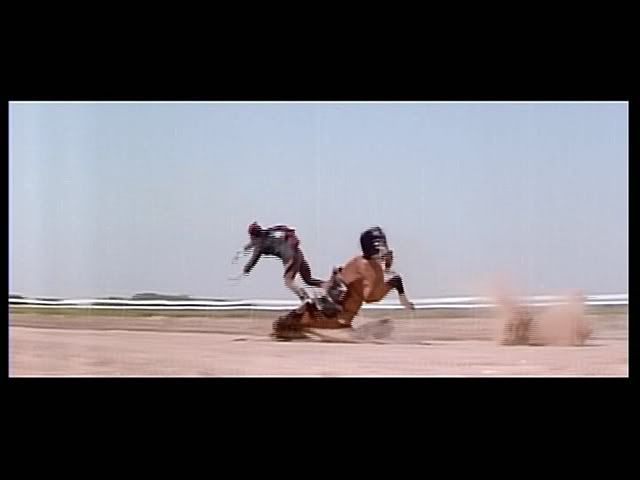

Crazy horse stuntery!


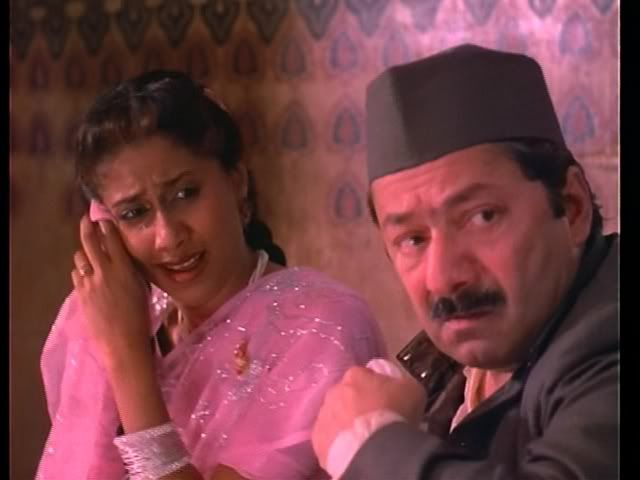
Alas, early happiness never bodes well in Hindi films, and soon enough, the evil palace uncle Virat (Ranjeet) connives to ruin their plans. When he tells the Queen Mother (Waheeda Rehman) what her Minister and the courtesan are planning, the Queen promptly marries Vikram off to the fresh-from-London Princess Priya (Padmini Kapila, wearing hideous contact lens). In one of our favorite and most painful scenes of the film, Kesarbai arrives at the palace, all ready for the engagement ceremony, only to find Vikram engaged to someone else and waiting to bind her in the ghungroo again.

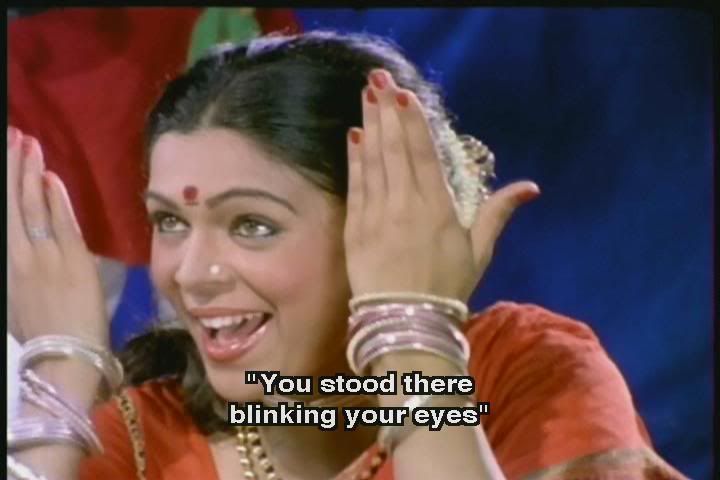
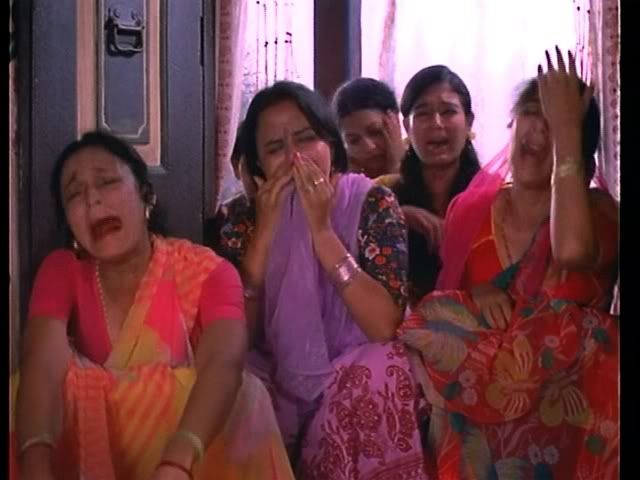
We have to pause and exclaim: this scene was lump-in-the-throat perfection! It combines some of our favorite things about Hindi cinema - the painfully beautiful courtesan's ghazal, terrible irony, and Shashi Kapoor (in pearl earrings, no less!) - and executes it all wonderfully. The underplayed, mute despair of Shashi and Smita, juxtaposed against the melodramatic music! The symbolism of the ghungroo - shackles of gendered slavery! The mirrored helplessness in Shashi's character, also bound by traditions and conservatism!

It's just so vicious and wonderful!

We love LOVED this song. You can watch it on YouTube, contextless and lacking the most excellent introduction. But at least you can see the wonderful moment when Smita shakes the ghungroo in Shashi's face - so aggressive and furious at their combined disempowerment!
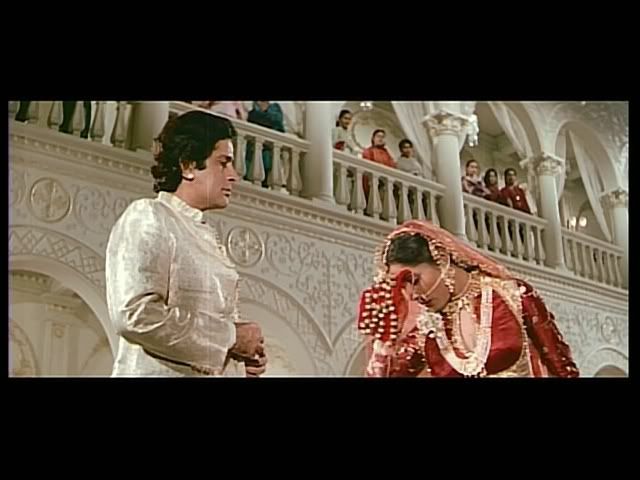

Eff you, patriarchal society. Eff frickin' you.


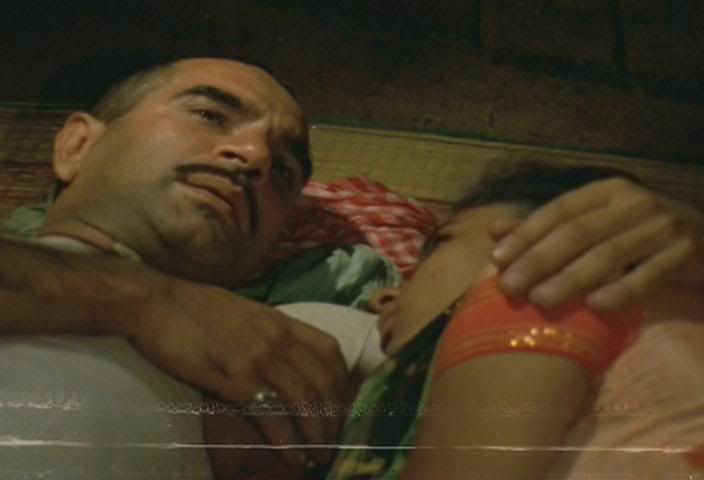
Tearing ourselves away: after Vikram is married off to Princess Contact Lens, Kesarbai gives birth to a baby girl. Her long-time admirer, the manly Suraj (Suresh Oberoi, father of Viveik), shelters her and her daughter as if they were his family. Meanwhile, Princess Contact Lens, knowing that her lovely Shashi's heart is already spoken for, takes to self-destructive drinking and driving, which leads to her death.
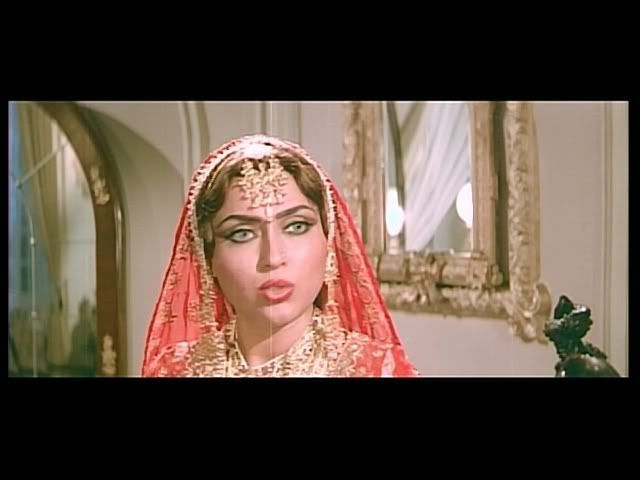

Scary Princess Contact Lens. Just look at them!
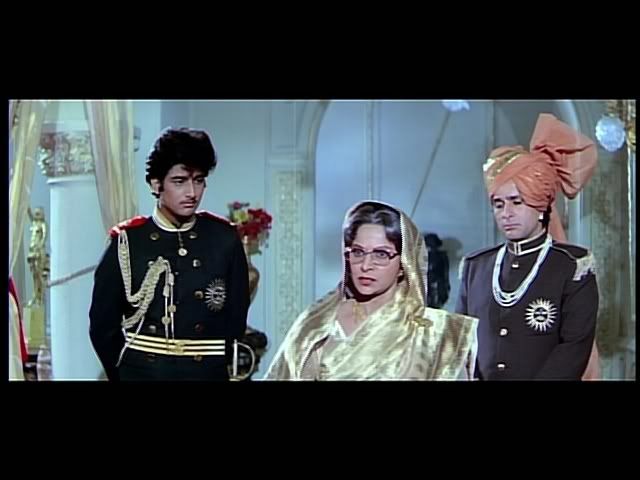

Prince Peach Fuzz reminded us a lot of Paul Atreides from David Lynch's Dune in that outfit. Fear is the mindkiller! Check out Shashi's adorable This Is My 'No Comment' Face and Waheeda's bug-eyed conservatism.


Fast forward ten or fifteen years. The young prince is now a strapping Rajkumar (Kunal Goswami), all gangly tall and peach fuzz moustache. Rajkumar is a likable, easygoing sort who doesn't see all the fuss with royal pomp and class/caste distinctions. Meanwhile, Vikram and Kesarbhai and Suraj's daughter has grown up into the plucky Renu (Komal). Renu is an ass-kicking heroine. In another one of our favorite scenes, she is on her way to college when she encounters a little girl fearfully hiding behind the bushes. The girl is hiding from a young loutish type who harasses the girls on the way to school. Renu promptly confronts him and, literally, kicks his ass. This scene is great! Shashi spots her from the royal car and quickly gets out to congratulate her on asserting her girl power. He offers to reward her with something, and she asks only for some fatherly blessings, which naturally provoked some verklempt-ness on both Shashi and the PPCC's part.
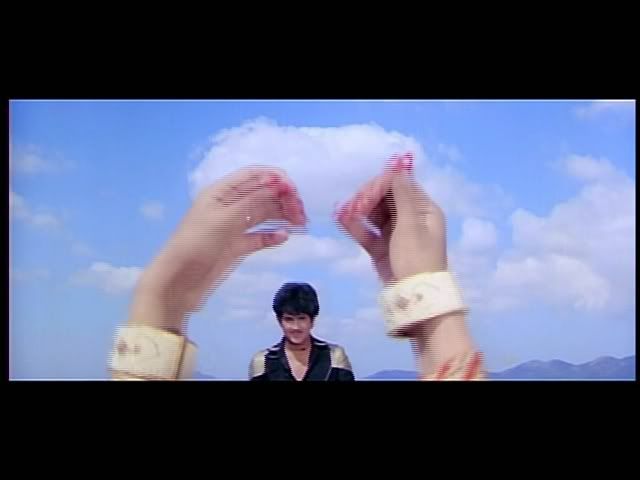

If the anklets are a symbol of female disempowerment, the bangles are a symbol of asserting modernity and independence.
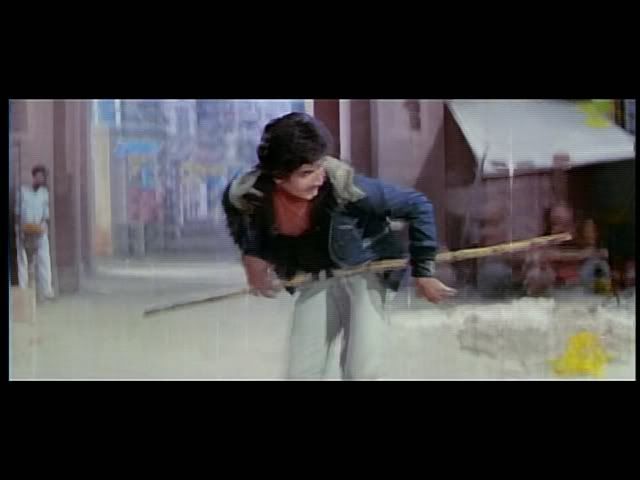

In the movie's weirdest symbolism, Rajkumar fights off some goons after sticking a rigid pole in his pants. He then literally drops it after meeting his potential father-in-law.


Anyway, as is expected, progressive and empowered Rajkumar and Renu fall in love. The rest of the film is about crashing through societal barriers, conquering obstinate traditionalism and classism, and, of course, kicking Ranjeet's butt. The second half of the film has a considerably lighter tone than the first half, but don't worry, none of the original seriousness is undermined and it's great throughout.

We liked so much about this movie. It was with great pleasure that we watched the shackled Vikram and Kesarbhai find their belated freedom in the younger generation - what a hopeful message and touching narrative structure! The overall gender relations were also fascinating and positive: the most powerful figure is a woman (the Queen Mother), and our sympathetic heroes - Vikram, Suraj and Rajkumar - constantly struggle to get those damned ghungroo off of Kesarbhai! In the end, even caste-ism/classism is targeted, and Rajkumar (literally) opens the palace doors to the proletarian masses and ushers in a more democratic form of government.

In terms of performances, Smita and Shashi really make this film. Their scenes together underline the entire narrative with emotional investment and believability - you want them to be happy, and you suffer when they do. Although the younger couple - Kunal Goswami and Komal - are likable, Smita and Shashi are incredible. Smita's best scene, we think, is all that surrounding Tohfa Qabool Hai. It's the only time in the film when we see her carefully concealed anger and hurt, and it's so powerful! OMG we felt so horrible for her as well in this scene - all dressed up for the wedding and ready to go. We've watched the scene repeatedly, and every single time we get verklempt when she puts the ghungroo back on.

Shashi - who normally gets relegated to super-objectified "fine, plastic doll" status at the PPCC - earned our respect big time in this role. It was interesting to see him playing his usual bourgeoise icon, and yet be visibly so disempowered. He was wonderfully subtle - such as when he was in the background, visibly muffling a smile at something the Rajkumar would say - but his best scene, most definitely, was the long-awaited Reunion Scene. We listed the Best Reunion Scenes in our review of Salaakhen, but Smita and Shashi's reunion in Ghungroo might be topping the list at #1 or #2.
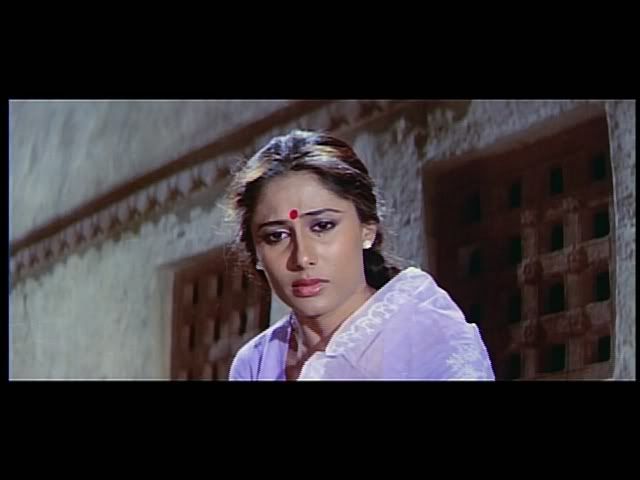

Getting verklempt again! Middle-aged love is so touching, and so rarely explored. "Let Rome in Tiber melt, and the wide arch of the ranged empire fall! Here is my space. Kingdoms are clay." - appropriate for this film, wethinks.
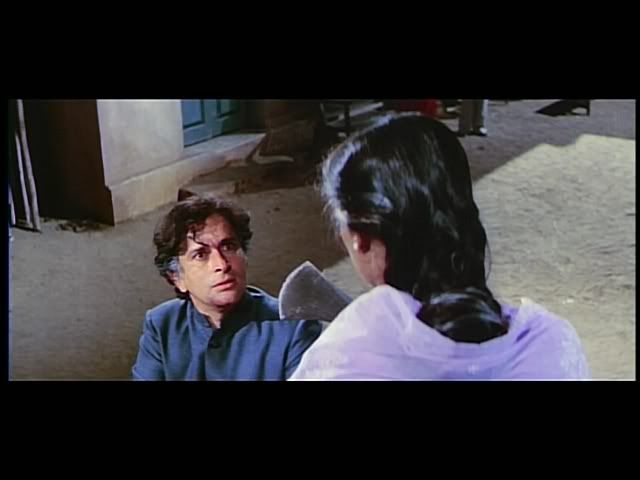

We didn't think Shashi could improve on his fab ability to register shock. But he did. Oh yes. He definitely did.


We smiled when we saw the IMDb ratings for Ghungroo - apparently it's a big hit among women. That might be expected, given that it's a pro-feminist (FINALLY) parable using a historical romance framework. If any of you PPCCers out there have seen this, we'd love to discuss this further as we really could go on and on and on...!

Monday, 22 October 2007

Namak Halaal (1982)

If anything defined 1970s Bollywood, it was the Amitabh-Shashi masala vehicle. Two brothers, lots of misunderstandings, big bellbottoms, shirts that open all the way down to the navel, and a little dishoom dishoom. Namak Halaal (Loyalty) is superficially such a film, but a parody of one. It's as if the stars of the 70s decided to go out in a blaze of glory before the evil vacuum of the 1980s fully consumed them. And we at the PPCC have been mega pumped to see it, ever since reading BollyBob's excellent review wherein it's described as a massive LSD trip.

While we at the PPCC are quiet, sober types, maybe getting blitzed during this would actually be a good idea (Shashi certainly spends most of the time in a bottle). But actually, you don't even need to. As BollyBob says, Namak Halaal is a trip in itself. It's like those dreams you have after eating cheese that's gone off. It doesn't quite make sense. Scenes skip and jump around, with narry a logical step to be seen. Sometimes the dialogue makes you do a double-take, especially when (as BollyBob note) characters answer questions by talking about something else. People appear on other people's chests, or floating in the sky. Characters disguise themselves for no reason. Amitabh talks to a fly and dreams of his grandfather while humping (YES HE WAS HUMPING) a pillow. What the hell is going on?!


Ring, ring. Hello? I want to kill you. I will kill you!


The plot has the standard masala ingredients (quasi-brothers, misunderstandings, bellbottoms, shirts and dishoom), except this time around, Amitabh plays Arjun, the dim-witted man-child who becomes the loyal servant to Raja (Shashi Kapoor), a boozy, snobbish hotel owner who is the target of numerous assassination attempts. BollyBob likens Amitabh and Shashi to Bugs Bunny and Porky Pig, and there's certainly an element of truth in that. Amitabh is so slapstick and elastic-faced that all he needs is a pair of floppy ears. And Shashi... well, the poor dear was gaining weight at a rapid rate in the early 80s. Add to that the photo of a 1970s in-his-prime Shashi that we are often subjected to during the film (everyone seems to have a copy on their wall, which is understandable), and Raja does acquire a sort of has-been, beer gut quality. Oh dear.

Anyway, everyone shows up at some point. Narang from Don. Om Prakash, beloved by the PPCC since Aa Gale Lag Jaa. That kooky toothy guy from Muqaddar Ka Sikandar, which we've seen but keep forgetting to review. What was his name? Oh, Ram P. Sethi. Even Smita Patil, for the love of God. We know Shabana and Tabu have slummed it around in Bollywood before, but Smita? SMITA?! What the hell is going on!?!


Amitabh's famous Engrish scene.


Yes, this is a movie to make you question a lot of things. Mostly reality. And then everyone's sanity or sobriety. It's a comedy, and some moments are funny, but many moments are just bizarre. For this reason, there is a certain amount of perverse delight in watching it. What could possibly happen next? Aliens? Time travel? Hey, why don't we have a fight on skis. Yeah. Some moments which were intended to be funny are genuinely funny; for example, when Amitabh convinces a bunch of businessmen that they must imitate Shashi's every move. Or when Amitabh nonchalantly picks up a woman, turns her upside down, and shakes out some stolen cash. Or when a drunken Shashi slurs and squeaks to the femme fatale meant to kill him in a pretty pitiable attempt at flirting. Or when Amitabh does the robot to some synthesizer techno (we kid you not). Some moments - mostly during the songs - are even sublime.


This is the robot song. Wait for it... wait for it...


In fact, the music deserves a separate paragraph. All the songs in this film are really great. Seasoned PPCC readers will recognize the wonderful Aaj Rapat Jaye To, for which Amitabh recently won the Dance Off (!!). Indeed, except for that one song with the scuba diving assassins, the PPCC loved every song as soon as we heard it. Our personal favorite was Amitabh's faux drunken song, Thodisi Jo Pee Lee Hai, which unfortunately has no YouTube vid but you can listen to it on Dishant.

Wednesday, 16 May 2007

Mandi (1983)

First, we really must share: when we took the rental copy of this movie with us, we stood in our door and sniffed. Something smells naff, we thought. Is it us? We smelled ourselves, and found no such stench. We smelled our clothes, our shoes, various dark corners of our room. Nothing. But there was certainly something which reeked. It was with alarm that we realized it was the DVD case which stank of human sweat. Buzzuh? How sweaty do you have to be to leave your stench on plastic? Unfathomable.

Anyway.


Don't sweat on my DVD!


It's time for some parallel cinema! We decided to watch Shyam Benegal's Mandi, which literally stars everyone and their mom: Naseer, Shabana, Om, Amrish, Smita, Kulbushan, Saeed Jaffrey and even the guy who played Don Abbaji from Maqbool.

Mandi tells the story of a brothel and all the various people who frequent and work there. Shabana Azmi plays Madame Rukhmini, queen mother of the courtesans. She is the center of the story around which the other characters rotate. There is the youngest prostitute and Madame's darling, Zeenat (Smita Patil), loved and envied by the other girls, who falls in love with a noted politician's (Saeed Jaffrey) son. There is the sleazy yet likable photographer (Om Puri) who finds every opportunity to snap a dirty picture. There is Phoolmani (Sreela Majumdar), the latest acquisition and a deaf-mute, and then there is Tungrus (Naseeruddin Shah), the brothel's resident bitch, who also says nothing during the day but then gets plastered at night and screams at the stars. And yea, all is well in the world.


The sleazy photographer and his prostitute girlfriend. Sometimes things are out of focus.


Naseer doing what he does best.


Enter Mr. Gupta (Kulbushan Kharbanda), who has recently bought the property on which the brothel resides. He seems friendly enough, even dashing. But there is trouble a-brewin'. Trouble in the form of social workers (damn social workers) who, parading under the banner of morality, declare that the brothel must be destroyed. Brothello delenda est! But no, the girls cry, this is our livelihood. Clearly the social workers don't care, the damn hypocrites. Better starving in the street than selling your bodies for money.


A surprisingly handsome young Kulbushan Kharbanda.


Mr. Gupta ji has a plan though. He sells some land out in the middle of the boondocks to the girls. They are sad, but something's better than nothing and off they go. Once there, Madame Rukhmini meets a hairy yeti-like Amrish Puri (are you loving this movie yet? I am) who tells her she is standing RIGHT on the grave of a famous saint! Pray to him! Pray to him! Madame Rukhmini prays for riches, and soon, lo, the town moves out to the boondocks to be closer to the brothel. The social workers are frazzled. The brothel thrives.


Shabana and Amrish! Praying for cash.


In keeping with the style of the Parallel Indian Cinema of the 1970s and 1980s, this movie is as gritty and real as mainstream Bollywood is overblown. It combines the moral vacuum, vignetty feel of the excellent Chakra with the topics of Umrao Jaan (and Naseer as a brothel slave, again). Although it's technically billed as a comedy, it's a bit more balanced: on the one hand, a smirking satire of self-congratulatory morality (the social workers are pretty despicable); on the other, just a meat-and-potatoes glimpse into the lives of these people.


Smita and Saeed! All our favorites are in this!


Everyone is, of course, excellent - this movie's like a showcase of The Best, and we highly recommend it as an introduction to Indian art cinema. Shabana Azmi is wonderful as the domineering, melodramatic Madame, while Smita Patil convinces as her naive, adopted daughter. If we have a criticism, it's that they're a bit too close in age to be playing such a relationship, so the behavioral differences seem a bit exaggerated to make up for it. The men are great as well: Naseeruddin Shah playing on his strengths of emotional vulnerability and, in this case, likable idiocy, while Om Puri preens and struts in the kind of role he rarely gets. The rest of the usual suspects - Amrish Puri as the mendicant, Kulbushan Kharbanda as Mr. Gupta, Saeed Jaffrey as the sleazy politician - are great fun, though peripheral. Aditya Bhattacharya, who played the young lover of Zeenat, was notable.

Tuesday, 27 March 2007

Chakra (1981)

OH MY GOD. FINALLY. A New Wave 'artistic' Indian film that is actually... artistic! Hang on to your hats and socks for this one, because the first scene is guaranteed to blow them off in a wild ride of viewing pleasure.


Socks: blown off! Look at that imagery!


And that!


Chakra (literally, vicious circle, though the development economist in me could not help but think poverty trap) is the story of a shantytown slum somewhere near the highway leading into Bombay. As the movie begins, Amma (Smita Patil) remembers her days of idyllic rural bliss, back when she lived in a village with her husband and son. Bliss that was shattered by a rape, a killing, and exile to the big, dirty city. Soon after arriving in Bombay, her husband was killed and she was left to fend for herself and her son, Benva. Years pass. Benva grows up into a wiry Ranjit Choudhary, an indolent youth who sits around picking his nose in the sun. Like all movies about poverty, Amma dreams of getting out of the slum and taking Benva with her. She wants him to get a good job, get married, stay safe... but Benva is unfortunately bedazzled by the glamour of the local pimpmaster, Looka (Naseeruddin Shah). As the father figure, Looka instructs Benva in such helpful life lessons as 'unemployment is just another type of freedom' and 'bros before hos'.

The film has a fairly loose story structure. Time speeds up and slows down, and we get vignettes of life in the slum. The various characters are all presented believably, and all is sweat-stained, crusty, and wretched. Les miserables indeed! This film makes other movies about poverty look positively plastic. There is no romanticism here, nor any explanations, excuses or grand philosophical statements. In a way, it felt like those excellent books I read in high school English class: Black Boy, A Tree Grows in Brooklyn. Books where the hardness of life, the discrimination, was presented in such detail that you were inevitably sucked in. You lived it, man.


Punk-ass Benva.


The director, Rabindra Dharmaraj, unfortunately died before this film was even released. This adds a sort of Jeff Buckley-esque mystique to him: if he made this on his first try, what would his next movies have been like? I imagine they would have been excellent. The cinematography of Chakra is amazing, leagues beyond anything else coming out of the parallel cinema during that time. He has wonderful wide shots of the train tracks next to the slum, the bustling alleys of Bombay. He wasn't afraid to pull in very close to the actors either; I particularly enjoyed the nighttime scene when Amma, Benva and Looka have dinner in the gloom.


My milkshake brings all the boys to the yard.


And they're like, "It's better than yours." Hey, another Monsoon Wedding alum! (Kulbhushan Kharbanda)


As Amma, Smita Patil is excellent. She offers no prettiness to her role, instead presenting Amma with a hardened, swaggering confidence. This woman's life is clearly difficult, but never once does Patil succumb to the all-too-easy 'tearful heart of gold' routine. Instead, she brings all the boys to the yard (damn right), playing them for what they have, and meanwhile tries to juggle everything else: getting Benva a bride, avoiding the police, just surviving. Her shields are always up, so it's a surprise to see those glimmers of genuine love for her Truck Driver Lover (yes, that's his name). Sigh. He is such a nice guy.

Ranjit Choudhary, who looks familiar but we don't know why, is fabulous as Benva. All nervous energy and spindly arms and legs, he is an explosive young man wavering dangerously close to making the wrong choices. Never is he simplified into the Loving Son or Angry Young Man, though we see flashes of both and everything.

Naseer improves as the film progresses. Looka's beginnings as the exuberant, slightly off-kilter alpha male felt a bit forced, but after his syphillitic fall from grace, Naseer cuts loose on that lovely emotional depth we PPCCers are so fond of. Maybe we at the PPCC seek out too much symbolism, but are we wrong in thinking of untreated STDs as the poverty that eats away at my face?


The face of syphillis. The face of poverty.


All in all, excellent. We have found our Archetypal Parallel Cinema Movie, the one we'll show to friends when they go, "What is this alternative Indian cinema you speak of?"

Friday, 16 March 2007

Mirch Masala (1985)

I regret ever saying I wanted a stark moral dichotomy.


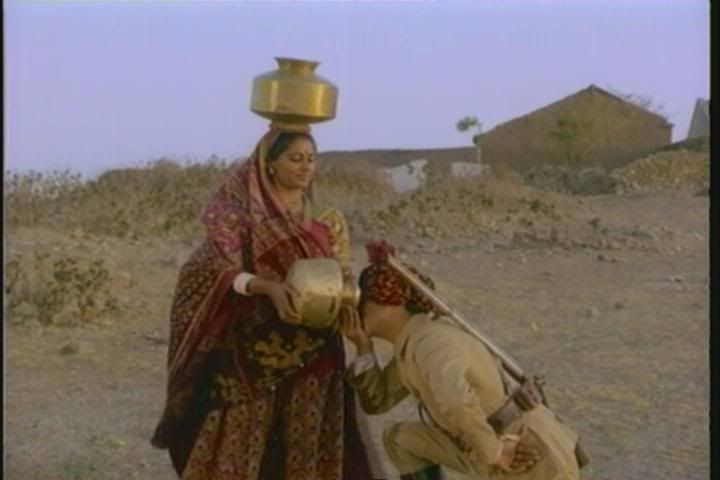
Ooh, I drink from your jug, so kinky.


I found Mirch Masala sitting in a discount bin at the local South Asian DVD shop. Naseeruddin Shah's angry face looked out over Smita Patil's windblown shoulder. The movie looked lonely. It looked like it needed a home. And was I going to get fussy over a discount DVD with Shah on the cover? Certainly not. So I bought it.


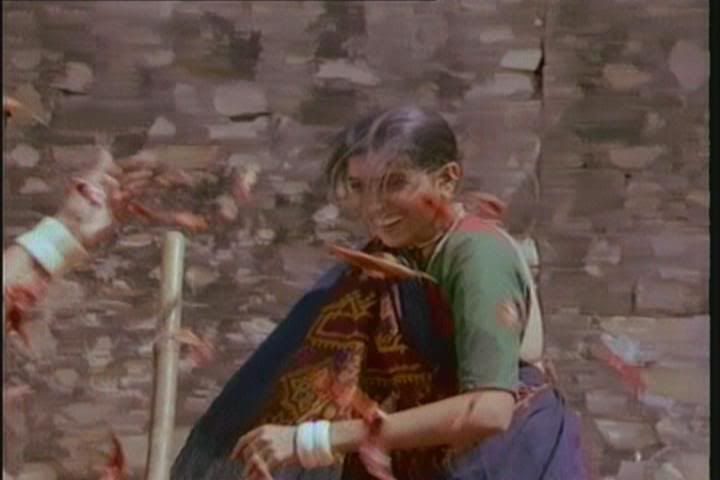
Chili fight! Somewhat kinky.


But sometimes I regret not having any standards when it comes to Naseeruddin Shah or Om Puri. I'll watch anything that has both of them in it. Plus, I had heard good things about Mirch Masala. I had even heard it called "the best Indian movie ever made." BEST Indian movie EVER made? My God. Surely, I had to watch it.


Keenkee? I keel yew wiz my scyze. Shi-ing!


And surely, whoever said it was the best Indian movie ever was either on crack or has never seen another Indian movie. Because Mirch Masala is bad, my friends. Even with the Parallel Powerhouses like Naseer, Om and Smita. Even with the Hero Hiralal director. Even with a great plot. It is just bad. It was painful to watch.


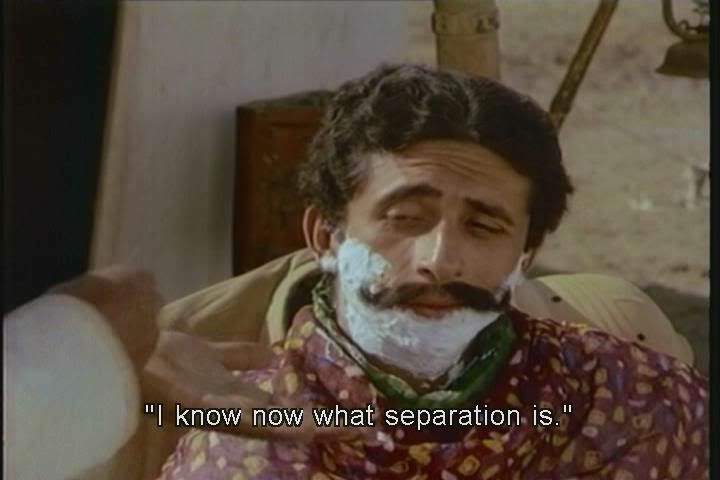
He-ey, shaving cream. Kinky.


What happened?! God knows, the story had promise enough: 1920s rural India, Sonbai's (Smita Patil) husband has just gone prancing off to work for the "railroads" in the "city". Meanwhile, the evil tax man (Naseeruddin Shah) comes galloping into town, demanding all the money and women that ye have, arrr! Tax Man takes a particular liking to Sonbai after drinking out of her brass jug (insert your own joke here), and he subsequently demands her services. Sonbai slaps Tax Man, and escapes into the chili factory. Abu the Guard (Om Puri) closes the factory gates and the chili women fuss over Sonbai. The town goes into lockdown. Tax Man says that if he doesn't get Sonbai by nightfall, he'll burn the village to the ground, roar. (Presumably taxing them first.) The village chief, wearing too-large shoes, tries to reason with the Tax Man but fails. The men of the village try to grow spines but also fail. Soon everyone is at the chili factory doors, demanding that Sonbai just come out and face the inevitable rape. Sonbai prepares her scythe for battle, and meanwhile the Tax Man's troops beat down the doors...

Well, I won't tell you how it ends, though chili powder is involved.

How did a movie with so much promise - great plot, great setting, great actors - implode into a vacuum of badness? Perhaps it was the painfully simplistic moral dichotomy: men are spineless creatures beating down on their noble, intelligent, brave wives. So much for subtlety!

Perhaps it was, and I hate to say this, Naseer's fault. Smita Patil and Om Puri (despite the Aging Troll look) performed up to par - indeed it was refreshing to hear Om just lay the moral smackdown from time to time - but Naseer, on whose shoulders the movie's believability inevitably sat, decided to play Tax Man like some maudlin silent film villain. He even twirled his black moustache while hatching evil plots! Why, Naseer, why?!


Someone uses rollers in his beard. Not kinky.


We at the PPCC have decided to pen a letter to Naseer in an effort to rectify the situation.
PPCC Headquarters,
Blogspot.com
Internet

Dear Mister Shah,

What were you thinking?! Please tell us they made you do it. We want to love you, but you make it difficult sometimes.

Sincerely, your biggest fans,

the PPCC.

Or perhaps it wasn't Naseer's fault (he is infallible, after all), and perhaps it was just a series of tiny mistakes which ate away at the movie's quality, like ants eating away at a delicious picnic.

Perhaps, perhaps, perhaps...

Suffice to say that the most fun we had with this movie was finding ways to say "kinky" in all the picture captions of this review.


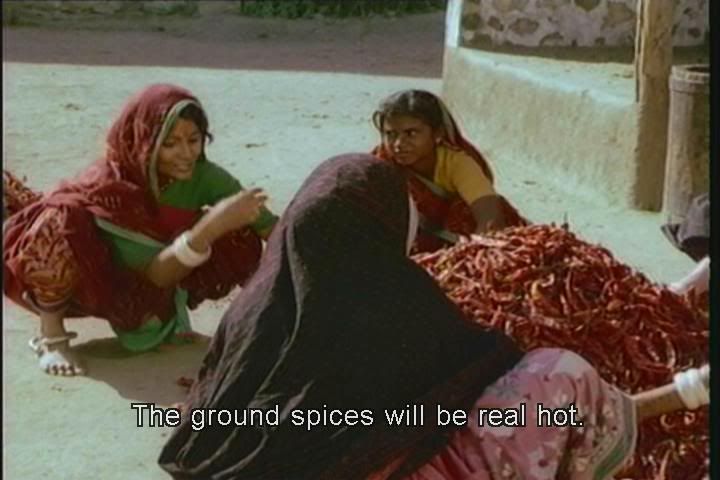
All the women in the movie wear red, like the chilis they pound into dust. Is this some sort of kinky metaphor for women being hot and spicy little chilis pounded down by patriarchal society? We at the PPCC sincerely hope not.

Saturday, 10 March 2007

Aakrosh (1980)

To inaugurate this illustrious project, we choose Aakrosh (1980). Why Aakrosh? Because we at the PPCC are just smitten with the New Wave Indian movie scene at the moment - Naseeruddin Shah and Om Puri in particular - and why pretend not to be?


Two days ago, my mailbox had a package in it. I smiled like an idiot for the rest of the day: Aakrosh and Masoom had arrived!

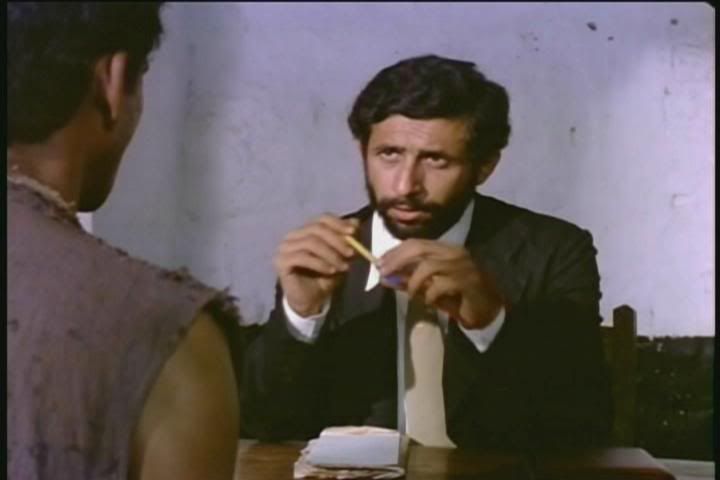
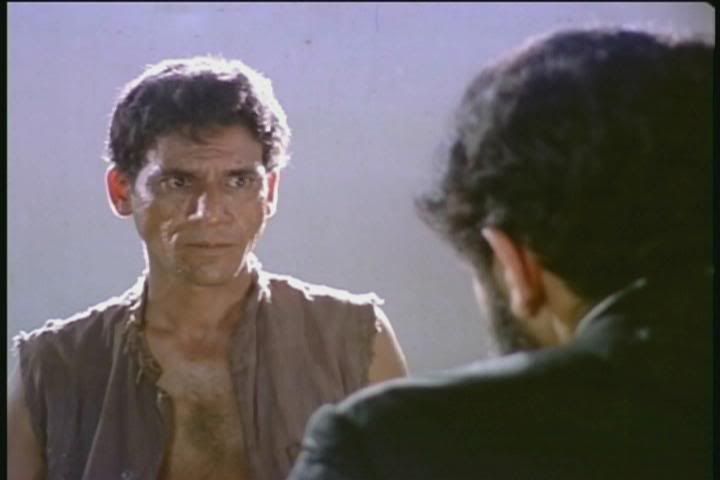
Aakrosh is a legal drama set in a tiny village somewhere in rural India. A young and Shah-froed Naseeruddin Shah plays the idealistic pup of a lawyer, Bhaskar Kulkarni, all bright eyes and bushy tail and ready to fight for justice, yes, well, maybe. Amrish Puri, whom Western audiences will remember as the cult leader bellowing "KALI-MAAAAAA!" in that punk-ass Orientalist gob, plays his mentor and father figure, Dosani. Om Puri, who would have the most awesome cameo in Gandhi two years later, is Lahanya, the downtrodden Untouchable accused of murdering his wife. The movie plays on the ambiguity of whether Lahanya actually killed his wife. Meanwhile, we watch Shah-fro huff as he bicycles up and down mountains in his quest for the Truth, while Amrish Puri plays bridge with Brahmin cronies.


This is the Shah-fro. ALL HAIL SHAH-FRO.


The Strangely Attractive Om Puri doing what he does best: sucking you in with his eyes!


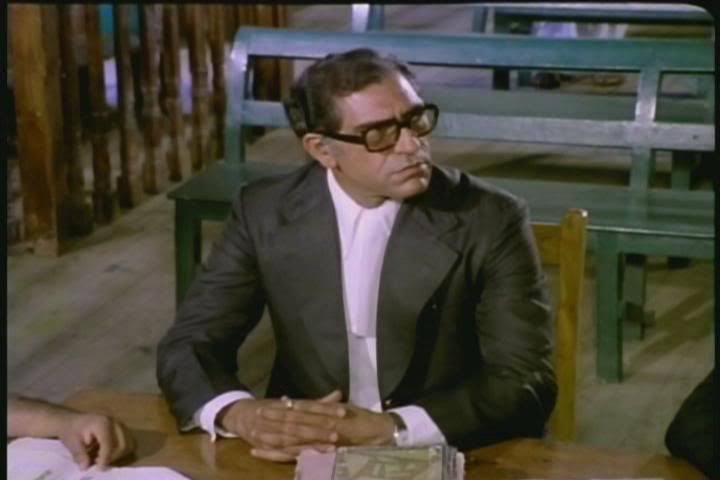
Amrish Puri thinks you're all fools. He also plays the baritone Dosani.


The ending is fabulous, in that it's sudden, unexpected and leaves you thinking. And just when you thought you had the movie all figured out - honor killings, the blight of the caste system - the real ambiguity dawns on you. I won't spoil it for you, dear readers, but let's just say, our squirrelly lawyer-hero seems seriously misguided. Oh, Bhaskar, you just can't handle the truth!


The only proper 'Bollywood number', skillfuly juxtaposed against the generally depressing plotline.


The context of the film was the so-called New Wave, or Parallel, Cinema of the 1980s in India. Naseeruddin Shah and Om Puri featured prominently in this stuff, and it was known to break the usual Bollywood mould by dealing with more serious, controversial subjects. It was arthouse, it was intelligentsia, yeah, baby, yeah!


Sad-fro.


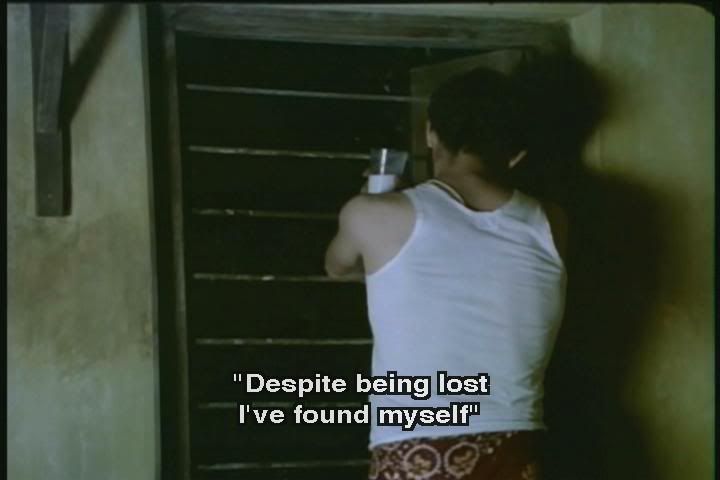
He drinks milk and listens to sad music on the radio. I liked this scene.

The film is very nicely directed, if you can look past the ancient AV quality. It's directed a bit like a horror film: very quiet, very tense, with lots of strange glances from random extras. The actors play their roles with a real subtlety and depth; you're never quite sure what to think, and what to think they think. Naseer's Bhaskar, for example, largely begins as the stereotypical Idealistic Young Lawyer that we've all seen in John Grisham dramas... but what makes him also fascinating is the slight twinge of paranoia they give him, the overall ignorance, the brief flashes of cowardice (he's a bit of a lump when they knife him, oh you silly Bhaskar) which contrast so sharply with the (doomed!) courage.

Om Puri, who has maybe three lines in the whole film (the last one being a fabulous roar) lets his face, and particularly eyes, do the talking. If you've ever seen Om Puri in anything else, he's in top form here. Lots of moments that make you go, "What? What is it, Om?! Say something! Oh my God, I can't handle the tension anymore!!" Also, the tiny vest... kinda sexy.

Amrish Puri has a flatter role, as ambiguous as the others but without too much room for sympathy from the audience. We never quite learn how dirty his hands were, nor do we really care. He is also less sexy in this than he was in Tridev (what? I liked the mullet).


The guy who played the judge looked remarkably like Amartya Sen.