Showing posts with label the trendy indie. Show all posts

Saturday, 14 August 2010

Scott Pilgrim vs. the World (2010)


Transferring a beloved graphic novel to the screen can work, or not work, or sort of work, or whatever. Uh, stuff. And Scott Pilgrim, and all his six volumes, is well-beloved by the PPCC. We don't remember how he came into our life, but one day, he was there, and we were in love. Scott Pilgrim!

A lot of people love Scott Pilgrim, actually, and his Canadian exploits full of indie bands and Mortal Kombat and the archetype of the 20something quarter-life-crisis-ing slacker. Such as Brianosaurus or the director of Scott Pilgrim vs. the World, Edgar Wright. Wright's well known to us as the director of the Simon Pegg (another SP!) classics, Hot Fuzz and Shaun of the Dead, though the style he uses in Scott retains only the deadpan portrait shots and super-rapid cuts of his previous hits. The rest of Scott Pilgrim's aesthetic is very much... Scott Pilgrim. That is, the Bryan Lee O'Malley graphic novel version of Scott: pixelated, 8-bit, abstract, absurd and very ADHD.

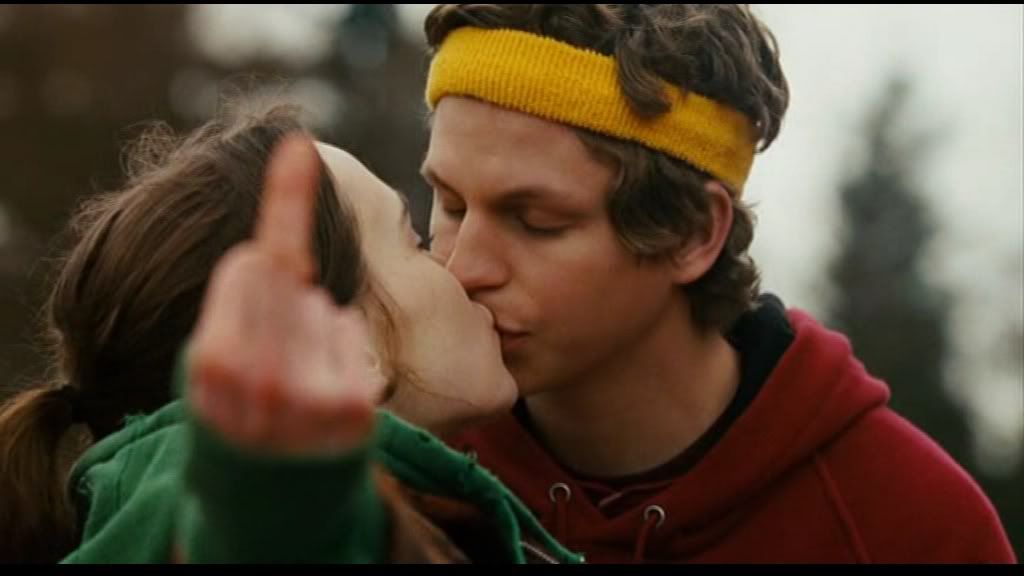
The story: Scott Pilgrim (Michael Cera) is a 20something slacker, going nowhere. He lives in a basement flat in Toronto with his gay roommate, Wallace Wells (a glorious Kieran Culkin). Scott's dating a 17-year-old Chinese Catholic school girl, Knives Chau (Ellen Wong), who, after hearing Scott jam with his stereotypically bad-in-a-charming-way band, Sex Bob-Omb, gets sparkles in her eyes and falls in love. Meanwhile, Scott's starts falling for a rollerskating American girl with kaleidoscope eyes hair, Ramona Flowers (Mary Elizabeth Winstead).

What begins as a standard adolescent love triangle soon becomes a multi-level Nintendo game: Scott must defeat each of Ramona's seven evil exes in order to continue dating Ramona. These battles are much like scenes from Mortal Kombat or Naruto: defeated exes explode into jingling coins, the soundtrack is 8-bit techno, and opponents mostly power up, run really fast towards each other, and then explode away from each in melodramatically slow motion while a bass-voiced narrator bellows, "K.O.!" And it's all a clever parable for the emotional baggage we bring to relationships blah blah blah. OK, we actually read that somewhere else, but it makes sense so we're repeating it.

For the most part, the film is a super-faithful reproduction of the graphic novel: scenes exactly mimic frames, the narrated "SO ANYWAY..."s float above the actors, pages from the actual comic book are used in the flashbacks, and sounds are often emphasized with floating closed-captioning ("RIIIIIIING"). For this reason, for a lover of the graphic novel, the movie just feels rushed, superficial and unoriginal. The only novel ideas which the movie can provide are: (1) Broken Social Scene provides the music for Sex Bob-Omb, and that's great, and (2) the climactic final duel with Gideon (Jason Schwartzman), the Big Evil Ex, turns very annoyingly, boringly Hollywood, and that sucks. This is kind of a shame. A new medium (movies) could have built up some cool stuff, if only Edgar Wright had been a bit less slavish to Bryan Lee O'Malley and the Standard Hollywood Narrative and had branched out a bit more. It's a very conventional take on a story which broke, and teased, conventions.

That said, this movie is also pretty much required viewing for hip, young 20somethings suffering their own quarter life crises, as seen through the prism of Super Mario Bros. The graphic novel is hilarious, and, if you've never read it, the movie will probably be eye-popping and very funny (did we mention it's very funny? thank Kieran Culkin and the vegan police for that). So watch it! Read it!

Friday, 25 June 2010

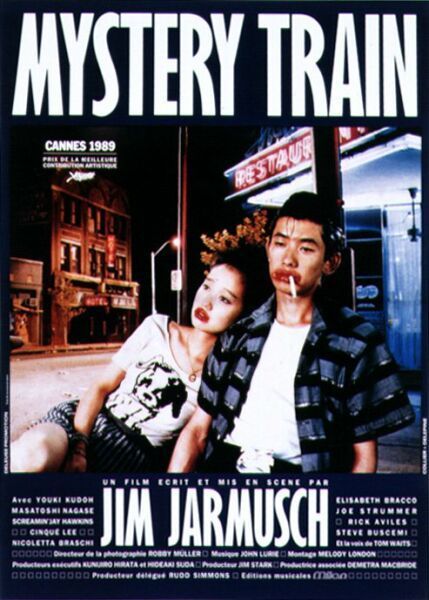
Mystery Train (1991)


Guest blogger Brianosaurus returns with another wacky tale, this time set in Memphis.

Jim Jarmusch has been making indie movies since 1980. That’s at least 15 years before it was cool. In fact, ‘indie’ is the only kind of movie he makes. And he’s damn good at it.

His moody films have a melodramatic, meandering pace. The sets are usually broken-down bits of America inhabited by broken-down bits of people just passing through. We usually only get to see a glimpse of the character’s personalities. Their dialogue is that cracked conversation old friends have on long trips: Lots of looking out the window. Friendly silence. Most directors would run from such long, silent, nothings of a scene. Certainly most studios would! That’s were Jarmusch’s success is born. By working outside major studios for his entire career, he has developed a candor in his storytelling that is unique and yet intimately familiar to us all; it’s just the way we are.

Mystery Train is slightly less bleak than Jarmusch’s other efforts. Set in Memphis, Tennessee, this story follows the unrelated yet intertwined journey of three groups of people. Although these stories are slightly more sequential than, say, Pulp Fiction, you could take that film as a reference. All three of his stories center on an old, seedy hotel in the bad part of Memphis. Most of the story takes place late at night, when "normal" people are in their homes. It’s when the rest of the city, the seedy side, is awake.

The first act, Far From Yokohama, follows two young Japanese lovers on a quest to see Elvis’ home, Graceland, and Sun Studios, where many of the great blues legends made their first recordings.


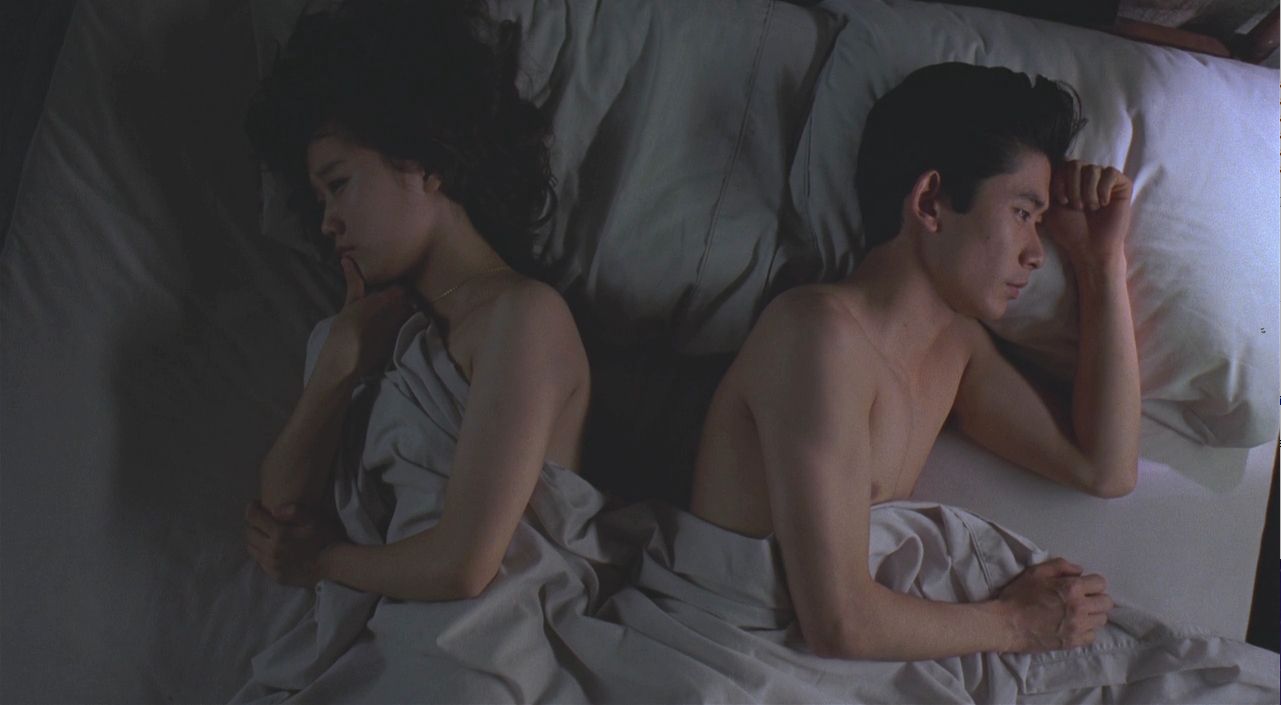
Endlessly happy Mitzuko and her boyfriend, the tiresome stoic, Jun.


Our Japanese travelers, Jun (Masatoshi Nagase) and Mitsuko (Youki Kudoh), can’t seem to agree on anything; what to see first (Sun Studios or Graceland), who’s the best musician (Carl Perkins or Elvis Presley), etc. Despite their differences, it’s Jarmusch’s direction that makes them feel so close to each other, and us so close to them. It’s in the way they walk, sharing the load of their suitcase, keeping step with each other perfectly. The way they work together in simple things like closing the suitcase. It’s in the things unsaid. These two are a pair, no doubt about it. After a quick tour of Sun Studios, they end up at Arcade Hotel, where the film is centered.

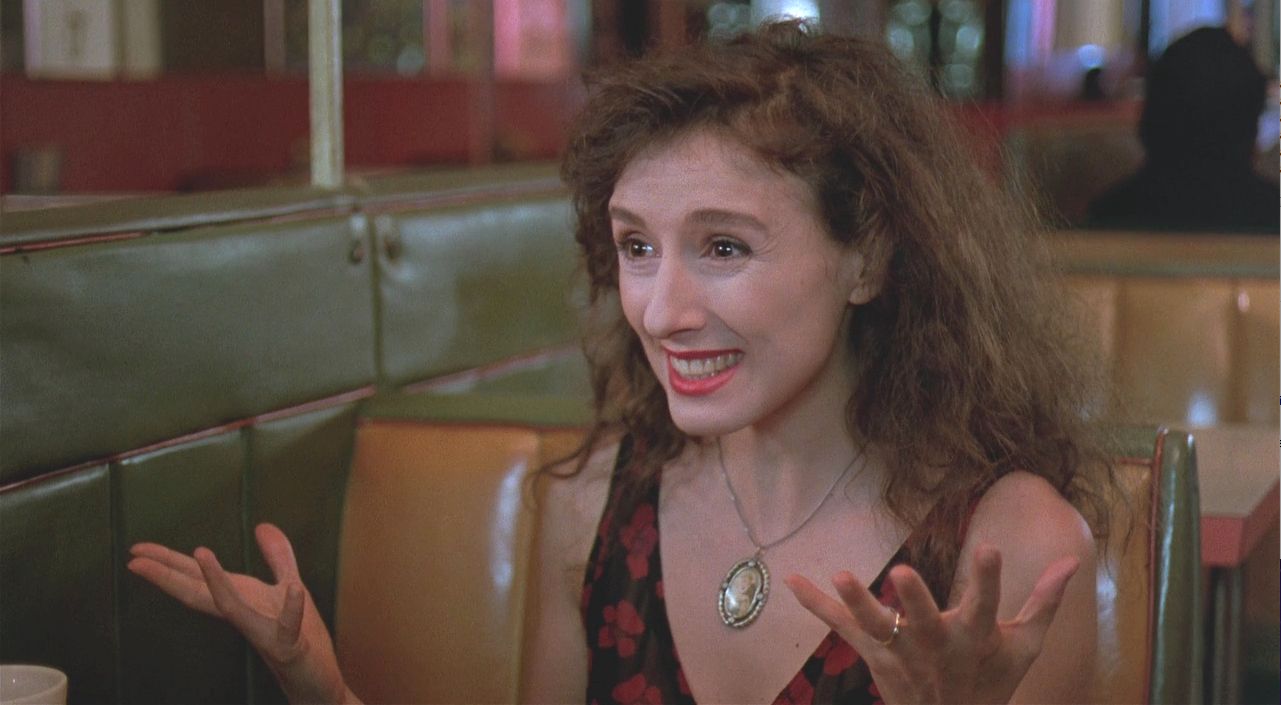
The second act, A Ghost, follows Luisa (the always pretty Nicoletta Braschi, Life is Beautiful) as she wanders the streets of Memphis trying to kill time before she catches her flight out of town the next day. Jarmusch gives us a brief introduction to Luisa, and it’s enough to propel her character’s innocent journey through the nighttime streets.


“Elvis Presley?”


Luisa also eventually winds up at Arcade Hotel. After bumping into Dee Dee (Elizabeth Bracco), another lone traveler, on her way to the hotel, she ends up sharing a room with her. It’s here in this room where she has the encounter that gives name to this act.


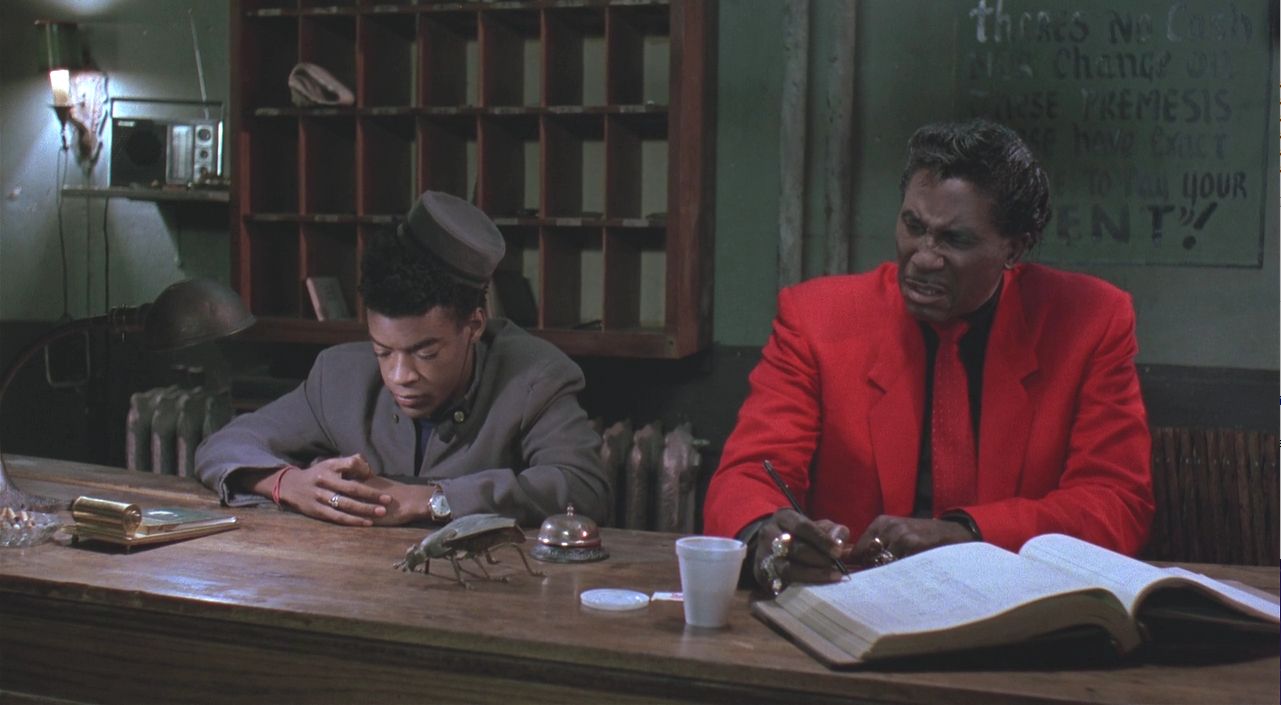
“Jiffy Squid?” Cinqué Lee and Screamin’ Jay Hawkins play Bellboy and Nightclerk of the Arcade Hotel.


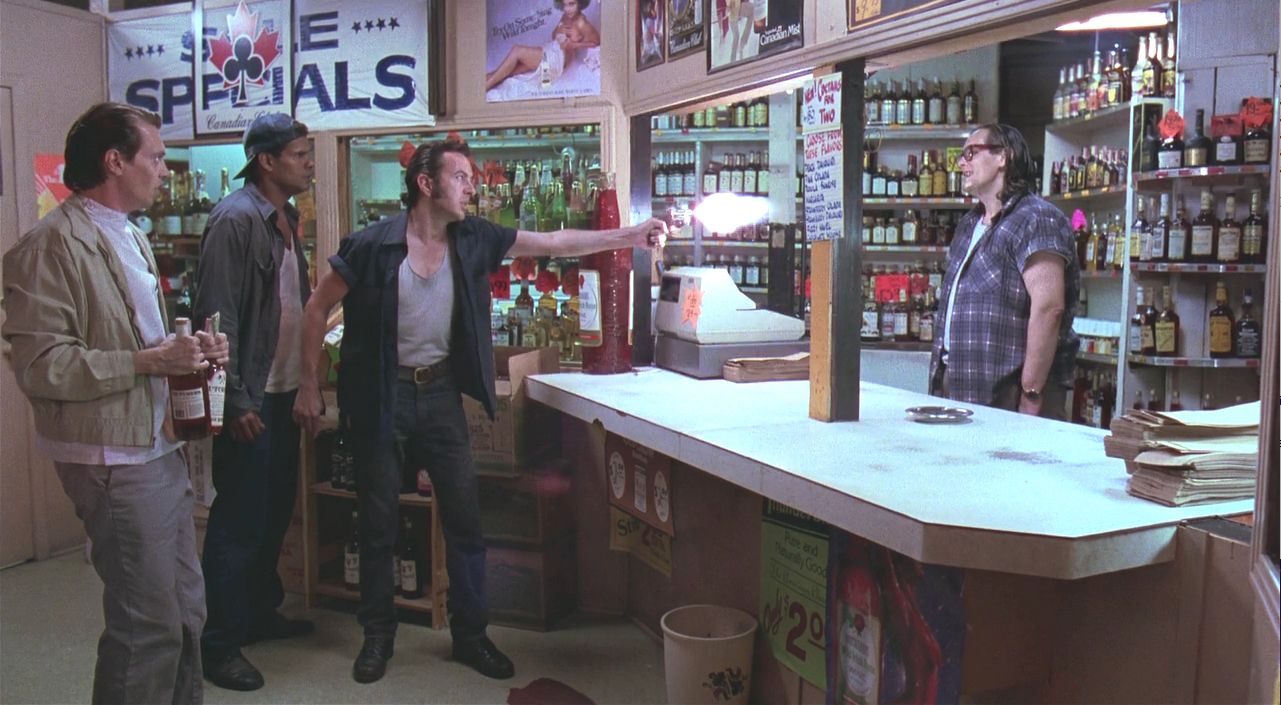
The last act, Lost in Space, is by far the most melodramatic. It follows the night of three men, Johhny, Will Robinson and Charlie the Barber (Joe Strummer, Rick Aviles and Steve Buscemi respectively). Will and Charlie try to keep Johnny (nicknamed Elvis) under control after he loses his job and breaks up with his girlfriend, Dee Dee. They fail and Johnny needlessly shoots a liquor store clerk. The guys ride around town trying to figure out what to do before ending up at Arcade Hotel to lay low.


Danger Will Robinson!


Although each act is thematically different from the next, Jarmusch does an excellent job tying them all together with the Hotel Staff (Lee and Hawkins are fantastic) and with a synchronous DJ (Tom Waits) spinning late nights tracks heard throughout the film. Each story is its own thing; yet tied to the next just enough to carry us through. The middle act, A Ghost, carries slightly less weight than the other two, but gives a bit of whimsicality to an otherwise bleak film.

The music of Memphis is like another character in the film. Classic tracks are performed by Elvis, Junior Parker, Roy Orbison and Otis Redding. These men are the soul of Memphis and lend their story to Jarmusch’s. Original music composed by John Lurie (another Jarmusch veteran) is also very good.

Mystery Train fits nicely into Jim Jarmusch’s record of pleasantly melodramatic indie films. It’s a wonderful film and another intimate look at the lives of travelers and strangers as they cross paths on the streets of broken-down America. Recommended.

**If you want to know more about Jim Jarmusch, John Lurie and Tom Waits, I suggest you have a look at Fishing With John!

Sunday, 20 June 2010

Pioneer One: season 1, episode 1 (2010)


Pre-Internet business models are quickly becoming outdated in today's networked world, where data can be copied and transferred at near-zero marginal cost. Anti-piracy campaigns try to liken downloading movies to walking out of a store with a DVD: you'd never have the guts to do it in "real" life, so why are you so brave online? But this is a false comparison. You might feel a little more gutsy if you could walk out of the store and leave an identical copy behind.


No Macs in space?


So. Pioneer One is a torrent-only sci-fi show which premiered for download a few days ago. You can download the first episode here and, if you like it, donate to the cause. Wethinks a substantial portion of the Pioneer One's target audience will just be happy to stick it to the man, and put their money where their fingers type. That's all fine. As Cory Doctorow and Rudy Rucker and Radiohead have shown, good content pays for itself. In the uber-democratic Internet, you don't need the advertising campaign. Let content speak for itself, become viral, and voila! Fame and fortune. Sort of.

Unfortunately, Pioneer One's content doesn't measure up.

Beginning with grainy, handheld shots and a mumbling, thoughtful overture reminiscent of the voiceover in Primer (an indie sci-fi flick that worked), Pioneer One takes place in Helena, Montana, where a piece of space junk has just fallen from the sky and given everyone radiation poisoning. The Feds - scruffy Tom Taylor (James Rich) and angular Sophie Larson (Alexandra Blatt) - show up and, after retrieving a severely malnourished man from the space pod, realize that they've stumbled onto something very weird indeed. As Soviet cosmonaut helmets, cancer and secret Cold War space programs are unveiled, the episode ends with a big revelation and cliffhanger.


Her.


Him.


Them.


The filmmaking is amateur indie, with shaky cameras and shaky acting. That's forgivable. What's less forgivable is the tired writing and trite story. We're trying to break down outdated business models and reinvent media and culture... with a pair of rehashed Mulder and Scully drones stumbling into the plot of Stranger in a Strange Land? It's cliché after cliché - from the designer stubble of the weary, cynical Fed agent, to the perfect make-up and witty 1950s rom-com banter of his assistant (and yes, what is she but his assistant?). "The best and the brightest. Which one were you?" she asks. Come on, people! Secret government programs regurgitated from the Cold War? Bland, unimaginative jokes? Let me guess: does Tom Taylor have a drinking problem? And really: is a female protagonist so mind-bogglingly weird?

We hate to say this, because we agree with the idea of it: new stories for a new medium, made in a new way. But this just doesn't cut it. We've already seen this story done by Hollywood; yes, we had to pay the man. Why would we want to see it again now? It's regressive content in a progressive package.

If you want to see innovative, non-Hollywood sci-fi, take a look at Primer. Primer's budget was $7000, and it managed to shake things up and become a new cult classic. Pioneer One's first episode budget was $6000, and it was about as exciting as a mediocre X-Files fanfiction (without the sex!). If you want to give your money to the alt culture, support the underground and stick it to the man, we'd recommend you join the crowds on the Cory Doctorow bandwagon or check out Therefore, Repent!. Skip this one instead.

Tuesday, 8 June 2010

Primer (2004)


As whoever narrates the English version of Hyderabad's Birla Planetarium show says in that magnificent way of his, some things are just "mind... BOGGLING."

One of those things is Primer. Yes! It was/is/will be Time Travel Weekend at the PPCC! Except Primer's really good.

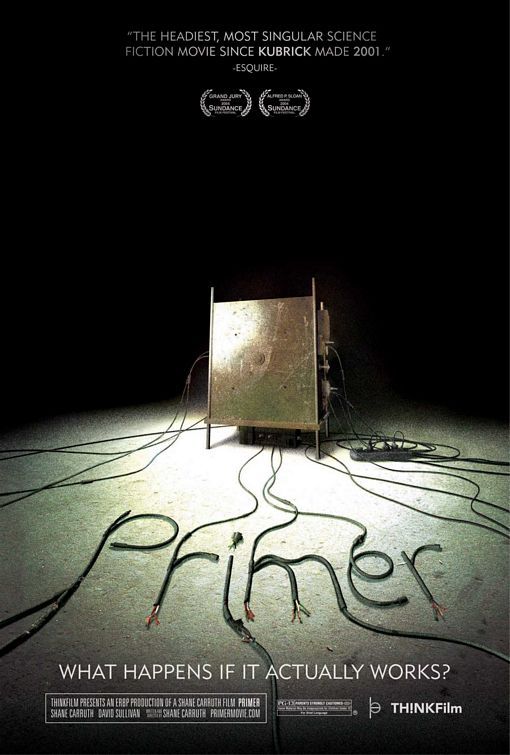
Made on a shoestring budget by unknown mathematician/engineer Shane Carruth, Primer is a Blair Witch-style (forgive us the comparison!) low-fi look at some young engineer-hobbyists who manage to accidentally build a coffin-like time machine, which they call "the box". While initially driven by patents and cash and maybe fantasies of Bill Gates-style Nirvana, the two buddies, Aaron (Shane Carruth) and Abe (David Sullivan), quickly fall into a tangle of mind-melting paradoxes, as they accidentally and intentionally manufacture timelines, copies of themselves, stock market scams and basically try to out-Groundhog Day each other. As one character notes, "The permutations were endless."

The film, shot like a homemade video or particularly scratchy episode of Cops, has little use for the usual cinematic devices. Actors mumble, wander and speak in tecchy jargon which often means all of nothing to the viewer. The film also flutters back and forth and around the timeline, so that we never quite understand which "version" of which day we're watching. This was apparently done intentionally to heighten the sense of confusion Aaron and Abe experience as they tumble further and further into the rabbit's hole box.

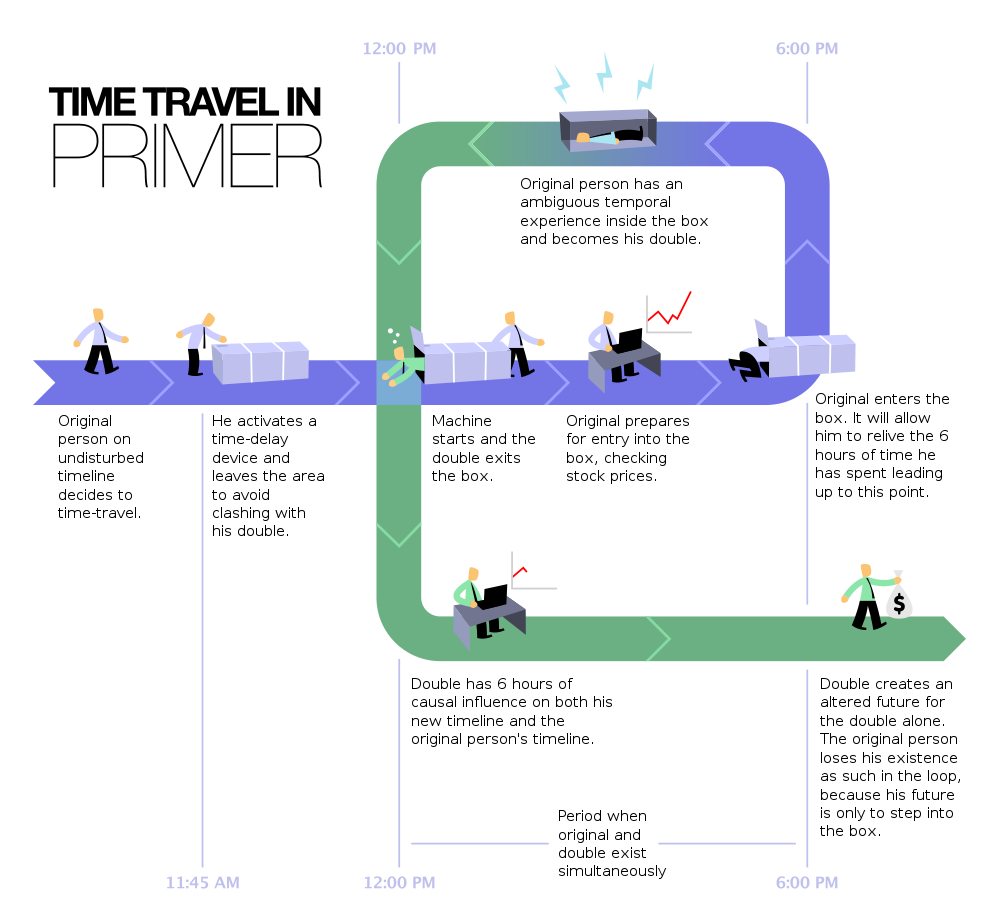
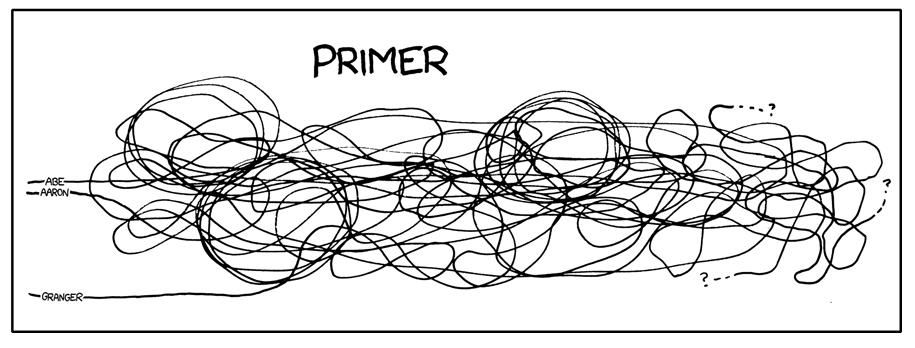
The whole thing is like a creepy, neverending, self-replicating Rubik's cube, but one thing remains clear: the tense relationship between Aaron and Abe. Aaron, ambitious and a family man, is quick to see the commercial uses for a time travel box. Abe is more boyish, almost slacker-like, but he is also the more cautious and possibly more ethical of the two. A mysterious voiceover narrates the action from a distant, third person view - enriching the sense of mystery and tension. By the end, you'll probably have a lot more questions than answers. This graph can help with some:

And this can help with all the others:

Or you can just do what we plan to do: watch it again and again and again. Recommended.

Monday, 7 June 2010

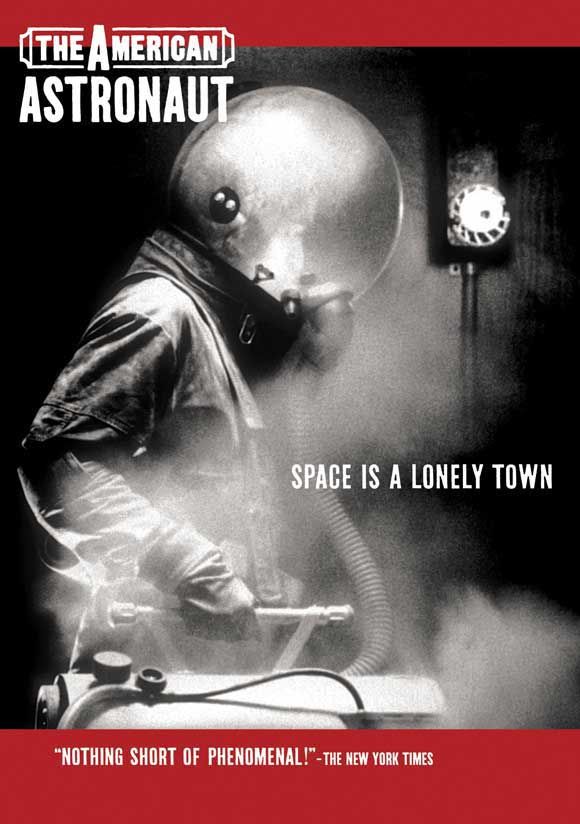
The American Astronaut (2001)


Guest blogger Brianosaurus (rhymes with "rhinoceros") is a sci-fi geek jet pilot who recently laid the smackdown in the House of PPCC by knowing waaay more about dystopias than we did. Today he brings his encyclopedic sci-fi knowledge with a review of a movie we've never heard of, let alone seen. Though clearly it's the best ever! Also, a note: Brian mentions Primer, a brain-pretzeling indie sci-fi cult classic, and we'll have the review for that one up soon (we promise). In the meantime, hold onto your ten-gallon hats and enjoy!

The American Astronaut in a nutshell: If Hugh Jackman from Oklahoma played Han Solo in a musical Flash Gordon set in the 1920s.

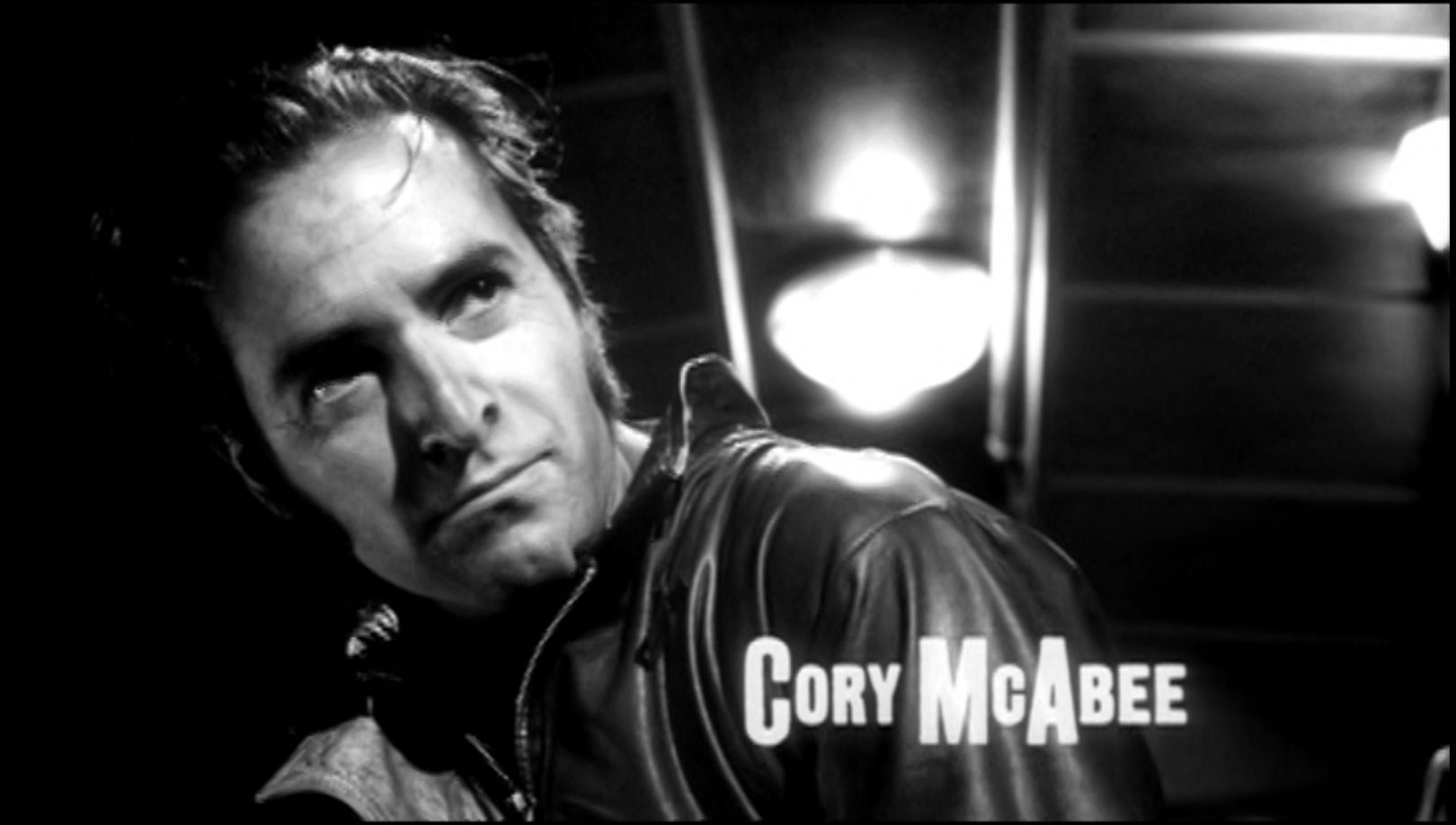
Meet Cory McAbee.


He’s that guy you know; the one that can do everything. McAbee is the writer, director, and star of American Astronaut. He also wrote all the music for the movie with his band, The Billy Nayer Show (yeah, he’s in a band too). So without a doubt, The American Astronaut is McAbee’s baby. I’m just telling you so you know who to thank later!

The American Astronaut, shot in black and white on 35mm film, falls into one of our favorite genres: the Space Western (think Star Wars and Firefly). Set in an alternate past, the story follows Samuel Curtis (Cory McAbee) as he travels across the solar system trading goods on various planets and asteroids, always trying to stay one step ahead of his nemesis, Professor Hess (Rocco Sisto).

McAbee’s universe is at once very old and, by the nature of space-travel, very futuristic. Everything looks like it was cobbled together from scraps at a salvage yard (it actually was), but it works. We see grimy, dirty worlds filled with rough and dirty men. Rednecks and criminals. And when I say men, I mean only men. There are no women out and about in McAbee’s rough universe. They all moved to Venus after they figured out how to asexually reproduce. The rest of the solar system is filled with men who can’t even imagine what women are like. Sex is so far out of their realm of possibility that they don’t even know how to talk dirty. Because of this, men have developed an interesting culture on their own, where music and dancing are not only part of their way of life, but also a means of communication.


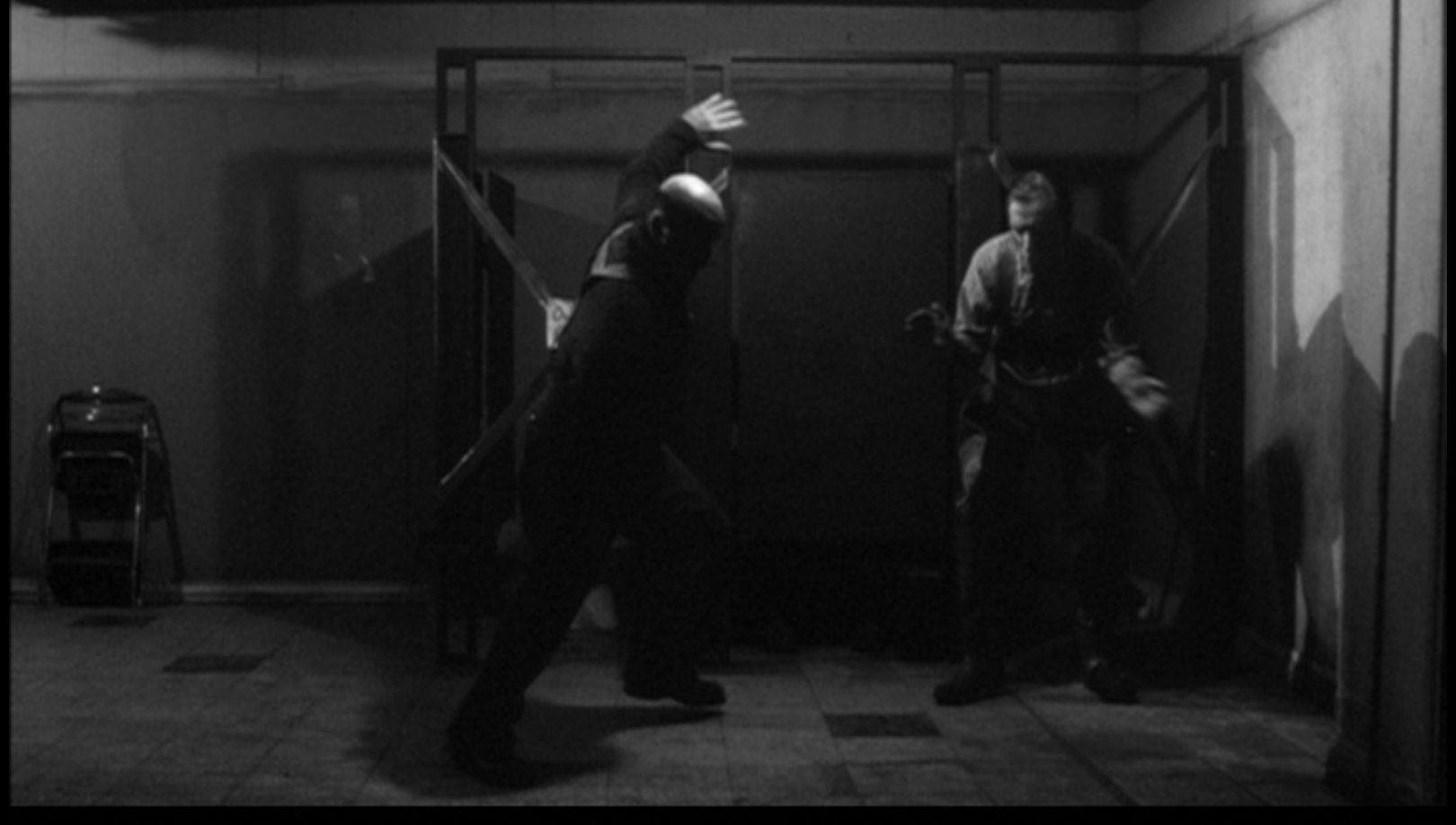
Awesome bathroom music attack scene!!


**Spoilers** We see this immediately in the movie as Sam Curtis makes his first delivery (a cat named Monkeypus) to a bar on the asteroid Ceres. On his way to the bathroom, Sam is ‘musically’ attacked by a pair of dancers clad in overalls (one of my favorite scenes!).


The Boy Who Actually Saw a Women’s Breast. McAbee uses shadow to give his sets greater depth.


Sam trades Monkeypus for a Real Live Girl (we assume an embryo in a box), which, after talking to his friend, the Blueberry Pirate (Joshua Taylor), he decides to take to Jupiter for more trading. Jupiter, by the way, is now a mining colony run by Lee Vilensky (Peter McRobbie channeling Robert McNamera), who rewards his workers with shows from The Boy Who Actually Saw a Women’s Breast (Gregory Russell Cook, who “gets to” wear a great costume: “It was round and soft”). Sam convinces Vilensky to trade him The Boy for the Real Live Girl. He succeeds and jets off, intending to trade The Boy on Venus for the recently deceased King. Since only women inhabit Venus, they keep a stud male around to keep the gene pool from stagnating. The former stud has died and his wealthy family on Earth is willing to pay handsomely for the return of his body. Sam and The Boy get held up along the way to Venus, however, when they run into a flying barn in space. After a quick discussion with the barn’s inhabitants (silver miners from Nevada who accidentally gained super intelligence), Sam agrees to take a boy (who wears a bodysuit and is ignorant) back to Earth with him in exchange for chocolate and cigarettes.


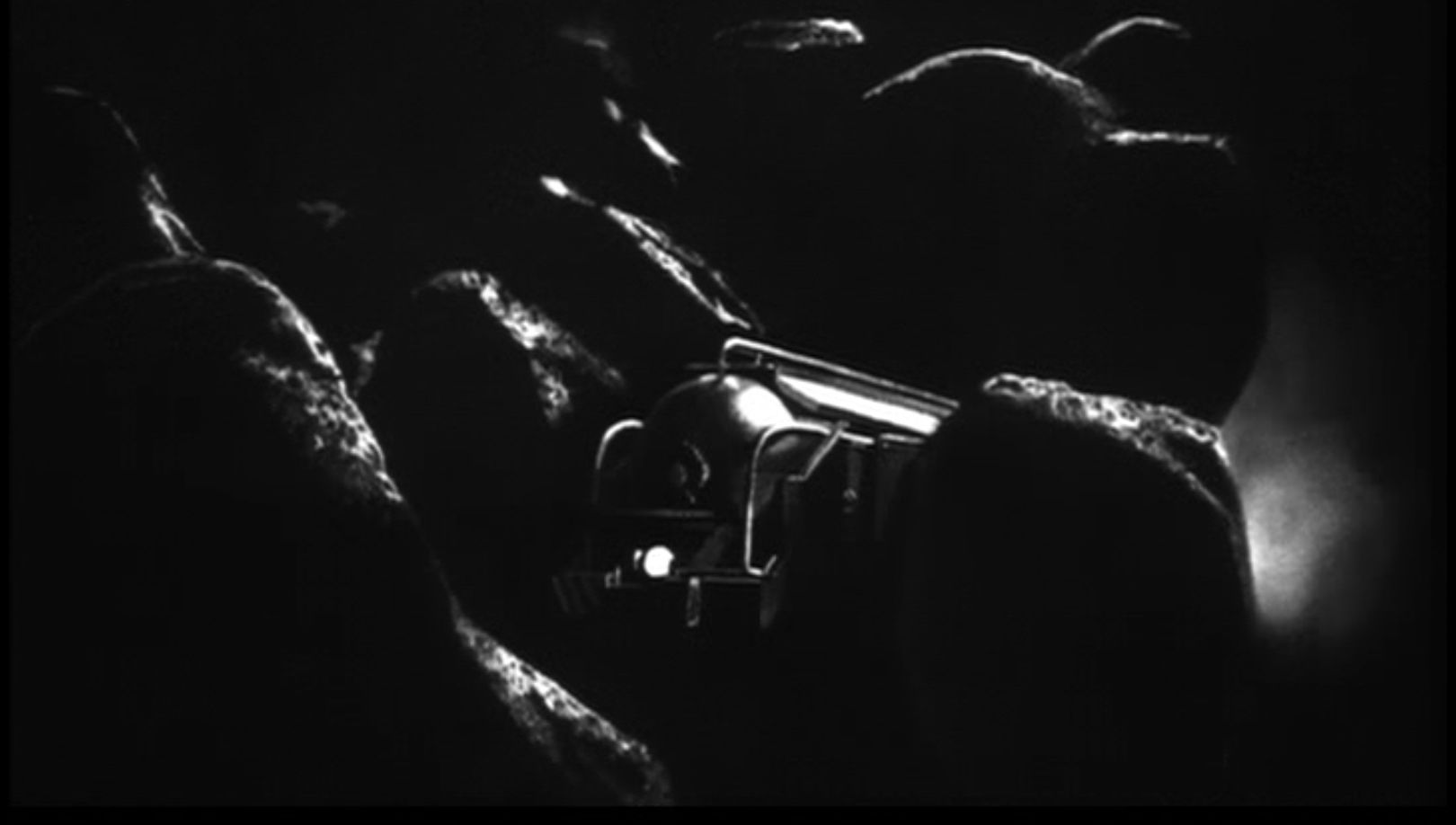
Samuel Curtis’ spaceship, an example of McAbee’s painted exterior space scenes.


When they finally reach Venus, they find Professor Hess is waiting for them. Fearing for the safety of The Boy Who Actually Saw a Women’s Breast, Sam decides to give the women Bodysuit instead. The story more or less ends here. We find out Sam takes The Boy back to Earth and raises him as his son while Professor Hess stays on Venus to help Bodysuit. **End Spoilers**

Cory McAbee’s universe is wonderfully portrayed in the film. McAbee’s use of lighting and shadows gives the otherwise simple sets a sense of depth. He makes us feel as if we are in the 1920s (or watching something from that era) with effective use of makeup on characters like The Boy Who Actually Saw a Women’s Breast, who is shot like a silent film star.

Another striking element to the story is the music. The Billy Nayer Show really comes through here and adds something rich to a story that would have otherwise been a bit thin. Another interesting element is the fact that due to the low budget of the film, all space travel shots are actually just painted pictures mixed with the live action inside Sam’s spaceship (a sparsely decorated one-room apartment with fantastic wallpaper). This actually worked for us. It gave us that feel of very old Saturday morning serials and didn’t distract like intrusive CG does.


The Boy’s makeup is like that of a silent film star’s.


McAbee’s storytelling isn’t quite on par with his design though. The story is continually off-kilter and overly weird. Weird for the sake of weird is fine to a point, but here it interrupts the story at times. I also question the use of the villain, Professor Hess, as the narrator. I would much rather have heard Sam telling the story so we could get closer to him as our hero and main character. Listening to Hess move the story along doesn’t feel right, especially at the end where the story falls short and the narration kicks in. Our last moments are with the villain Hess, not our hero, Samuel Curtis, the American Astronaut.

But Cory McAbee’s vision is fantastic. He proves to us that imagination and the art of storytelling are more alive in common people than Hollywood would have us believe. McAbee is part a small group of artists (like Shane Carruth from Primer fame) that are not held back by the mainstream production system and are able to deliver their story and vision to a willful and eager audience. Imperfections will be there, but it doesn’t matter: we need more Cory McAbees.


Don't buy it from the man, buy it from Cory McAbee himself!

Tuesday, 19 May 2009

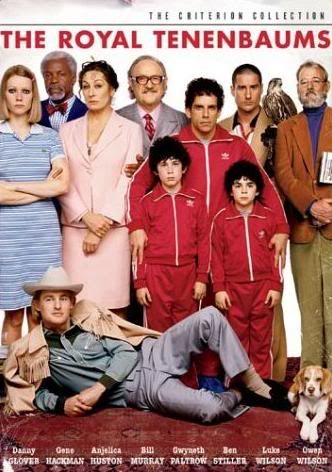
The Royal Tenenbaums (2001)


The Royal Tenenbaums made it into the Criterion Collection?!?!


Wes Anderson's quirky The Royal Tenenbaums is a study in fussy, geometrical postmodernism. Films like this - self-knowingly trendy and almost terminally ironic - can be cold. They can keep you at a distance. Yet just in those moments when we had had enough of the twee gimmicks (Alec Baldwin as narrator! archaic early 1980s fashions! yet another "colorful, extraneous detail"!) and being kept at arm's length, The Royal Tenenbaums finally turned around and delivered some good ol' fashioned sticky sweet, microwave-hot mush.

And we at the PPCC are very, very big fans of mush.

With all the mushy mushiness of a Lifetime Original Movie, The Royal Tenenbaums is about an estranged family's rapprochement. The eventual emotional reunion is just as sugary sweet as can be found in a more pop mainstream movie, despite the intentionally indie, stiff-upper-lip, "too cool to emote" aesthetic the film goes to great pains to maintain.


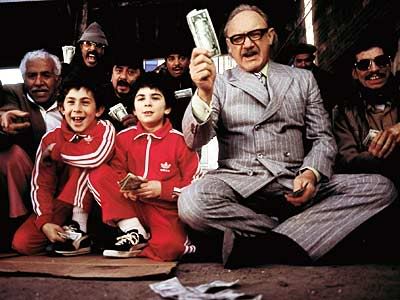
Gene Hackman as Royal Tenenbaum, the family's loose cannon patriarch.


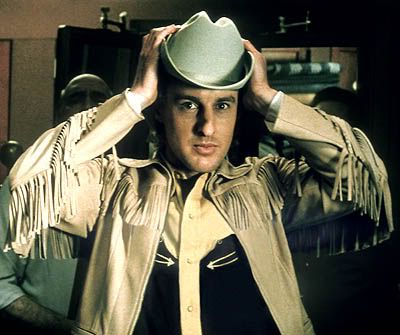
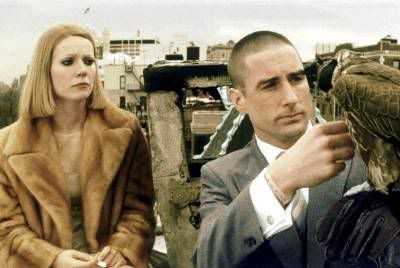
But more about the Tenenbaums themselves: a "family of geniuses", they are two parents - the scattered, quasi-Dionysian good ol' boy Royal Tenenbaum (a wonderful Gene Hackman) and the driven, anchor-like Etheline (Anjelica Houston) - and three children. The eldest son, Chas (Ben Stiller, as an adult), seems to have inherited his mother's single-mindedness: he becomes a business tycoon in his tweens. "I used to be a homeowner myself," Papa Tenenbaum reminisces in one scene, "Until our son expropriated it from me." The middle daughter, Margot (Gwyneth Paltrow), has a hard, frosty exterior: constantly having been reminded of being adopted as a child, she lives inside a shell of privacy as an adult. For example, no one in the family knows she's been smoking for almost twenty years. The youngest son, Richie (Luke Wilson), is a sensitive artist-tennis star who harbors a life-long crush on his adopted elder sister. Rounding out the cast of characters are Etheline's newest suitor, Henry Sherman (Danny Glover, who is black in case you forgot... but don't worry, the film will be more than happy to remind you over and over again), the envious neighborhood childhood friend, Eli (Owen Wilson, brother of Luke), Margot's hyper-intellectual husband (an underused Bill Murray) and his trailing behavioral experiment (Stephen Lea Sheppard), and the family's Indian servant, Pagoda (Kumar Pallana).

One thing Wes Anderson has been criticized of, especially since Darjeeling Limited, is his latent racism. We haven't seen Darjeeling Limited, so we can't judge that film in particular. But there were a few cringe-worthy moments in The Royal Tenenbaums which reduced non-white characters to silly and unfunny stereotypes: Royal confronting Henry in "jive", or describing him as "big and black", or Pagoda's thick Apu accent and the fact that he trails Royal around like a loyal, um, well, servant! (And Pagoda's room: all decked out in Orientalist trinkets, complete with colonial era depictions of elephants on walls and gently-playing sitar music in the background.)

It all looks very "trendy" and is supposed to be funny in that usual twee, hyper-ironic "stuff that white people like" (tangentially, a website we, uh, don't like at all) way. "But hipsters are supposed to be sensitive and cultural!" you may say. Indeed, we don't think this film intentionally trivializes or caricatures Indians and blacks. It just seems to exploit stereotypes for some cheap laughs. It also seems to think that the non-white characters have no interesting independent stories to tell either - they appear only to exoticize the trimmings of the white people's center-stage angst.


Owen Wilson does his usual lovably dopey thing.


...while brother Luke Wilson does his usual sensitive guy thing. Meanwhile, Gwyneth Paltrow gets every woman's dream role as (drumroll) the object of the men's lusts, affections and angst. Good thing we're needed, eh, ladies! Gosh, otherwise we'd be non-entities.


That is the only big criticism we can levy against this film. As we said, the mushy mushiness was tastefully done - earning a few PPCC Tears of Emotional Manipulation, thanks to the cunning use of indie woe (Elliott Smith, Nick Drake, Van Morrison...). We've seen smarter takes on the same "family of alienated intellectuals living in a brownstone in New York City" plotline before (e.g. the magnificent The Squid and the Whale) and we've seen just as refreshingly pomo aesthetics before as well (e.g. the under-appreciated, and much less precious Breakfast on Pluto). So, for us, The Royal Tenenbaums was not as groundbreakingly brilliant or incisive as it thought it was and wanted to be. But it was a pretty okay roll nonetheless.

Saturday, 14 February 2009

Ugly aur Pagli (2008)

Back when we saw Ugly aur Pagli (Ugly and Crazy) on a tiny, flickering television on a semi-deserted island, we had only one significant criticism: it tries too hard.


Wake up, Mallika, the review has started.


This is hardly damning, as surely it's better to try too hard than not try at all. And the worst thing Ugly aur Pagli does is proclaim its quirkiness loud and clear when, in many moments, a lighter touch would have been better. Rather than narrating the odd adventures of Kabir (Ranvir Shorey) and Kuhu (Mallika Sherwat) via a relentless voice-over, it would have been far more effective and fun to let the story speak for itself. Indeed, the best part of the film is the last half hour, when Kabir finally shuts up and lets us watch in peace.

But maybe our criticism is missing the point, as Ugly aur Pagli is a veritable celebration of the ignored, imperfect, weird couples out there in the world. The ones that aren't chocolate box fluff beings from the Planet Perfect. The ones with pimples and drinking problems. And it wants to PROCLAIM this quirkiness IN CAPS (including from a skyscraper's rooftop). Beginning with the very first frame, being different is celebrated: while a tinkling anti-filmi indie anthem plays, we see snapshots of quirky love in all its guises. A pair of transvestites. A lesbian couple. A dwarf and his average height girlfriend. It is, thanks to the music and gentle affection on display, oddly touching. And a good start to a story about a loser "ugly", Kabir (Ranvir Shorey), falling in love with his aggressive, binge-drinking "pagli" friend, Kuhu (Mallika Sherwat). When Kabir first meets Kuhu, she vomits all over herself. As they become friends, she slaps him repeatedly and challenges him to outrageous dares (such as wearing her stilettos across a busy Mumbai intersection). Kuhu is loud, combustible, feminist and angry. She writes action-packed screenplays about heroines saving their wimpish heroes from disaster and expresses her growing affection for Kabir by dragging him around by his shirt. The wimpish, bewildered Kabir spends most of the time scrambling to keep up with her wild mood swings and impulsive decisions. It's only when the two are separated that they, and we the audience, realize how meaningful their attachment was.


The dominatrix stuff was sometimes tiresome...


...but the action heroine fantasies were hilarious.


Much of the film's humor is tiresome and forced (though we did laugh very hard at Kabir attending swimming lessons, for some reason), and many have criticized that the movie's transfer from Seoul to Mumbai lost a lot of... soul (ba-dum-shhhh, thank you, thank you very much). Indeed, this movie is saved almost entirely by the performances of the two leads. Mallika Sherwat and Ranvir Shorey both work their particular brands of offbeat, unconventionally attractive performers perfectly. Both known for envelope-pushing work - they each made their debuts in racy films (Khwahish for her, Ek Chotisi Love Story for him) - they seem to be teasing this image as much as they're exploiting it. At least, the S&M vibes were strong (the DVD menu features whips and handcuffs!). Furthermore, they're both playing to their image of fiery, free-spirited pagli for her and sensitive loser for him. What can we say? We love these two just like that. And so the film - despite its flaws - works because of them.


The drinking buddy song! Featuring Punjabi rap artist Hard Kaur, which definitely upped the film's street cred. If you want to kick it old school, see Naina's excellent drinking buddy anthem, Jane Mujhe Tune. (No, we will never stop plugging that song.)


We also just appreciate quirkiness on a philosophical level. Yay quirky! Yay different! Because of that, and the heart-squishing finale, we put this film in the Decent pile. We'd like to see more of the same from Bollytown, just with a bit more polish next time.


Oh, you two.

Sunday, 1 February 2009

Luck by Chance (2009)


Vah, vah, vah! Kya film thi!

Our money's on Luck by Chance - best film of 2009? Maybe. It's a bit early to call, being just February, and we're optimistic this year has even more in store. So while we don't have the courage to already dub it the year's best, we can say that it's a wonderful inauguration to what promises to be a year full of Hindi cinema potential. And what better way to kick out the jams of 2009 than a film about... making films!

Luck by Chance basically covers every single thing you need to know about the Hindi film industry. Sure, it's full of clichés - the desperately ambitious struggling actor, the sleazy producer, the idiotic princess - but it's such well-done cliché that we really have no complaints. This film manages to tackle every industry myth and real-life cliché with a smart cynicism: the filmi families, the superstitions, the light-dark skin tone racism, the Hindi-English dichotomy, the death of theater, the parallel cinema versus masala divide, even the "Bollywood" semantics issue... Not only that, rather than the glittering star parade of 2007's Om Shanti Om - another film about films - Luck by Chance's cameos are intelligent, wry and add depth. That is, the stars don't just walk on to pump up the film's appeal, but rather they serve key purposes: Karan Johar's explanation of the legendary "outsider" success stories at the party, for example. Furthermore, the entire cast is top-notch and there are some surreal, meta performances too (for example, Sanjay Kapoor as a failed hero and youngest brother of the big-shot producer).

The film follows a young struggling actor, Vikram (Farhan Akhtar), as he navigates the heady, two-faced world of behind-the-scenes Bollywood. He strikes up a romance with a B-movie actress, Sona (Konkona Sen Sharma), who has been waiting three years for a promised big break. Meanwhile, further up on the ladder is producer Romy Rolly (Rishi Kapoor) and his airhead trophy wife, Minty (Juhi Chawla). Romy's new film, Dil ki Aag (Flames of the Heart) is currently filming with his favored hero, the superstar Zaffar Khan (Hrithik Roshan, in a wonderfully ironic performance) and the debuting star child, Nikki (Isha Sharvani). Nikki's severe stage mom is the aging 70s superstar, Neena (Dimple Kapadia). When Zaffar lands a part in the upcoming Karan Johar film with Shah Rukh Khan - who, the film implies again and again, is at the top of the Bollywood pecking order - he dumps Romy's film. It's then up to destiny, hustling and sweat to get Vikram into the film's coveted lead role instead.

Ultrabrown's review makes a very good point that this film, which is ostensibly about the underdog outsider making it big in Bollywood, is made, instead, by the most gilded of star families: almost everyone in this film comes from a privileged filmi family. But we think this lends the film a knowing, self-consciously ironic air: as we mentioned, many stars have significant, smart cameos and the few actors in this film who are not playing themselves are generally playing parodies of themselves. Take Hrithik Roshan, for example: he has some wonderful moments such as when he laments that he's becoming "mechanical", that he is not Zaffar Khan but rather is the "employee" of the image of Zaffar Khan (something Shah Rukh Khan has said of himself) and when he eyes the rising star Vikram at the glitterati party with a half-predatory, half-insecure glare. And that's just one slice! Speaking of Shah Rukh Khan, his cameo, which is the culmination of the star parade, is the classiest of the lot: it's a real "we've finally reached the wizard of Oz!" moment.

Ultrabrown and Filmi Girl also noted that the film is difficult to connect with on an emotional level. And it's true: this film is primarily intellectual, it's a trendy arthouse movie wrapped in a commercial package, and so its tone is likewise snarky, cynical and ironic. In particular, the romance doesn't really work. And almost everyone in the film is an unlikably two-faced, overly ambitious and selfish social climber - at least most of the time. There is also a lot of gray, and a certain tragic air to the pervasive insecurity everyone seems to suffer from. It's indeed disheartening to see that the rat race never ends, that the top of the heap is a lonely and unhappy existence. The film's sense of humor is also the snort-and-snicker variety, with a lot of sarcasm and ridicule. All this makes it hard to like on a more straightforward, sentimentalist level. Yet there is some poignancy, such as when the aging Romy Rolly/Rishi bemoans the lost dignity of the current generation, and when Neena/Dimple instead reveals the harshness of her early life as a star (and this is interesting in itself; a commentary on the double standards for men and women in the industry, perhaps?). And just as a documentation of a fascinating industry, this film is great. We liked it and we highly recommend it - especially for those just getting into Hindi cinema. It's a crash course in all you need to know to be conversant with the lingo and mythos of Hindi films. Now we can only hope that the Raj Kapoor biopic starring Anil Kapoor (AHEM AHEM PLZ MAKE THIS FILM UNIVERSE) will have that same knowing, harshly cynical, exposé vibe about that era.

Friday, 23 January 2009

Rock On!! (2008)


Rock on, man! Yeah, man!


The much-acclaimed Rock On!! is a pretty bauble of a film, entirely masala-free and resembling other Hindi films only in the language the characters (occasionally) use. It offers an all-too-rare glimpse into the Indian indie music scene - that cultural underdog so often overshadowed by the filmi tyranny. However the film's dedication to a specifically Western cultural legacy - there are nods to The Doors, The Who, The Rolling Stones and so forth - means that the good ol' Hindustaniness gets left behind. For this reason, this is a great film to show your non-filmi Bollywood virginal friends, as these angst-filled rockers are easy to identify with from a Western perspective (and there's none of that pesky song-and-dance stuff). Yet it's also true that we don't watch Hindi films for movies like Rock On!!.

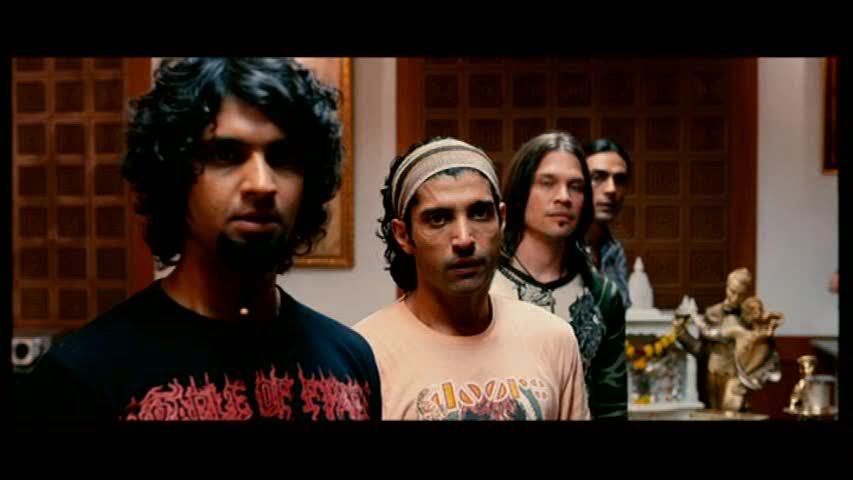
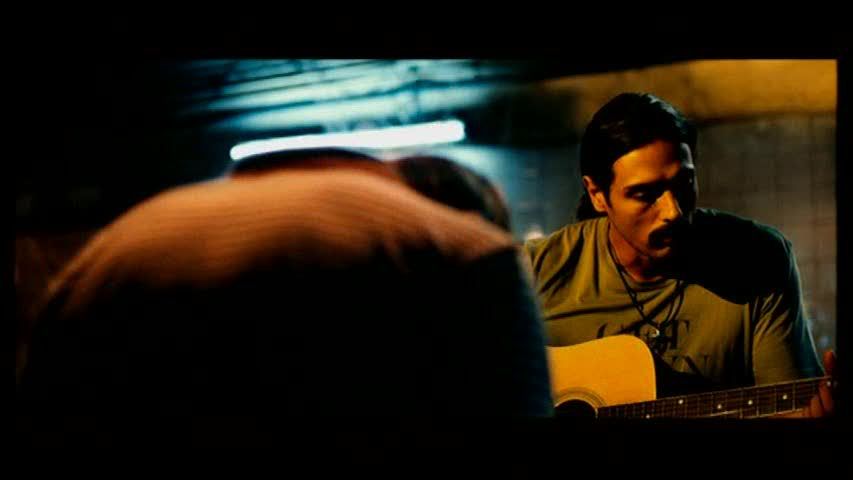
There once was a band named Magik. On vocals was the studly Aditya (Farhan Akhtar, son of Javed), a bit of a prima donna with Italian soccer star hair. On lead guitar: Joe (Arjun Rampal), whose quiet studliness hides an occasionally violent temper. On keyboard: the peace-making Rob (Luke Kenny). And finally on drums, the Puckish goofball, K.D. (Purab Kohli). After a quick opening number, we fast-forward ten years to find the four bandmates adrift in their separate lives, older, seriouser, sadder. Aditya has become an investment banker/emotional zombie, Joe is an unemployed sadsack, Rob is doing reasonably well under the patronage of filmi music director Anu Malik (for realz!) and K.D. is just not getting anywhere with the ladies.


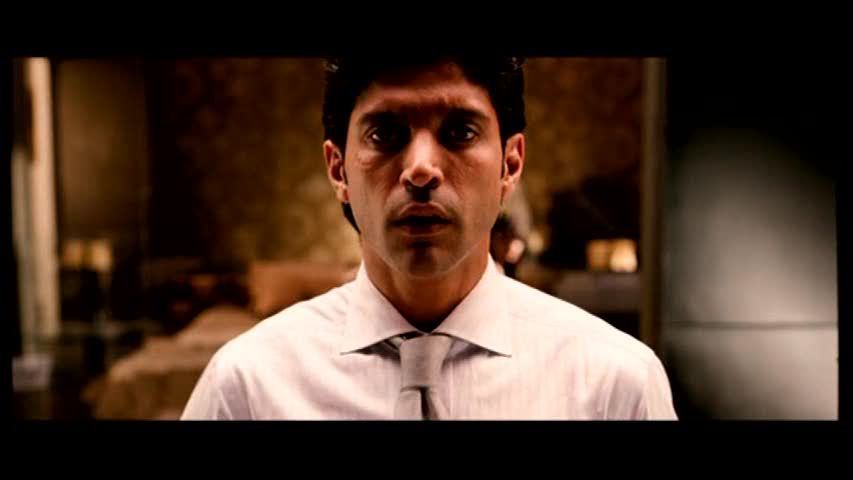
Aditya (Farhan Akhtar) has become a beige DRONE. Or should we say just another brick in the wall?! Nyuk nyuk nyuk...


Aditya's wife, Sakshi (Prachi Desai), finally gets tired of living with a zombie and, via a chance finding of Aditya's secret "band memory box" in the attic, she works to reunite the four boys in the hope that this will reignite Aditya's lost joie de vivre. As this plays out, we are treated to interlinking flashbacks which show us how the band broke up and why.

Farhan Akhtar, the well-regarded director of Dil Chahta Hai, makes his acting debut in this film - and he seems to be turning into an auteur for movies which directly address the dreaded quarter-life crisis through the lens of bourgeois hipster twenty- and thirtysomethings. Dil Chahta Hai was a smash hit since it touched a chord with the growing yuppie class in India, and Rock On!! follows much in that vein. The characters here are all relatively privileged, well-off individuals who live in swanky pads and dress in designer clothes. The only character who seems at all concerned about money is the slightly more middle-class Joe who, interestingly, is portrayed as a Goan Christian and therefore exhibits some characteristically Goan hippie trendiness. We say "interestingly" because more typically, in a masala film, poverty or middle-classness comes with a whole host of conservative norms, usually going hand-in-hand with Hinduism or, more rarely, Islam. Given that Christians are often seen as pretty fly cats in Hindi films - see Amitabh's boisterous Anthony Gonsalves in Amar Akbar Anthony or SRK's wacky parties in Kabhi Haan Kabhi Naa - this gives Joe the liberty to, well, be a dreamy-eyed rock star rather than an angry young tapori.


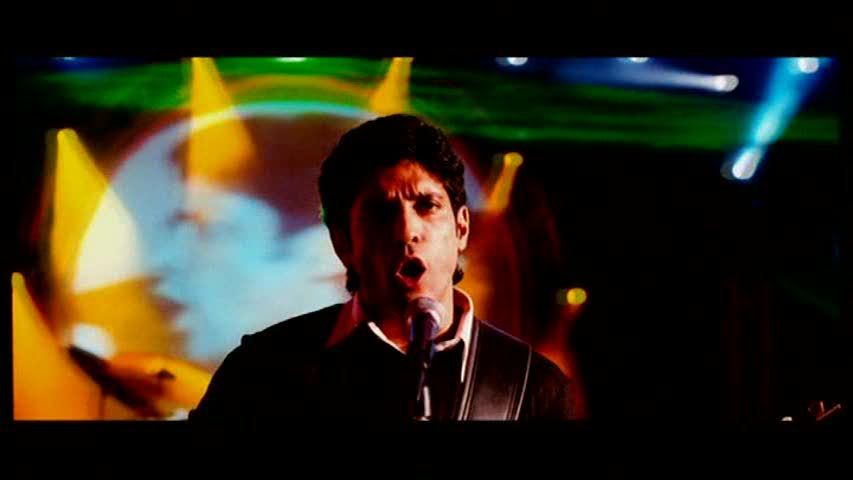
And God said, LET THERE BE A TOTALLY KICKASS POWER CHORD!


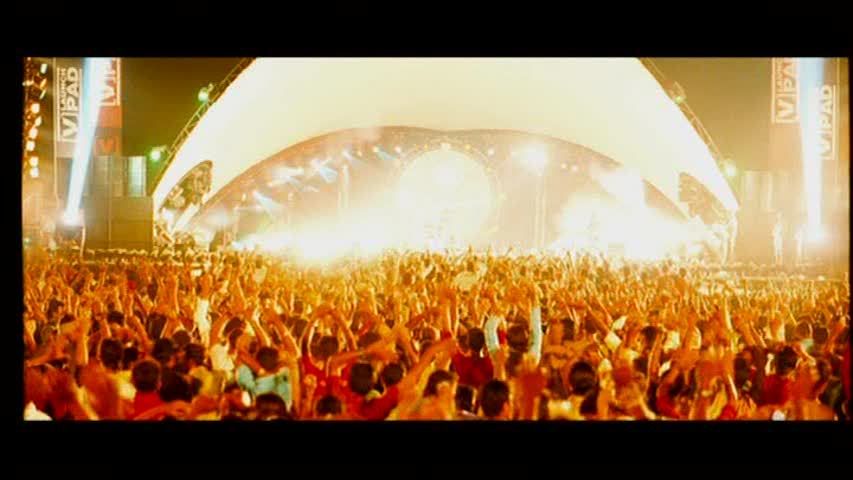
The best scene and the only one that lived up to its promise was the final concert. When Farhan Akhtar hit those falsetto notes (which, btw, he's a triple threat: actor, singer, director!), and with all those streaming colors, we had Radiohead at Glastonbury flashbacks. Joy...


All this means that this'll be a great film to show your Bollywood virginal friends, as it's no different from a Hollywood film. The aesthetics - bright colors, slap-dash camera angles, inventive editing and heart-meltingly gorgeous focal depth - resemble the energy and youthfulness of a tamer Danny Boyle (ironically!). There's even the presence of the mystical Hipster Color Combo - blue and orange - found in hipster movies and hipster books! Eerie, man.


GASP! Blue and orange! The official colors of our people!


The only problem is that these hipsters may come from the Planet Cool, but they seem to have forgotten their Hindustani heart. The only times when Hindi music is even considered as a possibility, it's presented as the very antithesis of rock, and it's either shown to be soul-deadening (Rob's work with Anu Malik), worthy of ridicule (the band's Dandiya concert), or tongue-in-cheek cutesie (Sakshi's karaoke moment).

Yes, we feel a little silly saying this, as we constantly criticize the overwrought nationalism of other, more jingoistic Hindi films, but we really missed Indian culture in this film. The characters lived in a bubble of globalized, heavily Western-influenced luxury, completely detached from the realities present in the usual Hindi film: familial demands (the guilt trip!), institutional corruption, poverty, the often-constrictive dharma. So while Rock On!! should be pretty enjoyable to a Bollywood novice, it won't be particularly enlightening. (For this reason, we're much more looking forward to Farhan Akhtar's upcoming Luck By Chance, which satirizes the Hindi film industry with the same knowing, angst-filled hipster aesthetic.)


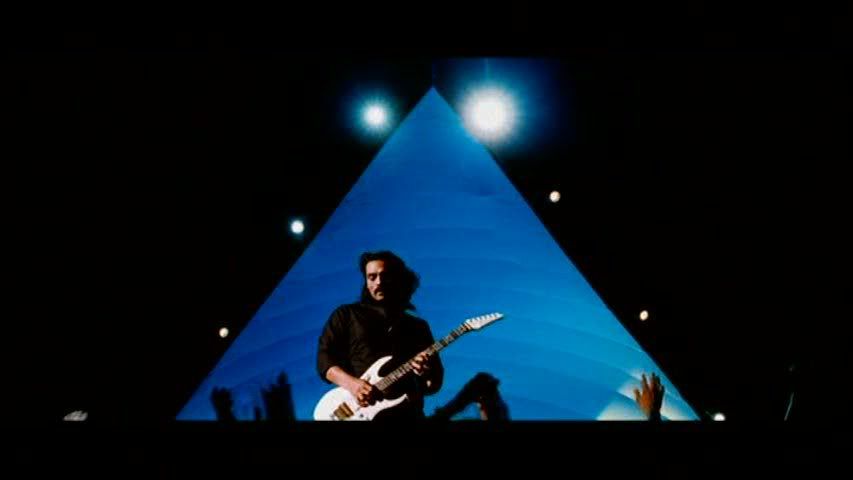
So when's this coming out on Guitar Hero?! And look: Pink Floydy triangles!


Don't get us wrong. The PPCC is all about cross-cultural fertilization and the glories of fusion. Jhoom Barabar Jhoom is a good example of a film that manages to take Western and Indian aesthetics and create a quirky, lively, fresh hybrid. Heck, even the outrageous tackiness of Tashan merits praise for forging brave, new paths of fusion fashion. Rock On!!, for however pretty it is, often comes across as a mediocre mimicry: we weren't impressed by the songs, which sounded like uninspired and recycled pop (except for the outstanding Tum Ho To with the Baba O'Rily-esque ending), and the costume design was metrosexual but standard.

That said, we can see how Rock On!! is a necessary breath of fresh air to Hindi commercial cinema. While it doesn't seem very relevant except to trendy hipsters thick in their quarter-life crises (PPCC bell goes CLANG!), and it doesn't have much to Say, it does attempt to introduce the indie culture into films and that is a worthy target indeed. Today's grade is a B-.

Thursday, 23 October 2008

Good Will Hunting (1997)

As is our way, sometimes we see one movie - in this case, Mamma Mia! - and come out of it wanting to review another - today, Good Will Hunting. The connection between the two: the lovely Swedish actor, Stellan Skarsgård.

Nugget Mamma Mia! Review: Well, not even middle-aged romance (our favorite neglected genre) and references to classically Greek ideals like choruses and Bacchanalia can save us from the horror that is Pierce Brosnan singing. Also, as always, A.O. Scott is right: forced cheer and crappy directing.

Proper Good Will Hunting Review: Back in 1997, the proto-PPCC stuffed itself into a crowded cinema hall, forced to watch the new trendy indie flick from the extreme edge of the front row.

And back in 1997, we came out of that cinema hall with our head in the clouds and a spring in our step, thinking: "My God! That was God's gift to cinema!" and "Gosh, and that professor was a stud!"

We've since revised our opinion (BIG TIME) on the former but still maintain that the professor in question, played by Stellan Skarsgård, was one studly piece of Nordic studliness. But about the film itself: what we didn't realize at the time, being ignorant types, was that Good Will Hunting benefits immensely from its indie packaging. Take that away, and you have some pretty trite melodrama.
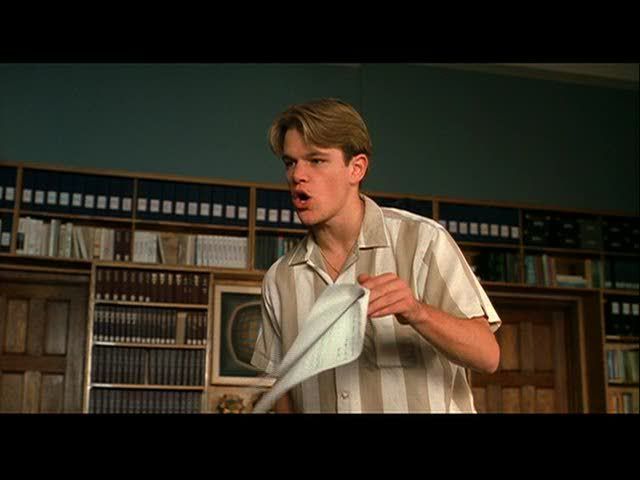

The PPCC was lazy and took a total of 2 (two) screencaps. Here is the first one, where Matt Damon plays the cocky genius, Will, who likes to belittle people and throw his emo-drama weight around.
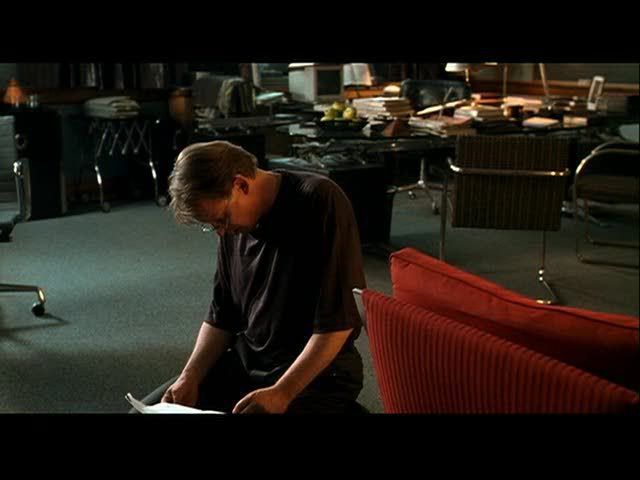

Here is the object of Matt/Will's belittlement, his patron and the film villain, Prof. Also-Cocky, played with aplomb by our favorite Swedish actor, Stellan Skarsgård. Yay Stellan!


Welcome to Boston! Enter our hero, the young Will Hunting (Matt Damon). Already in the first scene, as the credits roll, we see Will scribbling complicated mathematical equations on his bathroom mirror. Yes, Will is one of those strange creatures that inhabit the celluloid universe: the Movie Genius. These types of people are effortlessly super-intelligent. With barely a lift of their intellectual pinky, they can produce reams and reams of angelic music even while dying. These people, you see, are just conduits of the supreme energy force of Genius.

Anyway, if you buy all that, then you'll be amazed by Will's sheer, unadulterated super-intelligence. Will is a grown orphan living on the hardknock South Side of Boston, and his crew of layabout, blue-collar, Irish American friends include the loyal Chuckie (Ben Affleck), the strong and silent Billy (Cole Hauser), and the boyish Morgan (Casey Affleck). These guys ride around in their beat-up car, occasionally getting into fistfights with the Italian Americans. Meanwhile, Will works as a janitor at the ultra-prestigious MIT. When star professor, Prof. Lambeau (Stellan Skarsgård, yay!), challenges his student to a difficult mathematical problem, Will finds the time to scribble the solution on the board outside the classroom. At first, the mystery genius remains elusive, but eventually Lambeau finds Will... characteristically, the younger man is on his way to jail.

In an effort to keep Will's genius free, Lambeau gets an agreement with the judge: Will is allowed to become Lambeau's new pet math project if Will also attends counselling. After going through a stream of ridiculous and ridiculed therapists (including the wonderful, late George Plimpton), Will finally settles on Sean Maguire (Robin Williams). Like Will, Sean Maguire is a working class "Southie" whose seen the hard side of life - he's a Vietnam veteran and professor at the local community college. He is also Lambeau's old roommate from MIT, and the friction between the two men - due both from old tensions and new arguments over Will's future - begins to heat up again. Meanwhile, insert random love interest in the form of Skylar (Minnie Driver), genius med student, quirky, British and an orphan herself.

Now, on paper, that all looks pretty great. Genius orphans! Rich dad, poor dad! A cameo by George Plimpton, wowzers! And indeed, considering that a very young Matt Damon and Ben Affleck wrote the script, it's pretty impressive. (Though the original script apparently had a whole bizarre action subplot involving the FBI.) We'd describe Good Will Hunting as being something that, at its core, is quite compelling and touching, but is then covered by a lot of posturing and affected melodrama, which is then covered by a sugary indie Gus Van Sant-ified outer coating. In 1997, we consumed the sugary indie-ness - the Elliott Smith song, softly strummed in the background, the grainy shots of Boston at dawn - and we were hooked. Ten years later, the coating's gone, and we're left with the stale taste when you've finished your candy.

It's interesting that the hero of the film is a young man who is effortlessly intelligent, while everyone else around him - Lambeau, Skylar, Chuckie - must struggle and suffer for their achievements. In one touching scene, Lambeau and Will butt heads over Will's increasing rebellion. Lambeau loses patience and sighs, "I think you could show me some appreciation." Will quickly fires back, "Do you know how easy this is for me? Do you have any fucking idea how easy this is for me? This is a fucking joke." He then lights a math whizz solution on fire, causing Lambeau to leap forward in a most undignified manner, kneeling on the ground and blowing frantically at the flames. It's an odd, painful scene to watch - as Lambeau's intellectual inferiority is emphasized and pitied. Even though Lambeau is the stereotypical Ivy League celebrity professor - arrogant, entitled, out of touch with worldly realities - he has worked his entire life to be where he is, only to have an alien from the Planet Genius swoop in and undermine him. It's hard not to feel a bit sorry for him!

What is the film exactly trying to say about intelligence, entitlement? Representative Snobbish Intellectual Lambeau is, at best, pitied, at worst, mocked and demonized. The real hero, the man who raises Will up, is Sean the Good Ol' Boy Therapist. Indeed, the film comes down hard in favor of working class "good ol' boy" companionship over austere ivory tower snobbery. We can't help but wonder whether this film is suffering from a bit of American anti-intellectualism. Sean's earthy goodness melts Will's armor, even though it's Prof. Lambeau who takes all the practical steps to get Will out of poverty - providing him with job opportunities, saving him from jail, even putting him in contact with Sean's healing force in the first place. Sean, however, is shown to have given up a promising career in the intelligentsia to work, instead, with uninspired working class kids at the local community college. That - and the fact that he's a Vietnam vet - give him a heroic veneer of rough, honest good-heartedness. The film is definitely in favor of Sean.

Onto the acting. Well, despite the general melodrama, everyone pulls their role off with realistic aplomb. Obviously Stellan Skarsgård left quite an impression on us, mostly by refusing to allow Lambeau to become a charicature of evil (as much as the script wants him to be!). Robin Williams sometimes gets teased for making two kinds of films: the clean-shaven comedies and the bearded dramas. But we think he's amazingly effective at drama - his earthy compassion is lovely in this, and he's also excellent in Awakenings and Dead Poets Society. Sure, sometimes he goes overboard (What Dreams May Come, oh God, save us), but generally he gets it right. Yay, Robin! All the young folk - Matt Damon, Ben Affleck, Minnie Driver - are very strong, though, it should also be said, they are in safe territory. Matt Damon and Ben Affleck, both originally from Boston, basically play native stereotypes. Also, as can be seen in their later, individual works, Matt Damon is the stronger actor of the two.

Anyway, overall, it's definitely not a bad film, but it's certainly not as good as we originally thought it was.

Sunday, 17 February 2008

Juno (2007)


The trailer.


The PPCC is currently not tapped into the American indie film market, and ergo we are behind the curve where Juno is concerned. For several weeks, we had seen this Juno movie pop up in New York Times articles, already apparently having acquired the mythical status of the successful Trendy Indie movie. We had read part of the interview on the Guardian with the lead actress, Ellen Page.Overall, we were getting the vibe that Juno was this year's Garden State or Little Miss Sunshine.

And in a way, Juno is everything that that market - the trendy lefty American indie movie market - loves: a superficially provocative but not necessarily very difficult theme, lovely indie acoustic guitars, a suburban setting full of alternative-indie aesthetics, with zingy smart dialogue, teenagers and teenagerness, intellectual liberalness, and slightly ironic cinematography. Now, we'll come clean. The PPCC is a trendy lefty American, and so it pushed all our buttons. We laughed, we cried, we very much enjoyed Juno. It was hard to actually hunker down and write a slightly more objective, more analytical review. We were too close to the material.


Sassy Juno and her boy Bleeker.


The plot: Juno (Ellen Page) is a wise-cracking tomboy. Seemingly wise beyond her years, one evening Juno decides to bed her long-time friend, Paulie Bleeker (Michael Cera), out of boredom. This unfortunately leads to a positive pregnancy test, and Juno is left in the bind of possible teenage motherhood. She goes to the abortion clinic, but, after a Christian pro-life friend yells after her, "Your baby has fingernails!" Juno can see and hear only fingernails in the clinic's waiting room, and she literally flees. She decides to keep the baby and give it up for adoption. After perusing through the Pennysaver magazine, she finds a perfect-seeming couple, Vanessa (Jennifer Garner) and Mark (Jason Bateman), who are desperate to adopt. Juno's parents, while shocked, are understanding and supportive. Everything is puttering along well, until Juno, who is developing something of a crush on Mark, is appalled to learn that Mark wants to leave Vanessa. Oh, the humanity! Thankfully Vanessa is still very keen to adopt, Mark bedamned. And meanwhile this heartbreak has woken Juno up to her real feelings for Bleeker: he is not a mere sex toy, but her best friend and, she now realizes, the love of her life. Bleeker is thrilled. The baby is born. Vanessa is thrilled. Juno and Bleeker put the pregnancy behind them and live happily ever after, strumming their guitars on suburban American lawns.

Obviously a film of this sort is highly politic. We've seen some desperate reviewers trying to avoid the political nature of it by saying things along the lines of, "Dammit, it's just a good film! Can't we just love a good film?" Ellen Page seems similarly reluctant to engage on the issue. This is endemic of much of the talk surrouding Juno - people have been over-charmed by Juno herself, by her wit, her uniqueness. And this is justifiable. One of the best aspects of the film is Juno herself and how she presents a new, teenage femininity. As Ellen Page has commented in her interviews, Juno gives young women a new role model; they no longer need to oscillate between the over-sexed bimbo or the unhappy Goth. There is a middle way! And they no longer need to hide their articulate, intellectual natures. You can be smart, sexual, empowered and hip! This aspect, the PPCC loved, mostly because we saw ourselves in Juno very much. However, as refreshing as the character is, we can't avoid the main point of the plot: teenage pregnancy.


A lovely shot.


While Juno is not necessarily pro-life, as some reviewers claim, it seems the screenwriter - Diablo Cody - has the understandable attitude of finding abortion distasteful, but, in certain contexts, a necessary evil. However, it remains distasteful enough that Cody cops out of ever giving Juno any truly difficult decision where abortion might come into play. That is, there are two highly unrealistic assumptions in the film which essentially over-simplify Juno's problematic teenage pregnancy, making it no problem at all really: (1) that an intelligent, articulate, suburban middle class girl would have sex without protection - especially when the sex was her choice, entirely sober - is a bit hard to believe, and, more importantly, (2) that Juno finds a Representative Perfect Couple immediately to be the adoptive parents. That is, never is there the real threat that Juno may have to bring up this child on her own. The biggest problem comes when the Perfect Couple break up, but even then, Juno still has the Vanessa escape option: a rich, older woman desperate to raise a child. Overall, it's almost as if the film is saying that only society's disapproval and the physical pain of teenage pregnancy are problems, but teenage pregnancy itself is not necessarily wrong. This is certainly true; teenage pregnancy per se is not wrong. It is only all the accompanying problems that make it a problem: that having the baby would mean severely inconveniencing, if not stopping altogether, the teenage girl's education and career, that having an abortion would be morally difficult. Most teenage mothers are not white, middle class, educated elites like Juno. As the film tries to destroy cliches about teenage pregnancy, it destroys a lot of realism with it: hey, most often it is the poor girl in the ghetto who is pregnant, and it is rare that she has the luxury of finding adoptive parents so quickly and painlessly. Most of the time, parents are not instantly supportive. The father is not the cute, compassionate Michael Cera.


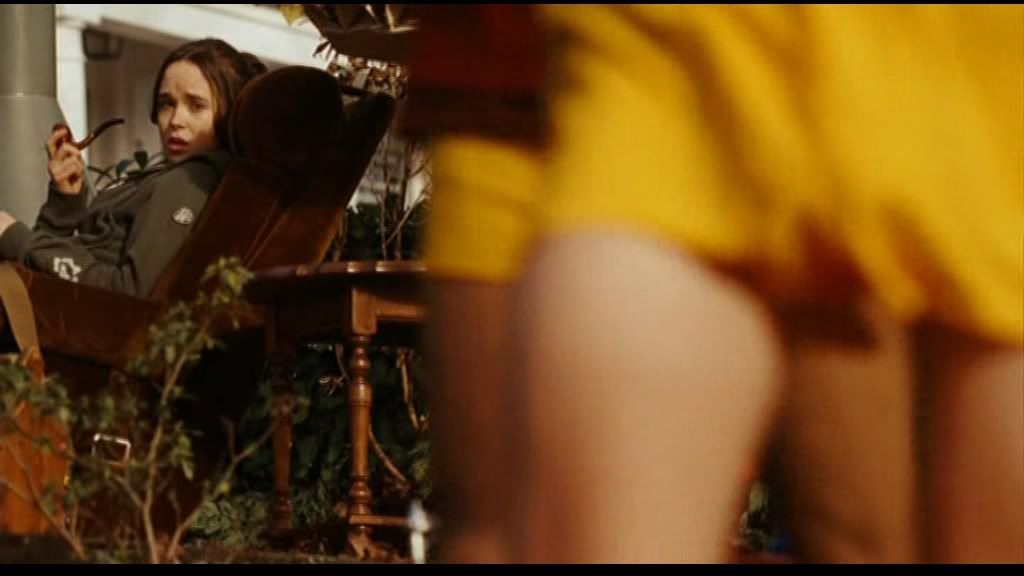
A great scene where Juno comments on how it's impossible not to objectify boys when they run around in loose gym shorts.


That is to say, Juno is not a brave film. It is not edgy. It is a safe fantasy told by an educated liberal for educated liberals. Statistically, things are never so easy. And while the film acknowledges the difficulties of teenage pregnancy (the abortion clinic scene, the fear that sometimes passes over Juno's face between her snarks), it quickly dismisses them in the favor of a facile solution. Things get a little hairy with Mark and Juno's relationship, but everything else just falls into place as planned (or, forgive the pun, unplanned... nyuk nyuk nyuk).


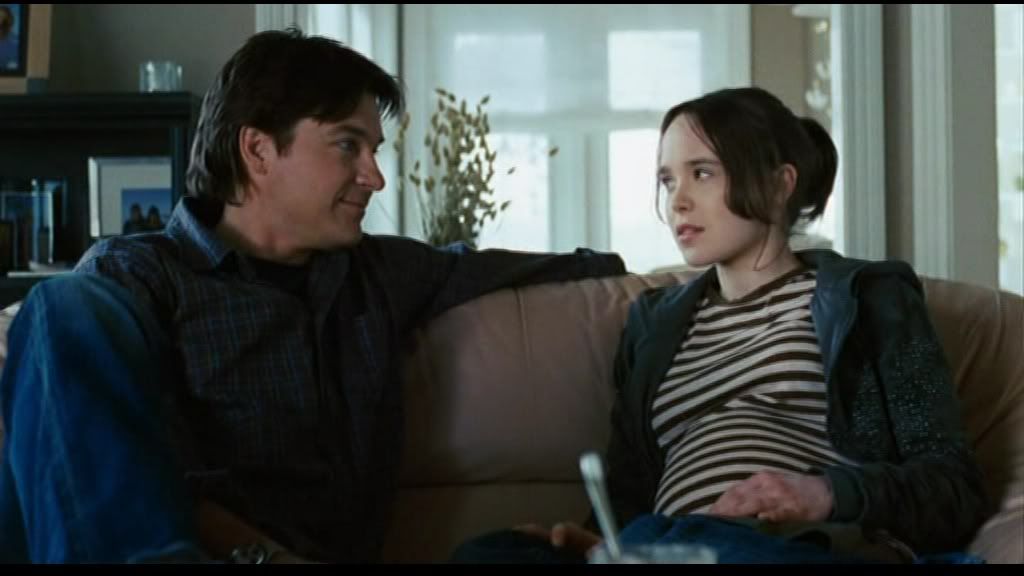
Yeah, we would have fallen for Jason Bateman too. Sah-weet.


Suffice to say, however, that the craft on display - the cinematography, the music, the acting - is all very good. The film looks good (read: trendy), and Ellen Page does carry a lot of emotion in her face, giving Juno much more depth than the script seems to provide her. The soundtrack - always a measure of these genre indie films' street cred - is decent though tending a bit more towards folk for the PPCC's liking. Tracks from Belle & Sebastian's Tigermilk are wisely selected, including the PPCC favorite, Expectations. Overall, the film seems smart enough that maybe there are yet more layers to investigate; like, why does the track team keep running past?