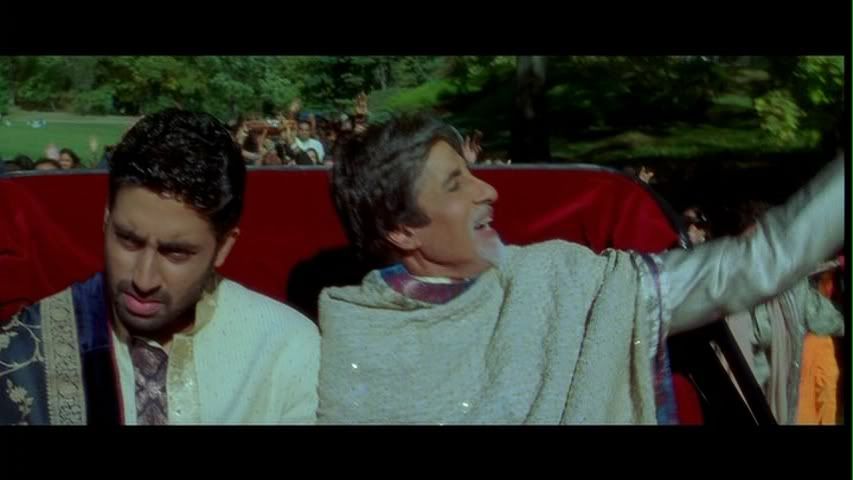
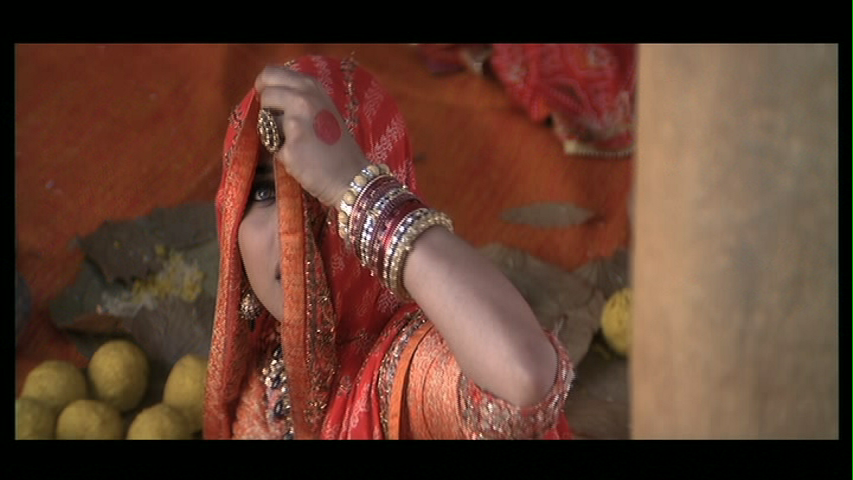
Showing posts with label rani mukherjee. Show all posts

Thursday, 25 March 2010

The (spectacular) Ends

Endings can be hard.

Pulling the audience in with a snappy idea can be relatively straightforward - we at the PPCC usually rely on some scatological goodness to draw the reader's eye (POOP) - but letting them go in a satisfying, glorious, sunsetty way is hard.

So what makes a good ending (apart from the sunset)? We think it has to satisfy certain criteria:
  • The payoff. This is the MUST of any skilful ending: presumably the story has been building to some sort of conclusion and an ending can be judged by how well it serves that final, match point.
  • The ability to make the PPCC feel a glowing sense of bittersweet finished-ness. In other words, emotional satisfaction.
  • Music! Honestly, this is a deal-breaker. Good music has raised mediocre endings to heavenly heights, and lackluster music has muted even the most powerful of conclusions.


So here are, according to us, some of the BEST ENDINGS EVER. As is obvious, MASSIVE SPOILERS for all of these - don't bother reading further if you haven't seen some of these and you value your virginity (narratively-speaking).

1. Dilwale Dulhania Le Jayenge


Jaa, Simran, jaa! Is larke se zyada pyaar tujhe aur koi nahin kar sakta! / Go, Simran, go! No one could love you more than this boy!


The best ending prop that we can think of, apart from a golden sun, is a train. What better symbol of quickly-accelerating opportunity, of the LAST CHANCE for change, redemption, resolution and joy?

The Hindi classic, DDLJ, cashes in on a 3-hour courtship full of anxiety, hoodwinking and desperate hopes to show us that - yes, YES - the Pater Familias can let his daughter go. Oh my Lord.

Tissue Rating: Pretty epic.

2. Kabhie Alvida Naa Kehna


Preity Zinta forgives you. Shah Rukh Khan loves you. Now you can be happy forever!


Basically, the same deal, the only variation being that this time, parental authority isn't the main obstacle for our lovers, it's chronic misunderstanding and a bad knee. Also features a train.

Tissue rating: Embarrassingly monumental.

3. Battlestar Galactica


I will never deny my agricultural heritage again.


Many people got all huffy with the Luddite deism of the BSG series finale (and, yes, it was a bit facile), but it did - thanks to composer Bear McCreary and actor James Callis, mostly - contain one of the most epic payoffs we've recently experienced. First of all: the long-simmering romance between Admiral Adama (Edward James Olmos) and the dying President Roslin (Mary McDonnell) finally reached the climax that we had been waiting eighty episodes for. And, far more unexpectedly, a single line by Gaius Baltar (James Callis) both resolved and redefined his Odyssean journey in a completely new way for us - talk about backward revisionism! Oh, Gaius. His name means Earth? OF COURSE IT DOES.

Tissue rating: We cried through the credits, through a shower, through a change into our pyjamas and, finally, to sleep.

4. Glory


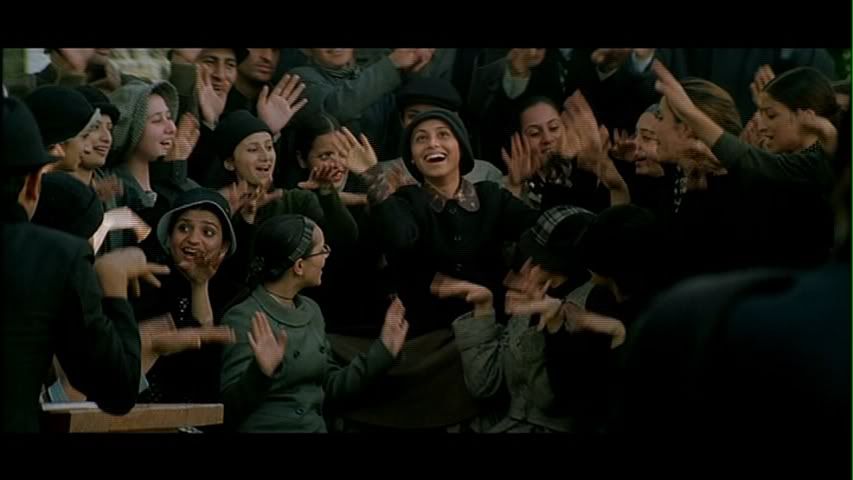
Start at 5:16.


Talk about going out in a blaze of.

Tissue rating: Huge. HUGE.

5. Goodbye, Farewell and Amen


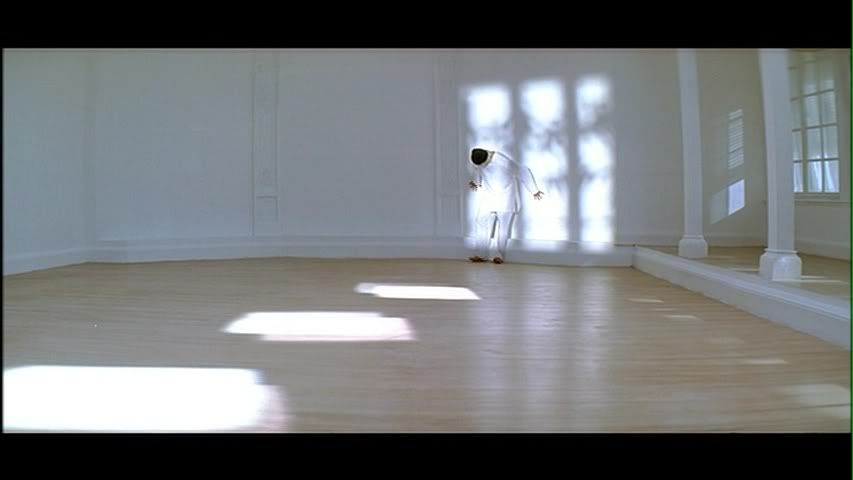
The end-all, be-all ending from a movie dedicated to the epic conclusion of our favorite series, what can better encapsulate the impermanence of everything (especially the beautiful!) than a simple, honest exchange of love, coupled with some Zen rock gardening?

Tissue rating: If we were to be honest with ourselves, we never really got over this.

6. Insert your ending here

That's what the Comments button is for! We have this itchy feeling on the back of our tongue that we've forgotten some major ones, so please: sharing is caring.

Wednesday, 23 September 2009

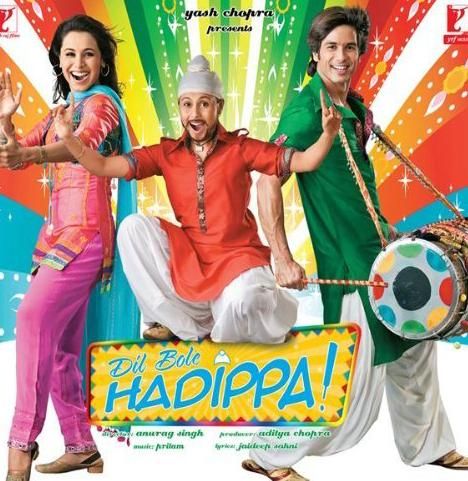
Dil Bole Hadippa! (2009)


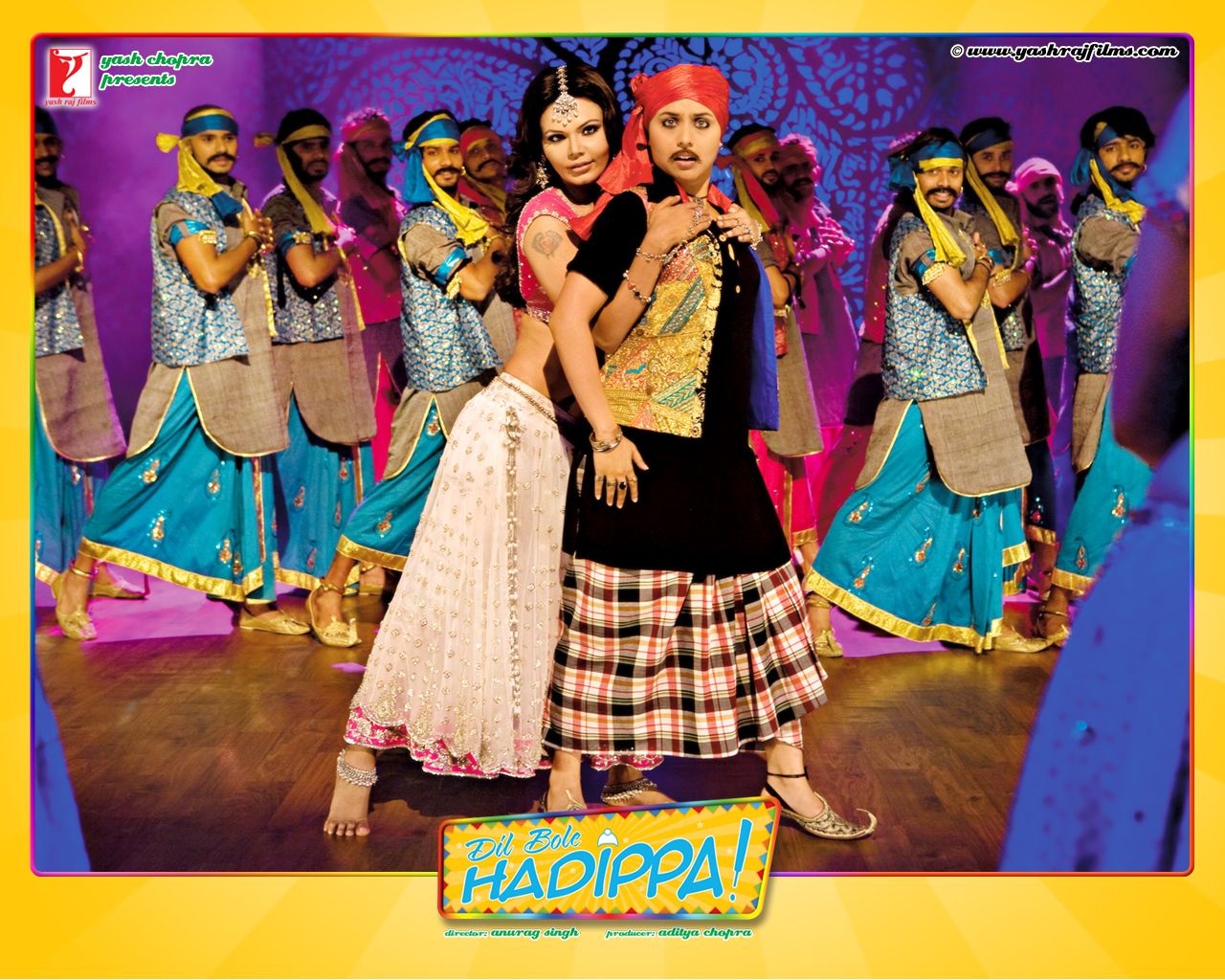
Dil Bole Hadippa! (The Heart Says Hadippa!) is your pretty standard quirky masala lite post-2000 fare - think Diet Aaja Nachle with a sprinkling of Chak De! India. It covers two increasingly popular topics in mainstream Hindi films - the sports film and the girl power film (as well as one ever-popular topic: the Punjab) - and does it using the ever-charming Rani Mukherjee in the gender-bending role of Veera Kaur and her alternate ego, Veer Pratap Singh (popular name...).

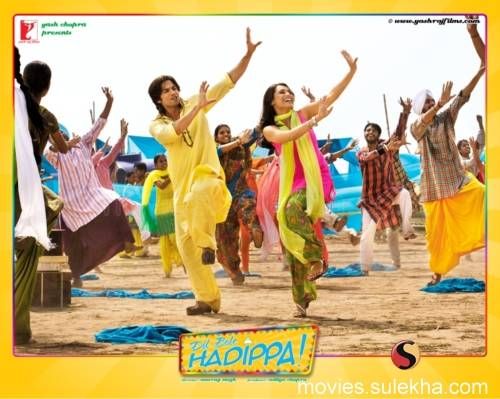
"Charming" is a good word to use for the film overall - from its bright, bubbly beginning, to its satisfyingly large bhangra dance numbers (a must, in a film so soaking in Punjabi-ness). Unfortunately, it loses considerable steam after intermission, to the point that the climactic cricket match and lover's spat feels boring and forced. Oh, just get on with it, we were thinking. Thankfully, the film's heart is in the right place: with cheerful vibes of Indian-Pakistani unity (though India, of course, must win the cricket match) and a positive girl power message.


The best song, purely in terms of volume, color (man in a pink shirt, alert! yay) and bhangra-y goodness.


Time to bring Shahid back to his roots, man.


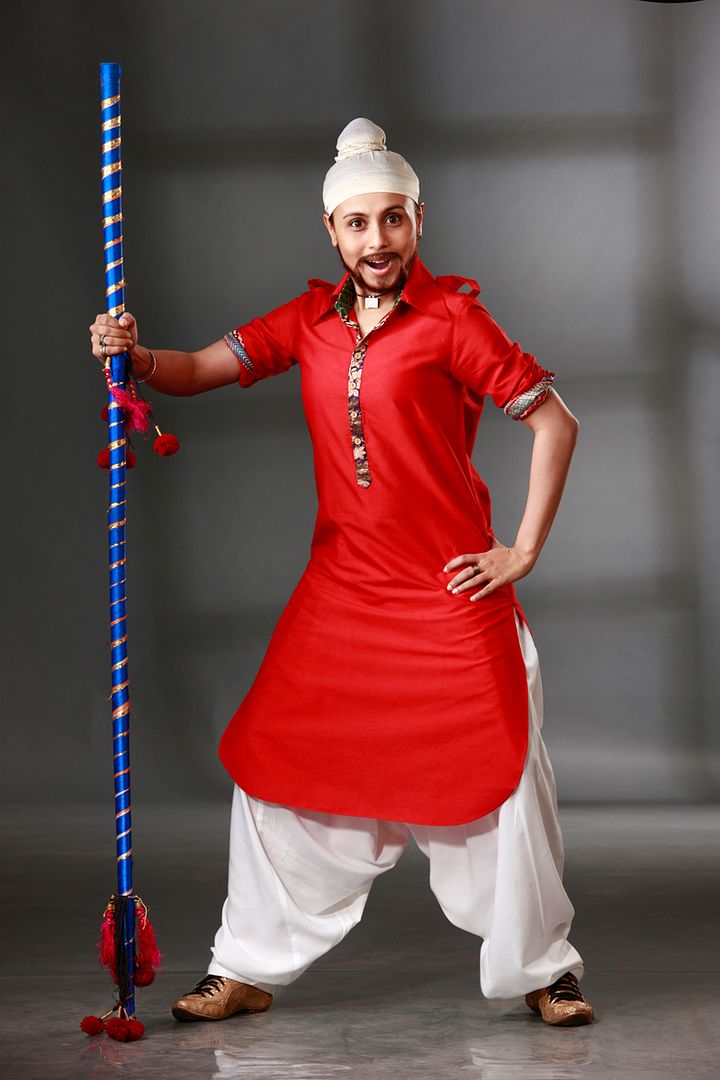
Optimistic and energetic Veera Kaur (Rani Mukherjee) is a self-declared "world-class batsman, right- and left-handed", and, when not helping out her local Punjabi theatre company, she busies herself with kicking ass on the pitch. One day, local cricket coach (Anupam Kher) and his best buddy from across the border (a very unexpectedly fly-looking Dilip Tahil - gosh, he's aging well!) have their annual India-Pakistan cricket match. With much sadness and woe, India loses. Twelve (?!) years on, and that same coach calls his cricket star son, Rohan (Shahid Kapoor), back from London - and, using some of that old-fashioned Hindi parent emotional arm-twisting - guilt-trips Rohan into staying on in the Punjab to help his dad's team beat Pakistan in the re-match. Veera, looking identical even after twelve years!, tries out for the team but is cast away due to the fact that she has a uterus. Whatever. Dejected, she mopes back to the theatre company... where she gets roped into cross-dressing as a jolly Sardar in the show's next big bhangra number. This, of course, gets Veera thinking, and no sooner than you can say "Sat Sri Akaal!" she's lost the eyeliner and donned a fake beard, reintroducing herself at the cricket tryouts as Veer Pratap Singh (uterus-free!).


Aww, Rani is a cute man!


Oh my! This is the first time we've seen girl-on-girl undertones in a Hindi film since 1959!


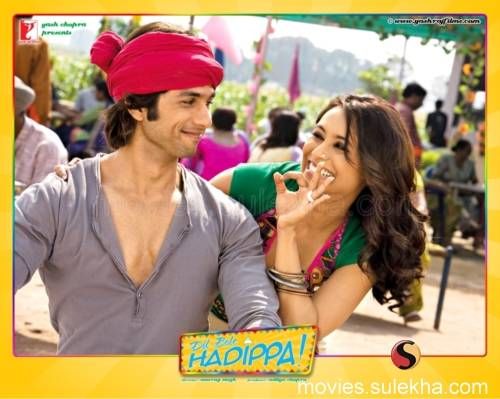
The rest of the story goes much as you expect, with some unexpectedly racy girl-on-girl and men's locker room gags. It even goes into a slightly Twelfth Night vibe, once Rohan falls for Veera and asks "Veer" for help, but things don't get too crazy.

Everything is sparkling and clean in this film, making it an altogether pleasant experience. Nothing is particularly mind-blowing - the songs are cute, the performances acceptable, the plot pretty straightforward - but we have no real complaints either. We saw this without subtitles, and so we floated above any double entendres given our limited Hindi, but we also don't think there was any great subtlety to the script. (At least, judging by everyone else's reactions.) Rani Mukherjee was her usual lovable self - we always enjoy seeing her, and she's one of the few Hindi actresses today who has that same spark and vivacity that the Greats of Old (Nargis... Neetu... Parveen...) had. Shahid Kapoor has been impressing us this year, given this and the grimy, quirky Kaminey, and we look forward to the Era of Shahid once the aging Khans finally allow themselves to be dethroned. Anupam Kher was subdued and cried a lot - which we always appreciate. And Dilip Tahil - where do you shop, my man? Because you were looking fly as heee-eeell.

Our advice: see this in the theatres, if you can. The big songs and big fun are worth it, and we expect that it'll lose quite a bit on the small screen.

Monday, 8 December 2008

THE JODI: a bonanza of love!

जोड़ी - jodi, n. Hindi. pair, match, duo


The Masala Jodi
Shashi Kapoor & Amitabh Bachchan, "Shashitabh"


The rest of this list isn't in any order, but this is definitely first. It would be silly to pretend that our favorite genre of Hindi films isn't masala - that unique and characteristic blend of outrageous, operatic, zany emotionalism that they make so well in Mumbai. Fellow blogger Beth has already discussed what aspects makes masala masala (dishoom dishoom, gangster lairs, lost babies, disguises), and indeed the masala genre - especially its golden era in the 1970s - is much beloved by the blogosphere. We have to admit - masala is like crack. Once you start, you can't get enough. Or maybe it's like sushi - an acquired taste, addictive for the converts but unpalatable for those missing the gene. Masala demands that you suspend all logic to honor instead the big heart of humanity. Dishoom! Its high point, we would argue, was in the mid to late 70s with the films of Manmohan Desai, though there have been some peaks since then (e.g. Farah Khan's films).

The jodi that best defined that golden era of 1970s masala was, of course, our beloved Shashi Kapoor and Amitabh "Biggest superstar of Bombay" Bachchan. These two met at the party that was Roti Kapada Aur Makaan, but they fell in bromance in Deewaar. The chemistry between these two already very charismatic actors was magnetic - whether they were playing estranged brothers or even antagonists, we could rest assured that they would always have a very strong connection. Like the Force! They complimented and contrasted each other as a quirky yin and yang: Amitabh's macho bravado against Shashi's fey dandying. Sometimes one would be the "straight man" to the other's gags (e.g. Amitabh begging Shashi not to report him in Suhaag), sometimes the roles would switch (e.g. Shashi begging Amitabh to save him from marriage in... Suhaag again). They had unique and different screen presences (and hotness factors) which, combined, became even better. Like... chocolate and raspberries! Pizza and pineapple!

What are some magic jodi moments? Most people would probably point to the iconic "Mere paas maa hai!" dialogue from Deewaar, but we've never cared for that film. Instead, we love:
  • Amitabh dragging a drunken Shashi away from an Amazon-style Parveen Babi in Namak Halaal.
  • When Amitabh and (a sick!) Shashi fight off some goons in Immaan Dharam, and Shashi warns the goons that their (platonic) girlfriend has two brothers looking out for her. When none of them are actually related!
  • In Silsila, when Shashi gives Jaya a tape of Amitabh reciting poetry. Jaya asks, "Praytell, who is this gentle poet with the fly voice?" And Shashi smiles in that Shashi way of his and croaks that Shashi voice of his, proudly informing her, "Mere bhaaaaaaai hai!" ("He's my brother!") And then a fast cut to Amitabh kicking it with a brass band in tow.
  • Basically, all of Suhaag, but especially the bit when Shashitabh's mom enquires about whether Amitabh is already/is intending to get married, and Shashi jams his toast and says, "And who's gonna marry this loafer, goonda, idiot..." under his breath.


Where can I watch this jodi in action? Deewaar, Suhaag, Immaan Dharam, Trishul, Do Aur Do Paanch, Namak Halaal, Silsila, Kaala Patthar... and in particular Aa Yaar Sun.


The Endangered Jodi
Rani Mukherjee and Anil Kapoor, "Anvil Rain, by Meatloaf"


Anyone else reminded of Broken Social Scene's Lover's Spit? "Oooooh, all these people drinking lover's spit, sit around and clean their faaaace with it."


We must make special mention of our newest favorite jodi, Rani Mukherjee and Anil Kapoor. These two are endangered because, as Anil creeps along to 30 50 (!), it becomes increasingly unlikely that he'll be playing many hero roles and indeed, as Filmi Girl notes and we agree, he's instead moving into the Pran territory of character roles. Meanwhile, Rani, at 30, is in her heroine prime - though heroines have a much shorter lifespan than heroes in Bombay, and so she might be finding herself in that netherworld of Juhi Chawla-esque pre-"Naaahiiiiin!"-ing Mom roles in ten years (good for this jodi!). Either way, it's unlikely that we'll see this jodi again anytime soon - as much as we really, really would like to, Mr. Bollywood Producer! Surely Anil's producer brother, Boney, can get something going for these two? Maybe they can be the kooky sideplot couple in some multi-starrer melodrama? (Though, honestly, we'd prefer to just give 'em a big ol' three-hour masala meltdown movie as hero and heroine. That would rock!)

Anyway, the reason we like these two so much is because, as with all good jodis, they have great chemistry. They're both talented at comedy of the squishy dil variety; e.g. expressive, funny and able to freely burst into tears. They can both carry much more depth, if needed. But we really like them for their light-hearted romping in Nayak, our newest favorite movie. Those acid trip scenes won us over completely.

Magic jodi moments?
  • In Nayak, when Anil says something sweet to Rani, causing her to burst into tears. After letting her cry for a minute, he goes, "Okay, okay, give me a smile now. Come on, smile." When a blubbering Rani tries to smile through her tears, Anil looks disgusted and drawls, "Theek-se haanso, naaaa?" ("Laugh better!")
  • In Nayak, when an angry Rani admits she had fed Anil's lunch to the goat because she was so angry at him, and so can only give him some stale roti and onions. Anil not only assures her that "stale rotis with you is great!" but cries when she feeds him.
  • And basically everything they do in the roti song, the Mughal-e-Azam song, the chalo chale song and the pot people song.


Where can I watch this jodi in action? Nayak, Calcutta Mail, the movie that we're going to make the day we win the lottery and take over Bollywood... and that's IT!


Jodi of the Future
Farah Khan and Shah Rukh Khan, "Yes, we Khan!"


While choreographer/director Farah Khan and superstar Shah Rukh Khan have been friends since their early days in Mumbai, they only started their most potent collaboration in 2004 with Farah Khan's directorial debut, Main Hoon Na. This film revived in grand style the best of masala (which the Shashitabh jodi embodied): it was loud and beautiful and fun and frantic and smart. The two followed this up with 2007's Om Shanti Om, which was even louder and more fun (though with a crazy second act... a more unfortunate masala characteristic!). Given the superhit status these two films achieved, we're pretty sure that Farah and SRK will be teaming up again, and we look forward to whatever they'll give us with great anticipation!

Why is this jodi so great? Well, Farah Khan knows masala and she knows exactly how to use SRK. The man was made to be a singing, dancing, charming performer - a star, more than an actor - and Farah puts his hamming and preening to work in the best possible context. Om Shanti Om, in particular, is loaded with a knowing, self-deprecating sense of humor as we watch SRK the struggling extra ham his way up to SRK the egotistical superstar, with ample in-jokes along the way. We love Farah and SRK because they are two intelligent entertainers who make seemingly "brainless" pop which is actually not so brainless at all!

Magic jodi moments?
  • A scene that made us go, "Yes! YES! THANK YOU, FARAH KHAN!" was in Om Shanti Om, when Om the struggling SRK comes home to his mother and engages in the most filmi melodramatic meltdown over his doomed chances at becoming a star. This scene - with its silly camera angles, and SRK's angsty posturing - was perfect and great, a silly piss-take both of SRK's critics and SRK himself.
  • In Main Hoon Na - another film filled with in-jokes about the aging SRK playing the eternally youthful college student - the scenes when SRK expresses his most charming nerdy side, singing off-key, throwing his limbs around helter-skelter, swooning at Sushmita Sen and generally being buoyant and wonderful and freeeee. Sometimes we forget why we love SRK so much, but then we watch Farah's films and dance routines and go, "Oh, yeah."


Where can I watch this jodi in action? Main Hoon Na, Om Shanti Om, and almost any SRK dance routine in the 90s and 2000s was choreographed by Farah... so we'll just pick the legendary Chaiyya Chaiyya from Dil Se as representative.


Golden Era Jodi
Nargis and Raj Kapoor, "Setting screens alight (burn, baby, burn!)"


Sigh. Raj and Nargis. To call what they had "chemistry" is to undervalue it. These two were on fire. They were electric, magnetic, alive. Perhaps it was due to their rumored affair, but watching Raj Kapoor and Nargis together on screen was something so elegant, intimate and intoxicating that we at the PPCC always feel a little voyeuristic. Their connection leaped off the screen, it just seemed like they were in each other's skins. We reckon they defined the black and white era of Bollywood too, as they made some of the biggest classics together - Shree 420, Awaara, Chori Chori. Already two very talented performers, they improved each other - especially since powerful, fiery Nargis tempered Raj's tendencies for objectification. And they were equals - another very important aspect of all our favorite jodis.

Magic jodi moments?
  • When Raj Kapoor realizes Nargis is his long-lost childhood sweetheart in Awaara. He takes her home and shows her a childhood picture and she turns, eyes alight. "Oh, Raj, it's you!" And Raj just smiles serenely and shrugs.
  • Actually, all of Awaara.
  • Their flirting and mutual seductions in Barsaat, where they cast burning glances at each other while the Sitars of Sex blaze in the background.
  • In Chori Chori when, after a long journey of Benedick-Beatrice style snapping at each other, Nargis realizes her feelings for Raj and realizes that they are reciprocated. Her joy and longing in the song Aajaa Sanam is just incredible to watch. Guh, they're so beautiful!


Where can I watch this jodi in action? Awaara, Barsaat, Chori Chori, Shree 420


The Alt Indie Jodi
Naseeruddin Shah and Om Puri, "How do you like them apples?!"


The whole reason we started this blog, Naseeruddin Shah and Om Puri are probably the most recognizable and palatable jodi for the Western Bollywood virgin. With their naturalistic acting, and their tendency to appear in Western films as well, these two are most fun when they can just cavort together like the Statler & Waldorf of Hindi cinema, grumpily heckling the younger generation. Honestly, when our well-meaning and thoughtful Hindustani friends try again and again to tell us why Aamir Khan is really a great guy, blah blah, we just think of Naseer and Om cackling in the background. Because they are it - they are the real deal. Aamir Schmamir, Naseer and Om are the real progressives.

The best parts of the jodi can be found in their Parallel Cinema days, but there are also some Bollywood moments to be had. Magic jodi moments, off the top of our head:
  • Naseer trying to save Om's butt in the first film ever PPCCed. Oh, the memories!
  • The wasted Om and Naseer peeing over the side of the balcony in Maqbool.
  • Team Naseer-Om kicking dacoit butt in the Kurosawa-inspired misfire that was... CHINA GATE.


Where can I watch this jodi in action? China Gate, Aakrosh, Maqbool, Sparsh, Arth, Shoot on Sight

The Official PPCC Jodi
Pran and the PPCC, "A match made in heaven"


It was love at first sight here at the PPCC when Pran made his debut on our television screen and in our hearts. Never again would we be able to review a film co-starring Pran in the same way, as his presence inevitably provoked such an intense burst of passionate affection that we usually can only write "PRAAAAAN!!!!!!!!!!!" and be done with it.

What is it about Pran that makes him so gosh-darned special and so golly-whiz lovable? Is it his characteristic delivery WHERE.EVERY.WORD.SOUNDS.LIKE.IT'S.OWN.SENTENCE!? Or is it his craggy, pirate-esque features? Is it the fact that he was apparently some sort of mathematical genius? Or is it all those fabulous character roles he played, where no masala treat would be complete without "...and PRAN!" in its title credits?

Whatever it was, we identify with Pran. We are like the Pran of the blogging world. When they make the masala madness meltdown movie of Bollywood bloggers, we want to be the Pran - perhaps a little ambiguous, a little shady, but distinct, quirky, memorable! Hero, schmero, GIVE US MORE PRAAAAAAN!!!!!!!!!

Magic jodi moments:


Where can I watch this jodi in action? Amar Akbar Anthony, Madhumati, Do Musafir, Don, Chori Chori, and our hearts

Monday, 1 December 2008

Calcutta Mail (2003)

Have you guys ever seen the Korean film, Oldboy? It's a great movie. A stylish, intense, hyper-violent thriller with a plot like a bullet train. It's one of the Founding Films of the PPCC - something we always wanted to write about, and decided to start a blog to do just that - yet it lingers on our To Review list for an embarrassing 1.5 years now.

Now that we've just watched a very similar Hindi movie, Calcutta Mail, we're reminded just how good Oldboy is, and how we really should get to reviewing it.


Lots of great shots of Calcutta. See the chawl!


The crowds!


The parallels between the two films are eerie, though the plot of Calcutta Mail differs in several key respects (and it's a remake of a Telugu film, Choodalani Vundi, anyway). In both films, we begin in media res, with a tormented, haunted protagonist getting harried by all sorts of goons and bad memories. (Oldboy shows us at least some of what's haunting protagonist Choi Min-Sik - being forcibly imprisoned for 15 years without any apparent justification.) Both protagonists are likable Everymen who are driven by an intense and mysterious desire for revenge (and gosh, they even resemble each other physically!). Both have iconic moments of totally flipped out intensity - the scene in Oldboy when Choi Min-Sik eats a live octopus, or the scene in Calcutta Mail when Anil manages to blow a police officer's desk aside by the sheer force of his screaming. Both films feature a seemingly implausibly bubbly female foil, a perky potential girlfriend who both aids the protagonists and keeps their tenuous morality in check. And, of course, both films are moody, dark thrillers that leave the final mystery's details unsolved until the very, very last moment. Both have some pretty kick-ass fight scenes, though Oldboy's (especially that legendary single tracking shot in a corridor) are generally better. That said, Calcutta Mail is dark, fun and intense. It is a genuinely thrilling thriller.

Without giving too much away - as the mystery of the narrative is one of Calcutta Mail's strongest points - the film begins with our harried hero, Avinash (an exhausted-looking Anil Kapoor), arriving in Calcutta from Bihar. He is searching for one Lakhan Yadav (Sayaji Shinde), and is, by his own account, bahut pareshan ("very troubled"). As he phones shady-looking goondas at mysterious telephone numbers, he arouses the interest of the evil Lakhan himself, who starts trying to kill him. Meanwhile, Avinash finds a room in a chawl (yay! we love chawls!) with the zesty Bulbul (Rani Mukherjee). Bulbul, an aspiring writer, is immediately attracted to this mustachioed Byronic hero spending sleepless, weepy nights on her balcony, and she - by way of two songs (one which is completely inappropriate considering the film's vibe and one which is an adorable fantasy) and some fake drama - weasles her way by Avinash's side. Her support becomes very useful as knife fights, train crashes and Manisha Koirala scenes begin piling the problems up.


Storm's a-comin'.


The director, Sudhir Mishra, is an expert at building and maintaining tension. He establishes it with brooding "before the storm" moments and punctuates it with excellent editing - for example, there are several scenes where he'll cut away from the drama, just when Anil is to be squished by two oncoming trains, to show us a wide shot of the countryside, or the city. "Argh!" we would scream. "You tease! Show us what happened!" And he always does - don't worry. His camerawork provides excellent pacing - shaky, disorienting fight scenes, sweeping mob scenes, and quieter stuff for intimate moments. The palette - if our crappy VCD can be trusted - is muted and filled with shadow. He makes everything - even the expected comfort of a homey middle-class chawl - look hostile and threatening.


Black and white flashbacks, shaky cameras, scary!


Some things to note, for those that have watched the film:
  • Isn't Ishu the Hindi name for Jesus? If so, that's interesting.
  • Is it just us and our Shashi-shaped glasses, but to what film is Anil referring when he does his Shashi-impression? ("Jahan baaaaap hai to kya baaaaat hai?") It's totally intentional. Aa Gale Lag Jaa?
Anil Kapoor, newest PPCC favorite, is a legend, as usual. One of our favorite things about our favorite actor, Toshiro Mifune, is how he would totally flip out sometimes. He would just lose it! Indeed, our highly-honed and practiced Toshiro Mifune Impression is us, spouting garbled Japanese ("Domo arigato!!! Ohaio gozaimas!!! Toshiro Mifune gas ki des!!!") at an increasingly frenzied pitch. Anil has some similarly demented scenes of maximum voltage - and we loved it! It was intense and it was awesome! He's good at those. We were also impressed by how sleepless he really did look - method acting, or cunning lack of make-up?
One of the very satisfying Anil meltdowns. MAXIMUM VOLTAGE!!!
Poor Rani had a bizarre role and did what she could with it. Her scenes of light-hearted teasing, her invented drama and total initial misunderstanding of the gravity of Anil's problems were loud false notes in the narrative. Unfortunately, the best she could do was get out of the way. This is a shame, since a well-written girlfriend/sidekick would have been a treat and Rani's always great. Alas, we'll retreat back to Nayak for the Anil/Rani jodi (tho thweet!). Sayaji Shinde was an excellent villain. He managed to project a sort of demented explosiveness coupled with moments of creepy vulnerability (ughh, his scenes with Manisha). Manisha Koirala, who we haven't seen since Dil Se, was acceptable but made us miss Rani.

Thursday, 27 November 2008

Nayak: The Real Hero (2001)


This movie was so 1990s we were having Kris Kross - totally krossed out! flashbacks. And it was made in 2001!


With blow after wacky blow, Nayak: The Real Hero slowly wears down any reluctance you might have to it. "You know you love me!" the film insists and, even though we cringe in embarrassment and scoff and laugh at it, it's right. "Love meeee!" The IMDb review entitled "Bright and brash" by rl400 perfectly sums it up:
A very silly, bright and brash comic book of a film that highlights Indias significant corruption problems but still entertains. Despite starring the old and hairy Anil Kapoor and the awful Johnny Lever in an irritating first ten minutes this film is bursting with vibrant colour, grand song sequences and energy. Rani is as stunning as ever in her occasional appearances as the love interest and sports a rare (but very welcome!) cute village girl look...It won't trouble any brain cells but the three hours whizz by.. a real old school entertainer.

Part Dave, part "This is your brain on drugs", it's one of those psychadelic masala movies, only with a (delayed) 1990s bite of satire, media frenzy and parody. If you're one of those people who recoils in fear from clowns, you might want to avoid this - it's a circus in total chaos! It is over the top to the max, merrily flinging around extreme scenes of extreme emotion. This may make it sound hard to get into - what about suspension of disbelief? - but honestly, it is a rollicking good time. We haven't had this much zany fun since the 70s.


Just one of the many bizarre moments you'll enjoy when you watch this film.


As Mr. IMDb reviewer briefly describes, the plot centres around bouncy, likable reporter Shivaji Roa (an admittedly very hairy, pre-wax Anil Kapoor). Shivaji's just a cool Mumbai homeboy with a heart of gold. He and his partner (Johnny Lever) work for a TV station, capturing in their paparazzi-glare the rioting, corruption and cynicism so seemingly embedded in their city. During one of their reports in a remote village, Shivaji's heart is captured by the spunky village belle, Manjari (an absolutely adorable Rani Mukherjee). Things seem to be on the up for Shivaji (like Anil these days!) - he's just been promoted, and he's been asked to interview the Chief Minister of Maharashtra State, Balraj Chauhan (Amrish Puri). The idealistic Shivaji gleefully dismantles Balraj's entire political credibility on live television, earning him many enemies and a challenge from Balraj himself: "Oh yeah? You think you could do better? Well, I henceforth make you Chief Minister for a day!"

The remaining two and a half hours basically follow this conceit over a roller-coaster of craziness. Just like Kevin Kline's everyman president in Dave, Shivaji turns out to be a much better politician than all the others: single-handedly tackling all the hairiest (no pun intended) problems like slums, low employment, Eve teasing, judicial lags and, of course, corruption. This naturally earns him the hate of those invested in the status quo, and there are many, many wacky fight scenes - including one where he loses all his clothes and emerges from a pit of sludge like some nude mud monster doing bizarre kung fu! When not getting almost assassinated and drenched in sludge (or milk), Shivaji retreats to his village Elysium where he frollics through the fields with Manjari taking hallucinogenic drugs, cavorting and being hilarious and adorable. Indeed, the entire romance is solely based on several similarly-themed songs ("We took LSD and now we're going to roll around in the great outdoors!") - which may make it sound like a bore, but it's actually delightful and cute to watch.


The "evil pot people" song.


The "Rani has totally seen Mughal-e-Azam too many times" song.


This stuff is pure pop, but it's pop of the best kind. It takes itself seriously when it should - that is, it never undermines or teases the real problems of the society it satirizes. For example, when a traffic jam degenerates into full-fledged rioting, the camera lingers on the victims and there is great sympathy in its treatment of the poor and downtrodden. Anil Kapoor, as the Everyman Hero, plays it straight: his earnest emotional reactions ground the film's insanity into something at least remotely relate-able. The package may be crazy, but the message is pure and true.

Performance-wise, as we said, Anil does a really great job. He is deeply likable as the charismatic, "buddy to everyone!" Shivaji. Apparently this role was originally going to go to Shah Rukh Khan, but we're very happy Anil got it instead (indeed, we're even thinking Anil would have been better than SRK in certain SRK roles as well). Rani Mukherjee, with a relatively small and limited role, managed to be likewise adorable - she did all her tradermark "cute Rani!" things such as pulling silly faces and freely bursting into tears. Johnny Lever had literally one joke in the entire film, which he insisted on repeating in every single scene he was in. Amrish Puri, who we're starting to regard as a gem of Hindi cinema if only for so gamely tackling any role he was given, gamely tackles the super-evil, super-corrupt, "I break people's arms in my limousine window as I drive away" politician. He was a lot of fun.


Oh my gosh, so CUTE.


Poor Anil character fell down the stairs after taking too many - JUST KIDDING.


What really gives the film its personality, though, is the direction, cinematography and song picturizations. We were slowly coming to grips with its Wayne's World-style extreme close-ups and "earthquake" effects when this song popped up and we were completely enamoured (and not a little scared). It was nightmarish, Alice in Wonderland-style insanity - and incredibly compelling! In fact, all the songs were such fun! While not A.R. Rahman's best, music-wise, their picturizations were so lovable that we ended up watching several of them several times. One of our favorites - and a great example of Anil and Rani's chemistry (dudes, Calcutta Mail is sooo on our list now) - was the "How much fun is eating stale rotis when you're around! Oh, I've gotten drunk on cold water!" song. This song was a riot - they exchange clothes! they lick each other's tongues! they give each other tummy raspberries! she plays make-up with him! They just go nuts, and it's incredibly cute. We would have been happy if the whole movie was just one long protracted 1990s MTV session of Anil and Rani going mental.

In the end, we were surprised how satisfying this movie was. It was loud, colorful, unique and full of "who gives a flying eff" WTF insanity. Highly recommended.

Friday, 8 June 2007

Black (2005)

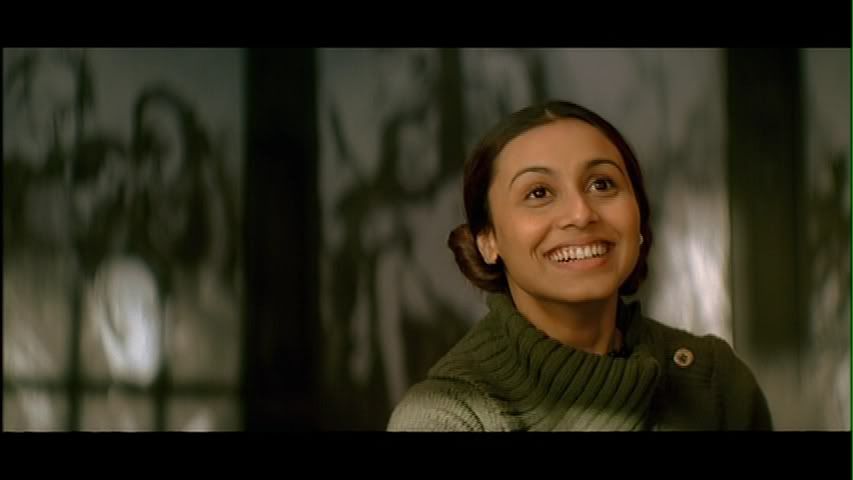
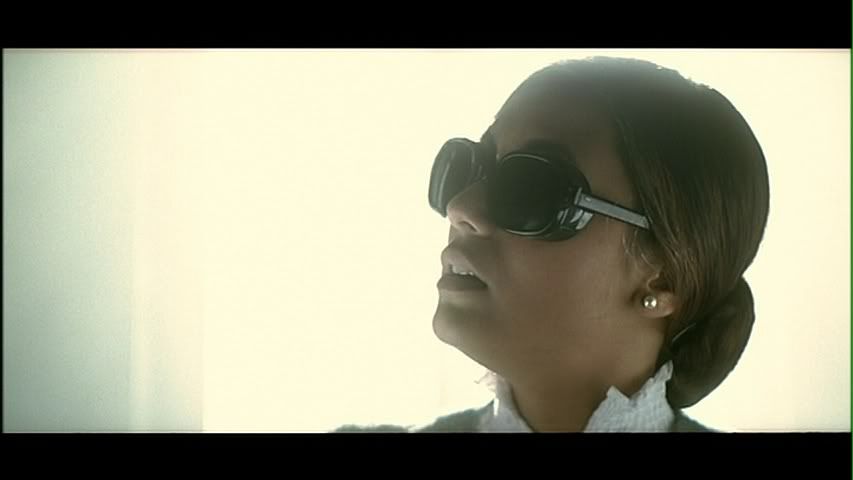
There's really only one reason to watch Black and that is Rani Mukherjee's performance. While an aging and curmudgeony Amitabh Bachchan tries to win over our love by being gruff and paternal, he is still outshined by Rani, who shows that she can do much more than just cry in Shah Rukh Khan's arms all the time.


I am Rani, Queen of Acting Skill.


I am Amitabh. I am out-acted.


There are two Helen Keller quotes before the title, and this sets the tone of the film. Black is practically an unofficial remake of Helen Keller's life, with the slightest of Indian touch. You will see narry a bindi here, for Black takes place in a make-believe India so Europeanized it makes Switzerland look exotic. It is the story of Michelle McNally (Rani Mukherjee), an Anglo-Indian girl who is born deaf and blind. For eight years, her parents struggle to care for her, but they can do little more than tie a cowbell to her side and resign themselves to her fate. That is, until, they find a teacher and self-proclaimed magician, Debraj Sahai (Amitabh Bachchan), who - as the back of the DVD case would have us believe - is a "battle-weary warrior" and also braille and sign language expert. Thanks to Mr. Sahai, Michelle "comes into the light" and is able to lead a thriving, dynamic life, something she never knew as a child. She goes to college and earns a BA in Arts, a triumphant achievement.


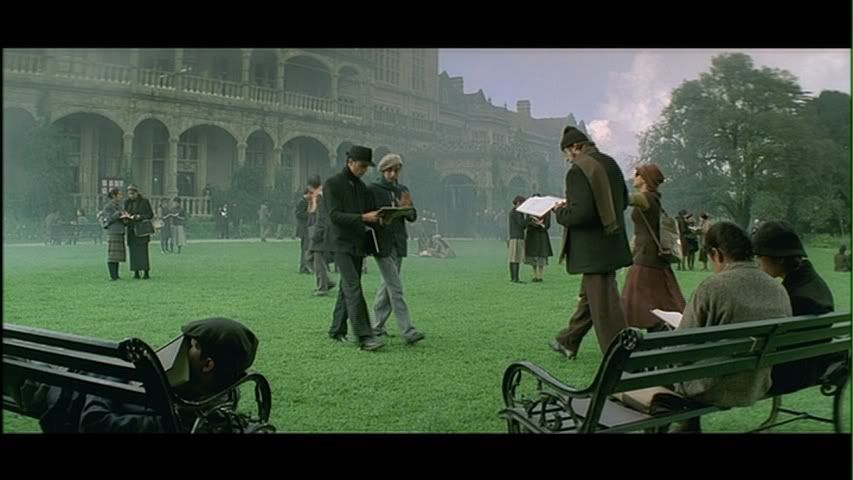
A lovely college scene.


Jesus College, Oxford University, India.


But all is not well. Mr. Sahai, who certainly didn't lead the most healthy of lifestyles (booze + choleric personality + that ever-present beanie!), ages rather rapidly and soon begins suffering from Alzheimer's Disease. It is then an adult Michelle's task to bring her teacher "into the light", re-instructing him in all that he has forgotten.


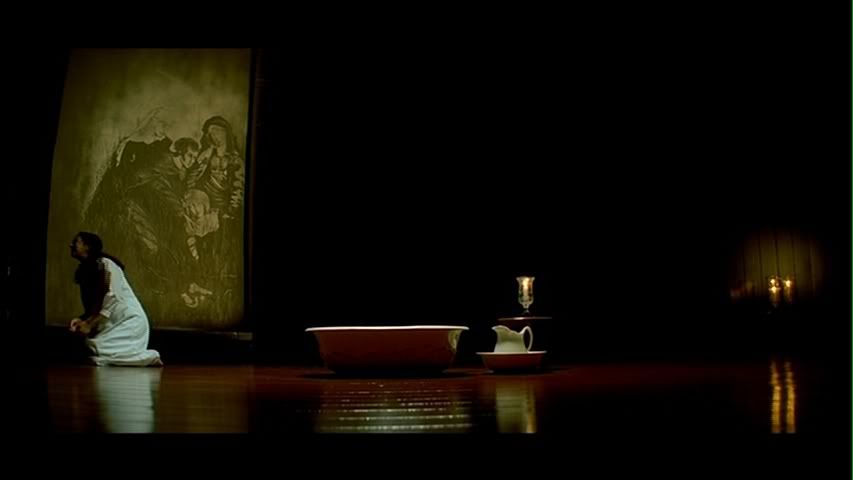
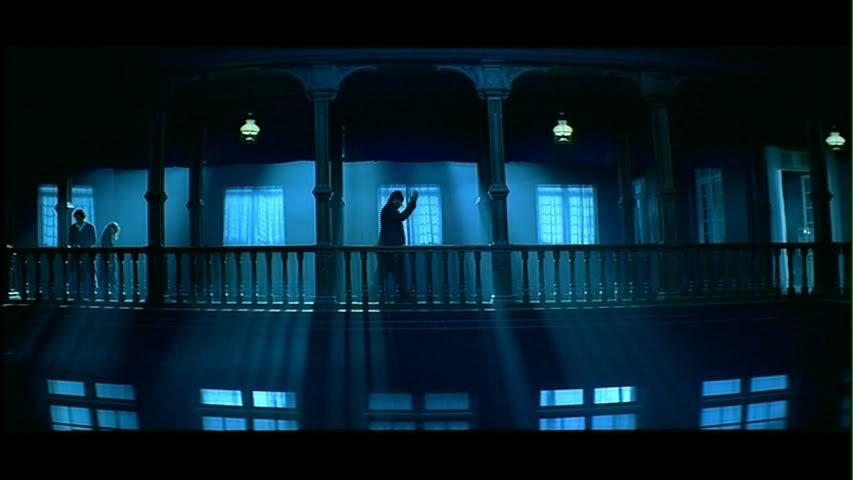
Gothic imagery, almost to the point of being creepy.


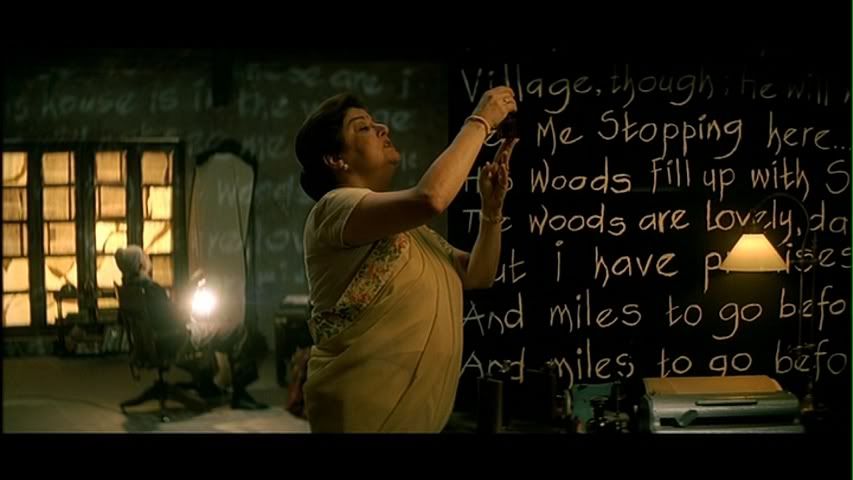
See?! Robert Frost on the walls? Creeeepy.


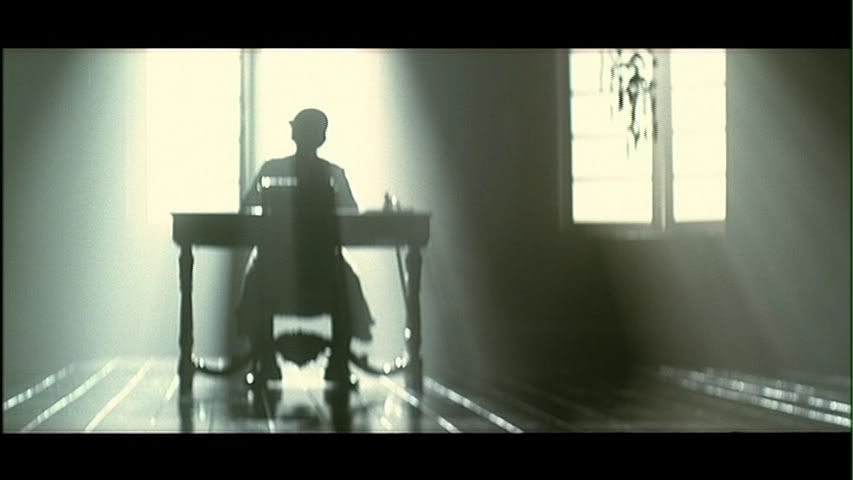
Like a horror film! Aieee!


Well, it's certainly hard to be hard on a story as triumphant and inspiring as this. The fact that it is, practically par for par, a re-telling of Helen Keller's life means that, at least somewhere, something as amazing as this really happened. And that's quite an achievement. Wikipedia's entry on Helen Keller will fill you in on the details - but the teacher-pupil relationship of Mr. Sahai and Michelle is obviously based on the real-life relationship between Anne Sullivan and Helen Keller. For example, Mr. Sahai also takes it upon himself to discipline Michelle as his first task, and the break-through scene is, indeed, when Michelle understands the sign for "water" and then demands to know the signs for every other object around her. There are, of course, a few, minor differences in this fictionalized account; the fact that it's Amitabh Bachchan, former superstar and now crusty-yet-lovable Obi-Wan Kenobi figure, clearly changes the nature of the relationship to something a little more complicated. At least, Michelle cannot help but demand a kiss in one scene. (Who wouldn't? Come on, now, it's the Big B!)

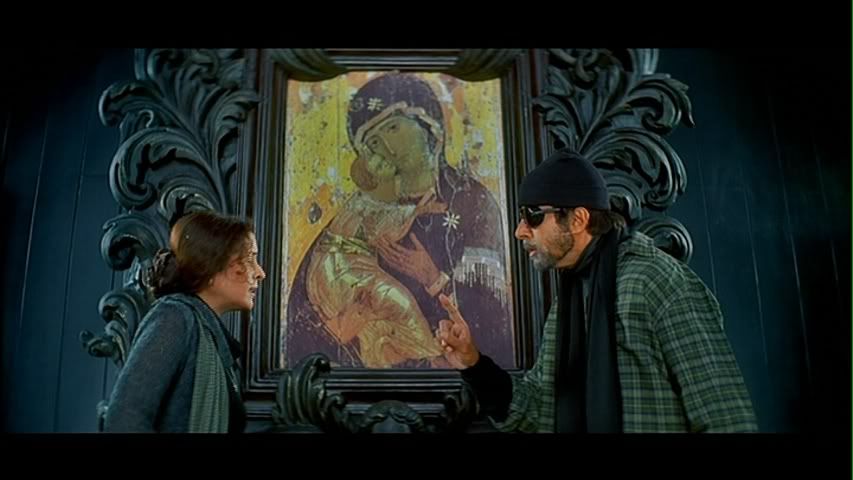
For a film directed by the guy who directed Devdas, this is as opulent and austere as that mainstream Bollywood fest was, except now with an overblown European, uber-Christian setting. Instead of a huge Ganesha in the atrium, we have the Virgin Mother looking down on us. Apparently Christian homes also resemble Gothic cathedrals, complete with very tall windows and poor lighting. While the film maintains the thin belief that this is "somewhere in India", most of the dialogue is in English, the characters all clearly Christian, and the costumes straight out of the latest autumn catalogue of Abercrombie & Fitch. For those of you wanting to see some Hindi cinema, this is about as far from Hindi cinema as a Hindi film can get. Unsurprisingly, there are no songs.


Your standard, run-of-the-mill Gothic cathedral house.


With lots of walkways and railings. Like in Devdas.


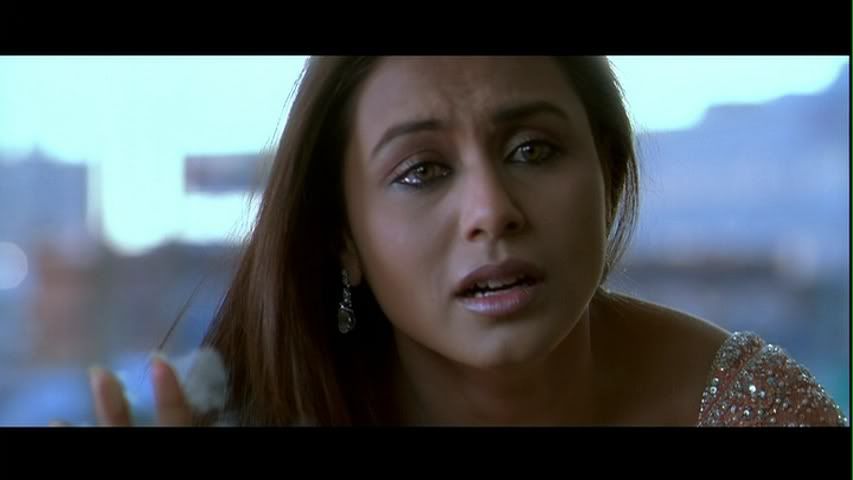
But Rani Mukherjee really is amazing. Her transformation from the eternally weepy Barbie to Shah Rukh Khan's Ken is stunning, and she takes a big leap in playing an unglamorous and difficult role like Michelle. The young actress who played the eight-year-old Michelle, Ayesha Kapoor, is also incredible - we assumed she was really deaf-blind until we read in an interview that she wasn't. All we can say is, DAMN, GIRL. That is amazing for a child actor. Amitabh Bachchan is enjoyable, though not necessarily realistic, as we kept noting to ourselves that if someone as loud, theatrical and gruff as that came into our lives, we would think our life had turned into a bit of a movie. Also, his insistence on wearing a black beanie at every occasion - weddings, graduation ceremonies, psychiatric wards - over a period of twenty years, became a bit silly. Still, you gotta love the Big B. And, of course, ask the eternal question: Why isn't Shah Rukh Khan making stuff like this?


Good question!

Wednesday, 6 June 2007

Kabhi Alvida Na Kehna (2006)

The best scene in the 3-hour soap opera, Kabhi Alvida Na Kehna (Never Say Goodbye), is the classic train station finale. You've all seen it. It was in Reds. It was in Dor. It was even already an hour earlier in this same movie. With sweeping choral voices to accompany the slow-motion chase, Maya (Rani Mukherjee) races through the station, saree flowing behind, searching frantically for her love, Dev (Shah Rukh Khan). Quick! The train leaves in one minute, and if you don't catch him now, YOU'LL NEVER BE ABLE TO TELL HIM YOU LOVE HIM! (Mobile phones and Hallmark cards don't have quite the same effect.) Thanks to some tragic misunderstandings, Dev has actually seen Maya and is quickly limping away, trying to avoid her. The camera swoops, we see Maya running while Dev hustles through the crowds. The camera zooms, we see Dev stop in his tracks while Maya asks someone for help. The music climbs to a climax: Dev dodges into the train, sits, and then -


COME TO MY BOSOM, DEV BABU!


Admittedly, you have to wait three hours and five minutes for this piece of conventional cinema gold. Since we watched this movie in half-hour snatches throughout an otherwise busy but boring day, we would say it was digestible. It was like having the Friends season finale, going on and on and on... Bored with work? Turn on KANK for a few minutes. Tired of KANK? Back to work.


Meh, why not?


Maybe that's being a little cruel. But we had prepared ourselves for the worst: one of those multi-starrer post-2000 Bollywood extravaganzas that hide a vacuum behind a thin shell of tears, bad jokes, and unsatisfying songs. We were a little surprised then: the story is presented with sensitivity and a light, deft touch (rather than overbearing melodrama... well, it's not that overbearing), and Shah Rukh Khan's powers beat us again, for we cried. (For you at home keeping score, that makes Shah Rukh Khan - 5, PPCC - 0. Curse those dimples!)


Oh, those dimples!


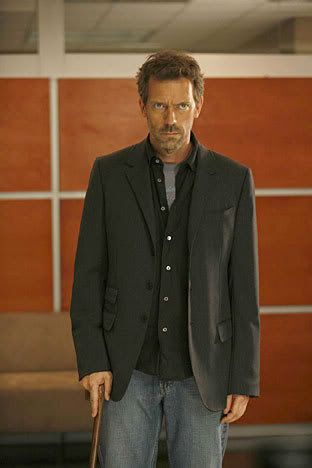
The story is this: Rishi (Abhishek Bachchan) is a happy-go-lucky guy who loves life and loves his wife, Maya (Rani Mukherjee). Maya, however, is Frosty, Queen of Ice, and interminably dour. And also infertile. And shrewish. Meanwhile, Rhea (Preity Zinta) is a go-get-'em fashion magazine queen; she's a sunny, successful businesswoman, a model for us all. She is, like Rishi, in a bit of a lopsided relationship, as she's married to the man-shrew, Dev (Shah Rukh Khan), who, after a spectacular car accident early in the film which ends his dreams of becoming David Beckham, hobbles around like Gregory House, hating the world and himself.


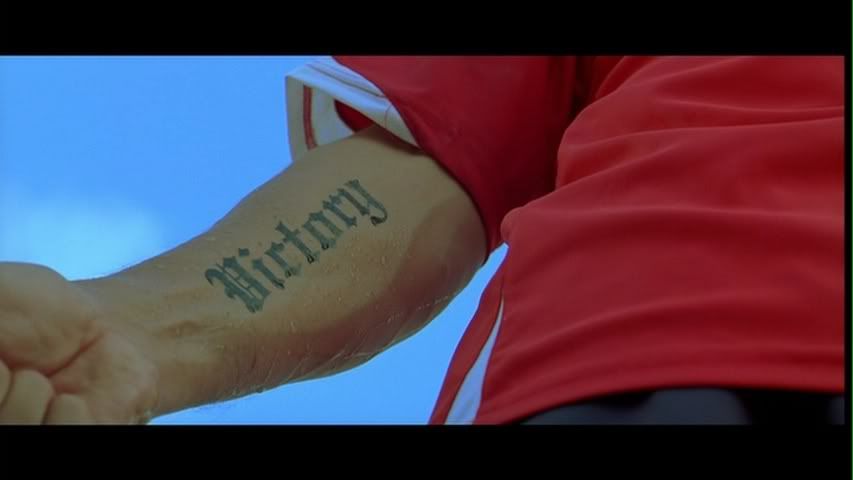
From David Beckham...


...to Gregory House.


Interestingly, rather than the sunny Rishi and Rhea falling for each other, the movie shows us the blossoming love between the depressed Maya and Dev. With the pretense of being 'friends' who want to 'help each other save their respective marriages', they are, of course, clearly on the road to a little some'n some'n. Tears ensue. Fights. Dramatic scenes where lovers lie to each other, their spouses... and themselves!

Love is in the air for the senior citizens as well. Samarjit (Amitabh Bachchan), known to some as Sexy Sam, is Rishi's dad and a man perpetually handcuffed to anonymous call girls. Yet despite his boozing, libertine exterior, in his chest beats the heart of a sensitive soul; it's all mourning for his late wife, you see? (We don't see...) But Dev's mom sees, and how! Who can resist Amitabh's powers, anyway? Especially when he does that dance of his.


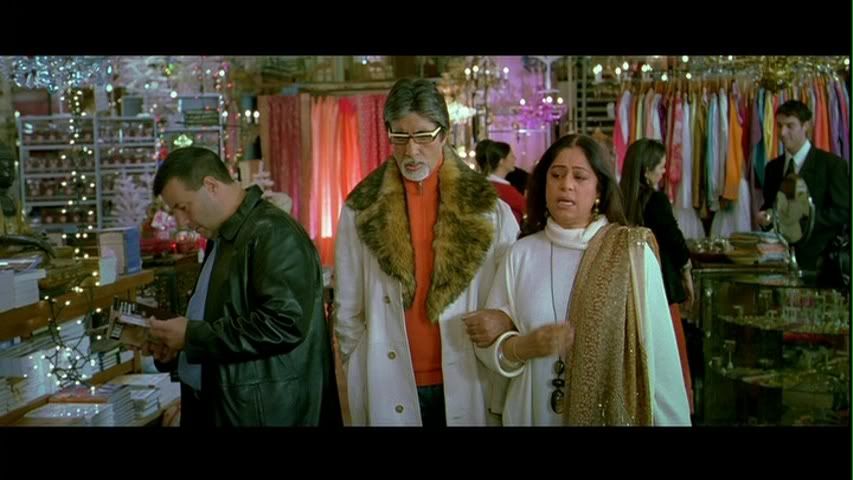
And furs! He'll even match your outfits!


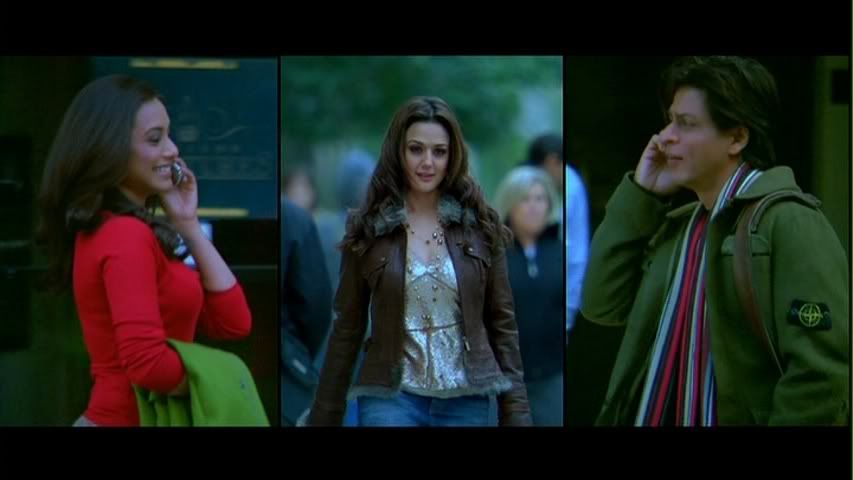
The director was big on split screens, which made everything feel a little 1960s human drama-esque.


The movie is a long series of light-hearted and genuinely funny moments à la Sleepless in Seattle punctuated by the requisite tearful arguments, reconciliations, and dizzying dance sequences. The viewer certainly feels for all the couples, even if they are all just stylized archetypes: Dev the Byronic Hero versus Rishi the Too Perfect Man. The acting was fine, in that it was about as good as if we had used puppets with funny voices.

We could not help, being native English speakers, noting with amusement the liberal use of English when needing to punctuate an emotion. Behold Dev's Han Solo-esque demands, "I love you and you love me too." Dammit.


Step back everyone: Shah Rukh is Acting Now.


The portrayal of Americans was also quite funny. It seems we'll never shake that alternatively obese or steroids-pumped look nowadays, complete with shrill voices and ultra-casual garb. There is a children's soccer match scene which teases these stereotypes particularly well. The New York Times notes that this may be payback for Hollywood's portrayal of non-Americans. Err... Apu, anyone?


Oh dear.


Oh my.


But the influence of America is not just in the presence of a lot of non-Indian faces. This is a movie deeply enmeshed into the multicultural, globalized view of an NRI; marvel at how the Bachchans call each other dude (one of the best lines of dialogue, in English, goes:

Amitabh: Dude, what's up?!
Abhishek: Dude, I'm nervous!

This is the "Dude! DUDE!" scene.

Shah Rukh gets the chance to tease this Americanissimo behavior by mimicking Abhishek in one scene: "Yeah, 's cool, totally cool, man."). Marvel at the explicit mentions of homosexuality (never seen that before in a Bollywood movie!), the cell-phone-flipping, Armani-wearing, Hinglish-speaking, completely integrated and yet uniquely and forever Desi NRIs. The plot itself - failing marriages, adultery, even a sex scene (with no kissing, of course) - was also clearly part of the integrated, modern outlook of a global India. And the music! Don't get us started, we generally didn't care for it, yet it was interesting to note the fusion of bad American pop with more standard Bollywood fare. Par example:


The Bachchans kick butt while a House-ian Shah Rukh can't join in. Damn.


A note on the Bachchans: When we began this journey deep into Indian cinema, we decided to be anti-Bachchan on instinct. That was before we saw Don, Kasme Vaade, and Parvarish, and now we have come to accept and love Amitabh as if he was our own Big B. (And he is, of course, for he is everyone's Big B.) We still maintained our bias against Abhishek, because while Shah Rukh hauled himself up from middle-class unconnected beginnings in an industry more nepotistic than British royalty, Abhishek was just born into the lap of fame. This is our first Abhishek film and we must say, OK, he's not terrible. He was actually quite cute and cries much more convincingly than Shah Rukh's purely movie, albeit effective, Tears of Manly Restraint. This was reason enough to put Abhishek on our good list and, after booty-shaking with as much panache as his dad, we decided he is there to stay.


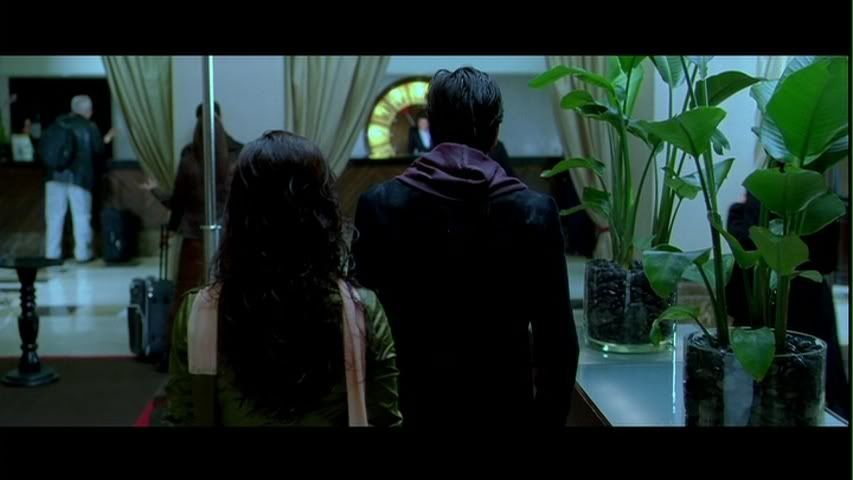
One of the most oddly touching scenes. Dev and Maya check into the hotel. Finally.


Oh, you may as well watch it for yourself. Dev and Maya get tragically jiggy with it while their respective spouses dance to bad techno. No kissing allowed, sorreeee.

Saturday, 12 May 2007

Paheli (2005)

Folk myth + feminism + sweet sweet lovin' = huzzah!


Love, love, looooove.


Amol Palekar's Paheli is an equation of love, oh yeah, baby. It's also sensitive, intelligent, and different, a perfect woman's fantasy, sending barbs to our squishy heart. It manages to transmit both that sense of stylized archetypes we find in old folktales, as well as modern themes of spousal obligations and women's needs. And it does all this while still retaining the human aspect! We even cried in the end. Oh, how we cried.


Glitz!


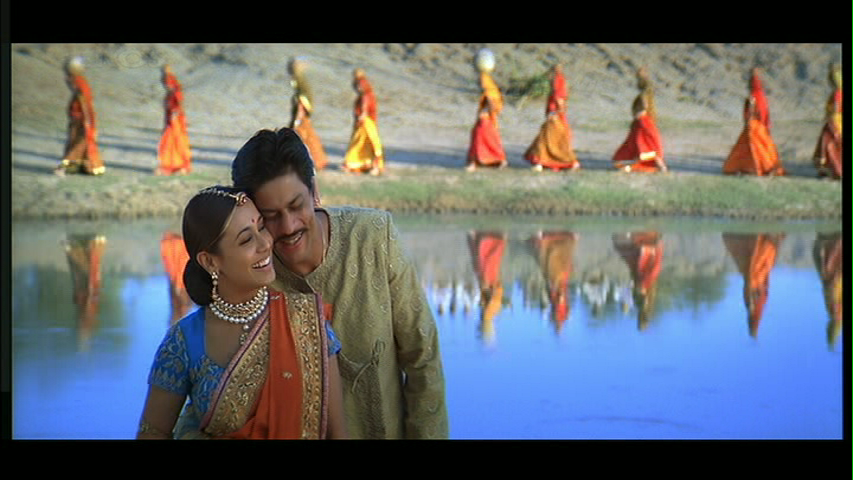
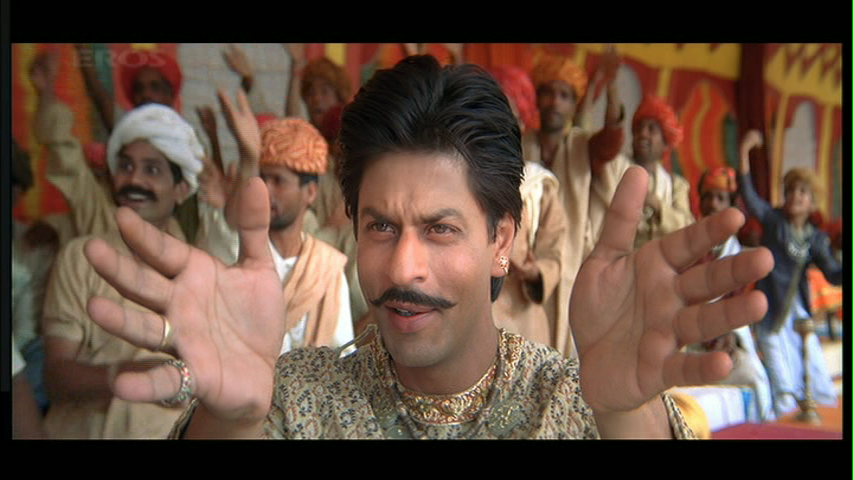
Somewhere in ancient, untouched Rajasthan, a woman named Lachchi (Rani Mukherjee) is marrying into the rich trading family of Kishanlal (Shah Rukh Khan). While Lachchi's lady friends warn her about the inevitable bom chicka wah wah that accompanies wedding nights, Kishanlal turns out to be a repressed, fussy asexual, more preoccupied by his wedding accounts than his newly acquired wife. Lachchi is understandably disappointed, and she's even further let down when Kishanlal announces he'll be going away on business for FIVE YEARS. Lachchi cries. But unbeknownst to her, a ghost/demon/spirit (Shah Rukh Khan) has taken a most uncharacteristically human fancy to her. As soon as the husband's out of sight, the ghost promptly assumes his moustachioed, dimpled form and comes waltzing back into the bedroom. Lachchi, I'm ho-ome!


Ta-da!


Apart from being infatuated, the ghost also exhibits other strange signs of humanity: he cannot tell a lie. So after confessing his otherworldly origins (and turning the romantic charm onto hyperdrive), he offers Lachchi a choice: either wait for your deadbeat husband who gets turned on by balancing the accounts to return, or get this new, shiny lookalike who loves you for really real. And's gonna love you aaaall niiiight looong. Is it any surprise who Lachchi picks? He-llo.


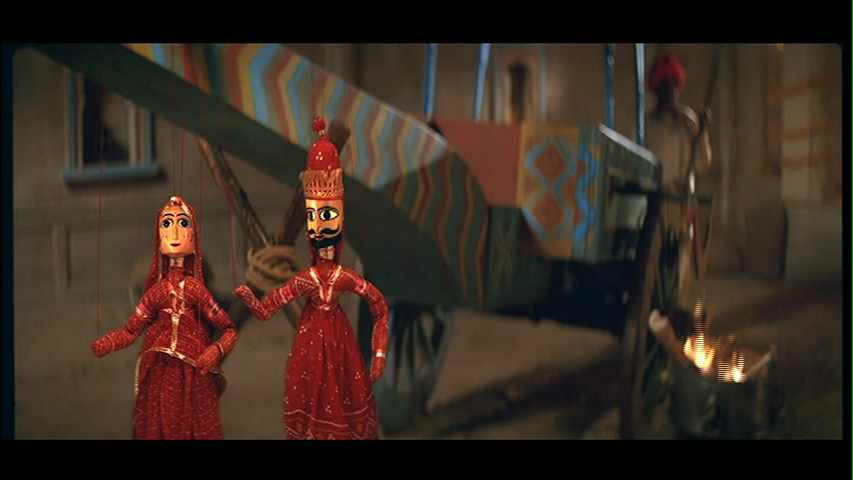
Naseer shall be king of all puppets!


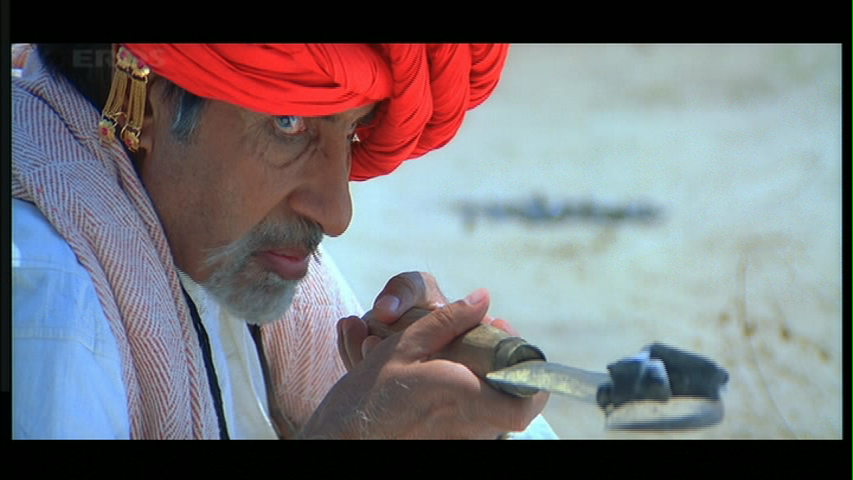
Well, it's all fun and sexcapades until the real husband turns up after five years, right when a pregnant Lachchi (Rosemary?!) goes into labor. Demon baby! "Huh?" the villagers cry. "Who's who?!" We get double Shah Rukh (believably done) and a very confused supporting cast. Clearly, it's time to call in the Patriarch of Bollywood, Amitabh Bachchan (helpfully dressed as a goatherd), to settle the score. But first, let us pose a philosophical query: who is the real "husband"? The legal one who went through the rituals, or the nonhuman one who really really loves her?


Amitabh will crush you with his hot coals of justice.


Throughout the film, two puppets drop down from above to narrate and comment. The fact that these puppets are voiced by Naseeruddin Shah and his wife, Ratna Pathak Shah, as well as the fact that Amitabh Bachchan shows up for five minutes in a comically large turban, should be signal enough: this movie has been endorsed by the rulers of Bollywood and Parallel Cinema alike. And indeed, this film is one of those rare gems where the commercial blends with the aesthetic/intellectual to make something appealing for all of us (or, rather, every part of us). It presents us with interesting ethical dilemmas too: all three characters (Lachchi, Ghost, Real Husband) have sympathy and depth, making a tidy ending impossible. The conclusion is fascinatingly ambiguous, leading us to go all Freudian and declare that the story was really about one husband's dual responsibility (to work, and to home) and repressed need to be loved. And thank goodness for respecting the woman's wishes. Finally!


A wonderfully meta finish. Because we're all puppets on parade, aren't we?


Shah Rukh Khan's charm is nearly overpowering, especially when he's playing Every Girl's Dream Boat, the Ghost. Here is a man (well, man-like entity) who will shower you with praise, remain loyal, love you everywhere and anywhere, and has no fear of crying. Be still, our hearts! Shah Rukh is also excellent in juxtaposing Perfect Husband to the nerdy Kishanlal; most impressive was how he managed to infuse this comical, traditionally villainous character with a big heart. Poor dear.

Rani Mukherjee is also lovely as Lachchi, though she really doesn't have to do much other than go "whoopee!" when she gets her ghost and cry when she doesn't. More interesting is Juhi Chawla, older and wiser since her Naajayaz days, who carries a lot of depth in her Penelope-like role. We should also note Dilip Prabhavalkar as the pothead uncle, and Rajpal Yadav as the harassed mailman constantly delivering letters between the two Shah Rukhs.